48
%
say systems and data sources aren’t integrated with each other well

 The Gap No One Talks About
Every year, enterprise B2B organizations invest heavily in go-to-market (GTM) strategy. New segmentation models, motions, technologies and metrics, all with the promise of accelerating revenue growth.
Yet many organizations struggle to turn that strategy into execution.
This isn’t a small problem. In a survey of B2B leaders conducted by Harvard Business Review, 83% of respondents said GTM strategy is very important for selling to B2B buyers, but only 38% described their strategy as very effective.
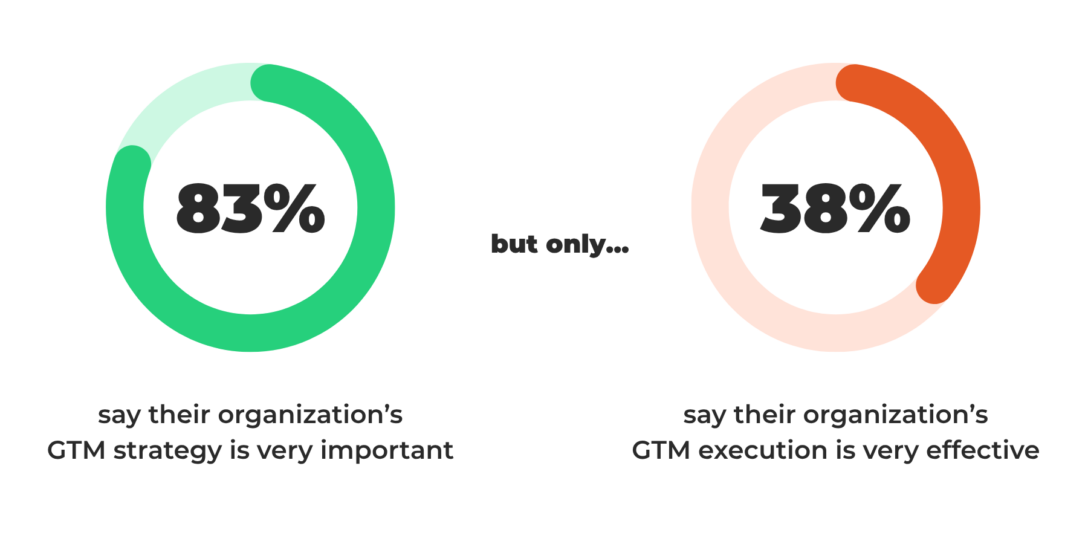
Source: Harvard Business Review Analytic Services survey, September 2025
And none of this is invisible. It shows up every quarter in pipeline, conversion rates, and lost revenue.
The answer is better execution, and better execution requires Intelligent GTM
Orchestration.
This guide explains what Intelligent GTM Orchestration is, why it matters, the
framework behind it, and how successful enterprise organizations are putting it into
practice today.
 Executive Summary
Too many B2B enterprise organizations are executing their go-to-market strategy the same way they did a decade ago, with processes built for a buyer journey that no longer exists.

And yet most GTM teams still operate with siloed data, disconnected tools, and handoff processes that create friction at every stage of the revenue lifecycle. The organizations that are pulling ahead share several critical differences: they treat GTM execution as a discipline, not an afterthought. They coordinate actions across teams with a shared view of the buyer journey. And last, they respond to buyer signals in real time, with the right context, delivered to the right person.
Every revenue leader has felt this: the strategy looks good on paper. The segmentation model is logical. The ideal customer profile is clearly defined. The plays are mapped out.
Then it hits the field and execution breaks down.
This isn’t a talent problem. It’s a GTM foundation problem.
HBR research identified the top challenges organizations face in designing and executing their GTM strategy:
Source: Harvard Business Review Analytic Services survey, September 2025
These challenges only compound at enterprise scale. The more products you sell, the more segments you target. The more regions you operate in, the harder it becomes to coordinate a consistent motion.
Enterprise B2B organizations have more buyer data today than at any point in history:
Clearly, the problem is not a lack of signals. The problem is that those signals live in different systems, get interpreted by different teams, and trigger different, sometimes conflicting responses.
Imagine a prospect visits your website four times in a week, downloads a whitepaper, and attends a webinar. Three different tools capture three different parts of that activity. None of them automatically connect to the others. Your SDR team learns about the webinar attendance. Your marketing automation platform tracks the content download. Your intent provider sees the website visits.
None of these systems talk to each other. No one has a complete picture. And by the time a rep finally reaches out, the buyer has already moved on, or worse, is already in conversation with a competitor.
This is the coordination problem at the heart of AI GTM execution.
There isn’t a function within the organization that owns the entire journey of the customer end to end. So there are a lot of handoff and coordination challenges that you encounter, with lots of issues in big, complex sales motions especially. Chris Dent
The modern B2B buyer journey looks nothing like it did even five years ago. Buyers do more research before engaging a seller. They prefer to remain anonymous as long as possible. And increasingly, the “buyer” is not one person, it’s a group.
According to Forrester, the average number of people involved in a B2B purchase decision is 13. Organizations selling high-consideration enterprise software are routinely navigating buying committees of 10, 12, or more stakeholders, each with different priorities and different levels of engagement.
A GTM motion built around individual leads, or even individual accounts, was never designed to handle this reality. And the weight of that mismatch shows up every quarter in conversion rates, sales cycle length, and pipeline health.
Most revenue teams know intuitively that their GTM execution has gaps. But the cost of those gaps is often invisible and scattered across metrics that don’t connect. Here’s what execution breakdowns look like in practice:
 Lead Leakage
Missed Buying Group Members
Slow Follow-Up
Conflicting Outreach
No Visibility Into What’s Working
Lead Leakage
Missed Buying Group Members
Slow Follow-Up
Conflicting Outreach
No Visibility Into What’s Working These are not edge cases. They are everyday realities in enterprise B2B organizations who are silently losing revenue.
Intelligent GTM Orchestration is the practice of connecting buyer data, automating signal-driven actions, and coordinating the right response across every team and system involved in the revenue lifecycle, from the first signal through closed-won and beyond.
It’s not a single tool, and it’s not automation alone. Further, it’s not the same as CRM configuration, marketing automation, or sales engagement.
Think of it this way:
The word “intelligent” matters here, because not all orchestration is created equal. Basic orchestration is rules-based. If this happens, do that. These rules work, until the business changes: a new territory, a new product, a reorganization. Every change requires someone to rewrite the rules.
Intelligent Orchestration goes further. It:
 Learns from signals across all systems to surface the right context
  Applies AI to match, cluster, and prioritize buyers with accuracy
  Adapts dynamically as data changes, without requiring manual rework
  Provides full transparency and auditability into every decision and action
  Works across systems, human-led, system-triggered, and AI-driven, with a consistent logic layer
 The result is a GTM motion that responds to how buyers actually behave, rather than how your rules assume they will behave.
Intelligent GTM Orchestration is built on four interconnected capabilities. Together, they form a continuous loop that improves with every buyer interaction.
Every orchestrated action starts with reliable data. That means consolidating buyer signals from across your GTM stack: CRM, marketing automation, intent platforms, sales engagement, customer success tools into a unified view of each person, account, and buying group.
Once signals are consolidated, the orchestration layer automates the right response: routing leads to the right rep, triggering notifications, enforcing SLAs, scheduling meetings, and advancing the buyer through the journey.
Orchestration only works if the right people can see what’s happening. Shared visibility across marketing, sales, and operations teams is what separates coordinated execution from siloed activity. This includes:
The final pillar closes the loop. The orchestration layer surfaces insights from the full revenue lifecycle: what’s converting, what’s stalling, where deals are leaking so teams can refine their strategy continuously. This includes:
Not every organization starts at the same place. The GTM Orchestration Maturity Model describes three stages of organizational capability and what it takes to advance through each one.
At this stage, the primary goal is getting reliable data into the CRM and ensuring leads are routed to the right people. Organizations at this stage are moving away from manual triage and spreadsheet-based assignment processes.
Core use cases: Data deduplication and enrichment, intelligent matching, lead and account assignments, SLA tracking, process auditing
Results: Speed to lead, reduced manual effort, fewer assignment errors
Change management:
At this stage, organizations move beyond basic assignment to automate the full GTM motion from first signal through closed-won. Buying signals from multiple systems are consolidated and trigger coordinated actions across teams.
Core use cases: GTM data integration, workflow automation, meeting scheduling, SLA enforcement, AI signals and outcomes, ABM orchestration, Buying Groups
Results: Higher conversions, pipeline acceleration
Change management:
At this stage, orchestration extends across the full revenue lifecycle including post-sales motions for adoption, retention, and expansion. AI-powered insights help teams optimize their approach continuously.
Core use cases: Customer onboarding, partner assignment, renewals and churn management, upsell and cross-sell orchestration, AI-powered insights
Results: Higher customer lifetime value, post-sales efficiency, full lifecycle visibility
Change management:
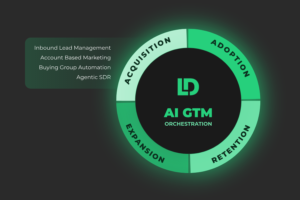
In the acquisition phase, every minute counts. Research consistently shows that responding to a buyer signal within the first hour dramatically increases the likelihood of a meeting. Yet in most enterprise organizations, the average time from a lead submission to a sales rep follow-up is measured in hours or days.
The reasons are predictable: manual routing processes, unclear assignment rules, leads going to the wrong territory or the wrong rep, no visibility into whether anyone has followed up.
Intelligent GTM Orchestration solves this by automating the entire path from signal to response.
What this looks like in practice: The lead is matched to the existing account record in the CRM (if one exists), checked against territory and assignment rules, routed to the right SDR, and a Slack notification is sent to that rep, all within seconds. The prospect receives a calendar invite before they close their laptop.
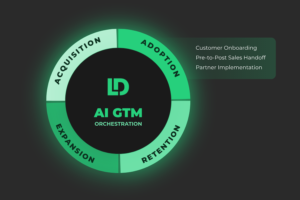
The moment a deal closes, the clock starts on customer onboarding. And for many organizations, this is where the carefully orchestrated acquisition motion falls apart.
The sales rep who closed the deal knows the customer well. They know who the champion is, what problems they were trying to solve, what promises were made. But when that knowledge has to transfer to a Customer Success Manager or an implementation team, often manually, through
email or a CRM note, critical context gets lost.
The customer, who just made a significant investment, receives a generic onboarding email and a calendar invite with someone they’ve never met.
Intelligent GTM Orchestration extends the signal-driven motion into the post-sales lifecycle. When a deal closes, the orchestration layer automatically:
The result is a customer who experiences a smooth, professional transition and a CS team that starts the relationship with full context, not a blank slate.
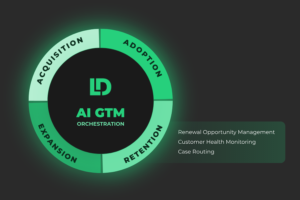
Customer churn rarely happens overnight. There are usually signals: declining product usage, unresolved support cases, missed check-in meetings, a key champion who has left the
The problem is that these signals are spread across different systems, and no one is watching all of them at once. Intelligent GTM Orchestration pulls these signals together and routes them to the right person at the right time, before a renewal conversation becomes a cancellation conversation.
What retention orchestration looks like: When a customer’s usage drops below a defined threshold, a workflow automatically creates a task for the account’s CSM and sends an alert via Slack. If the customer submits a support case that isn’t resolved within the SLA, the escalation path triggers automatically. If the champion contact leaves the company, the system flags the account as at-risk and prompts outreach to remap the relationship. These aren’t manual processes. They run automatically, based on signals, with full auditability.
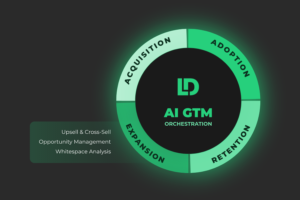
Expansion revenue (upsell and cross-sell within existing accounts) is often the most efficient path to growth. Customers already trust you. The relationship is established. The sales cycle is shorter.
But capturing expansion opportunities requires the same kind of signal-driven orchestration as acquisition.
These moments require fast, coordinated action. However, most organizations miss them because no one is watching for them systematically.
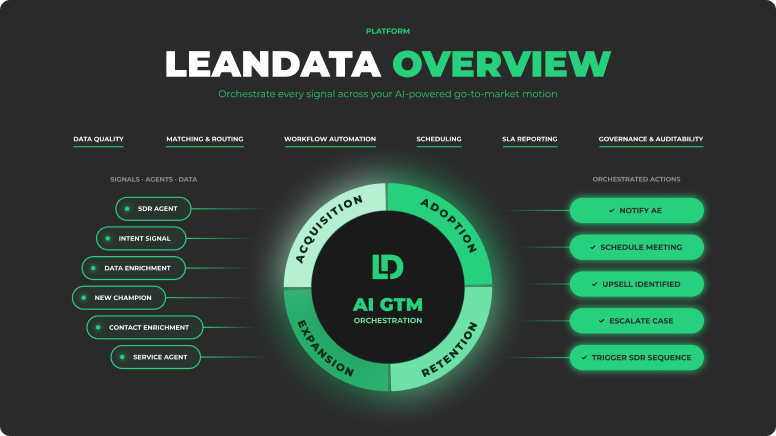
LeanData operates as the connective tissue between your existing systems: CRM, marketing automation, intent platforms, sales engagement tools, customer success platforms, pulling in signals, normalizing data, automating actions, and surfacing insights.
The platform is built natively inside Salesforce and also supports Microsoft Dynamics 365, making it the orchestration layer within the systems your teams already use every day.
 DEPTH OF GTM EXPERTISE
NO-CODE FLEXIBILITY
ENTERPRISE-GRADE GOVERNANCE
DEPTH OF GTM EXPERTISE
NO-CODE FLEXIBILITY
ENTERPRISE-GRADE GOVERNANCE 


AI is changing every part of the B2B buying and selling process. AI SDRs are qualifying prospects. Predictive intent platforms are surfacing buying signals. AI-powered content tools are personalizing outreach at scale.
But most organizations are adopting AI tools in isolation, each tool generating outputs that no one is systematically acting on:
The problem isn’t AI. It’s the absence of an orchestration layer that governs what happens after AI generates a signal. Intelligent GTM Orchestration makes AI useful by connecting AI outputs to coordinated, governed, auditable actions.
Whether actions are system-triggered, human-led, or AI-driven, LeanData is the logic and coordination layer that connects them across your revenue stack.
Uber for Business’ enterprise sales team operates at significant scale: multiple products, global territories, complex account structures. Managing lead routing and assignment across that complexity was a significant operational burden, and inconsistencies in routing were creating delays that cost revenue.
Uber for Business implemented LeanData Orchestration and BookIt meeting scheduling to centralize and automate its lead routing and assignment process. LeanData’s intelligent matching engine ensured leads were connected to the correct account records and routed to the right rep based on territory, product, and account.
The possibilities are endless with what you can do in LeanData… I really recommend it for any RevOps leader looking to automate processes, clean up your CRM, and increase deal velocity. It’s very impactful.Nicole Peinado
As one of the world’s largest cybersecurity companies, Palo Alto Networks has a complex, multi-product GTM motion across hundreds of territories and thousands of accounts. Their lead management infrastructure had grown organically over years: a patchwork of routing rules, manual processes, and siloed systems.
Palo Alto Networks partnered with LeanData to rebuild their lead management infrastructure, centralizing routing, improving data quality, and implementing a Buying Groups Motion that connected individual contacts to opportunities and gave marketing and sales shared visibility into the full buying committee.
ExtraHop’s lead management infrastructure had accumulated
years of technical debt. Routing logic was outdated and
frequently misrouted leads. Disconnected systems created
inefficiencies and made it nearly impossible to measure funnel
health accurately.
ExtraHop centralized their lead management using LeanData, giving Marketing Operations direct control over the lead funnel. They connected LeanData to the Salesforce Territory
object, giving Sales Operations control over assignments and establishing a single source of truth. Outdated routing rules were updated and consolidated, reducing the need for manual intervention. A governance model was established to empower both Sales Ops and Marketing Ops and built for scale.
Before building a roadmap toward Intelligent GTM Orchestration, it helps to understand where your organization stands today. The questions below help you locate yourself on the maturity model.
Are leads and accounts matched accurately in your CRM, or do reps frequently receive leads assigned to the wrong account?
Do you have documented, consistent routing rules or does assignment rely on manual triage?
Can you measure how quickly leads are followed up after they enter the system?
Do you have visibility into whether leads are sitting unworked?
Are signals from your intent platform, marketing automation, and CRM connected and coordinated?
Do you have automated workflows that respond to buyer signals across the full acquisition motion?
Can marketing stay engaged mid- and late-funnel, not just at top-of-funnel?
Does your meeting scheduling process connect buyers to the right rep automatically?
Does your GTM motion extend through the full revenue lifecycle, including post-sales?
Do Customer Success, sales, and marketing teams share a unified view of every account?
Are expansion signals surfaced automatically to the right team?
Can you measure the full revenue impact of your GTM programs, from first signal to renewal?
For most enterprise organizations, implementing Intelligent GTM Orchestration is a cross-functional initiative that touches sales, marketing, operations, IT, and executive leadership. Building internal buy-in requires a clear case grounded in problems your stakeholders already feel.
Start With the Pain, Not the Solution
The most effective internal advocates for GTM Orchestration start by documenting the cost of the current state. What is the average time from lead submission to first contact? What percentage of leads go unworked for more than 24 hours?
These numbers tell the story. The solution follows naturally.
Build a Phased Roadmap
Intelligent GTM Orchestration does not require a big-bang transformation. The maturity model provides a natural phasing structure: start with Alignment, prove value, advance to Automation, then extend to full Orchestration.
Connect to Executive Priorities
Every executive cares about revenue efficiency. Frame GTM Orchestration in the language of the boardroom: faster pipeline velocity, higher conversion rates, more revenue from existing customers, reduced operational overhead.
Identify Your Internal Champions
The most successful implementations have champions in both operations and leadership: a Revenue Operations leader who understands the technical requirements, and a CRO or CMO who can sponsor the initiative and break down departmental silos.