














Summary
AI GTM, short for AI go-to-market, is the integration of artificial intelligence across the entire B2B revenue lifecycle, from how leads are generated and scored to how they are routed, assigned, and converted. This guide covers what AI GTM means in practice, where it works, where it breaks, and how leading revenue teams are building it in 2026.
What You’ll Learn
- What AI GTM is and how it differs from standard marketing automation
- Why AI generates signals that never turn into revenue, and how to fix that
- Which GTM tasks belong to AI and which require structured, governed execution
- How Uber for Business built an agentic GTM engine, and what it took to get there
- What the build vs. buy decision really costs when it comes to GTM orchestration
If AI is Everywhere in Your GTM Stack, Why Is Pipeline Still a Problem?
Most B2B revenue teams added multiple AI tools in the past 18 months. AI SDRs are generating leads. Intent platforms are scoring accounts. Conversation intelligence tools are summarizing calls. The signals are everywhere.
And yet pipeline is still challenging. Sales reps still miss SLAs. Leads still go unrouted. High-intent moments still go cold.
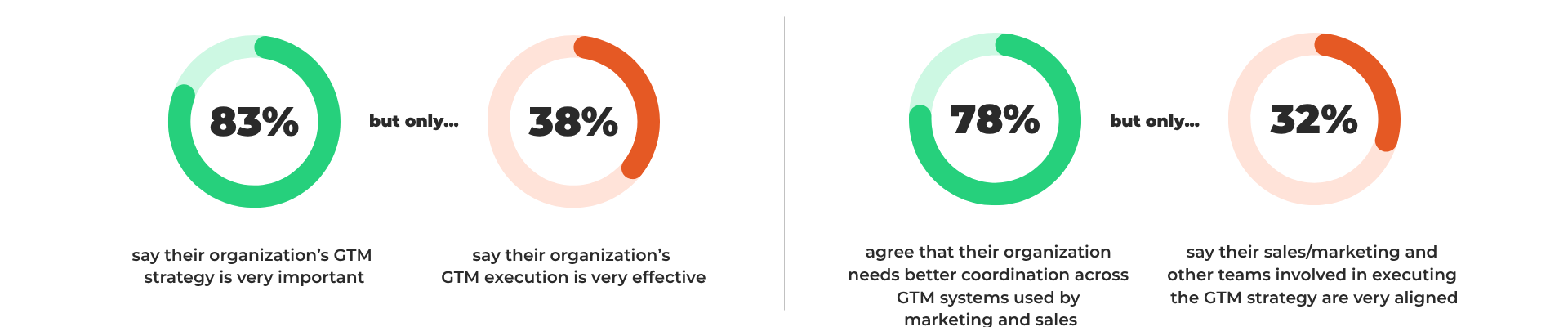
The problem is not a shortage of intelligence. According to a Harvard Business Review survey of 522 B2B leaders, 83% say their GTM strategy is very important for selling to buyers. Only 38% describe it as very effective.
That gap tells the real story.
AI is generating more signals than ever. But most GTM stacks are not wired to reliably act on those signals. That is the AI GTM problem most teams are not talking about.
First, let’s get clear on what AI GTM actually means.
What Is AI GTM?
AI go-to-market (GTM) refers to the use of artificial intelligence across the go-to-market motion, including how B2B teams identify buyers, prioritize outreach, route leads, schedule meetings, manage buying groups, and govern the full revenue lifecycle.
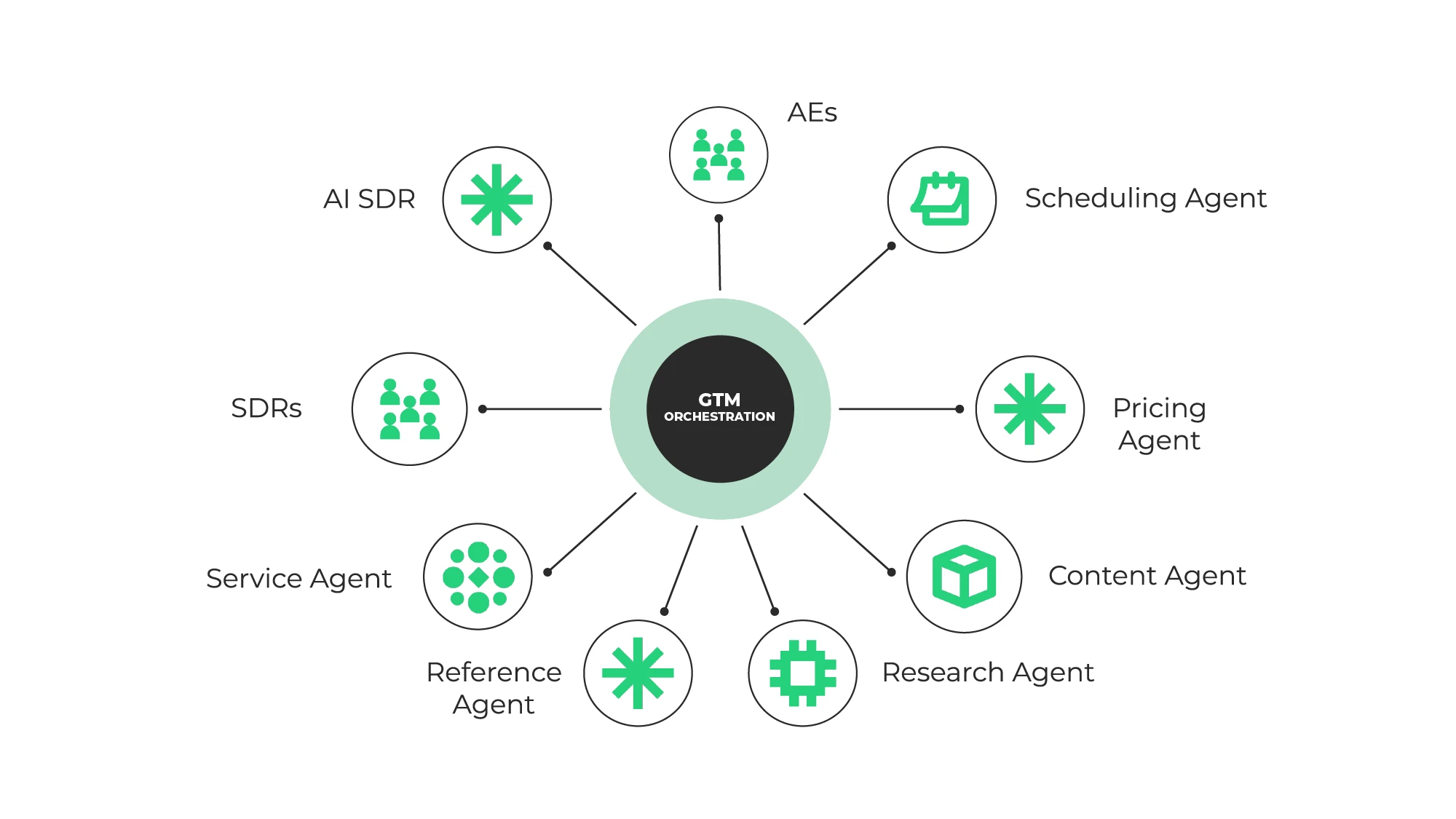
It is not a single tool or category. AI GTM is an approach. It spans AI SDRs, predictive scoring, intelligent lead routing, agentic workflows, and the orchestration layer that governs all of it.
Here is where the confusion starts: many teams treat AI GTM as a collection of point solutions:
- Buy an AI SDR
- Add an intent platform
- Layer in a scoring model
The result is more signals, but not necessarily more revenue. That is because generating a signal and acting on it reliably are two very different problems.
How AI GTM Differs from Traditional Marketing Automation
Traditional marketing automation runs on predefined rules and structured field values. It is good at executing sequences, sending emails, and updating records.
However, it is not good at interpreting unstructured inputs, reasoning across multiple signals, or handling situations the rules were not written for.
AI GTM tools handle what automation cannot:
- They read free-text form responses.
- They classify job titles at scale.
- They detect competitive signals buried in call notes.
- They surface buying group members from account intelligence.
The outputs feed into your automation layer, which then executes reliably. The two work together: AI interprets and automation executes.
The Three AI Initiatives Getting Funded Right Now
Revenue teams in 2026 are investing in three broad categories of AI GTM work:
- Agentic AI: AI SDRs, AI CSMs, and other autonomous workflows that act on behalf of a team. These agents handle high-volume, repetitive, time-sensitive tasks so human reps can focus on judgment-intensive work.
- Enrichment and signals: Intent data, account intelligence, predictive scoring, and enrichment tools that identify buyers faster and at lower cost than traditional methods.
- Revenue efficiency: Using AI to reduce cost-to-acquire, consolidate the tech stack, and eliminate manual work across marketing, sales, and customer success.
Understanding which category your current AI investments fall into matters. Each one creates different demands on your execution infrastructure.
Why AI GTM Is Harder Than It Looks
Adding AI to your GTM motion is not the hard part. Making sure AI outputs actually drive revenue is.
Here is what happens in most stacks. An intent platform flags a high-fit account. A scoring model classifies an inbound lead as a strong MQL. An AI SDR qualifies a conversation. Each of those is a useful signal. But a signal only creates value if something happens next: the right person receives it, within the right time window, with the right context attached.
That handoff is where most stacks break down.
The Signal-to-Action Gap
Most AI tools in a GTM stack generate an output and stop there. There is no unified layer governing what happens after the signal fires. As a result, leads sit unrouted, SLAs get missed, and meetings never get booked.
The B2B State of Martech and Revenue Operations 2026 report puts a number on it: only 11% of organizations have built AI for lead routing and assignment.
That means 89% are generating AI signals but not yet connecting them to reliable execution. AI ambition is outpacing operational readiness.
AI Amplifies What Is Already There, Including the Problems
AI tools perform only as well as the data they act on. If your CRM contains duplicate records, mismatched lead-to-account assignments, or outdated territory mappings, AI workflows will not improve those problems. They will make wrong decisions faster and at higher volume.
The same B2B State of Martech research found that 82% of respondents agree that clean data, defined processes, and reliable routing must come before scaling AI. That is not a minority opinion. It is the operational consensus among revenue leaders who have tried both orders.
Clean data is not prep work. It is the foundation that makes AI outputs trustworthy.
The Governance Gap
A third problem compounds the first two. Most AI tools generate outputs but do not govern them. There is no unified record of which action fired, why, when, and based on what rule or recommendation.
Only half of organizations are confident they have the governance and controls to deploy AI safely at scale, according to the State of Martech research. Skills readiness makes this worse.
Teams are prioritizing the ability to use AI over the ability to govern it. For revenue teams that need to audit a missed SLA, investigate a misrouted lead, or report on GTM performance, that lack of visibility is a serious operational problem.
Two Systems Every AI GTM Stack Runs On
Every GTM motion relies on two fundamentally different types of systems. Understanding the difference is what separates AI experiments from AI that drives revenue.
The first is probabilistic. AI tools generate outputs based on patterns in data. The same input may produce slightly different outputs across runs. That variability is acceptable and often useful for tasks like lead scoring, content generation, and call summarization.
The second is deterministic. These systems produce the same output every time given the same input. Lead routing, SLA enforcement, and meeting booking all require deterministic execution. Reliability and auditability are non-negotiable.
The GTM Division of Labor
The table below maps common AI GTM tasks to the system type best suited to handle them.
The pattern is consistent. AI handles the judgment calls. Deterministic systems handle the execution.
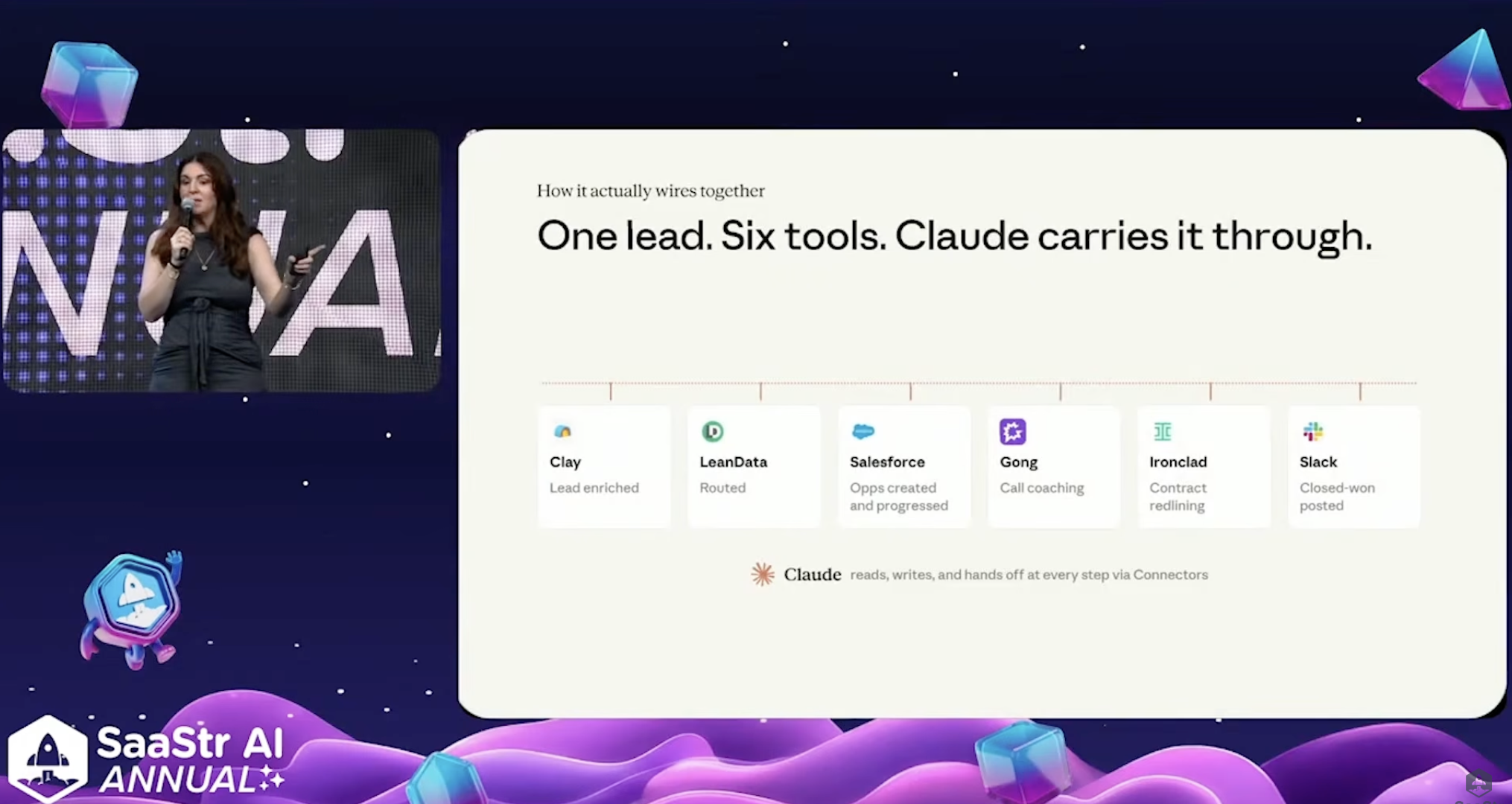
Even the companies at the frontier of AI development follow this architecture. OpenAI and Anthropic run their GTM on LeanData. The reason is straightforward: enterprises need intelligence that operates reliably at scale, and reliability requires structure.
Why the Hybrid Approach Wins
The most innovative revenue teams in 2026 are not choosing between AI and orchestration. They are wiring them together deliberately.
The LXA research captures this well: the most effective approaches incorporate limited AI steps within the guardrails of well-structured, deterministic workflows. That combination gives you the reasoning power of AI alongside the operational reliability of governed execution.
AI accelerates the intelligence layer. Orchestration makes the intelligence executable.
AI GTM in Practice: How Uber for Business Built an Agentic Revenue Engine
Uber for Business faced a classic enterprise GTM problem: disconnected systems, manual processes, and organizational changes that moved faster than the tooling could support.
Ten percent of marketing-qualified leads were going unassigned. Only 40% of leads were actioned within SLA. The fragmentation was slowing revenue growth.
Before deploying any AI agents, the team rebuilt its execution layer. They deployed LeanData to redesign lead routing and SLA enforcement from the ground up. Unassigned MQLs dropped from 10% to under 1%. SLA compliance rose from 40% to 85%. Meeting scheduling was embedded directly into the buyer journey.
Then, with the execution layer stable, the team launched AI agents.
Nicole Peinado, Revenue Technology Manager, AI Ops at Uber for Business, described the lesson clearly: fix the plumbing first, and the business outcomes follow.
The results after rebuilding the foundation and layering in agents:
- 95% reduction in MQL time-to-assignment
- 68% increase in deal velocity
- 53% increase in win rates
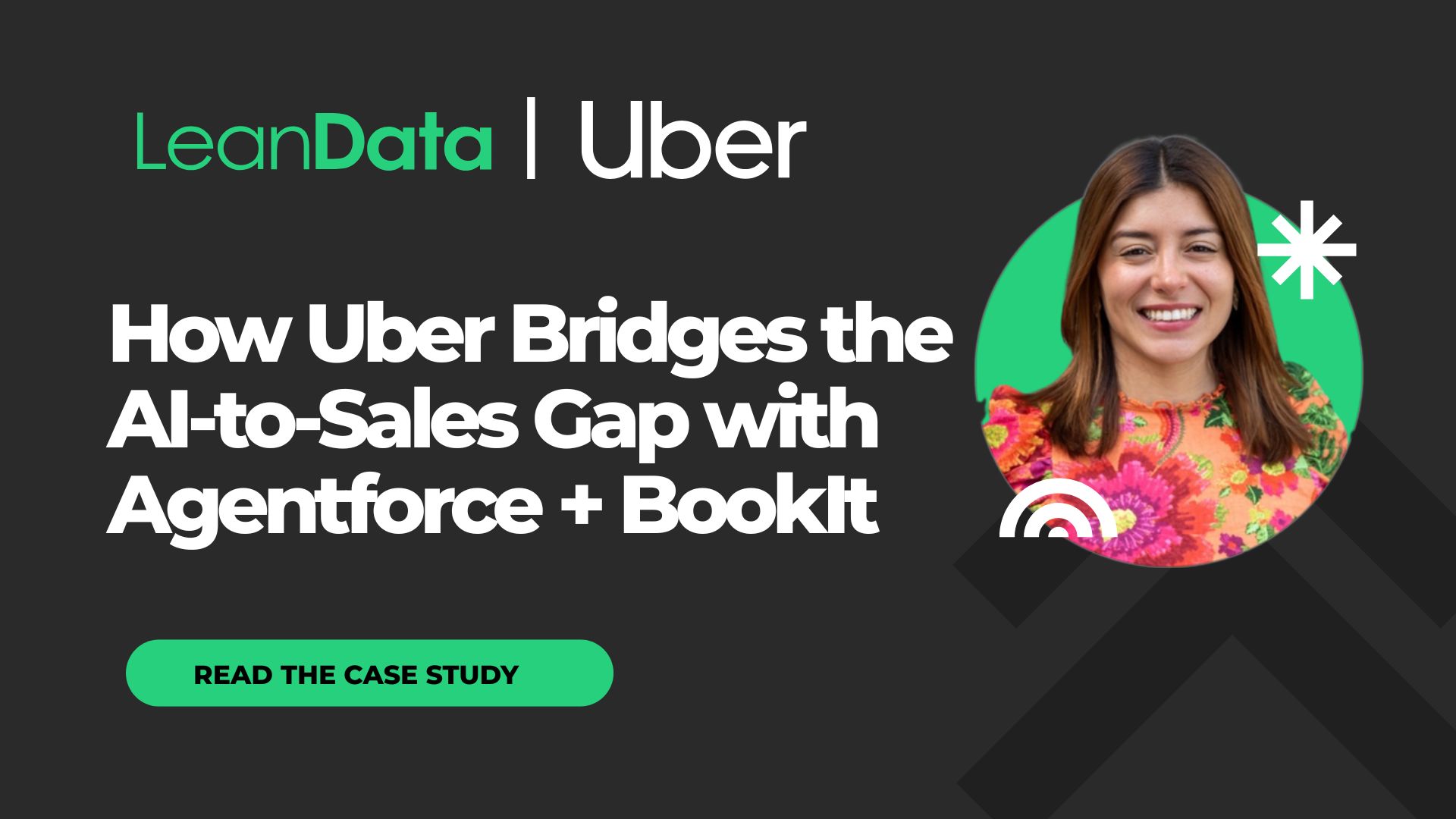
Uber for Business also launched an AI agent powered by Salesforce Agentforce to manage its self-service funnel. When the agent encounters a query it cannot resolve, it transitions the prospect to a live conversation and books a meeting through LeanData’s BookIt scheduling. The AI handles the front-end qualification. LeanData handles the handoff and the booking. Every step is governed, routed, and auditable.
That is AI GTM working as designed.
What AI GTM Requires Under the Hood
Understanding the architecture matters. Here is what the operational foundation of a working AI GTM motion includes.
A Reliable Execution Layer
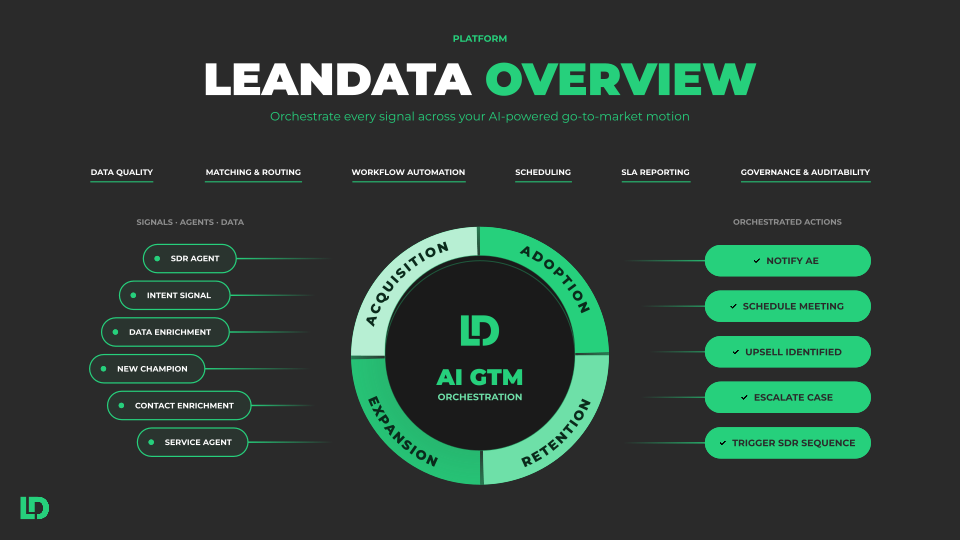
Every AI signal needs a place to land. That means a centralized orchestration layer that can ingest signals from any source, whether from a human rep, a rules-based trigger, or an AI agent, and route them through the same governance framework.
LeanData serves as this layer for over 1,000 enterprise customers. Leads, contacts, accounts, and opportunities all route through the same visual FlowBuilder interface that ops teams manage directly, without writing code or submitting IT tickets. When the business changes, the routing rules change with it, in minutes.
Lead-to-Account Matching That Handles Messy Data
Most AI tools assume clean CRM data. Real enterprise data is not clean. Subsidiary relationships, alias domains, duplicate records, and international naming variations all create matching failures that AI will act on incorrectly.
Intelligent matching uses fuzzy logic and AI-powered title normalization to correctly associate leads with accounts even when the data is imperfect. Plus, it generates plain-language audit summaries that explain why a specific match occurred, so ops teams have full visibility into matching decisions.
AI Tools That Ops Teams Can Configure and Govern
AI inside a GTM platform should not be a black box. Operations teams need to define the logic, review the outputs, and adjust the behavior when business needs change.
LeanData’s AI Inference Node lets ops teams write the AI prompt, define the output variables, and connect those outputs directly to routing decisions. Before activating in production, a built-in testing tool lets admins preview AI reasoning on real records. Consequently, teams can see exactly what the AI will do before it touches a live workflow.
Additional AI capabilities inside LeanData include:
- AI Graph Summary: Generates a plain-language explanation of any routing graph, including its business logic and optimization opportunities. Exportable as a PDF for compliance reviews and team onboarding.
- AI Graph Comparison: Shows exactly what changed between two versions of a routing graph. Designed for faster quality assurance and a clear audit trail.
- Title Clustering: Normalizes thousands of job title variations into defined personas using a proprietary LLM trained on title data, with a human-in-the-loop review step before full deployment.
- Buying Groups AI: Recommends likely buying group members, surfaces engagement gaps across the buying committee, and triggers coordinated actions based on defined signals.
Build vs. Buy: What the “Just Vibe-Code It” Argument Misses
Sure, AI coding tools can generate GTM workflows. However, generating code is not the same as building a production-grade orchestration platform that a revenue team trusts at scale.
What looks like a shortcut on day one becomes a liability by day 90. Routing rules change. Edge cases multiply. New objects enter the mix. No one remembers why the code works the way it does.
Here is what vibe-coded GTM logic cannot handle today:
- Cross-object orchestration: GTM routing spans leads, contacts, accounts, opportunities, and custom objects, with logic that depends on relationships between them. A single Flow cannot govern that.
- Governance and audit: Every routing decision needs a traceable record. That is not a logging add-on. It is foundational to compliance and operational trust.
- Matching at scale: Real lead-to-account matching handles fuzzy domains, subsidiaries, aliases, and hierarchies. Exact-match logic fails when data is not clean, which is almost always.
- Change management: Business rules change weekly. Ops teams need to update routing logic in minutes, not engineering sprints.
- Day-two operations: Who maintains the code when the person who wrote it leaves? Production systems need support, monitoring, and ongoing releases.
As shared in the State of Martech and RevOps research, only 11% of organizations have built AI for lead routing and assignment. The other 89% are still evaluating, and many of them have learned through failed build attempts why purpose-built orchestration exists.
Building Your AI GTM Strategy: Where to Start
The conversation about AI GTM can create decision paralysis. AI is moving fast. The technology is changing. It’s easy to feel behind. The best starting point is not the most sophisticated AI feature. It’s the most reliable execution layer.
Here is a practical framework:
First, audit your current routing coverage. What percentage of inbound leads are routed and assigned within SLA? If that number is below 90%, AI will amplify the gap, not close it.
Next, identify where AI signals are already entering your GTM motion without a clear handoff. Intent platform alerts, chatbot conversations, and form fills that sit unrouted are the most common failure points.
Then, map your buyer journey against your current orchestration logic. Enterprise B2B deals involve buying groups, multiple stakeholders, and signals that arrive across different channels and time windows. If your routing logic does not account for that, buying group orchestration is the next investment that pays off.
As a result of fixing those foundational gaps, agentic AI workflows become much more effective. Agents need a reliable layer to hand off to. When that layer exists, the speed and scale of AI actually translate into revenue.
See how LeanData customers are building AI GTM motions.
FAQ
What is AI GTM, and how does it differ from standard workflow automation?
Can AI fully replace rules-based lead routing for enterprise B2B teams?
What is an AI SDR, and how does it fit into an AI GTM strategy?
How do AI GTM tools integrate with Salesforce?
What should come before scaling AI across my GTM motion?

Kim Peterson
Kim Peterson is the Senior Manager of Content Strategy at LeanData where she digs deep into all aspects of go-to-market strategy and execution. Kim's writing experiences span tech companies, stunt blogging, education, and the real estate industry. Connect with Kim on LinkedIn.