













Summary
Shared customer context means giving go-to-market (GTM) teams across marketing, sales, and customer success (and their AI agents) a unified customer view that helps them understand what’s changed and what should happen next. Without it, even accurate data and well-defined processes can lead to disconnected actions from both humans and AI tools.
What You’ll Learn
- Why shared customer context matters for GTM teams and your AI strategy
- Where fragmented context causes teams and AI to miss signals or take the wrong next step
- The four traits of a unified customer view
A marketing campaign goes out to an account that customer success (CS) is trying to save. An SDR starts qualifying a contact at a company that’s already a customer. A promising expansion opportunity gets stuck in CS because sales never sees the signal.
Unfortunately, these aren’t unusual edge cases. They happen when marketing, sales, and CS each work from a different view of the same customer.
Here, we’re closing out our three-part series on the most critical elements of the foundation that AI needs to perform for GTM teams. Clean data helps. So do documented business processes. But even with both of those in place, GTM teams can still miss what’s happening across changing customer journeys. And as AI agents take on more of the work, those blind spots can create problems faster than ever.
That’s why your team needs a unified customer view. Data tells AI what it should work on. Process tells it when to start, what steps to take, and when to stop. Shared context shows AI how its next move fits in with what every other agent and team is doing.
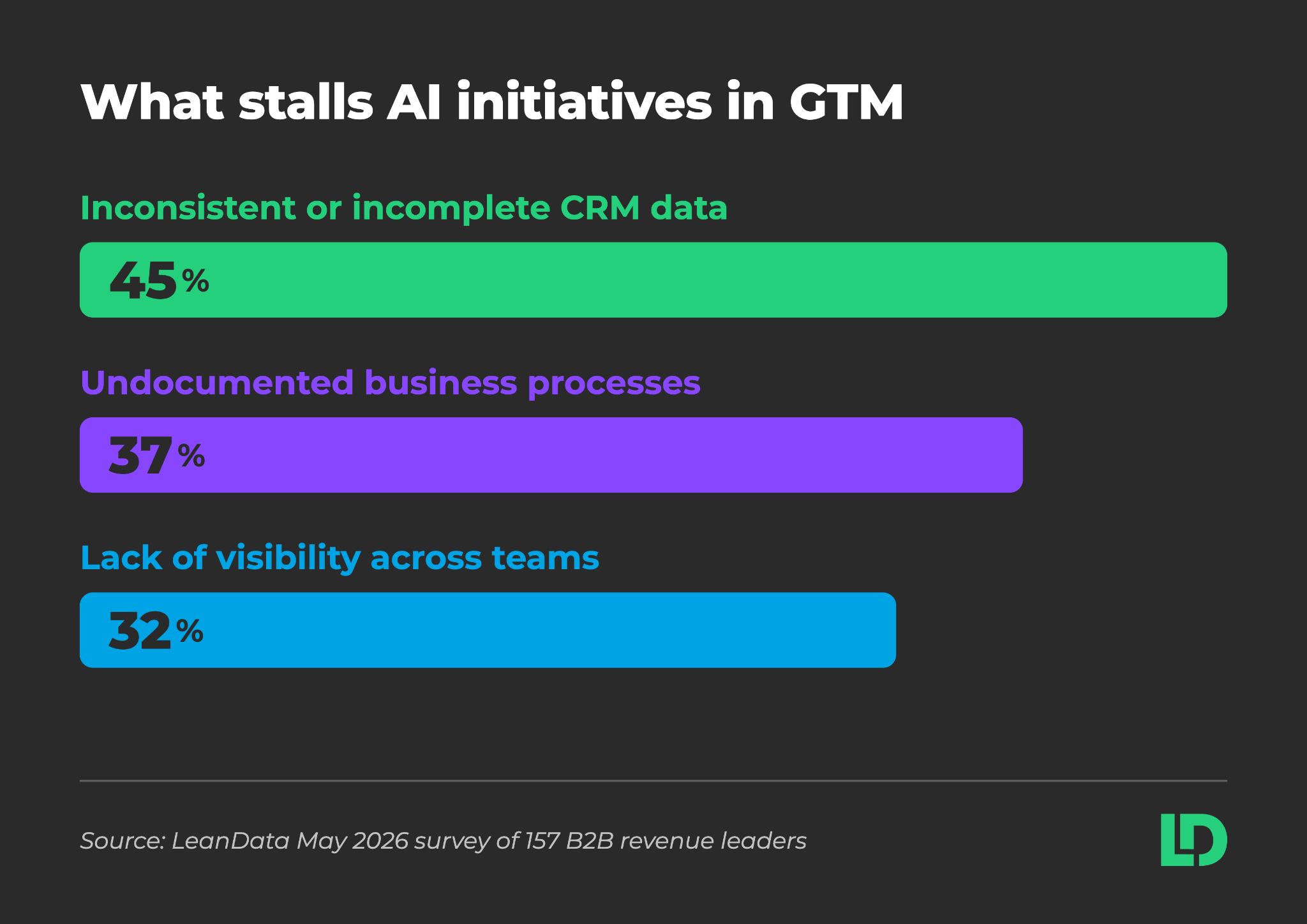
In LeanData’s 2026 State of AI Go-to-Market Readiness Report, 32% of GTM practitioners cited siloed teams as a reason AI initiatives stall.
More Agents Won’t Fix a Fragmented Customer View
The push for AI in GTM started with big ambitions. GTM teams rolled out pilots, added agents to existing tools, and looked for ways to automate more of the revenue engine. However, as we saw in the first two posts, AI initiatives are liable to stall when teams lack trustworthy data and clearly defined workflows.
Once you fix those problems, an agent working in a single system becomes far more reliable.
The challenge is that GTM doesn’t run in a single system. There are marketing automation tools, CRMs, and pipeline dashboards all being used in different ways by each team. In practice, these GTM silos leave critical context scattered across email threads, call notes, and individual reps’ memories.
Research from Harvard Business Review Analytic Services (sponsored by LeanData) puts it plainly:
“There isn’t a function within the organization that owns the entire customer journey end-to-end. This creates multiple handoff and coordination challenges, which confuses customers — especially in more complex sales motions.”Chris Dent
While people have the habit of bridging these silos by asking a colleague for context or checking in with a quick Slack message, agents don’t know they need to connect the dots.
Adding an agent to each team can even widen the gaps between teams. Each agent sees a given customer through the lens of its own system, while important context remains scattered across others. The result is fragmented decision-making, even when agents are working as intended.
The more you empower agents to do, the more it matters that your GTM foundation is ready.
Four Ways AI Agents Have the Right Logic but the Wrong Picture
When AI agents take an erroneous next step in a flow, it’s often because they’ve reasoned correctly from incomplete information. At the context layer, the breakdowns are predictable:
In every one of these scenarios, the agent does exactly what it was built to do. It just has no way of knowing it has an incomplete picture.
Why a Unified Customer View Is a Prerequisite, Not a Nice-to-Have
A unified customer view helps teams coordinate around the relationship rather than treat every interaction as a separate event. It also gives AI agents the context to make decisions that fit the broader GTM motion.
That’s why cross-functional GTM alignment can’t stop at shared definitions or periodic meetings. Your teams need a consistent view of account ownership, customer lifecycle data, buying activity, and relationship history built into the systems they use every day.
According to Harvard Business Review Analytic Services research sponsored by LeanData, 43% of B2B organizations cite siloed data that fails to provide a holistic view of buyer engagement as a barrier to GTM execution.
What AI-Ready Context Actually Looks Like
You don’t need one giant database or a single tool for a customer 360 view. You just need to connect the information that matters and make it usable across teams, systems, and stages of the customer lifecycle.
Four traits help define that kind of shared, AI-ready context.
1. Accessible across teams
Marketing-sales-CS alignment starts with the same core facts: account ownership, lifecycle stage, open opportunities, health and risk signals, and engagement. Each team keeps its own tools and workflows. What changes is that those tools connect through a shared layer that reflects the same account relationships. That way, no one has to spend a week reconciling records.
2. Persistent across handoffs
Account handoffs should carry the history of the customer relationship. When marketing passes an account to sales, all the relevant engagement and qualification details need to go with it. When sales hands a new customer to CS, the team should understand the buying process and commitments already made.
The same goes for AI agents. An agent taking the next step in a workflow needs the context behind the latest record or activity. Otherwise, automation simply speeds up the process of losing information.
3. Buying-group aware
B2B decisions involve committees. A “new” contact might really be a technical evaluator on an active deal or an executive sponsor at an existing customer. Buying group visibility ties each person and their activity to the right account and opportunity. When this trait is incorporated, a new name will show up as part of an existing relationship and not as a standalone lead.
4. Actionable across the lifecycle
Context matters most when it influences what happens next. An expansion signal that CS spots should reach the right sales owner. A drop in customer health should trigger a pause in promotional campaigns and sales outreach. CS needs a heads-up about new buying activity before the next check-in.
This is how teams maintain journey continuity. Every interaction builds on the last one, and customers never have to repeat themselves to a new team or a new agent.
The Third Pillar Completes the Foundation
Clean data and business process documentation get an agent to act correctly on its own. Shared customer context keeps every team and agent working from the same unified customer view.
LeanData connects accounts, contacts, buying groups, and customer activity across the GTM motion so marketing, sales, and CS share one view of each customer. That context carries through every handoff whether the next step belongs to a person or an agent. Run by LeanData extends that foundation, keeping your data dictionary, policies, and business context current so humans and agents work from the same facts.
 “LeanData has helped us break down silos with our GTM teams.”Kelly Sheetz

See How Connected Your GTM Really Is
Clean data and documented processes give AI a stronger foundation. Shared customer context is the final piece that fits the work into the broader customer relationship.
The 2026 State of AI Go-to-Market Readiness Report takes a close look at the gaps across data, process, and context that keep GTM teams from getting real value from AI. Use it to see where your own foundation stands.
Give Every Team and Agent the Same Customer View
FAQ
What is shared customer context?
What is a unified customer view in B2B?
Why do AI agents need shared customer context?
Do teams need a single customer 360 platform to get shared context?
How does shared customer context relate to clean data and documented processes?
Why are siloed GTM teams a problem for AI?

Jill Makin
Jill Makin is a Content Marketing Specialist at LeanData. Her content expertise includes B2B SaaS marketing across industries including fintech, healthcare, enterprise orchestration, and more. Connect with Jill on LinkedIn.