















Summary
A B2B buying group is the collection of individuals involved in evaluating and approving a purchase decision at an organization. Understanding who sits on that committee, and what each person cares about, is the foundation of any effective B2B sales and marketing strategy.
What You’ll Learn
- What a B2B buying group is and how it differs from a single buyer
- The typical roles on a buying committee and what each one does
- Why the same person can play different roles on different deals
- How buying groups have changed the way B2B teams approach the sales cycle
- How technology helps teams identify and engage the right stakeholders
The B2B Buying Group: More Than One Person with a Budget
B2B sellers take note: for high consideration products, your buyer is not one person. They’re a buying group.
You’ve likely known this for some time. But rather than change your sales and marketing processes to accommodate this reality, many teams continue to sell the way they want to sell, disregarding how buyers actually want to buy.
A new go-to-market (GTM) motion built around buying groups is reshaping how B2B revenue teams operate, moving away from MQL-centric and account-based marketing models that treat the buyer as a single entity.
So let’s get into it: who is in a buying group, what does each person do, and why does this matter for how you sell?

What is a B2B Buying Group?
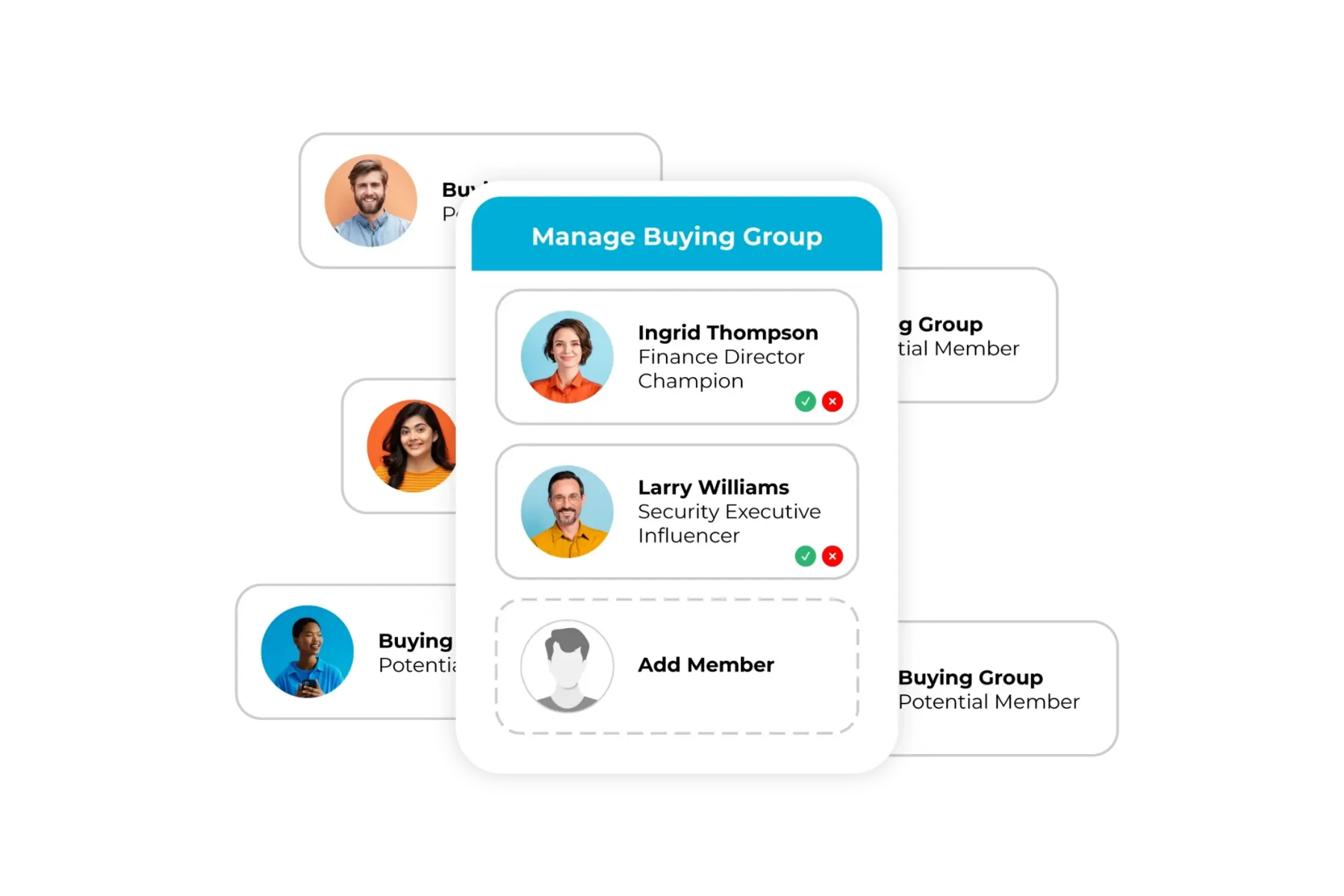
Buying groups are buying committees, familiar to anyone who has run Account-Based Marketing (ABM) initiatives. A buying group is connected to a specific deal moving through a sales cycle. At their core, buying groups are made up of individuals involved in an organization’s decision-making process.
Buying groups vary in size. According to Forrester’s revenue operations survey, 94 percent of sellers report selling to groups of three or more individuals. Thirty-eight percent sell to groups of 10 or more.
In addition, Forrester estimates an average of 27 engagements with seller-related content (both known and anonymous) across a buying group. Each member gathers information independently, and members may or may not share their research with the group.
In practice, what this looks like on the ground varies by company size and deal type. Teams at enterprise companies report targeting five to seven or more contacts per account for a single deal, while mid-market deals often involve three to five. Even smaller deals rarely come down to a single decision.
The point: the person who fills out your form is almost never the person who signs the contract.

Show video transcript Hide video transcript
Who is on the Buying Committee?
Buying groups include multiple departments, roles, and personas. While an individual’s department and persona are relatively static, their role on the buying committee may change depending on the product under consideration.
Further, buying groups usually consist of subject matter experts, contributors from a relevant department, and other stakeholders (or gatekeepers) from finance and IT.
For example, your marketing team may target the Head of Marketing as a primary persona. But in the context of a specific deal, that Head of Marketing may serve only as an advisor rather than a decision maker.
Moreover, each person in the group has their own priorities, concerns, and level of influence. Some people have the authority to approve. Others shape the recommendation without having a final vote.
B2B Buying Group Roles: a Breakdown
Members of the buying committee cover a broad range of responsibilities. Here’s a breakdown of the different roles you may find on a typical B2B buying committee:
The Sniper role is worth calling out specifically. This is the stakeholder who may never appear in your CRM, never attend a demo, and never reply to an email. But when a deal goes quiet or falls apart, they are often the reason why. Identifying potential vetoes early is one of the most important things a sales team can do.
Engaging with Each Person in the Buying Group
To effectively engage buying committee members, sellers need to treat each person as an individual with distinct needs, not as interchangeable contacts on an account.
A few principles that matter here:
Tailor your message. The message and approach for a Financial Approver should be different from the message for a User or a Champion. What the CFO cares about is not what the person using the product every day cares about.
Expect staggered entry. Buying committee members enter the process at different stages. A new stakeholder who joins late in the cycle is not starting from zero. They have likely done their own research, talked to peers, and formed opinions before you ever speak with them.
Treat the group as a group. Members of a buying group move forward together. When one person advances in their understanding, the rest of the group is often not far behind. Selling to a single contact while ignoring the rest of the committee leaves the deal exposed.
The Question Every Sales Team Should Be Asking
One of the most common challenges for sales teams working on complex deals is figuring out who is missing from the buying group. Which personas have not engaged? Which roles are unconfirmed? Which contacts might influence the decision without ever appearing in the CRM?
This question matters because incomplete buying groups are one of the primary reasons deals stall. If you do not know the Sniper exists, you cannot address their concerns. If you have not found the Financial Approver, you are one budget question away from losing the deal.
Identifying the full buying group early, and continuously updating it as the deal progresses, is a skill that separates teams who consistently close from those who do not.
How AI and Technology Are Changing Buying Group Identification
In 2026, AI is meaningfully changing how teams identify and manage buying groups. Where sales teams once relied on manual research and CRM contact roles to map a committee, tools can now surface likely buying group members based on intent signals, engagement patterns, and title clustering.
LeanData’s Buying Groups product, for example, uses AI-driven title clustering to automatically identify likely stakeholders within your CRM based on job titles and roles, then builds a journey that tracks every signal across the committee as the deal moves forward. The result is a single view of the buying group tied to an open opportunity, so sales reps can see who is confirmed, who is missing, and what the group has been doing.
This kind of visibility addresses a real operational gap. Most CRMs store contacts at the account level, not in the context of a specific deal. Buying group orchestration connects those contacts to the opportunity they are part of, giving revenue teams a clearer picture of where a deal actually stands.

Buying Groups Require a Different Kind of GTM Motion
Continuing to apply a single-buyer model to a buying group scenario will not produce the revenue growth your organization is looking for.
Moving away from lead-centric strategies is not a small change. It requires rethinking how marketing generates and qualifies demand, how sales builds pipeline, and how both teams hand off to each other. It means updating the systems that track engagement, the metrics that define success, and the processes that move deals forward.
But the shift is worth it. B2B buyers have always bought in groups. Aligning your GTM motion to reflect that reality, and building the processes and technology to support it, is how modern revenue teams close more deals.
Power Your Buying Groups Strategy with LeanData
FAQ
What is the difference between a buying group and a buying committee?
How many people are typically in a B2B buying group?
Do all buying group members participate at the same time?
How do you identify who is missing from a buying group?

Kim Peterson
Kim Peterson is the Senior Manager of Content Strategy at LeanData where she digs deep into all aspects of go-to-market strategy and execution. Kim's writing experiences span tech companies, stunt blogging, education, and the real estate industry. Connect with Kim on LinkedIn.