














“There isn’t a function within the organization that owns the entire customer journey end-to-end. This creates multiple handoff and coordination challenges, which confuses customers — especially in more complex sales motions.”
Chris Dent
Commercial Excellence, Bain & Co.
GTM STRATEGY IS IMPORTANT TO REVENUE GROWTH
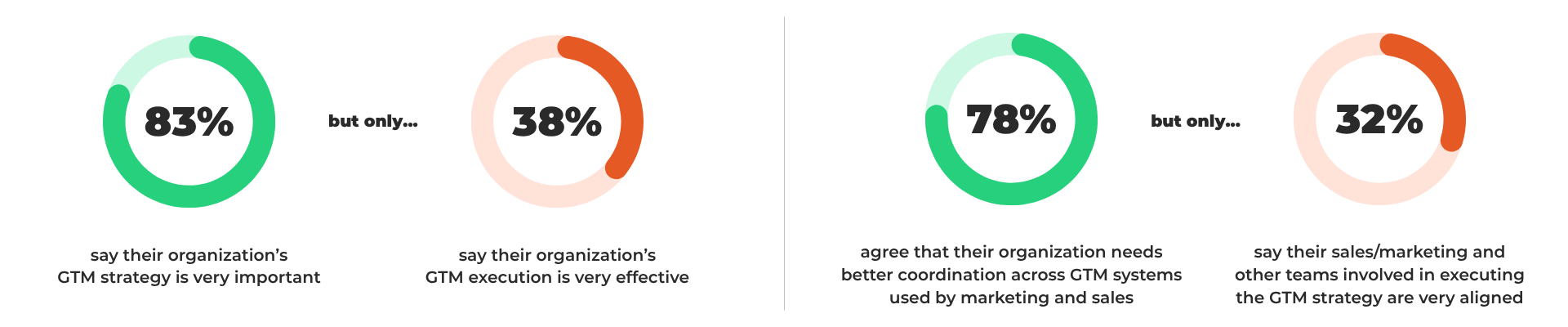
Having a strong GTM strategy is important to revenue growth for all professionals surveyed. Yet execution remains a challenge.
What the report reveals:
Increased revenue is the most-mentioned benefit (54%) that respondents say their organizations have achieved from improving B2B GTM execution.
What it means for your organization:
The gap between how your teams design GTM strategy and how they execute it is likely costing you revenue, and the highest performing organizations are already pulling ahead.
How Does Your GTM Stack Up?
How effective is your organization’s go-to-market strategy for selling to B2B buyers?
38%
Very effective
42%
Somewhat effective
20%
Not very effective
Hear From Your Industry Peers From Around the World
Harvard Business Review Analytic Services surveyed 522 professionals from its global audience across multiple industries and uncovered a persistent gap between go-to-market strategy and effective execution.
OVERCOMING GTM EXECUTION CHALLENGES
To solve the disconnect between strategy and execution, respondents are taking a multi-pronged approach. Alignment, collaboration, and technology are key. Understanding the B2B buyer journey is the organizing principle.
What the report reveals:
78% agree with that their organization needs better coordination across GTM systems used by marketing and sales yet, only 32% say their sales/ marketing and other teams involved in executing the GTM strategy are very aligned.
The organizations pulling ahead are aligned around buyer intelligence and AI at every stage.
Buying groups have changed how B2B decisions get made. Companies that haven’t adapted are losing deals they can’t see.
What LeanData recommends for your organization:
Align revenue teams around shared metrics, clear roles, and a common GTM strategy.
Use the buyer journey, not the funnel, as the strategic framework and understand how buying groups make decisions.
Deploy AI within structured, governed GTM orchestration to scale personalization and respond to buyer signals faster.
How Do You Compare?
What steps is your organization taking to improve its B2B go-to-market execution?
57%
Improving coordination among internal teams
40%
Adopting new tools to support internal coordination
37%
Encouraging sales team members to engage multiple members of buying groups
“Pick a very specific sliver to focus on — THIS product set for THIS customer segment in THIS geography. Get that right and start getting value from it.”
Bob Yang
Vice President, AI Transformation GTM, Adobe
GTM strategy is table stakes
Execution is where revenue is won or lost, and most organizations are falling short.
Learn where your team needs to focus next.

FAQ
Footnote:
Organizations were segmented based on how they rated both the importance and effectiveness of their GTM strategy for selling to B2B buyers on a 0-10 scale. Leaders (36%) rated their strategy as very important and very effective (8-10). Followers (42%) rated their strategy as somewhat important and/or somewhat effective (6-7). Laggards (22%) rated their strategy as not very important and/or not very effective (0-5).
Why is there such a big gap between B2B go to market strategy and execution?
In the survey, 48% of respondents cite systems or data sources that aren’t integrated with each other well as a challenge for designing its B2B GTM strategy and 43% cite siloed data that doesn’t provide a holistic view of buyer or account engagement as a challenge to executing its B2B GTM strategy.
What do high performing B2B organizations do differently to improve GTM execution?
Sixty-three percent of leaders report that their sales/marketing and other teams are very aligned in executing their B2B GTM strategy, compared to 17% of followers and 11% of laggards.
How do buying groups affect B2B go to market execution?
Purchasing decisions are increasingly made by cross functional buying groups rather than individual stakeholders, which adds complexity to every stage of the GTM process. Organizations that expand their view of buying group members report better pipeline and revenue outcomes. Successfully engaging buying groups requires deeper analysis of each stakeholder’s priorities and better information sharing across teams.
What role does AI play in improving B2B go to market execution?
Sixty-eight percent of respondents agree that using AI is important for their organization’s GTM strategy for B2B buyers. Among respondents whose organizations are using AI tools, the top uses are analyzing disparate data sets for insight, optimizing marketing campaigns, coaching sales reps, refining customer personas, and personalizing advertising or content at scale.
Why is aligning GTM strategy with the buyer journey important for revenue growth?
Ninety-two percent of respondents agree that to be successful, organizations should align their GTM strategy with the B2B buyer journey, yet only 29% say their organization understands today’s B2B buyer journey very well.
Sixty-four percent of leaders cite revenue growth as a benefit to having a better understanding of the B2B buyer journey, compared to 52% of followers and 37% of laggards.