


















Research Report · LXA × LeanData · 5th Annual Edition · 2026
The 2026 B2B State of Martech and Revenue Operations Report
LeanData partnered with LXA to survey 201 enterprise B2B leaders across seven countries. What they found is a clear and growing divide between where organizations want AI to take them and what their operations can actually support.
KEY TAKEAWAYS
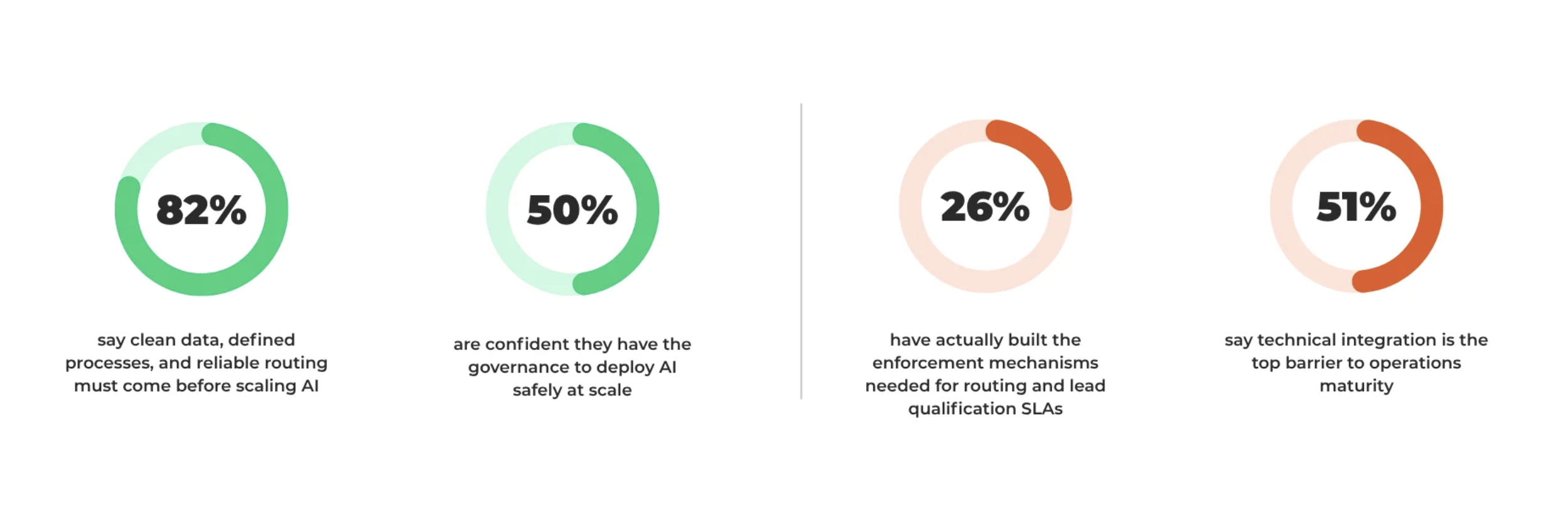
82% agree that clean data and reliable routing must come before scaling AI. Only 1 in 3 have the systems to make it happen.
What the Data Shows
Operations Are Lagging Everything Else
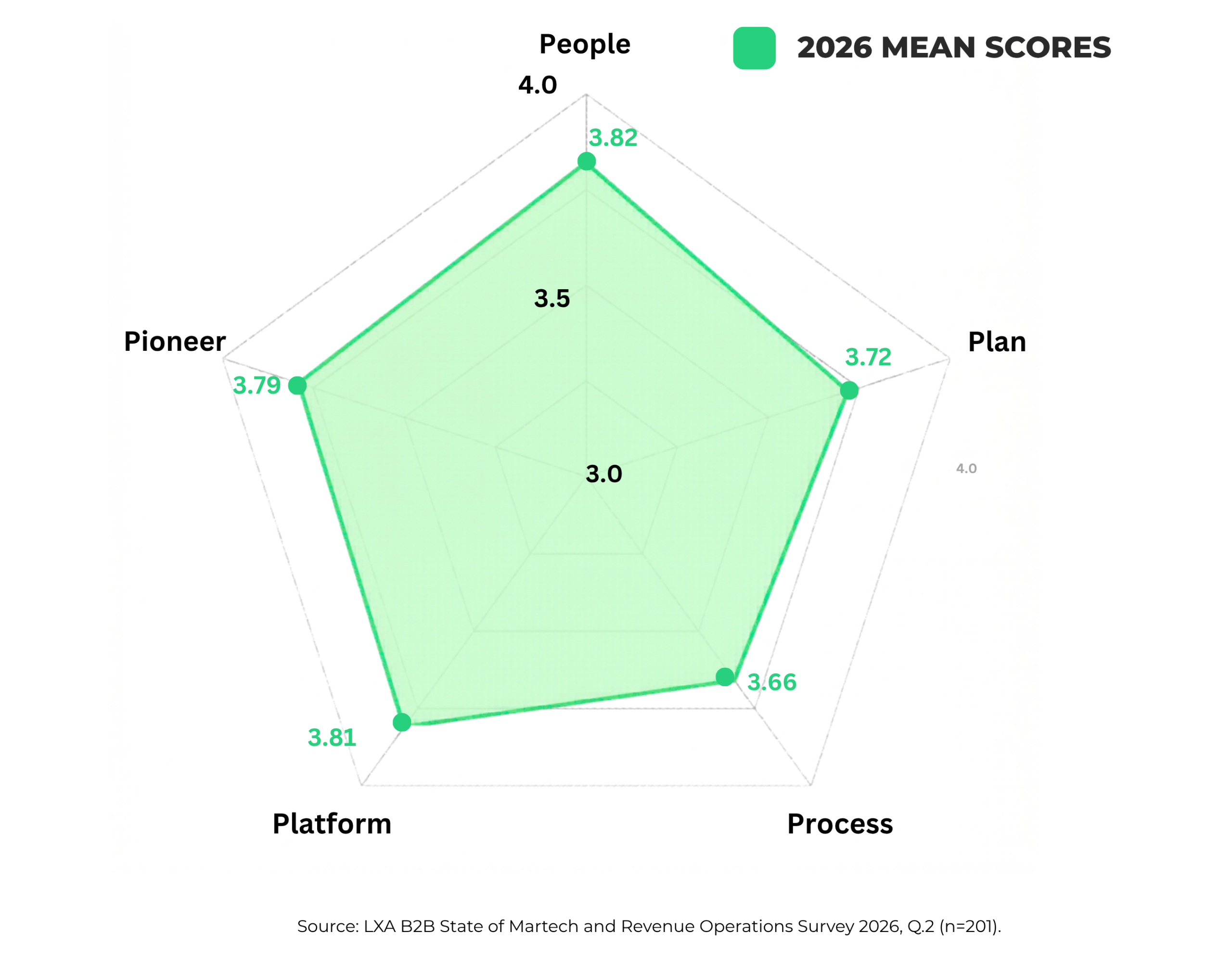
LXA’s five-pillar maturity framework scores enterprise revenue operations across five dimensions. The pattern is consistent for the third year running.
- People and Teams: 3.82 out of 5.0 (highest)
- Platform and Technology: 3.81 out of 5.0
- Process and Operations: 3.66 out of 5.0 (lowest, three years running)
Organizations have invested in talent and tools. However, the workflows and governance structures that connect them have not kept pace.
AI Is Widening the Gap, Not Closing It
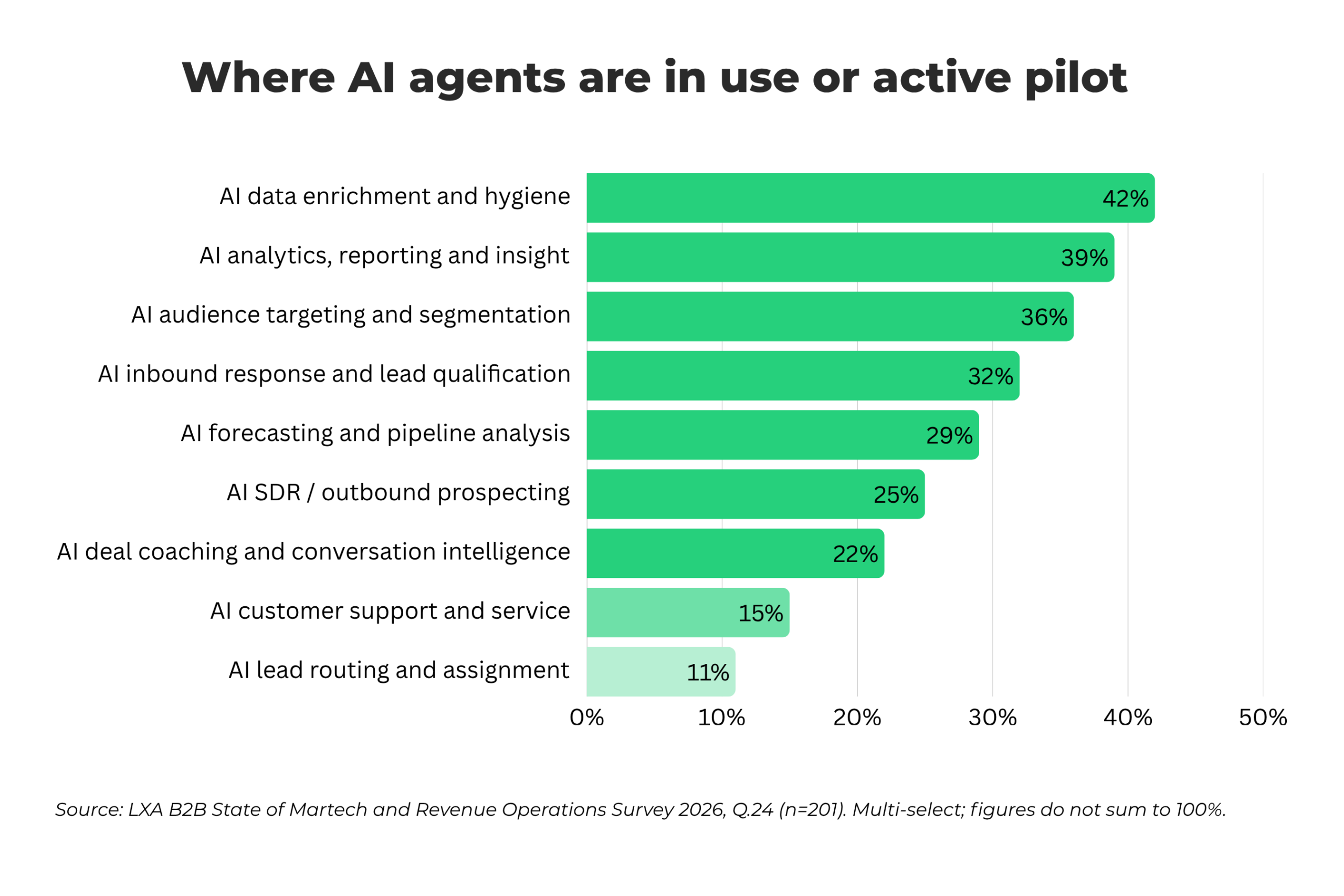
AI adoption is near-universal in intent, but budget is concentrated in low-risk use cases.
- Content creation and productivity tools: 46% adoption
- AI lead routing and assignment: 11% adoption, the lowest of any category measured
- AI investment is accelerating before operational foundations are ready to support it
A bad AI-generated draft is an inconvenience. An AI agent that misroutes a lead or triggers an incorrect renewal has direct revenue impact.
The Lead Management Problem Is Structural
These are not coordination problems. They are infrastructure problems. AI only amplifies the cracks.

29%
have no visibility into what happens after the marketing-to-sales handoff

42%
cite poor alignment on lead qualification as a significant gap

32%
report duplicate or mismatched lead-to-account records
Six Priorities for Revenue Leaders in 2026
The research outlines six concrete imperatives for revenue operations leaders who want to close the gap between AI ambition and execution reality.
#1 Audit operational discipline before scaling AI.
Start with routing, qualification, and lead-to-account matching. Only 26% of organizations have enforcement mechanisms in place.
#2 Extend governance across the full buyer lifecycle.
A broken handoff between marketing and sales does not stay contained when AI is added on top. Orchestration needs to span acquisition through retention.
#3 Simplify platform fragmentation through workflow design, not procurement.
Average stack sizes have dropped to 37 tools, down from 62 in 2025. Integration complexity is still the top barrier. Aligning tools to workflow requirements minimizes integration gaps and process failures.
#4 Align revenue actions to how buyers actually move.
42% identify poor sales and marketing alignment on lead qualification as a significant gap. Shared definitions, unified visibility, and enforceable SLAs across functions are how you close it.
#5 Build governance that keeps pace with AI adoption.
Only 50% of organizations feel confident about their AI governance readiness. Governance ownership needs to be shared across RevOps, marketing leadership, and IT, not siloed in one team.
#6 Recognize the gap between operational leaders and laggards.
Process and Operations barely improved over three years of benchmarking. Companies with disciplined operations will gain an edge. Those without them will see AI amplify existing problems.
About the Report
The B2B State of Martech and Revenue Operations 2026 is produced by LXA in partnership with LeanData. LXA’s five-pillar maturity framework, the 5Ps, benchmarks enterprise revenue operations capabilities across People and Teams, Platform and Technology, Pioneer and Pilot, Planning and Strategy, and Process and Operations. This edition marks four years of continuous benchmarking, giving revenue leaders an established view of where progress is real and where it has stalled.
Research at a Glance
This is the fifth annual edition of the LXA State of Martech series, produced in partnership with LeanData. For the first time, the report focuses exclusively on B2B enterprises with 2,500 or more employees, across industries including technology, financial services, manufacturing, and corporate services.
Respondents include CMOs, VPs of Marketing, Revenue Operations leaders, Sales Operations managers, and Marketing Technology professionals across the U.S., UK, Canada, France, Germany, Mexico, and the Netherlands.
Respondents include CMOs, VPs of Marketing, Revenue Operations leaders, Sales Operations managers, and Marketing Technology professionals across the U.S., UK, Canada, France, Germany, Mexico, and the Netherlands.
| Research Detail | Snapshot |
|---|---|
| Survey respondents | 201 senior B2B leaders |
| Company size | 2,500+ employees |
| Countries represented | 7 |
| Field period | April 2026 |
| Top roles surveyed | CMO/VP Marketing, MarTech, Demand Gen, Sales Ops, RevOps |
| Industries | Technology, financial services, manufacturing, telecoms, corporate services |
About LeanData
LeanData is the leading Intelligent GTM Orchestration Platform. We sit at the intersection of AI agents, human sellers, and the systems they share, making sure every signal from first touch to closed-won to renewal reaches the right person and triggers the right action. LeanData is a native Salesforce application serving enterprise B2B companies that run complex, high-volume go-to-market motions.
Frequently Asked Questions
What does the B2B State of Martech and Revenue Operations report cover?
The 2026 report covers five areas of enterprise B2B go-to-market maturity: people and teams, platform and technology, experimentation and innovation, planning and strategy, and process and operations. Based on a survey of 201 senior leaders at companies with 2,500 or more employees, the report examines how AI adoption is intersecting with operational readiness, where the biggest execution gaps are, and what revenue leaders should prioritize to close them.
Why are enterprise revenue operations struggling to scale AI?
The short answer is that operational foundations have not kept pace with AI investment. 82% of leaders in the survey agree that clean data, defined processes, and reliable routing are prerequisites for scaling AI. Only 26% have the enforcement mechanisms in place to act on that belief. AI in revenue-critical workflows, like lead routing, qualification, and pipeline forecasting, requires a baseline of process discipline that most organizations have not yet built. Layering AI on top of unmonitored routing accelerates lead leakage rather than fixing it.
What is revenue operations maturity and how do enterprise companies measure it?
Revenue operations maturity refers to how well an organization has aligned its people, processes, technology, and strategy to execute go-to-market consistently across the full buyer lifecycle. LXA’s 5Ps framework benchmarks organizations across five pillars on a 1-to-5 scale. In 2026, the average enterprise scores 3.76 across all five pillars. People and Teams leads at 3.82. Process and Operations remains the weakest link at 3.66, unchanged in its ranking over three years.
What is GTM orchestration and why does it matter for AI-driven revenue teams?
GTM orchestration is the layer of workflow automation that connects your systems, teams, and buyer signals across the full revenue lifecycle. It ensures that every inbound lead, outbound action, AI-generated signal, and human interaction gets routed to the right person and triggers the right follow-up, with consistent rules and enforceable SLAs. As organizations deploy AI agents that act autonomously in revenue workflows, orchestration is what keeps those agents governed, auditable, and aligned with how buyers actually move. Without it, AI adoption in revenue operations creates faster, harder-to-trace leakage.
What role does AI play in improving B2B go to market execution?
Sixty-eight percent of respondents agree that using AI is important for their organization’s GTM strategy for B2B buyers. Among respondents whose organizations are using AI tools, the top uses are analyzing disparate data sets for insight, optimizing marketing campaigns, coaching sales reps, refining customer personas, and personalizing advertising or content at scale.