













Summary
For GTM and Ops leaders planning for 2026, the old playbook is obsolete. This session brings together experts from OpFocus, RevOps Co-op, and LeanData to discuss the critical trends shaping the future of revenue growth, from the breakdown of linear funnels to the strategic mandate for AI governance. The main takeaway is clear: success in 2026 depends on building a GTM motion around high-quality data, account-centric models, and intelligent orchestration.
Key Takeaways
- Move Beyond the Linear Funnel: The traditional waterfall model no longer reflects the reality of complex, non-linear buying journeys. Winning strategies are shifting to an account-centric model that orchestrates engagement across the entire buying committee.
- A Solid Data Foundation is Non-Negotiable: AI and automation are only as powerful as the data they consume. Investing in data hygiene, architecture, and governance is a prerequisite for building a predictable revenue engine and achieving a positive ROI on tech.
- Govern AI with a Strategic Framework: Ungoverned AI usage creates significant risks. Effective implementation requires a “walled garden” approach—establishing clear policies, focusing AI on high-impact business problems, and ensuring a human-in-the-loop for validation.
- Simplify to Win: In an environment flooded with information, the simplest buying experiences will win. GTM teams must focus on removing friction and making it easy for buyers to get the information they need to make a decision.
Speakers
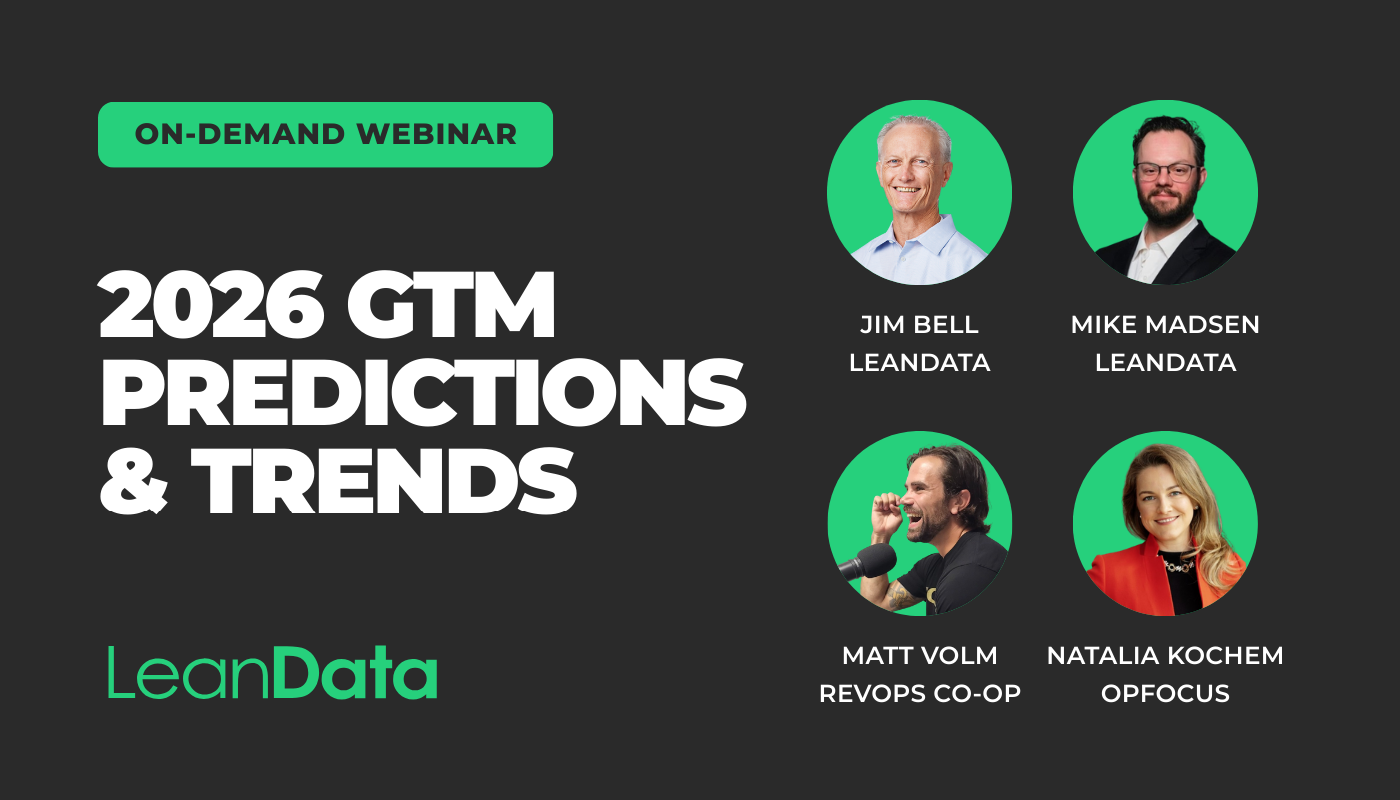
- Jim Bell, CMO, LeanData
- Natalia Kochem, VP, GTM Strategy & Operational Consulting, OpFocus.
- Matt Volm, CEO and Founder, RevOps Co-Op.
- Mike Madsen, Global Head of Revenue Operations, LeanData.
Frequently Asked Questions
Q: How can we start preparing our data for AI if it’s currently a mess?
Q: Our executive team is pushing for AI adoption, but we don’t know where to begin. What’s the first step?
Q: How can my team stay current with rapidly evolving GTM trends?
Webinar Transcript
Jim Bell
00:07 – 07:52
Welcome, everyone, to our twenty twenty six go to market predictions and trends webinar. Super glad to have you today.
I think we’re gonna have a lot of fun talking about, what’s going on in the world of, rev ops and marketing ops and go to market strategy, and got a great group of folks to talk with you about that today. So, welcome.
I’m getting myself oriented here. Alright.
We’re gonna go through introductions of our great speaker panel today. I’m gonna just share some insights from, I’ve been to probably, yeah, 20 or so conferences and, different events with, folks like yourselves out there who are in these roles trying to deal with what’s going on in the industry.
And so I’m gonna share a little bit about what I’ve, kinda run across and what I’ve heard from you all over the course of the year, and then we’re gonna jump into the panel q and a. So this will be a very interactive session.
They’ll be able to talk about any of the things that I bring up or their own things. So super excited about that.
And then we’ll have some q and a at the end, and then I’ll try to kinda wrap up. But we’ll take a little little under an hour here, and I think we’ll have a lot of great stuff for you all.
Alright. So I’m gonna start with our, our speakers for today.
I’m Jim Bell. I’m the chief marketing officer at LeanData.
I am, just really enjoy working with folks like you all and living in the world of, revenue operations, market operations, go to market strategy. My first, speaker along with me today on the panel is Natalia Kochem.
She serves as strategic partner to b two b revenue leaders and to PE firms as the VP of go to market strategy and operational consulting at OpFocus. OpFocus is a great partner of ours.
We work with them. We know many, great companies leverage them.
And Natalia specializes in solving operational challenges involved with scaling, involved with, sorry, scaling, with specific focus on marketing and customer life cycle. She works with leaders to align people and processes to their unique market position, designing operational road maps for go to market motions like ABX, buying groups, etcetera.
So really working with customers that are leaning into the most kinda forward, forward leaning kinds of go to market strategies. Along with Natalia, we’ve got Matt Volm.
Matt is the CEO and founder of Eventful, an events platform where you can run any type of event from webinars to in person. He’s also the founder and CEO of RevOps Co-Op.
So he represents the, I think it’s 15,000 plus folks, who are part of that community here. So excited to have Matt here to talk about what he’s hearing from his community.
Excuse me. 18 plus thousand.
And Matt has background spanning finance operations, early stage tech, and really brings a very practical operator first, kind of perspective to sort of more modern go to market and strategy. So super excited to have Matt here.
And then Mike Batson is also with us. So Mike is the global head of revenue operations at LeanData.
So he is my colleague. Matthew, Mike joined us more recently, but he’s focused on driving the evolution of go to market strategy and building scalable revenue engine.
He’s kinda recognized designing these best in class systems at a number of companies, including, some great work that he did at Workday, and I got to see some of that as Workday as a client of ours. But he has over a decade of working in high growth SaaS companies, including senior revenue operations leadership roles at Workday and driving literally billions of dollars of pipeline, impact within that that role and building new models and building really high scale, sort of programs to help companies, improve their efficiency and to grow revenue.
So super excited to have you here as well, Mike. Alright.
So to jump into it, I think we’re gonna I’m gonna start with the industry insights. And then as I ask each of you your first question, maybe you can just give me give us any more, insight you wanna give us about yourselves that I missed in your bios.
Okay. So for industry insights, like, I’ve been through, as I said, a number of conferences this year.
I think I’ve been to London twice, Dallas, Toronto, Chicago, Boston, New York, Denver multiple times, Phoenix a couple times, etcetera. Just talking to folks like yourselves, and there are three big themes that kinda came out of those conversations.
The first is sort of the buying complexity is just continuing to get more challenging. You know, and we’ll talk about buying groups later, but there there’s, you know, more people involved in the buying process.
You know, the introduction of AI has made it more difficult. And we’re really living in a world where there’s no longer this, to extent it ever existed, this ideal of this nice linear buying journey that happens that we could then go and map our go to market strategy to, right, which is where we had the, you know, this lovely waterfall model that we’ve all been using for years and years.
That whole process seems like it’s kind of broken up with all the complexities in the buying process and, the daily use of signals we have, the, number of technologies that we have, and go to market and the different teams that have specialized on the individual parts of that waterfall model. It’s all feels a little bit broken right now, and I think we have to move away from that sort of linear model.
And what I heard was a lot of people sort of dropping the idea of focusing too much on attribution or focusing too much on this linear, you know, progression of models, that always sort of go in one direction. So that’s one thing, I’ll throw out to our panelists as we move into the the q and a here.
The second is really around AI. And so I think this was has been a year of a lot of experimentation.
There have been, plenty of mandates from companies big and small to, try out new things in AI. People do not wanna miss out on all the value and leverage they can get from AI.
But I do also hear that, you know, sort of somewhere out of the 10, you know, sort of trials or experiments that people are doing with AI, particularly in larger companies, somewhere between zero and one of those actually get approved and move into production. And so I’m interested in hearing from this group, where do they think we are on AI and the balance between this experimentation movement to moving towards how do we get value out of AI, and how do we, leverage AI that can that we can trust? Because, typically, those, you know, nine to 10 of those, AI initiatives that get canceled have something to do with, privacy, security, data, things like that.
And finally, the the third one I’ve heard a lot about is really the continued move towards buying groups implementations. The size of buying groups has increased.
There’s just a lot of, company companies and buyers are being asked to minimize risk, and that means bringing more people into the buying process. And that is creating strains on aligning your go to market teams because you have all these different folks involved in the buying process.
But a buying group’s motion is where people are beginning to do a better job of bringing together marketing and sales, oftentimes with sort of the sales development team as the linchpin or the central point to drive that alignment. And so that’s another topic that I feel like I heard quite a bit of, over the course of the year.
Okay. Let’s jump into it and hear from the experts.
My first question is and this is kinda everybody is welcome to chat in. I hope some of our good leaders must prepare for.
Natalia Kochem
07:52 – 08:31
The the world that we live in is drastically changing for a lot of the go to market leaders because everything seems to be moving really, really fast. But I think the biggest shift is to focus on the things that are gonna have the biggest impact, and that might make folks realize they need to move a little slower.
And an example of that is focusing on really good data in your systems so that you can leverage that. So I think a theme that’s gonna come up for me is a lot of, really great data and getting obsessed with that so that you can move really fast once you’re there.
Jim Bell
08:31 – 08:37
Terrific. Matthew, let me ask you the same question.
Matthew Volm
08:37 – 09:20
Yeah. I guess on the, on the whole data topic, that’s really the area that I think is gonna shift in 2026.
So I think we’re coming to a realization that a lot of these things, like AI, for example, is only as effective as the data foundation that we ultimately have. And so investing in data related projects, data hygiene is gonna be at the the forefront, I think, next year.
And I think whether you’re in rev ops, whether you’re leading marketing, sales, customer success, your frontline manager, I think that’s the biggest thing that that folks have to have to prepare for.
Jim Bell
09:20 – 09:22
Alright. Thank.
you, Alex.
Mike Madsen
09:22 – 09:22
I’ll just.
Jim Bell
09:22 – 09:22
for data.
Mike Madsen
09:22 – 10:02
add on to that. too too, Jim, is I I I think I agree with both of you guys that the data foundation is key to to all of this.
I would go far further, though, is saying that the other kind of key thing that I’m seeing is building up the rest of the architecture and how this actually is gonna work in practice. Right? Today, we’ve been doing kind of piecemealing one off agents that are kind of looking at, you know, single datasets, so very narrow focuses.
They haven’t been as strong to, you know, produce ROIs as Jim alluded to. I think preparing for that influx of how we’re gonna architect data to context, to intelligence, all the way through the orchestration and agents is gonna be the biggest shift that I’m seeing here coming into the next year and the couple years after.
Jim Bell
10:02 – 10:48
Yeah. That’s a great point.
And I think the, data kinda lives at the center of all this stuff, and we certainly heard a lot of that this year, between CRM and CDP and all these other stores. And where do the key sort of metrics live, that are gonna help, make better decisions, but also to drive action among teams.
Fantastic. Okay.
Let’s see. Number two.
This one, I think, for Natalia. So as as revenue and and go to market, strategy consultant as you are and your team works on to kinda what strategic errors do you see that companies make when they are planning for 2026? We’ve got a lot of folks, you know, in that planning process right now.
What can they what should they watch out for?
Natalia Kochem
10:48 – 12:20
So I said that data is gonna be a theme. Just to elaborate a little bit further on that, and similar to what, Mike, I think you’re alluding to is, like, getting the data model right.
And from my perspective, that is not building systems to how sellers sell, but by how buyers want to buy. And so if you don’t take a step back and look at how your buyers are actually finding you, uncovering information of why you are the tool or the software or the solution to consider, and not catering your messaging and everything along those lines, you’re gonna be making you’re gonna be adding new technology to, I would say, broken GTM assumptions, kind of just elaborating more on kind of false foundational layers.
And so if you don’t take a step back to really understand how your buyers buy and the messaging along those line and when I talk about data, I’m I’m formerly a marketer. So from me, I’m more about, like, personalized content, the right messaging at the right time.
And I’m not sure about you, Jim, but with AI, I have a much higher expectation of sellers nowadays because I’m like, you have all this information available about me, so why aren’t you using it? And I think the reason why is because the information at their disposal is not built on a solid foundation.
Matthew Volm
12:20 – 13:03
And. the other thing is, we have all this baggage of, like, how things used to be, right, that we’re that we’re coming from.
And we’re, like, entering this new this, like, new era where, like, the possibilities are truly endless, and we kinda need to I don’t know. We need to, like, reconfigure our brains a little bit to actually understand and comprehend all the things you just said, Natalia Kochem, of like, oh, yeah.
This is what’s possible. This is how we can do things now.
I don’t need to look at things from just how we the perspective of how we sell and what those linear stages might be. It’s how do buyers buy and how can we best support that process.
It’s I mean, I still struggle with, like, trying to wrap my head around that as well.
Natalia Kochem
13:03 – 13:09
It’s a great, mission statement. Operationalizing that is, is why I have a job.
Matthew Volm
13:09 – 13:09
Yeah.
Natalia Kochem
13:09 – 13:11
So I reckon that it can be hard.
Matthew Volm
13:11 – 13:13
said than done. That is for sure.
Natalia Kochem
13:13 – 13:14
Yeah.
Matthew Volm
13:14 – 13:16
Yeah.
Jim Bell
13:16 – 13:17
Yeah. It it can.
Mike Madsen
13:17 – 13:17
Natalia,.
Jim Bell
13:17 – 13:18
go.
Mike Madsen
13:18 – 14:05
think that because we’ve always focused on, like, what’s our internal marketing process, the handoffs to sale, all of our stages, and all those things, that’s, like, our own internal way of trying to measure the the cycle versus, like like you said, how a buyer actually buys. We add in so much friction and so much complexity to the buying process, that slows things down, makes it complex.
And so, yeah, I agree as a RevOps Co-Op buyer and a buyer of go to market tech, I very much want more simplified kind of processes, ways that I can kinda interact with product or with, you know, value props from from the customers or prospects I’m trying to interact with or buy from. And it’s way different than IMQL.
I follow-up with you and and and this linear flow. So I I totally agree with your comment there.
14:05 – 14:43
I think you’re you’re hitting on another theme that I have for 2026, which is simplification. And I I think we can all elaborate a bit more on that.
But just with the the craziness of the influx of information, I think how people are going to be making buying decisions is where things feel simple to make that choice. And and so there that’s another kind of trend of how sellers and marketers can make the explanation of why their product is a great solution, more simple, for buyers.
Jim Bell
14:43 – 15:26
Yeah. Absolutely.
Let me so I think, yeah, data we’ve clearly established is is a big challenge. I also know that, you know, it is it can be a big and never ending problem, and I think there’s some comments in here about, yes, it’s sort of this stuff never kinda goes away, and as things evolved.
So maybe, Mike, I’ll ask you, yes, as we try to get better about data. But in the meantime, we’ve gotta deliver right against revenue goals.
How do we sort of think about what signals or operational metrics matter most, to be ready in 2026, and and how does rev ops help, you know, equip marketing and sales teams to, to pull that stuff out even if our data isn’t, you know, cleaned and ready yet?
Mike Madsen
15:26 – 18:21
Yeah. No.
I think the there’s a trend that I’m seeing in in the industry and folks I chat with and other reps professionals of you know, historically, when we talk about signals, we always thought about signals being a little bit of a, you know, on trend here, a linear flow that one signal hits, you know, someone downloads a a white paper, or there’s an m and a acquisition that happens, or there’s someone that leaves the company and goes to another one. And and that’s, like, a single point that we action on that, and we’re essentially, you know, driving all of our demand gen or prospecting off of that sing single signal.
I think what I’m seeing now, and there’s an emerging kind of space here, is how do you capture multi signals across the entire databases you have access to, whether that’s marketing, sales, CX services, all of those kinds of quote, unquote signals, which, you know, is this more or less data, and contextualize that, rationalize all that to then make kind of strategic bets on what the next best action should be. I know we’ve talked about next best action for a number of years.
I think, though, that with the new models we have in place today, it’s gonna be significantly more effective at predicting what those next actions should be using kind of this multithreaded, multisignal kind of capture. I see that as, like, the the future of where our quote unquote signals is going, and then how to translate that into then the operational metrics.
Where where I’m seeing kinda two things to prepare for is you kinda touched on this already is the ROI of the AI use cases. I think there’s gonna be a big push going into next year and into the short term here of shifting from all the rapid prototyping that’s been happening and really getting to, like, what is the true architecture of how we build agentic workflows starting at data, intelligence, orchestration, all the way to the one they eat and sit.
And so how we’re gonna be able to measure that is is it incrementally making the sales, you know, process more simple like we just talked about, more efficient? Are we converting higher? Are we making the actual sellers more effective? I think there’s gonna be a real measurement on each of those kind of use cases, of what actual ROIs we’re able to measure, whether that’s fully agent owned, and is that agent producing better than a human, or is it, you know, specifically an human in the loop, and how does that incrementally getting better? I think those are the core things that I’m seeing from an operational perspective is how do we actually measure is an agent in the AI workflows we’re building better than current state of what humans are able to do today. And so I think how do RevOps Co-Op prepare prepare for that is really getting crystal clear on what your kind of AI architecture strategy is, what are the AI use cases you wanna be focusing on, and having what I call, like, a walled garden approach.
When you build the architecture, you have kind of the garden that people can play in, that we’re really clear on governance, quality, QA, that we’re able to objectively measure the outcomes of these of these workflows that we’re building. So that’s the the big thing I’ve seen in the industry and what, you know, we’re trying to prepare for, going into next year.
Jim Bell
18:21 – 18:58
Yeah. Thank you.
Let let me pick up on that idea of sort of and and many of us have probably seen this before. There’s almost like a spreadsheet full of plays.
This signal happens. We run this play, etcetera.
But, obviously, as signals start to pile on top of one another, that doesn’t really work. Is that something that AI can help solve for? And maybe I’ll throw it to you, Matthew.
Sort of how should be people be thinking about AI initiatives for 2026. Is that a good place to put their efforts, or is there somewhere else where they can have more impact? And and again, back to, like, how do you be careful about where you apply AI based on data readiness as well?
Matthew Volm
18:58 – 22:15
Yeah. So when it comes to, I guess, planning for 2026, and you mentioned and even going back to the last question, like, there’s so many signals that you can have access to now.
There’s so many different things that you can measure. Things can get noisy really, really fast.
And so, you know, the answer always depends on, like, what your company looks like, what’s important to you. But if I was looking at 2026 and, you know, the last thing we were talking about, like, operational metrics signals that matter, right, it’s like, you know, I’d start with my closed one customers.
Like, what was the what was the buying process like for them? What sort of things did did did we do? What signals did they produce over that buying cycle to actually get to a sale? And then, obviously, look at, okay, if those are the things, then how do I do more of that for, you know, like, target accounts and customers that, you know, are in my pipeline. Right? So it’s like start with the, like, the universe that you know today, which is hopefully your customers.
And on that note, if I think about planning for next year and where to focus your effort, my main thing here is just, like, don’t do things backwards. So don’t say, like, oh, we gotta start using AI because, like, everyone’s using AI, and everyone’s posting all these really great, like, super complicated looking workflows and agents that do all these amazing things on LinkedIn.
It’s like, no. Like, you know, for me, it’s always like start with the problem, right, that you have.
Like, what’s your order of priorities in terms of problems that you’re looking to solve for? Is it do you have churn problems? Is it pipeline production problems? Is it conversion problems? Like, figure out, like, where you wanna focus your energy. And then look at AI as one of the potential solutions to solve those problems.
But it’s not gonna be the only way to solve your problems. And it shouldn’t be the only thing you focus on either because, again, we’ve been talking about things like data.
Right? You know, you need to have the right data foundation in place for AI to ultimately be effective. That example I just gave, you need to have an understanding of signals as it relates to how your customers bought and purchased from you, what that was like during the Biden cycle and able to look at, you know, look forward at what you want prospects and other things to do.
So you gotta have a solid data foundation in place. But the other thing is, like, if you have poor process, like, AI is only gonna magnify these problems.
So you also have to figure out, like, if you have your data in a good spot is, like, you know, make sure you understand, for example, like, how you would manually do things with a human or people before you say, oh, we’re gonna fully automate this with some sort of agent that’s gonna do this whole thing. And to go back to the, like, agent versus human loop thing that Mike was talking about, like, you can’t there’s no shortcuts with any of this stuff.
So don’t try to take shortcuts because you’ll only end up getting to planning for 2027 and looking at how can I now fix all these things that I’ve basically broke or magnified, amplified these problems, you know, for for next year, and no one wants to be in that position?
Jim Bell
22:15 – 22:48
Yeah. Thank you.
And we’re gonna go sort of deeper into AI, in a little bit, but I I wanted to sort of, use that as kind of a jumping off point in terms of planning, etcetera. As the leaders on this call are thinking about their teams and sort of the skills that they they need and how what needs to change from that standpoint, I’m gonna skip that one for now.
And maybe I’ll I’ll put this on on Mike. Like, what skills will RevOps teams need in 2026 that were might have been optional or maybe not as important in the last couple of years?
Mike Madsen
22:48 – 25:41
Yeah. No.
And I wanted to maybe touch on what Matthew just said. I I fully agree.
I think focusing all of the kind of AI use cases and what we’re gonna prioritize should be anchored 100% on what problems you’re gonna solve for, what your, you know, big bets are trying to make. So if you have a big cross sell motion you’re trying to run next year to to drive revenue, how is AI gonna help, you know, amplify that? I think that’s spot on, Matt.
So appreciate that call out. Yes.
When I think about the the skills that were happening in, you know, ’24 and ’25, there was you know, we were still, I think, in a bit of a legacy of the era of high volume of automation through a lot of the kind of, you know, platforms out there that allowed us to kinda touch lots of leads and cover lots of accounts. And I think building kind of simple workflows to kind of you know, broaden the aperture of how many people we are kind of interacting with was, was still a skill I was seeing a lot of people kind of anchoring on.
You know, like I said, the the sig the signals, that were kind of individual types, and we’re building workflows off of those signals. And all of those types of workflows, I think, were still in in prevalence, you know, a few years back.
I think we were dabbling in kind of these AI use cases. And as we kind of all mentioned, it was very much starting with, let’s go buy an agent, turn it on, and let it go do this use case without really having the data infrastructure in place or the strategy in place or to an extent even what problem we’re looking to solve for.
And so I think as I see, you know, the the the future of where rev ups are going, it it very much is gonna be anchoring on this kind of agentic architecture of how to kinda build the entire buying journey, the buying kind of funnel, and having, like we said before, really strong data. I think that’s gonna be a huge need across all businesses, specifically in rev ops, to help kinda lead that charge is how do we kinda have a data ecosystem, a governance on that, how we then gonna be building on top of that, whether we’re using MCP servers or kind of a API types of workflows to kind of tie into all the other kind of layers of the of the stack.
I think those are gonna be unique skills that, you know, in large enterprise businesses, they they may exist in, you know, the the the the mega or major accounts of the world. In the medium SMB, it’s definitely gonna fit into the rev ops function.
And so I think professionals in the in this rev ops category are gonna have to uplevel around getting really tight on data governance, data strategy, you know, MTP servers, you know, AI workflows, how to how to build agents and prompt them, how to measure ROI off of those, and and building this entire architecture. I think those are gonna be no longer just, you know, nice to have.
They’re gonna be required as kind of the, quote, unquote, go to market engineering type of role becomes more and more prevalent across the remote team.
Jim Bell
25:41 – 26:02
Yeah. Absolutely.
Let me let me kinda up love that up now. And maybe for you, Natalia, sort of we talked about kind of the skills on the RevOps Co-Op team, etcetera.
What about more of the organizational level sort of and go to market, you know, structure overall? What do you see in terms of models that are that’ll win in 2026?
Natalia Kochem
26:02 – 28:44
I think that the, the go to market team structure is going to be changing in 2026. I think for RevOps Co-Op, one thing I was gonna say as far as the skill sets, there’s kind of two sides that I wanna make sure people really hone in on when they’re hiring RevOps Co-Op resources.
A certain level of business acumen is needed for RevOps Co-Op leaders. I think at this point in time, what we’re gonna be seeing as a trend is companies really realizing how critical, GTM ops or a RevOps Co-Op role is in the business that they’re not just tech savvy and can get into the data, but they understand how that data serves up the business and serves up the direction of the business.
I think GTM leaders need to start with having a very clear vision of where they’re going to, and the RevOps Co-Op leaders need to align to that vision. There can be a lot of spinning of the wheels.
I look at AI as it’s another tech tool. But if you have this mandate from your board to incorporate AI, it’s not about, well, let’s let’s find a place that we can use this tech tool.
It’s going back to the foundation of, like, where are the problems that we can focus on that are gonna have the most impact to the team, and that what tools and resources are at our disposal that can actually solve that. So I I think it is focusing on really setting that vision and then being resourceful with the people and the technology and the and understanding your marketplace as much as possible.
I would say if there’s a core element to guide teams maybe from a GTM’s ops perspective when I think of organizational model, I am going back to kind of my Salesforce architecture mindset, which is understanding and getting, very obsessed of what’s happening at the account level is a very good way to kind of set the stage for a go to market architecture shift. Accounts buy.
Right? And leads don’t necessarily buy. Leads don’t necessarily sign deals.
It’s deals are happening at the account level with all these people involved, and so it’s getting very obsessed with that information. And if you can get all your GTM leaders aligned to what are the key metrics, what’s happening at the account level, looking at that on a weekly basis, you’re gonna see a lot more wins across the board as a GTM team because it’s not just about new business, upselling, expansion, that’s very critical to nowadays for companies.
Jim Bell
28:44 – 29:05
Yeah. I think that’s a great point.
I mean, I’ll just throw it out to the rest of the group. Do you think people are still too focused on sort of the allure of the of the hot lead over, you know, really sort of focusing out on the world that’s more focused on ICP based accounts and really, sort of swimming in in those waters per se.
Natalia Kochem
29:05 – 29:28
I still see it on my end. I still see folks very focused on those volume metrics.
And, but then you’ve got you’ve got kinda two sides of the coin where you have folks that are wanting to get to that account level and understand the importance of it. But there’s still quite a few, that are lead focused.
Mike Madsen
29:28 – 30:24
You You know, I I would agree. I I think the idea of, you know, one lead comes in, that converts, and that person buys your product is highly unlikely.
It’s, like you said, it’s a committee of people, buying groups, these buying decisions. And so, how to kinda build different types of workflows to measure the effectiveness of that.
I think Matthew kinda alluded to it looking at your previous customers. What what were the buyers that were interacting on your deal that you were able to close one? How do you then replicate that type of model further upstream for your demand gen or your prospecting? I think those are pieces that, fundamentally, I I agree we’re gonna have to figure out how to do that, more effectively.
And I think having, you know, data being an important part, but having then all the AI capabilities to be able to match those scenarios to your buyers is gonna become more and more accessible given that the tools now are are are even more powerful where they were before.
Jim Bell
30:24 – 30:24
Yeah.
Matthew Volm
30:24 – 30:24
Yeah.
Jim Bell
30:24 – 30:25
Let.
Matthew Volm
30:25 – 30:25
it’s,.
Jim Bell
30:25 – 30:30
me get, a ping on that and then also, just hear what you’re hearing for the community as well. Thanks.
Matthew Volm
30:30 – 33:27
Yeah. Yeah.
It’s like stuff so like, things are so complicated today. Right? Like, it’s never one marketing touch point that, like, drives a sale.
It’s never one person that drives an entire deal forward and, like, that decides to buy from you as well. And so, you know, like yeah.
It’s like, I wish it was that simple. Like, man, could you imagine what life would be like if if it was that easy or was like, oh, yeah.
Like, that one thing caused drove all this revenue. And so, like, let’s do, like, just more of that one thing.
Right? But, like, that’s not the way it works. And same thing with, like, you were talking about ICPs.
And I think, Jim Bell, you mentioned some of the stuff up front about, like, yeah, like, you know, like, kind of attribution and these linear things, like, you know, are kind of, I don’t know, going out the window or, you know, a lot less focused on today. I think the people that are are are doing their pride and kind of entering this new era are the people that aren’t aren’t taking for granted the way that things always have been.
And they are looking at their ICP, for example, of, you know, not just like, what have I always been what data points have I always been limited to, but, like, what else is available out there to help me define my ICP? And you you just have a lot more information at your fingertips, and AI can, you know, certainly help with that. And then, yeah, as it relates to things I’m hearing in the community, you know, we’ve got 18,000 plus people.
Like you mentioned, Jim Bell, I wasn’t gonna correct you up front, but you did it yourself. One of the, like, one of the biggest things I’ve actually I guess I’ve heard two main things.
One kinda hits on some of the stuff we talked about already. A lot of operators are being told by their executive teams, hey.
Like, you know, you gotta start using AI for stuff. Right? And they’re like, okay.
Well well, what? Like, what stuff? Like, I don’t know. Like, just use it for some stuff.
Right? And, again, like, start with the problems, work backwards. I hope next year is gonna be the year we finally invest in some of those data hygiene, data quality sorts of things.
And then the other thing as it relates to AI more broadly, a lot of people in the rev ops community are like they’re kinda looking for, like, what’s next when it comes to, like, those use cases. So, like, people really wanna hear about, like, how, like, how are the best operators out there, like, leveraging and applying AI? And we’ve kind of gotten past these examples now of, like, okay.
I know I should be recording all of our calls and leveraging the the context that exists within the call recordings. And we can kinda connect that to my CRM, and I can audit I can automate some, you know, and up automatically update some, you know, some properties, stuff like that.
But they’re like they wanna go for, like, what’s next. And so that’s really what people are looking for is, like, how can I take that next step with with AI? So those are those are two of the biggest things that I’m kinda hearing hearing from.
Jim Bell
33:27 – 33:32
Yeah. Absolutely.
And I wanna just take a moment to thank you and just.
Matthew Volm
33:32 – 33:33
right now.
Jim Bell
33:33 – 35:39
people, I think I mean, for me, most of the best, thinking and ideas that that I’ve come up with have come from community and and talking to peers. The best ideas that I still always have some, you know, basis and something I learned from somebody else and, you know, revenue operations, marketing operations, all all these roles.
It’s not like there’s a huge community within your company that’s gonna give you a diverse set of ideas where you’re gonna see, who’s doing new and, interesting and things like, what did they learn? What did they fail at? How do they get more efficient? Or how do you get more efficient in picking out the good ideas and the best places to try things, to pilot things? I just think if you’re not if you don’t have for you and for your team some OKR or something that says get out and talk to people in the community and talk to your peers, I think you’re really you’re really missing out, because a lot is evolving and you just cannot expect to figure it out yourselves or within your own with your own company. So between communities like, RevOps Co-Op, certainly our, you know, OPstars and the events that we run, I see so much value being created by people and light bulbs going off and just deep questions being asked because that’s where you get, like, specific advice.
Right? We’re doing this webinar. We’re talking about more generalities and strategy, but living and operating those communities, I think, is incredibly valuable.
Alright. Let me I’m gonna keep moving.
We’ve come back to any of the bonus questions if we have time. But, so next question, I think, is, just so Forrester, as an example, kind of predicts that ungoverned gen AI will cost b two b companies over $10,000,000,000 due to risk, legal exposure, misinformation.
Like, how should rev ops leaders sort of govern AI usage? And I’ll just kinda throw this one out and see what thoughts people have. This kinda struck me as like a, you know, kind of a bold statement, but but not totally surprising, I guess.
Natalia Kochem
35:39 – 36:34
I I, I worked with a client that their legal team had an AI policy. And in choosing a vendor, they basically said, hey.
These core, like, Gen AIs are what are acceptable. And I just think that, one, having an AI policy is a really good start.
Recognizing that there is an exposure and having your team, kick that off and say, hey. You know, individual users, how can you use AI? What kind of information will you be putting out there? And then there’s the purchasing of AI tools for the business and kind of giving those guardrails, for where can the what can the tool do.
So I kind of look at it as, like, you need to have a policy for your individual, you know, business users and then also for the tech tools that you have, and getting started there.
Jim Bell
36:34 – 36:36
Makes sense, Sharon.
Matthew Volm
36:36 – 38:24
Yeah. I always look at the I guess, I look at the misinformation part of, like, this this comment.
You know, you got hallucinations, things like that. I was talking to someone a couple weeks ago who said they, you know, like, didn’t, check the, like, the citations and sources for for some things they got from AI.
I wound up getting in a board deck. The board asked where that report was and had it wanted it sent to them afterwards.
Then they went to the Internet, and they were like, oh, yeah. That doesn’t exist.
So, like, I see that as being an an area where, you know, it’s like it doesn’t it it can’t replace thinking. Right? Critical thinking, the stuff that you do with it.
Same thing. Like, I, you know, I use the the the CRM example before.
Like, great. So you can have AI automate, you know, like, property updates in Salesforce so that it updates whether you’re on, like, Spice or Medpick or whatever.
But, like, it’s like the inputting of those fields is not like the value. It’s that you have someone selling according to a certain process that will drive outcomes.
Right? So, like, the point is, like, that information helps the, like, the human, like, produce better outcomes. Right? So, like, just because it automates getting in there doesn’t mean it’s gonna automate all the other stuff that’s supposed to be done with it.
Same thing with, again, like, misinformation, hallucination. Like, I heard the great example of someone who’s like, you know, these AI models are, you know, they’re like MBA interns.
Right? They’re gonna sound super confident. They’re always gonna give you a answer that sounds smart, but it’s up to you to, like, still use what you’re given.
So I see that as, like, a a big area where, you know, it it can you can waste a lot of money, a lot of time on that spot.
Natalia Kochem
38:24 – 38:36
how they’ll politely apologize when you call them out. They’re like, you’re absolutely right.
I was incorrect, But you know whose job is online? Your job, not their job. So.
it’s. like.
Jim Bell
38:36 – 38:47
Yeah. That’s great.
It’s like, oh, yes. Thank you for pointing that out.
It’s sort of like, okay. Well, you know, if I’m doing that, you know, after it’s already gone up to the board and then I’ve been called out, like, that is not gonna be helpful.
Matthew Volm
38:47 – 38:48
Yeah.
Jim Bell
38:48 – 38:50
And so, yeah, the undue.
Matthew Volm
38:50 – 38:50
And,.
Jim Bell
38:50 – 38:50
confidence,.
Matthew Volm
38:50 – 39:20
I guess on I know. I guess I didn’t give an answer on, like, how to govern that.
So it’s like I don’t know. I guess it comes down to, again, like, training enablement around the technology, the tooling, where you’re deploying it.
Like, you can’t just you like, as a rev ops leader, you can’t just take for granted that that stuff’s gonna magically happen. People are gonna leverage it, use it in the in the correct way, or that hallucinations just aren’t gonna happen.
Right? Like, those are all things you need to you need to consider as you’re rolling these things out.
Natalia Kochem
39:20 – 39:52
When it comes to tools that, pitch themselves as AI related tools, I do look at ones that, obviously, you know, have the least amount of hallucinations and allow escalations to a human, basically having those guardrails. And that that’s kind of as much as companies can recognize, like, AI is powerful, but you need that governance instilled in your product.
That that’s huge at this point for how companies are are selecting various tools. They need those guardrails in place.
Jim Bell
39:52 – 39:56
Yeah. And, Mike, I’m curious.
You you talked about architecture. You talked about sort of data.
Mike Madsen
39:56 – 39:57
Yeah.
Jim Bell
39:57 – 40:06
Is that is that a good framework to start with your criteria for governance on this stuff? Like, what do you how do people sort of figure out what’s my list of criteria to to look for?
Mike Madsen
40:06 – 42:07
Yeah. I know.
How I think about it and I’ve chatted with other people is, one, there needs to be, like, a foundational strategy that’s tied back to whatever your business outcomes are or whatever problems you’re trying to solve for. Right? There needs to be a a strategy and an architecture that’s you know, this is what we believe AI is and how it’s gonna use across this business.
And then there needs to be some type of governance, you know, console, community, committee what committee, whatever you wanna call it, that oversees the entire strategy itself. And so it’s gonna be a bit of a a balance between how much do you allow innovation and creativity and allowing folks to just try tools and play around with AI and come up with their own use cases versus what’s gonna be a top down where you’re kind of, quote, unquote, committee of folks who own kind of the strategy are gonna push down here is exactly how we’re gonna use AI across the business.
So that’s where I I see this idea I kind of alluded to earlier is, like, having this walled garden where there should be a group of folks that kind of call them the strategy that really are getting into the weeds on how effective are these models that, you know, producing outcome that don’t misrepresent information or hallucinate. What’s the right architecture that we need to kind of structure to be able to kind of facilitate all the use cases that sales cares about or marketing and so on and so forth.
And then having that ability to kind of have, like, this, you know, a walled garden where the end users can play within that space. They can be creative.
They can potentially create their own agents if we want them to do a certain use case, but it’s all predicated on the data that we’ve already kind of locked down, that they’re not kind of referencing ad hoc spreadsheets with kind of ad hoc kind of information on it as an example. So that’s where I kinda see this kind of blend between allowing creativity versus having, like, a strong policy where we’re just trying to manage it all ourselves.
And that’s something that I I think is gonna be a a balance that we we continue to kind of, know, pendulum swings one way or another as we step into this page.
Jim Bell
42:07 – 42:22
Yeah. Makes a lot of sense.
Alright. Let’s keep moving forward.
So, maybe, Natalia, for you. How does AI change planning and forecasting in 2026?
Natalia Kochem
42:22 – 43:30
I’m curious how many folks are are thinking about having, half year instead of annual planning. You’re changing it to semiannual planning.
I mean, I I think it kinda goes back to things are moving really quickly. And and there’s an element where AI, you’re if it’s if it’s done right, you know, it’s it’s capturing certain insights so you can have a better understanding of predictable revenue.
So that can help you. You know, you’re gathering more insights of, like, are you gonna hit your targets? But I also do think that companies are kinda changing their strategy of, of their of their targets and, you know, annual targets versus quarter pivoting.
You know? Seeing a bit more of an adjustment based off of what’s really happening and incorporating those insights. The the other thing is just recognizing the unknowns, and and kind of budgeting for that plant trying their best to plan around that.
Right? So I think that there’s some more conservative approaches that people are taking in 2026.
Jim Bell
43:30 – 44:31
Yeah. Absolutely.
And, yeah, when we do that here, yes, we have an annual, like, plan and annual budget. But in terms of objectives, and certainly in terms of the focus, you know, it’s it’s six month, you know, time frame is definitely just more gives you enough time to operate, but, just you know things are gonna change within that time frame that, totally makes sense to me.
So I’m gonna do one more kinda wrap up question on AI and then kinda move over into sort of buyer journey stuff. And I’ll just, open this one up.
Yeah. Where should if need for each of you, what sort of one, like, place where people should look at AI either, a a cautionary tale or a, like, hey.
Try this out. Like, I think there’s real value here.
Again, going back to what you talked about in terms of, how to apply it in a focused way, you know, around a true business problem and based on, you know, sort of success in the past. Matthew, I’ll start with you.
Matthew Volm
44:31 – 46:49
Yeah. I’ll, I guess I’ll go to the, like, the overhyped versus high impact, I think.
And, actually, like, even going back to the last question of, like, you know, where to apply AI and, like, planning and forecasting. Like, the answer is not it will do it all, and it will do everything for you.
And, again, like, you know, we all see the stuff either on, you know, LinkedIn or or elsewhere where, you know, it’s like someone has, like right, is like, hey. I built this agent to do this really complex thing for me, and, you know, it’s incredible.
And I’ve saved hundreds of thousands of dollars, and, you know, I built it in a day sort of stuff. Like, that’s just not it’s not real.
You know, like, that stuff doesn’t happen. So don’t feel like, you know, you see that stuff and you’re you’re somehow behind the eight ball or you’re missing out.
I think the high impact stuff is gonna be, again, going back to the, you know, the high priority problems that you have. But then the more focused that you can be in terms of where and how you apply AI is really where you’ll have the highest impact.
So just use, like, an example of, like, if you’re using it to, to help you draft, like, cold email like, cold emails, like, for outbound. Right? You know, like, you could have, like, AI do, like, the whole thing for you.
Right? Or you could say, like, oh, okay. Like, I’m gonna have one particular, like, agent focused on the subject line.
I’ll have another particular agent focused on, like, like, the intro or the hook and then, you know, another one focused on, like, I don’t know, value prop, CTA, whatever it might be. Like, that’s just one example of how you can, you know, kinda take something and split it apart into relevant sections.
The the just, again, like, the more tailored that you can where like, places where you can apply AI, like, the higher impact you’ll have. And with that, don’t try to do a bunch of things at once.
Right? Like, take a, like, take a slice. The more narrow you get, the higher impact results you’ll have.
It’s gonna be very tempting to try to boil the ocean, apply it to everything because the universe is truly endless. But avoid that because you’ll only run into to problems and challenges.
Jim Bell
46:49 – 46:52
Makes sense, Natalia.
Natalia Kochem
46:52 – 48:37
We’re in the middle of a of a a project where there is a mandate to incorporate AI as well as, really change how their GTM teams are using technology. And it’s fascinating because there’s this element of, like, okay.
Well, where are we gonna put AI? We are so focused on how the GTM team needs to be structured and fixing those foundational elements that at the very tail end, we’re gonna say where are the biggest problems. And if we can use AI to not add head count, maybe save some time, make the folks that have the biggest problems amongst the go to market teams, lives easier because now they’re removing a bunch of manual, efforts.
That’s a really great win for them. Right? So part of it is really I got go back to, like, the foundational layer, understanding what you can control and where your problems really lie, and then saying, okay.
I have this tool that is supposedly gonna help us out with everything. How can I apply a portion of that here? One takeaway though it’s like action on is pilots are great.
Right? Pilots are great for teams that have no experience with a particular tool, and so just getting small to understand the capacity, the capability of a tool that you have at your disposal is really helpful, and then figuring out how to extrapolate from there. So I I would say you think about AI as, I forget who who said this, but, like, it can magnify problems.
So keeping the problem focused, it is a real problem, but it is something you can pilot and action on without a lot of risk. I think that’s that’s the way you should think about applying it.
Jim Bell
48:37 – 48:39
Right.
Mike Madsen
48:39 – 50:35
Yeah. I think in the high impact space, one that I think there’s a pretty strong application is on the c x side.
So how do we get better at predicting churn? How do we understand what types of actions or workflows we should kick off to minimize churn? I I think that’s a, in in my point of view, a high impact. Also, just on the customer support kind of, you know, interface side, there’s lots of value there for sure, whether it’s efficiency or just getting to answers relatively quickly.
I I agree with Matthew on the overhyped, side. I think just turning on some agents that can just do kind of the AISDR and we’re gonna replace all all salespeople with with AI, I think is a little overhyped still.
I don’t see that happening anytime immediately. Yeah.
So I think those those ones are are definitely still in the overhyped category. And I think the last thing I would would touch on is that we we’ve talked a lot about AI, or at least I have a a lot about how it can be applied to the architecture, the go to market kinda technology stack, but Natalia kinda mentioned or Natalia mentioned that, apply you know, there’s more to rev ops than just go to market systems.
There is pricing. There is planning for fiscal.
There is enablement. There’s all these other functions, the traditional sales ops people that kind of help, you know, AEs manage deals and earn forecasting and deal review calls.
All of those things are super important, and I think those things are also high impact. Like, being able to anchor your value prop and where your spend is and how you’re kinda structuring your rev ops team.
We shouldn’t just over index on just tools and technology because that’s where, quote, unquote, AI lives. You gotta figure out how to kind of uplevel and and get strong value out of all those other areas because if you have a bad plan at the beginning of the year, it doesn’t matter how much AI you use throughout the year.
You’re not gonna really be successful. So, I’ll kinda leave leave with that too, Jim.
Jim Bell
50:35 – 52:42
Yeah. Thank you.
I’ll I mean, I’m gonna add on to this. I, I saw it, like, really what I thought was incredible and, like, very practical presentation and application of AI at our at our ops stars conference in October.
So it was by the team at, Samsara, and they were, like, just picking off these specific areas, like, one by one, and just had been on this journey that sort of led them to building sort of, like, their own internal, you know, sort of customer or GTM LLM. Right? And that they then would continue to improve, continue to bring in new data, and just solve specific problems.
Like, how do we get rid of bad data coming in through leads in the system? Right? How do we get to, like, literally tackling You you think about the process, and the complexities of literally, like, getting a lead in the system, getting it to the right person, making sure it’s clean, enriched, you know, trying to set a meeting to move your go to market process and your your selling process forward faster. There are a lot of little steps along the way.
So you can bite off one of those pieces and just think about what are the capabilities you need to to do that. So, I’ll point you guys to that presentation or shoot me a note, you know, on LinkedIn or whatever, and I’ll I’ll send you the deck.
But that was one. I thought it was really impressive and just, again, one of those examples of, I think, there’s some great ideas out there you can steal for people who’ve been sort of tackling things, you know, kinda one piece at a time.
Okay. So, I know we’re sort of getting down to the final final strokes here.
On the on sort of wanna talk about the buy buying journey. So, increasingly, buyers are sort of navigating this process independently.
You know? AI search is now kind of the number one, you know, sort of process and source that people use. They use others, of course, but, you know, 30 plus percent of them are are are definitely using sort of AI search.
How should companies sort of redesign and think about their funnel or their content strategy to kinda serve this, you know, kinda self guided buyer, as we move forward? Maybe start with you, Matthew.
Matthew Volm
52:42 – 54:15
Yeah. So this will I guess I’ll give a few examples.
This might this also, I guess, maybe sound a little self serving given that I have, you know, RevOps call up a community. But I think companies should look at kind of third party media as a place to invest in.
So obviously, like, we have partners, sponsors do whether it’s like in person events, digital events, things like that. But I’ve heard from so many people, even, like, community members recently where I’ve had some, like, onboarding calls, and people are like, oh, yeah.
I found you because I was asking about RevOps resources on chat g p t, and you guys kept popping up. And the first time I heard that, I was like, oh, like, that’s cute.
But then I heard it several times, and I was like, oh, wow. And I wish I could tell everybody here, like, oh, yeah.
The way you the way you do that is x y z. But, like, I have no fucking idea what we’ve done to get us to that point.
Like, we just have tons of content out there on the Internet. I think we’re like this third party, kinda like trusted resource, if you will.
And so when when it comes to, like, content strategy, right, like, if you can invest, partner, coexist with places, I think that’s a a great thing to do or start your own is, like, another. But I think, like, now there’s enough communities.
There’s enough of these, like, you know, kind of third party, like, outlets, things like that where you can invest in to help, yeah, to help you see great great outcomes in, you know, the current day and age.
Jim Bell
54:15 – 54:27
Yeah. That’s a great point.
I’ll I’ll pass it to you, Natalia, and I’ll add another option here, which is kinda talk about operational changes around, this sort of buy buyer paced, you know, buy cycle.
Natalia Kochem
54:27 – 56:19
Yeah. I think, well, one, just to go back to you, Matthew.
Like, I’m a part of several RevOps communities. I I I that is how I I learn and grow, and that’s how I challenge myself, and just, you know, get exposure to what other companies are doing there.
So they’re very critical, and I highly recommend. The the other quick thing is when it comes to AI, it’s like, what are what is best practice? And sometimes it’s really hard to know what best practice is when you’re asking an AI.
And so the other communities, like, going to Forrester, having key frameworks as kind of like your North Star and figuring out how to apply on that. I think that, like, looking at operational changes, I’m in this mode of control what you can control and really figure out the problem.
And if you if like, forget AI aside. Like, where are your real problems? If your problem is that your buyers don’t really understand what your how your product will solve their needs.
Right? It’s just really getting it’s really breaking down your buyer’s journey and the information that you need to share with them around where they’re at in the journey, but also recognize it’s not just one person. Buyers are buying as a committee.
Right? So you have to get a lot more targeted, and there’s a very valid reason to get a lot more targeted nowadays. And so if you’re just recognizing that and then you need to figure out how to operationalize that, that starts at the account.
I will just tell you everybody. It starts at the account level.
It is a really good single source of truth if you can get obsessed at the account level. Get into things like who owns the account, who owns it at this stage, you know, what you got it both sides, operational buyer side, like, what have my customers actually bought? You know, there’s so many different elements and attributes that are critical to how you can target an account even more.
Jim Bell
56:19 – 56:36
Got it. Mike, how about you? And I’ll also kinda add another option for you to, to sort of play out here.
Actually, I, you know, I’ll leave it where it is. So, yeah, what do you think in terms of the this, sort of buyer based buying cycle?
Mike Madsen
56:36 – 58:38
Yeah. No.
I I agree with, with Natalia and, and and Matthew here. And I think Matthew was maybe touching on, you know, this new area of AEO, you know, shifting from SEO or or, you know, not shifting.
We’re adding on to SEO with answer engine optimization writing. That’s gonna be a place that people continue to go.
I know I go a lot when I’m trying to do re research on on different tech that’s out there from a from a RevOps, you know, go to market perspective. So optimizing that, I think, is gonna be a a big area that both marketing plus RevOps or go to market ops, you know, need me to anchor on.
And then I’ll I’ll maybe do a little bit of a thought provoking, comment here is going back to the simplification, how to allow buyers to get access to all the relevant information on your product, on your value prop. You know, historically, you kinda tied those behind forms or, you know, you have to give us your information to be able to get access to this stuff.
Like, you can’t see a demo unless you talk to a person. So I think some of that, you know, going back to simplification and and we’ve created friction.
Like, as a buyer, I just want information. I wanna know if you can solve my problem.
And at some point, yeah, if your price is competitive, great. But, really, the first part is most important, and we’ve kind of always locked those things behind these sales cycles or marketing cycles.
And so I think going to the future, my expectation as a as a buyer is that that’s gonna be so easy. I can talk to a bot on your website, and they can pretty much tell me everything I wanna know.
And I can have a conversation with that chatbot as long as I want to qualify myself and see if this is a fit or not. I think those are things that I’m seeing and what I personally want and where I think kind of the community is gonna continue to shift is unlocking information, allowing buyers to kinda get this stuff.
And we’re gonna have to figure out how much, you know, data retrieval we give up where I’m not gonna capture your email potentially, and I’m just gonna go through a process figuring out how to how to measure that effectiveness. I think I think that’s gonna be a problem, but that’s where I see this kind of buyer pace changing towards as as allowing buyers to kind of go through their own cycle.
Jim Bell
58:38 – 59:30
Yeah. Absolutely.
I’ve always sort of not to dislike salespeople in general, but there’s always sort of that. I’ve always had that feeling of, like, if you can really design for what the buyer needs and try to put it out there as to allow them to kinda self serve, then you take there’s less burden on your sales team to actually give the pitch and, you know, sort of get it right and ask the right questions and all those other things.
You just, you just better support them because they can point at things, you know, if they are engaged. And if they’re not, yeah, the buyer can can kinda self serve.
Alright. We’re kinda down to the the final, minute or so here.
Any quick final thoughts I’ll throw to each of you for just a like, any one practical piece of advice for people, that you wanna either remind them that of what you said earlier or or something new. But, let’s let’s run through them quickly here.
So, Natalia.
Natalia Kochem
59:30 – 59:43
I think the themes are simplification, great data, frameworks, best practices, community, like and knowing your buyers in an obsessive way.
Jim Bell
59:43 – 59:46
Very good. Matthew.
Matthew Volm
59:46 – 01:00:01
I would say start, just start start somewhere, whether it’s with AI or anything else. And, you know, the more narrow specific, starting point, that you pick, the better.
Jim Bell
01:00:01 – 01:00:04
Okay. Mike.
Mike Madsen
01:00:04 – 01:00:20
Yeah. I think building out an AI strategy on what problems or outcomes you’re looking to achieve and then building out the, you know, governance and the architecture to solve that, I think is gonna get people to the direction of getting use cases out the door.
Jim Bell
01:00:20 – 01:00:40
Great. Thank you all so much, for this.
A bunch of great information, and I thought some really good focus areas for people. People feel free to reach out to me on LinkedIn about the the things that I talked about or any of this team.
We’re here to help, and, help everybody be successful. So have a wonderful holidays and a great 2026.
Thank you.