













Summary
To map AI ambition against real go-to-market (GTM) readiness, LeanData surveyed 157 B2B revenue, marketing, and sales operations leaders. This research report looks at where teams are putting AI to work across GTM, where execution tends to break down, and what revenue teams need before they can fully trust the agents inside their systems and processes.
Key Findings
- AI adoption is outpacing governance. 79% are deploying agents, 70% report poor data, and 30% lack an audit trail.
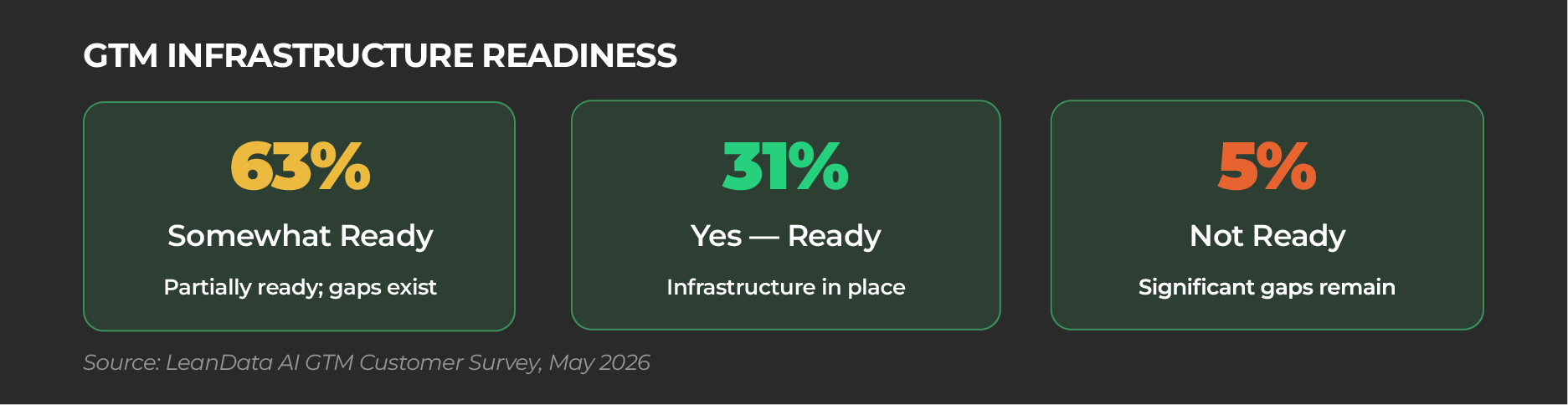
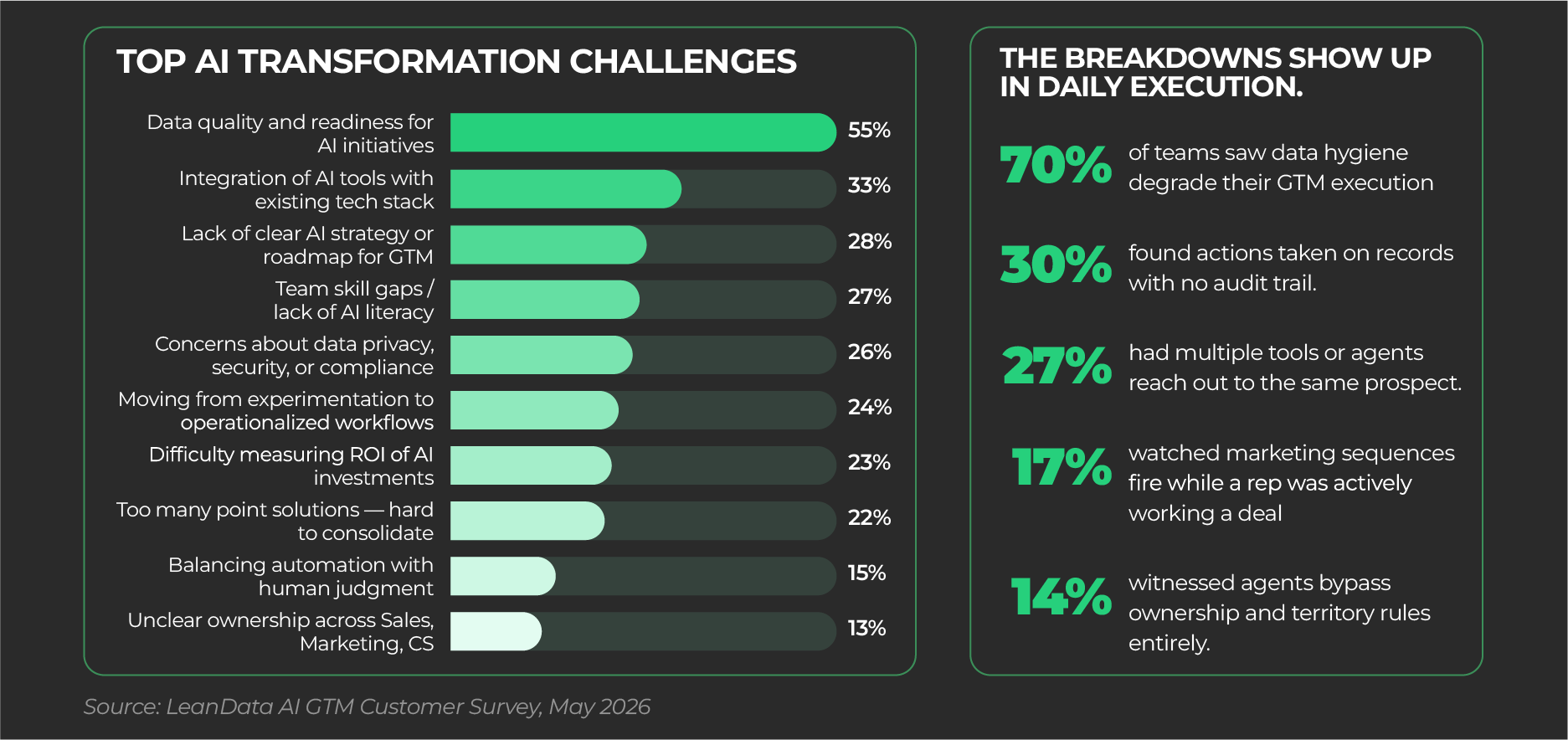
- Data quality is AI’s biggest blocker. 55% cite it as the top challenge, and 94% say their GTM infrastructure isn’t AI-ready.
- GTM teams want control, not more agents. 60% fear actions on the wrong records and want a complete audit trail.
- AI failures are usually infrastructure failures. 45% blame bad data, 37% undocumented processes, and 32% siloed teams.
Everyone Has AI. Few Have the Foundation to Trust It.
For the last several years, the AI mandate in B2B go-to-market was simple: move fast, try everything, and sort out the mess later. That era is closing fast.
Teams are now running their AI initiatives through AI councils and security reviews, all while facing an even harder question: where is the impact?
To understand how ready GTM teams really are to implement AI, LeanData surveyed 157 B2B revenue, marketing, and sales operations leaders about the state of AI across their systems and processes. The results expose a striking gap. While 93% have already put at least one AI agent into production, only 31% believe their infrastructure is ready to support it.
Where Execution Breaks
Data quality tops the list of AI challenges for 55% of teams, and 70% watched data hygiene degrade their execution. Agents pile up from five or more sources. A third of operations leaders can’t say how many agents touch their records, and 30% found actions taken with no audit trail.
These are coordination failures, not capability failures.
“Data, data, data. We are years into an undefined data infrastructure. We are in the process of building our data dictionary, aligning source of truth, and determining the correct source for each data metric.”Sr. Director of Revenue Systems
What GTM Teams Want instead
Ops teams’ biggest fear is agents acting on the wrong records, ahead of any worry about raw performance.
So the wish list starts with control: a complete audit trail, agents that follow the same rules as people, and proof that coordination improves pipeline. Probabilistic reasoning needs deterministic guardrails around it.
Build the foundation first, and AI ambition finally has ground to stand on.