













LeanData helps revenue teams orchestrate every signal across the full customer journey, from the first inbound lead to renewal and expansion. GTM Connected is an ongoing webinar series exploring the real-world use cases that drive that motion. In this webinar we’ll focus on a use case every revenue team is wrestling with right now: the AI-to-human handoff.
AI SDRs can qualify a lead, but they can’t determine who owns it, whether the account is already a customer, or what to do when the right rep is unavailable. That last mile is where revenue leaks and where orchestration wins. Join us to learn how intelligent routing and scheduling with LeanData answers the questions AI can’t, including a live product demo.
You’ll learn:
- Why the AI-to-human handoff is one of the highest-risk moment in your GTM motion
- How to tier and route signals so hot leads convert and junk leads never reach your sales team
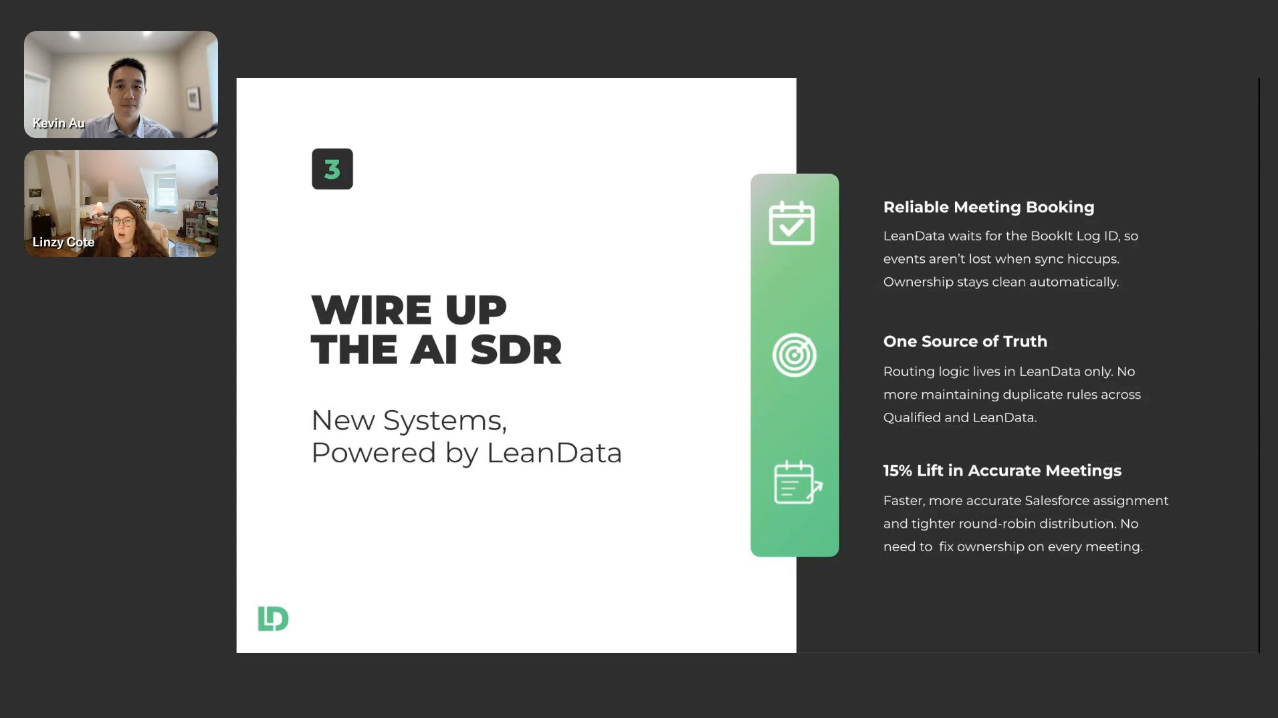
- How LeanData Scheduling connects AI-qualified leads directly to the right rep’s calendar
Why this matters:
The speed-to-lead problem has a new layer: it’s not just how fast a rep follows up, it’s whether the handoff from an AI agent is accurate, governed, and traceable. Misrouted leads, account collisions, and ungoverned AI actions are silent pipeline killers.
Deterministic routing and scheduling ensures every AI-qualified signal reaches the right owner with the same governance and auditability revenue teams already rely on in Salesforce.
Use Cases
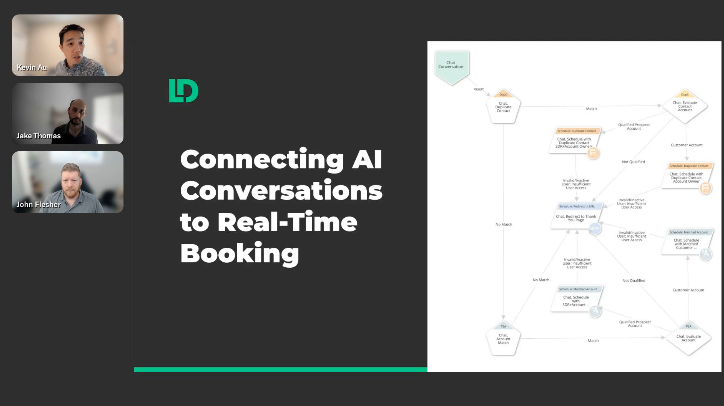
- Connecting an inbound AI SDR (Qualified, OneMind, Agentforce) to BookIt for real-time meeting scheduling
- Routing AI-qualified leads with tier-based logic: hot leads directly to account owners, warm leads through qualification, junk filtered at the source
- Running hybrid round-robin pools with both AI agents and human SDRs to test and control distribution percentages
- Enforcing SLAs on AI-worked records and routing escalations when agents miss milestones
- Preventing account collisions by matching AI SDR contacts against existing accounts and open opportunities before routing
LeanData Customer Story: Uber for Business
Uber for Business runs Salesforce Agentforce to manage their self-service funnel around the clock. When a prospect’s needs exceed what the agent can handle, LeanData BookIt routes them to a live rep with full CRM context—no re-engagement friction, no misrouting. Their sales cycle dropped from 78 days to 25, and win rates improved from 32% to 49%. Read more: How Uber Bridges the AI-to-Sales Gap with Agentforce + BookIt
Frequently Asked Questions
My AI SDR already includes scheduling. Why do I need LeanData?
Which AI SDR tools does LeanData work with?
How does LeanData prevent an AI SDR from re-engaging an existing customer as a new prospect?
Transcript
Hilary Terrell: Alright. Welcome. Welcome. Thanks, everyone, for joining us today. I’ll give it one more sec as folks are streaming in. We are coming to you live. Both Brenda and I are on on the West Coast. Let me know where you are joining us from in the chat on your on your right hand side, and we’ll use that chat widget, throughout our time today. Give it one more minute. Denver, Iowa. Awesome. California. Alright. I’m gonna get us rolling. I appreciate the the punctuality for those who are who are here first. Just a couple of housekeeping items before we get started. We will be sharing the recording at the end, but feel free to to still scribble notes throughout. And then if you do have any questions, there is a live chat feed where folks are already, typing. There’s also a q and a tab. So when we get to the end, that’s where we we will be pushing the question so we can make sure we get everything answered. If we do run out of time for any minute, we’ll make sure to follow-up. We can see, who’s posting any of the questions. So keep things rolling throughout. We’re gonna try to keep this as interactive as possible. Right. Here’s how we will be using our time today. First, we’re gonna introduce this concept of our use case framework and how the data can be used across the revenue life cycle. We’ll then move into the topic at hand, which is the use case around the AI SDR, where we’re seeing things in the marketplace, where it breaks down, and where LeanData fits in. We have a video that we’ll jump into with a demo, and then we’ll open it up for live q and a. But as I mentioned, feel free to to keep the chat and the q and a going throughout, and we’ll address things as we can. Here’s your your LeanData team. As I mentioned, we are live, so we’ll be rolling with with the punches today. I’m Hilary. I lead our product marketing team here at LeanData, and I’m joined by Brendan Hawkins on our solutions consultant team, our resident product expert as we talk about this use case today. Alright. We’re gonna open up things with a poll. Try to get a sense from the audience, where are you in this journey with AI SDRs. Are you still in the exploration phase? Are you live in production? Not even thinking about it, just here to learn. There should be a poll tab on the right hand side, same place where the chat is. So if you pop over there, click your answer, and then we’ll kinda see where where our audience is today. I’ll tell you on the LeanData side, we are live in in production. If you go to leandata.com, you can see our AISDR, Charlie, who, you may have engaged with before. So we’ll let the poll run for a sec. Awesome. One more sec, and then feel free to to push it live. This is the poll. Oh, you can see it on the live results. Go to polls tab. Awesome. Thanks for getting those submitted. Let me know if I should stop sharing, and we can pop up the poll results, but no stress. If not alright. Let me stop sharing for a sec. I wanna see the data.
Brendan Hawkins: Show me the numbers.
Hilary Terrell: Yes. Awesome. Okay. It’s our first time doing a poll, so appreciate everyone’s patience. So it looks like most are live in production. Almost half. Cool to see. Just exploring, evaluating. This this pencil is very real. That that’s kind of what we figured that everyone’s kind of in a different phase of of this journey. So, hopefully, everyone can can take away a different a different piece of of information as you’re thinking through this process. Awesome. Thank you, my backstage folks. And I will share my screen again and keep us rolling. Alright. We probably have a mix of folks, on this webinar today, people who are existing LeanData customers and wanna learn more about this use case or maybe folks who are newer to LeanData, so so bear with me just to give a sense of who LeanData is and how customers are using us. So we call ourselves the intelligent orchestration platform, really tailored for your AI go to market motion, and we serve as the connective tissue across every stage of your revenue life cycle. So if you see that circle in the center, we are there from the lead acquisition stage to the post sales stages of adoption, retention, and expansion. On the left hand side, what we’re really doing is taking all of those signals within your go to market motion, whether they are AI or human or other systems in your tech stack, and we’re doing that orchestration in the center through data quality. We’re doing the matching, the routing, automating your workflows, scheduling, the governance and reporting, and then we’re orchestrating actions on on the right hand on the right hand side. So we’ve been around for about twelve years, and what we have found is that, no surprise, most people, customers and and non customers, know us for that acquisition phase, that lead acquisition phase, top of funnel from lead through to the handoffs of opportunity and then revenue. And we saw that internally as well. So this is really the genesis of an internal exercise that we did to document and better understand how customers and the data ourselves is using the product throughout the customer life cycle because we know that revenue doesn’t stop at that lead acquisition phase or that first opportunity phase. So we did this project, gosh, about six months ago to really document actual use cases of how our customers are using us. And so all the ones that you see here are ones that we have existing customers leveraging LeanData. And so it went from kind of an internal tool of how we talk about use cases to a customer facing tool that we were using with existing customers to show, here’s where you are on your journey with LeanData. Here’s kind of a natural progression or evolution of how other customers are leveraging us in other use cases. So we take this visual and and help paint that picture, both for existing customers and and net new. So the idea was to bring this concept to life with an ongoing webinar series that we’re calling GTM Connected. So you are here for for our very first one, and the idea is we’ll we’ll drill into each of these use cases over time, and we’ll continue to add to this map as we’re learning about, new use cases. Agentic SDR and routing wasn’t one on our radar about a a year ago. So that’s definitely something that that we’re seeing changing in the marketplace. So that’s the use case that we’re going to focus on today, how customers are leveraging LeanData within their agentic SDR scheduling and routing. So what are we seeing in in the landscape today? Where does LeanData fit in? So first, a couple of stats. We did a survey of our entire customer base a couple of weeks ago. So this is hot off the press. We haven’t published these results yet, but we wanted to get a sense of where our customers were on this AI transformation journey. So a handful of results I thought were relevant to our conversation today. The vast majority, and I was actually surprised at this, have deployed at least one agent within their go to market motion, and almost 80% are scaling or actively deploying AI. So deploying AI doesn’t necessarily have to mean an agent. It could be other AI driven, workflows within go to market. So this is absolutely something that’s top of mind, for our customer base, hence why we we started with an AI use case. So drilling in more specifically on the AI SDR use case. So think of it as as the agentic version of of your SDR, your BDR, your your XDR who’s handling potentially the inbound, potentially the outbound, but really that tip of the sphere tip of the sphere for the first stage, of the sales life cycle. So what are we seeing externally in the marketplace? A massive uptick in adoption. If you rewind back the clock, to about two years ago in terms of adoption in production, almost 41% have an AISDR in production now. The market size also significantly growing over that time period and is expected to continue to grow, between now and and 2030. What does an AISDR actually do? The results that customers are sharing, and not just our customers, anyone using an SDR, is the ability to qualify a lead in less time. So in under under five minutes versus roughly thirty minutes, for a human, and really getting more of that top of funnel productivity versus a non AI outbound team. Doesn’t mean AISDR is gonna solve all of your use cases or all of your all of your pipeline, challenges. There’s absolutely still a human element in the loop, and we’ll and we’ll talk about where where that fits in. What we are seeing is that, typically, AISDRs can’t go the last mile. They’re generating a lot of signals. They’re helping to do maybe qualification on your website or answer questions, but they don’t always have the information to determine what should happen next. So depending on who that person is, can the AISDR understand, is this a net new prospect, or is this an existing customer that I need to get to the the representative for that account? Do I need to pass it to, an SDR, the account executive, a CSM, maybe a product expert, and who’s actually available? So the AISDR typically has a limited set of information that it can work from. And what that means is that the handoff breaks, and that means your revenue life cycle is broken. So first, the most common thing that we see is misrouting the leads and the AISDR not being able to know, is this an existing customer and treating that person as if they are a net new prospect, asking them the same questions. Imagine how frustrating that would be. Losing someone at the point of interest and losing meetings that would turn into an opportunity and revenue. And one that we definitely hear come up with our customers is this idea of of a black box. People know LeanData for that ability to have a full audit log and governance and auditability, and an AISDR isn’t providing that level of of visibility. So our view is that the agents are probabilistic as they should be, but your routing shouldn’t be. And LeanData bridges that gap between the probabilistic AI reasoning and the deterministic action that needs to happen to make sure those signals become a meeting with the right person every time, and that translates into revenue. So our point of view is that we wanna be that agnostic layer. We know that this market is gonna change. We have customers using LeanData with all of the SDR AISDR agents that you see on the right hand side, but this is a bring bring your own model. So whether you’re building one in house or thinking about some of the players that are on the market, the way that we have built our LeanData integration is for you to leverage LeanData routing and scheduling through our APIs or our new MCP support so that you can really get the most out of the investment that you want within your tech stack. So you might be thinking, well, my AISDR that I’m looking at does scheduling. So what is LeanData doing differently? Some. do have scheduling built in, some don’t. So what we’re seeing with the ones that do have scheduling built in is that they can only go so far. And so the routing logic may have some basic capabilities, but when you think about all the complexity that you know and trust LeanData for, why rebuild that in a second place and not map to your GTM motion that you’ve already captured with LeanData? It also often doesn’t have that round robin that you’ve built in to your capabilities and know which person needs to go to, who should it go to in the round robin pool, what if someone’s out on on vacation, and have all of that downstream information to make the right decision. And then finally, that black box and and auditability as well. So while some AISDRs may have that scheduling capability built in, our customers what we are seeing within our customer base is that they are extending their AISDR, but tying it to what they’ve already built into LeanData with their robust routing and and matching logic. We also know that agents are showing up not just in in this AISDR use case, but in all of these use cases across your go to market motion. So while we won’t dive into all of these today, I just do wanna kind of underpin the ideas that we’re the orchestration, that agnostic orchestration layer underneath where we can extend those agentic capabilities based on all the governance and routing and logic that you know and trust LeanData for. A couple of stories, and if, you are have been on any of our, customer marketing webinars, Most recently, we’ve highlighted a couple of of these use cases. You can also find all sorts of more detail on our on our website if you’re interested in learning more about these customer use cases. But a handful of AI AISDR, stories in motion today. So Uber for business is using agent force to think about their self-service motion and how they can really scale that one to many part of the the smaller end of their market. And so they can a new customer can engage with their AgentForce agent to get fully onboarded. But when an issue comes up, LeanData BookIt, allows that person to connect in real time, book a meeting with someone on their support side to keep that self serve customer moving. So they’re bringing in the human at the point of need and letting the agent kind of take those steps in the meantime. Tealium, also using an a AI chat solution. I believe they are a OneMind customer, is pulling up that BookIt, which we’ll we’ll show in the demo in a second, to be able to book when a meeting is is ready and someone is is ready at that that time of interest. And if it’s a known visitor, they can automatically route that to their rep versus maybe it’s not right for an SDR. They’re ready to talk, to an actual account exec executive. And then Treliant, I believe that was one of our most recent stories that we talked about. They’re leveraging Qualified, which we also have on our website. And, again, sharing that book it in real time ability for a customer to, book time with the right person. They’re also using one of our newer capabilities, the LeanData AI inference node in their graph to enrich the data to make sure they are validating and routing it, to the right BDR in their organization. So this next slide before we hop into the demo is intended to just kind of give you a sense of where LeanData fits, into the flow. And, Brendan, please feel free to to come off mute as I I chat through this, and I will I will build out the slide from left to right.
Brendan Hawkins: don’t think I’m on mute. Okay. Yeah. So, I mean, essentially, the agent, will start by engaging with a prospect on your website in most cases. So people are experimenting with Qualified in one mind. So you’ve got, you know, Piper and Mindy, AgentForce, warmly dot ai, you know, whatever agent they’re using, you can either, use one of the LeanData’s, sorry, BookIt APIs to embed the scheduling, or you can even just use our simple scheduling links, which is an easy way to test the different marketing tools. And then what’s gonna happen is some folks will schedule with the agent, and some folks won’t. A lot of folks will just ask questions of the agent, and that’s still gonna flow into your LeanData lead router where you can apply things like SLAs and automatically adding people to campaigns, cadences, and sequences. Now when it comes to the different, severities of leads, most folks are testing this out on, you know, SMB commercial space, low, kind of level leads. When it comes to these hot leads, you know, we’re gonna surface the calendar of, you know, a matched account owner or matched opportunity owner, but probably not engaging an agent in that case. But then as we move down and we look into, like, warm leads, well, there’s an opportunity for an agent to answer some questions and, you know, just do basic qualification. Like, on our website, if you go, you’ll see that we ask, what what CRM system do you use? Because we work with Salesforce primarily. So it’ll do those basic qualifications and then schedule with a live human. Now what we’re starting to see at the bottom level here that kind of, you know, either who leads that went cold or really, you know, low market areas is that maybe you have an agent that can take it full cycle. We definitely have customers that are taking it all to the point where you’re basically just ordering the product at the end of the conversation with a live human, and LeanData is able to make that warm transfer, pull up that human’s calendar, and maybe have that conversation, you know, right now, essentially.
Hilary Terrell: Awesome. Thank you. So this isn’t the only way it can be set up in your flow, but it’s a question we get from a lot of customers, kind of where would LeanData fit in in this overall kind of signal to, action, next step. Alright. So now we are going to jump into a demo recording. So I’m gonna pass over to our team to get that going live.
Video: My absolute favorite part about LeanData’s scheduling app is that you just download it off the AppExchange natively into Salesforce. It really has to be one of the easiest to implement marketing tools out there today, Especially if you’re an existing LeanData customer, where all we need to do is fire up this new tab for BookIt. And then it will automatically enable scheduling for both humans and agents alike. Everything will also leverage your LeanData matching. For over a decade, LeanData has been recognized as the heavyweight champion when it comes to lead to account matching in Salesforce. And you better believe when data comes in from these AI SDRs, it’s good, it’s bad, missing, ugly, not unlike the forms and chatbots that preceded them. So we’ll apply tools like word component tokenization, synonym and acronym dictionaries for people and companies, fuzzy matching algorithms, and, of course, your custom tiebreaker rules when we run into multiple matches. What does all this mean for scheduling? It means that we schedule with the right person or team the first time every time. All right. The first AI SDR that we’re going to be looking at today is the one for your website, likely in place to answer questions, provide information, maybe even quick demos, and then, of course, to book live meetings with human SDRs. We do all of this, of course, through standard web forms. But what’s become very popular in 2026 with LeanData customers is to experiment with tools like Piper from Qualified or Mindy from OneMind. We have folks using warmly.ai and of course Agent Force as well to engage with prospects on their website, answer questions, and book meetings. So this is Charlie. This is LeanData’s AI SDR that’s built on the Qualify platform. I have the ability as a prospect to have a live conversation with Charlie, ask probing questions, and then, of course, book meetings. Let’s go take a look. How can I help you? Hey, Charlie. I was wondering if you could tell me what LeanData does. Of course. LeanData is an intelligent GTM orchestration platform for Salesforce. It automates lead to account matching, routing, scheduling, and coordinated actions across your revenue team. That’s fascinating. Who are some of your largest customers? Great question. Some of our biggest customers include Anthropic, OpenAI, and Databricks. They rely on LeanData to streamline their go to market operations. That’s amazing. Can I get a live demo? Happy to set up a demo. What’s the best email to use? You can type it into the chat for accuracy. Charlie’s gonna take my email, process it, and determine if you should book a meeting and then with whom. Could be a matched account owner, matched opportunity owner, next Monday, round robin. Could you let me know the size of your company? You can pick from the options on your screen. Great. Got it. So what Charlie has done is he’s gone into Salesforce. He’s pulled up a flow builder and then gone into the individual or individual’s calendar, whether it be Google Cal or Microsoft, and pulled up availability based on a set of rules. Within the Book It Forms flow builder, you’ll find entry nodes for demo requests, our qualified AI SDR, chat conversations, and routing links, new for 2026. Within the qualified SDR node, you’ll find every answer to every question that was asked of the prospect that you’ll be able to use in booking decisions. You’ll also be able to match to any record inside of Salesforce to identify account owners, opportunity owners, and round robin pools that you may wish to schedule with. Many customers will also reject a strong percentage of prospects. Maybe they’ve given you an email address that contains a personal domain, while LeanData maintains a list of public domains globally that you can leverage. Even more customers, if they don’t match to your account, may choose not to schedule a meeting with you. Not to say they won’t chase after that lead later, but if we don’t know who you are or who your account is, we may not wanna roll out the red carpet and schedule a meeting. When it does come down to scheduling, we can schedule with matched record owners or round robin pools. Within the round robin pools, we have count based pools and order based pools. You can also have additional hosts that can be either required or optional. All meetings will come with a meeting type, which will determine the branding, logos, length of meeting, and communications that go out to the prospect. And then for every meeting we schedule, we’ll create an event in Salesforce that you can stamp with custom data. Now the fact of the matter is many people will engage with these AI SDRs, but not everybody will schedule a meeting. This is what brings us to use case number two for LeanData’s AI SDR orchestration. For our next AI SDR use case, we’ll be discussing email agents. This process starts by creating dedicated Salesforce users for each one of your email agents. As new records come in, clients will take a number of different steps when it comes to enrichment, matching, and then ultimately decision making to determine who gets the record. In our example here, we have enterprise and commercial leads. When it comes to AI SDR experimentation, LeanData customers are strongly leaning into the commercial and SMB prospects. With this particular round robin pool, we have a hybrid round robin pool of both Charlie, our AI agent, and Hugh and Heidi, our human SDRs. Leveraging lean data allows them to change the distribution percentages that go to the humans versus the agents as they do their AB testing. This also allows you to use LeanData reporting and dashboards to ensure that every record gets worked on every time. LeanData also has the ability to automatically add prospects to outreach sequences, sales loft cadences. This allows you to automatically kick off emails with scheduling links to schedule meetings with live human beings. We also track SLAs, and this isn’t just for the humans. AI agents break down too. You have the ability to enforce one or multiple milestones within your SLA with LeanData’s new SLA node. You also have the ability to evaluate only while the user is working. This works great for humans because it makes the rules fair. For agents, they can work around the clock. Also new for the SLA node is extended tracking time, where you can see ultimately how long it took to get the process completed even if the SLA expired. Built in notifications are available, although with this particular use case, we’re gonna send a different notification to a human if an SLA is missed versus if an SLA is missed by an AISDR, that notification will go to the AISDR admin. And if you are a human SDR or SDR leader, you’ll really like our SLA dashboard package that’s up on the AppExchange. This allows everyone to track their performance against their peers to ensure they’re never ever replaced by an AISDR.
Hilary Terrell: Thank you, Brendan. We tried to cram a lot into that recording so you get a sense of both the end user experience on on the front end and what’s happening, on the back end with LeanData. So thank you so much for capturing that, and let me keep our slides moving. I see we’ve had at least one, two questions come through the chat, so keep those coming as we round out, our conversation today. Brendan, anything you wanna mention on that initial question regarding, APIs with the integrations?
Brendan Hawkins: Yeah. I mean, we’ve done a number of different scenarios. I mean, obviously, the ones we showed you where you’re presenting calendars through agents. We’ve also had humans take over conversations with agents. So once they’re qualified, a human takes over it. I couldn’t remember if the customer decided they were gonna tell the purse the prospect or not, but, we can do those transfers. You know, in terms of, you know, the use cases, they’re all kinda coming from different corners these days. We have, customers using LeanData also for, orchestrating, like, sales process agents that look for risk on deals, like, you know, single threaded opportunities and $0 deals after certain, you know, stages. So there’s other things in the background. Yesterday, our first example of an outbound calling agent was presented to us by another customer where. the agent is calling out to a prospect. It’ll answer questions, and then it uses the book at APIs to pull up the calendar and suggest times when you can meet with your matched account owner or, somebody who’s up next in your round robin pool. So, you know, if there’s some limitation you run into our or into our into with our APIs, I think our team is willing to, you know, add on to them.
Hilary Terrell: Yeah. Absolutely. And, great question, and thanks for sharing the documentation, Brendan. Yeah. Curious in in the chat if there are use cases you all are thinking about with with the AI SDR, or other tools maybe that we haven’t mentioned. Would would love to hear from folks in terms of what what you’re exploring. Brendan, I’ll pass you to answer that next question that. just came in.
Brendan Hawkins: Yeah. So, Olga, BookIt is our tool. So it’s our scheduling, tool, the calendar piece that you saw pop up, and it can be integrated with Piper, with Qualified, OneMind. You could run two of them simultaneously to see which one books the most meetings for you. That’s kind of the beauty of LeanData is we allow you to use that scheduling tool on multiple marketing tool sets.
Hilary Terrell: And, Brendan, how long do you in terms of, like, configuration, what’s been your experience in terms of getting a a customer up and running?
Brendan Hawkins: I mean, when it if you’re already a LeanData customer and you have your matching setup, that’s really the the tough part is to fine tune that to go add on. I mean, good example when, Drift kinda imploded last year, we had about a dozen customers that moved over to qualified. They were over in a couple days, and only because they wanna go to sandbox and test. The actual implementation is done on a phone call, like, one hour workshop.
Hilary Terrell: Yeah. And just to to double click on, the question that was there. So when you think about LeanData’s offering, you’ve got orchestration, our our core matching and and routing engine, and then BookIt is our is our scheduling solution. So those two work work hand in hand.
Brendan Hawkins: Yep. So they’ll schedule meetings hopefully with Piper. When they abandon that calendar, it’s gonna come through your lead router, and we can take all kinds of actions like automated emails with, scheduling links. This is a pretty common next step.
Hilary Terrell: Awesome. Awesome. We also, released the BookIt MCP server if you wanna chat about that at all, Brendan, and how that differentiates from, customers have been leveraging our BookIt APIs, and and now we do have the
Brendan Hawkins: MCP server. Yeah. But you get all kinds of insight, you know, connecting, book it with other systems and see, you know, not just, you know, meeting volumes, but what’s going on within these meetings, the trends that are happening out there today, and then being able to connect it just to all your different systems in and outside of Salesforce. And then I see, are they navigated to a separate window? It’s actually, vendor by vendor, and it depends on their APIs. So, with qualified, it’s a model experience. So we pop the calendar right next to the chatbot vendor. With agent force, it’s inside the chat. With OneMind, it’s a, a new tab that opens up. So it’s a 100 to do with the, APIs available by the chat provider or a AISDR provider.
Hilary Terrell: Great question.
Brendan Hawkins: This is
Hilary Terrell: other one
Brendan Hawkins: SDR.
Hilary Terrell: Go.
Brendan Hawkins: outbound. Yes. We have SDRs doing outbound. We we do this today using a CrewAI, and we’re actually moving over to CloudFlare. But we have outbound AI SDRs that, are sending emails and scheduling, meetings with live humans using BookIt. And then I mentioned the phone call, you know, outbound phone agent is something that’s very new. Just just, was presented yesterday.
Hilary Terrell: Absolutely. So inbound or outbound motion, you can weave in, the the scheduling piece, depending
Brendan Hawkins: can also add our scheduling links to campaigns, cadences, sequences. So all those standard tools that people are using for outbound work as well. And then we do have a whole toolset for, the SDRs called handoff. That would be for, like, human to human transfers.
Hilary Terrell: Awesome. We’ll give it another minute if other questions come through the chat. What I will do in the meantime, so we’re not sitting here in in silence, is just share some of the additional resources and and next steps that we have. So I I mentioned earlier that we’ve been leveraging this solution, use case map with our customers. And what we’re able to do, if you’re an existing customer, is run a report, to see based on how you have configured LeanData, what use cases, it looks like you are currently leveraging LeanData for. It’s been really helpful when we’ve been doing, quarterly business reviews with our with our customers. So everyone who is here and a customer will, be receiving from your account manager in the next week what your view of this looks like. If you are a prospect, we are absolutely still happy to have that conversation and share based on, answer any questions based on on your initial use cases and where you’d like to learn more about LeanData. So be on the lookout for that as a follow-up. I don’t see more questions yet. So this is our our next poll. So we wanna make sure this series is tailored to what you all wanna hear in terms of learning more about use cases that you may not, be familiar with in terms of, what LeanData can do. So let me stop sharing. Tell us what you would like to see us cover in a future GTM connected session. This one was focused more on that acquisition phase, but do you wanna hear more about how customers are leveraging LeanData for maybe customer adoption, retention management, expansion? So the poll tab is back if you wanna click over there and tell us what you would love to hear more about. If you are an existing customer, you can always flag that to your account manager or or CSM, and we’ll make sure to prioritize what you are hoping to learn more about. And if there is a use case that you did not see us show, we wanna hear about it. We’re trying to document customer stories across all of these. Oh my gosh. These are pretty neck and neck. Predeposed sales hand off. Awesome. That’s one that we use internally here at at LeanData as well. So that would be a great one for us to to share more about. Awesome.
Brendan Hawkins: So all good ones.
Hilary Terrell: Alright. Let’s see if there’s any more oh, one more question. You wanna answer that, Brendan? I’ll. get, this slide.
Brendan Hawkins: Wendy. Direct to account owners and direct to opportunity owners, definitely. Sometimes in the enterprise, account owner space, you’ll see an SDR that’ll get in between the conversation. But in most cases, that’s what we’re doing is matching to record owners and scheduling with those record owners. Yeah, account owners. Imagine if you’re mid late stage in a deal and somebody else goes on to the website and ask for a demo, you know, they don’t need to go talk to an SDR. It’s obviously, like, a second, third buying influence, so we could pull up the opportunity owner’s calendar. And then the rest of it is usually round robin pool based.
Hilary Terrell: Good question.
Brendan Hawkins: Yep.
Hilary Terrell: Awesome. I’ll I’ll, like, drag this out as folks think of a few more few more questions. We did wanna highlight a handful of resources that we have, on on this use case. We will share, the recording. We will be, reaching out with our our use case assessment as well. And then we’ve got various resources on this topic to help get you up to speed. There is a new landing page on on our website. We’ve got a blog post on it and a brand new technical implementation guide as well, to really help you configure, your AISDR with lean data. And then we’ve got subject matter experts on on our side who get involved in the configuration, as well. I see one more question that’s come through. In order to get this solution installed, do we need to engage with professional services at LeanData? Is it done, through our CSM?
Brendan Hawkins: Professional services does get involved usually because you also wanna turn some things off and change some things on your lead router to accommodate for these folks that are scheduling. But, Olga, usually, we just start with a a live demo. If you wanna schedule one, I’d be happy to reach out. We’ll get that on the calendar, and we can talk through all the implementation steps and the the product as well.
Hilary Terrell: Awesome. Sweet. Well, thank you all for joining for our first, in in this new series. Open to any feedback. Hope this was helpful, and we’ll see you on the next one. Thanks, everyone.
Brendan Hawkins: Yes, everyone