













Summary
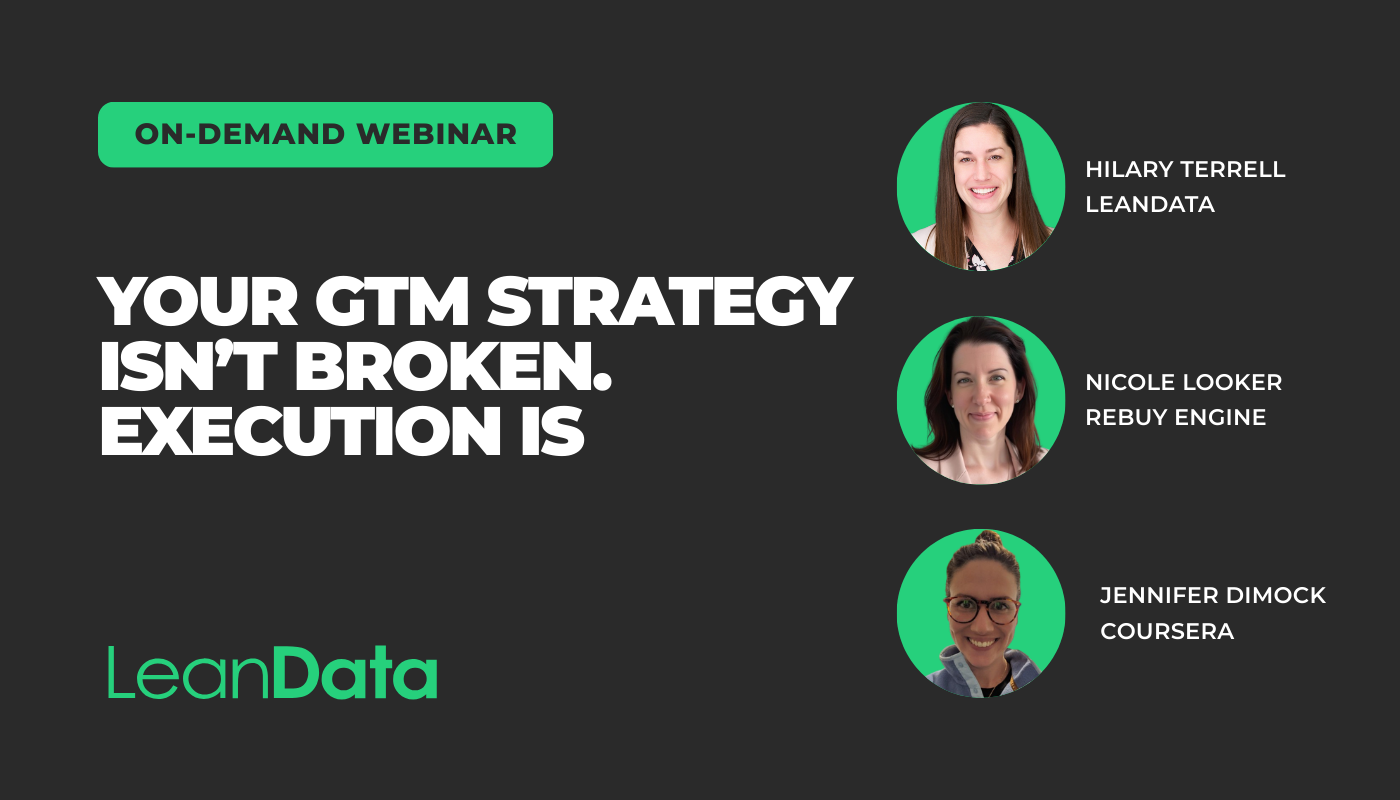
Many B2B teams believe their GTM strategy is the problem. In reality, most organizations already understand their market, positioning, and buyer journey. The real challenge is execution across marketing, sales, and customer teams. This webinar explores the GTM execution gap and how RevOps leaders coordinate systems, signals, and processes to turn strategy into consistent execution.
Key Takeaways
- Why many strong GTM strategies fail during execution
- The operational breakdowns that prevent teams from acting on buyer signals
- How RevOps helps align marketing, sales, and customer teams
- Practical ways to coordinate data, workflows, and systems across the buyer journey
- How AI helps teams surface insight and respond faster to buyer activity
Speakers
- Hilary Terrell, Head of Product Marketing, LeanData
- Nicole Looker, VHead of Revenue Operations, Rebuy Engine
- Jennifer Dimock, Senior Marketing Operations Business Partner, Coursera
Frequently Asked Questions
What is the GTM execution gap?
Why does GTM execution break down?
How does RevOps improve GTM execution?
How does AI help with GTM execution?
Webinar Transcript
Hilary Terrell
00:43 – 02:56
All right. Welcome, everyone.
Seeing where everybody’s joining in the chat, thank you for joining from
Snowmageddon on the East Coast, The UK. All Let’s go ahead and get started.
I think we have a lot of great content to cover today. Welcome, everyone.
Today, we are going to challenge something many go to market leaders like
myself quietly suspect, or maybe not so quietly. Your go to market strategy
probably isn’t the problem.
In fact, most teams have never been clearer on their market, their ICP, or their
positioning. But strategy alone doesn’t drive growth.
Execution does. And we’re seeing a widening execution gap.
That’s what we’re really gonna unpack today. So here is how we will be spending
our time.
I’ll start with a quick framing and some data on why execution, not strategy, is
now the primary growth constraint and some of the recent research we have
conducted with Harvard Business Review. Then we’ll move into discussion with
our amazing customer panelists to hear how this shows up in the real world, and
we will leave time for live q and a at the end.
We are live. So I’m gonna do my best to keep up with the chat and keep up with
the q and a.
So in your webinar screen, you should see a tab on the right hand side for live
chat and then a q and a tab. So if you do have a question for our panelists, type it
into the q and a tab, and we’ll keep an eye at the end.
And if there’s ones that we don’t have time for, we will follow-up afterwards. And,
yes, a recording will be available.
So let’s get into some quick introductions. My name is Hilary Terrell.
I lead the product marketing organization here at LeanData. Today, I’m joined by
two of our customers from Rebuy Engine and Coursera, Inc.Both of them bring hands on experience building and scaling go to market
motions inside their organizations. So you’re gonna hear their firsthand
perspective on everything that we will be talking about today.
So before we get into the content, let me allow each of them to introduce
yourselves. Let’s hear about your title, a little bit about your company in case
folks are familiar, and where your role, your team sits within the organization.
Why don’t we start with you, Nicole?
___________________________________________________
Nicole Looker
02:56 – 03:48
Yes. Hi, everybody.
Super excited to be here this morningafternoonevening for everybody across the
globe. As Hillary mentioned, my name is Nicole.
I am the head of rev ops for a SaaS ecommerce software company called Re
Buy Engine. And we sit on the Shopify ecosystem and help merchants with cross
sell, upsell, buy more, save more, subscribe and save, things along those lines.
So I’m sure many of you have come across our app with online shopping. In my
role at Rebuy Engine, we sit directly under the CRO, which gives us a really
unique perspective across the entire go to market org and support with finance,
engineering, and product as well.
___________________________________________________
Hilary Terrell
03:48 – 03:51
Awesome. Great to have you here.
Jennifer?
___________________________________________________
Jennifer Dimock
03:51 – 04:20Hi, everyone. I am Jennifer Dimock.
My role is senior marketing operations business partner at Coursera, Inc.
Coursera, Inc.
, for those of you who don’t know, is a global online learning platform. So we
partner with top universities and companies from all over the world to offer online
education.
And my operations role at Coursera, Inc. , we sit under the marketing umbrella,
so ultimately reporting up to the to the CMO.
___________________________________________________
Hilary Terrell
04:20 – 13:01
Awesome. Thank you, thank you.
So I’m going to share a bit of context setting before we get into our discussion,
but lots to cover with our panelists. So stand by.
So we won’t bury the lead. You saw the title of this webinar today.
What are we seeing as the go to market execution gap? First, let’s define go to
market strategy. For this discussion, we’re going to define it by three revenue
outcomes, new customer acquisition, expansion through cross sell and upsell,
and customer retention.
All of these elements are, of course, widely recognized as critical to growth. Now
the data.
So we recently partnered with Harvard Business Review, which I mentioned
earlier, and surveyed over 500 go to market leaders about their strategy. PS, this
is forthcoming research, so you are all getting a a firsthand sneak peek before
the this comes out next month.
What we found is that 83% of those leaders say their strategy is important to
growth. Not surprising.
But only 38% say their strategy is actually effective. Why? Lots of reasons, and
we’re gonna unpack those.
I think one of them is, you know, leaders are great at building growth tables on
slides and plans, setting acquisition targets, retention goals, building outexpansion plays and plans. But sometimes that strategy is handed down to our
friends in rev ops as an almost finished product without ever stopping and
asking, well, can we actually deliver on all of this? How do all the different pieces
and parts fit together? We call this the execution gap.
You have a unified strategy on paper, but then we see things break down
downstream. The gap isn’t a lack of vision.
It’s the inability to translate that vision into a coordinated action across people,
across process, and technology, and things that work across the entire customer
journey. So again, execution, not strategy, is the real growth constraint.
We also asked our respondents, well, what benefits, if any, has your organization
achieved by improving your go to market execution? The number one reason
that you see there at the top of the slide that our attendees cited was increased
revenue as the number one outcome. Amazing.
The benefits go beyond pure revenue. The leading organizations also cited
improvements to overall buyer experience, shortening sales cycles, leading to
higher conversion rates.
In other words, execution just isn’t operational hygiene. It is a growth engine.
So this is an inflection point. Strategy is defining our direction.
Our buyers are defining the complexity of our go to market motion, and execution
is determining the results. And in a buying environment that is even more
dynamic, even more multithreaded, more nonlinear than ever, execution quality
matters more than ever.
So teams know that execution is sometimes missing the mark. I think we’ve all
felt it in our careers in the past.
But many don’t know why or where to to start in terms of how to fix it. When
asked the top priority on how to address it, leading organizations were clear.
Better coordination across marketing, sales, and customer teams. Not more
tools, not more headcount, coordination, orchestration.
That means execution fails when the tools, the teams, and the technology aren’t
designed to work together. And what are those failure points that we see?
According to the respondents, in our own discussions with customers, execution
typically breaks down into these four predictable ways.First, fragmented signals and data. The buyer context that we need lives
everywhere in different systems and is difficult to pull together into a source of
actionable truth.
Second, siloed team execution. Marketing, sales, customer teams are acting
independently, not intentionally, though.
And despite our best efforts, we’re often disconnected from cross functional
partners in ways that ultimately have downstream revenue impact. Third, a lack
of operational intelligence.
Go to market plans exist, but sometimes execution still depends on manual
triage. We might be relying on static rules in a dynamic buying environment.
I think we all know AI is disrupting our go to market motion more than ever. And
fourth, disconnected handoffs.
Buyers are experiencing gaps between their interests and how they’re engaging
with you across their customer journey. Meetings, follow ups, next steps,
sometimes depending on manual coordination behind the scenes among our
teams.
So whether you experience one of the one of these things that you see here or or
many, you’re not alone, and that’s what we’re going to be discussing today. In the
chat, I’d love to hear from folks on the viewing side, what are you seeing as some
of the failure points in your transition from strategy to go to market execution? I’m
sure these are not the only ones.
So if execution isn’t the primary constraint, what is the path forward? The answer
isn’t more dashboards. It is a different model and one that we believe is anchored
into how buyers move through their journey, not necessarily how teams are are
structured internally.
This is what we call intelligent go to market orchestration. What we’ve seen is
that high growth teams anchor their execution around how buyers move, not how
sales or marketing teams are structured.
And that to operate effectively, go to market teams need intelligence built into the
execution itself. We’ll talk a bit more about what intelligence means.
Intelligent go to market orchestration connects every execution step. Signal
response, routing, follow-up, engagement, even meeting handoffs into one
coordinated motion across the entire buyer journey.So whether your company is looking to acquire new customers, service and
retain existing ones, or expand your business through upsell and cross sell,
orchestration isn’t tied to a single technology or signal. It’s connecting all of the
signals across people and technology.
It is an a coordinated revenue execution model that allows every aligns every
team to the buyer journey. So what do we mean when we say intelligent
execution? We think it comes down to four primary things.
First, the buyer journey becomes that organizing principle. Second, signals are
unified, and there’s a shared context.
Teams can act from the same understanding of the buyer and the opportunity
that’s in play. We have signal driven action and intelligence, not manual triage,
which means the right response can happen automatically at the right moment.
And finally, it’s continuous evolution and feedback and improvement based on
that feedback. Execution improves over time based on our outcomes.
So this isn’t more complexity. It is smarter coordination or orchestration.
And when that improves, we see a lot of things happen. And we’ll talk about
some of the outcomes that our panelists have seen.
We see better alignment across sales and marketing and customer success. We
see an improved buyer experience and buyer engagement.
We see improved efficiency, and as a result, revenue performance gains. This is
where orchestration really shifts from operational improvement to a strategic
advantage.
So all great in theory, right? Let’s talk about how it actually shows up in the real
world. I am gonna stop my my slides so we can see everyone’s faces.
So give me one sec. Awesome.
I can see you there. Hello, panelists.
A little context setting, but this is the piece I am most about, how this actually
shows up in your organizations at Rebuy and and Coursera. So you’re both
leaders in rev ops and and marketing ops, and thank you again so much for your
time here today.Let’s go back even before the execution stage. To create that strategy, there’s, of
course, a lot of planning that is involved cross functional planning, leadership
offsites.
I’d love to hear from each of you how you typically see your role and your teams
getting involved in the development of the strategy itself. What have you seen
work? What hasn’t worked? And then what are kind of those downstream
impacts that you have seen? Jennifer, I’m gonna start with you, if that’s okay.
___________________________________________________
Jennifer Dimock
13:01 – 14:48
Yeah. So, historically speaking, I have seen ops brought in too late, often way
too late, certainly post strategy discussions.
And the results of coming into the conversation late and being asked to perform
as more of a ticket taker rather than that integral voice and viewpoint in the
strategic planning is that things break really as soon as they’re built or launched.
Typically, these breaking points could have been identified early on if opts had
been a part of that conversation early enough to to call those out.
When this happens, the operations teams, in my experience, are typically asked
to continue fixing or solving post launch by really applying Band Aid fixes, which
we all know don’t don’t work great. What I have seen work really well is
operations being an integral part of strategy.
So, actually, our, senior director rebranded our marketing operations team, to
marketing strategy and operations, and I’ve seen the success of this rebranding
over the last year. I’m involved in a lot more conversations, with executives or
just more, I’d say early on in the process so that really we can say, you know, this
won’t work for this reason, or how about we do it this way? Or maybe there’s
actually already a conversation or a project ongoing that kinda supports whatever
this new idea is.
So it’s it’s essential that operations be brought in as soon as those conversations
begin happening. We can’t let silos dictate what or when operation hears of a
new idea or request.
And and as I said, our voices need to be heard and valued in those strategic
planning conversations for better strategy to execution, just a very harmonious.
flow.
___________________________________________________
Hilary Terrell
14:48 – 14:51
So we all need to add strategy to our team.
___________________________________________________
Jennifer Dimock
14:51 – 14:53
Yeah.
___________________________________________________
Hilary Terrell
14:53 – 14:54
Nicole, how about you?
___________________________________________________
Nicole Looker
14:54 – 15:42
Yes. I am very similar to Jennifer.
Historically, in most of my roles and even prior to the last few months here at
Rebuy Engine, it’s been very much the same where we’re looped in when it’s
time to build. Like, it’s they figured it all out, and now it’s time to go, and it’s being
launched tomorrow.
So we have to build it really fast. And what ends up happening is you put Band
Aid on Band Aid on Band Aid, and then eventually, the Band Aid are just gonna
come off because they don’t do anything any anymore to solve your your issue.
What’s been working for us now, and I think we’re living it in real time, we had a
new CRO come on in November. And for those of you where where where that’s
happened, I know, LeanData, that you guys have experienced some leadership
changes too.
___________________________________________________
Hilary Terrell
15:42 – 15:42
Mhmm.
___________________________________________________
Nicole Looker
15:42 – 16:34
That happens, you know, pretty much a lot of stuff is torn down and rebuilt or or
there’s new strategies or new ideas. More new new leadership comes on.
And what that means to me as a RevOps leader is that I need to be in the room,
like, ASAP. Even if it’s a fly on on the wall to just hear it, I need to be there.
And I’ve been advocating for that big time throughout the past few few months.
I’ve even went as far as, like, being the guide for some of the conversations and
just proactively scheduling the conversations with all the right people in the room
as I’m hearing things.
And that’s really helped for us to start collaborating, picking out gaps, making
sure that we’re able to properly plan and avoid the having to do it all at once,
which also happens during this type of transition as well.
___________________________________________________
Hilary Terrell
16:34 – 16:55
Yeah. We have definitely gone through our our own version of of that here for
sure.
And you both kinda mentioned having that seat at the table during strategy and
and planning. Are there any examples either of you can share where that has or
hasn’t happened and kinda the downstream impact?
___________________________________________________
Nicole Looker
16:55 – 18:18
Yes. So I have two of that I can think of.
On the positive side, luckily, our CRO has recognized the need for rev ops to be
involved in in, like, the strategy conversations, and we have a strategy leg on our
team now. So we’ve advocated for that and talked about it, and that’s really,
really helped us.
When we haven’t been in been in been involved, I can think of, like, one one
perfect example of this. We decided we were gonna change how we sell to new
new clients and really focus on con contracts.
Like, that was the, like, focus. We need to get everybody on the contracts, the
month to month stinks with churn and and retina retention.
However, we were, like, brought in after they even decided to, like, do this, and
no one told us that they were gonna be doing this. So we had contracts coming
to us and being put into into Salesforce, and no one knew what to do with them.
So my team just had to slap in some, like, fields and tell them to up upload the
contract on the the the account. And what that has led to now, like, a year later is
how do we report on it? We have too many pipe pipelines, too many record
types, or fields scatter.
What’s the handoff process?
___________________________________________________
Hilary Terrell
18:18 – 18:18
Yeah.
___________________________________________________
Nicole Looker
18:18 – 18:29
Where if we were brought into that in the beginning when the decision was made,
we could have designed a much better process instead of having to redesign
what’s currently in place.
___________________________________________________
Hilary Terrell
18:29 – 18:40
Yeah. There’s a a comment in the chat.
Says, please be specific. I think that’s a pretty good specific e a.
little bit. And ever any anyone that come to mind for you?
___________________________________________________
Jennifer Dimock
18:40 – 18:59
Yeah. Well, I was I mean, I’ve absolutely been where Nicole has been quite a few
times.
I was actually more so thinking, I mean, something’s launched anything, a
campaign, a new process, we integrate a new tool, and reporting requirements or
expectations were not discussed. I mean, Nicole just touched on this, but this
one happens quite often.
___________________________________________________
Nicole Looker
18:59 – 18:59
Mhmm.
___________________________________________________
Jennifer Dimock
18:59 – 19:38
Suddenly, ops is included to solve the for this lack of data or reporting, and it
really becomes a fire drill, which is, like, never fun. It’s because an executive is
asking to understand the performance or the ROI, and we’re just kinda
scrambling to get it.I would say that’s kinda the best case scenario because on the flip side, you can
actually find yourself in a situation where you don’t know how to easily report on it
or you really don’t have, you know, everything built to report on it in the way you
want to. And then this very, I’m gonna use air quotes, simple request for a report
is.
not, in fact, simple. It’s a much bigger, project.
And, again, all this could really be avoided if we had just been there from from
the get go.
___________________________________________________
Hilary Terrell
19:38 – 19:39
Yeah. Yeah.
___________________________________________________
Nicole Looker
19:39 – 19:48
And then and then how. many how many hours do we spend backfilling data to
be able.
to actually do the the reporting then?
___________________________________________________
Hilary Terrell
19:48 – 19:48
Yeah.
___________________________________________________
Jennifer Dimock
19:48 – 19:48
Mhmm.
___________________________________________________
Hilary Terrell
19:48 – 20:20
Absolutely. That time could have been spent on growth opportunities for the
business versus versus data opportunities.
So I talked a little bit early about some of those key failure points that we see
between strategy and and execution, the siloed data, siloed teams, disconnected
handoffs. I’m curious from your experiences what you’ve seen as some of those
biggest failure failure points from the point of strategy as execution rolls out.
Nicole, I’ll start with you on this one.
___________________________________________________
Nicole Looker
20:20 – 20:58
Yes. So I think there’s two areas that I’ve seen that really stand out.
So one, I’m sure many people will agree with this. Nowadays, our data is just all
over the place.
It’s in Slack. It’s in Salesforce.
It’s in BigQuery or Snowflake. It’s in it’s in LeanData.
It’s in other tools, all over. Like, we just have things being stored and going
everywhere, and our teams want the insight and the signals.
And to have it all put together in one one spot, which gets challenging when
you’re dealing with structured and unstructured data. Like, how do you do that
very well to make it usable?
___________________________________________________
Hilary Terrell
20:58 – 20:58
Mhmm.
___________________________________________________
Nicole Looker
20:58 – 21:21
And the other piece that I’ve seen is getting alignment on business definitions. So
what is termed.
company wide? For for example, when what I’ve seen is that, like, our CEO, our
COO, our VP of sales, our VP of success all have a different definition of churn,
which then means their reporting is all very different with how they filter.
___________________________________________________
Hilary Terrell
21:21 – 21:24
Yeah.
___________________________________________________
Nicole Looker
21:24 – 21:49
And then when we’re trying to talk about it and make a decision on what the data
is showing, it’s like, well, how are how do you filter that? Why filtered it this way?
Well, why’d you filter it that? Where’d you get this, like, data? And then we spend
the the phone call or the the the Zoom call talking about why the data is this way
rather than coming to those calls to, like, talk about what the data is showing and
making the strategic recommendations based off of it.
___________________________________________________
Hilary Terrell
21:49 – 22:00
Yeah. We’re we have something similar here where we’re leveraging AI tools.
No no surprise. We’ll talk more about it.But the answer that you’re gonna get depends so much on the prompt that you’re
putting in.
Jennifer Dimock
22:00 – 22:00
Mhmm.
___________________________________________________
Hilary Terrell
22:00 – 22:11
And so we’re to the same answer sometimes, but the way in which we’re
querying the data can be different. Jennifer, I’ll turn to you on this one too.
___________________________________________________
Jennifer Dimock
22:11 – 23:39
Yeah. I mean, I think it’s gonna go perfectly into what my next point was, what
you guys were talking about.
I would say it’s the single source of truth. So whether that’s getting to it,
designating it, or building it, like, I think, is in a really good position to establish
this resource, maintain it, like that one decided single source of truth, and then
really drive it within the business so that everybody’s referring to that one source
of data so that we’re all coming to the conclusions from that same original piece
of data.
The second one, I’ve written down is that it’s really like, it’s it’s enablement.
Operation teams are positioned well to work cross functionally and collaboratively
with the enablement teams to help drive success from from strategy to execution.
But without including enablement early on, similar to operations, it doesn’t matter
how brilliant the execution or strategy is. The intended users won’t know how to
use it or won’t know what to do with it.And, I mean, I’ve seen oftentimes, like, operations, it’s kinda stuck with
enablement too if you don’t have that really strong alignment or maybe you don’t
have those resources. Personally, I’ve seen tremendous, a tremendous uptick in
our execution projects that I’m, you know, executing on since strengthening that
relationship with our enablement partners because it really allows for that handoff
to be seamless and really just gives, like, the execution the, you know, proper
ammo it needs to actually, like, go do in the world beyond what we’ve built and
and set up internally.
___________________________________________________
Hilary Terrell
23:39 – 24:13
Yeah. Totally.
Like, that last mile is so critical to get it into the the customer facing hands as
well. Awesome.
Thank you. So we use the term intelligent go to market orchestration.
I use it in these slides. If you’ve seen these LeanData’s materials anywhere,
you’re gonna see that show up.
I’d love to hear, like, how do you define it in in your world when we think about
that seamless coordination across teams, technology, process? How how does it
show up in in your vernacular in in in your worlds? Nicole, I’ll start with you.
___________________________________________________
Nicole Looker
24:13 – 25:48
Yes. Yeah.
Definitely an important term to think about and apply apply to our day to day. And
I think to us, like, to our CRO, it’s very important.
With with him coming on and even prior, like, I’ve done a lot of research and
discussions with with my go to market leaders and stakeholders about the
importance of taking into cons into consider consideration everything that does
happen presales and during sales, but also for the post sales process. And
everything.that happens after new new biz, like, is closed one, is mission critical for
whatever is gonna happen with your business long long term. I think during the
COVID boom, you know, we’re all focused on growth at all costs.
Like, that was the, like, mantra. We’ve seen it everywhere.
SaaS exploded. But now with where we’re at in this landscape, the post customer
journey and what happens throughout their time with with you is more important.
Like, it’s yes. We need to get the new biz to continue the growth, but the revenue
is gonna come from your expansion, your cross sell, your upsell, right, retaining
them over time, building the the re the relationships.
So when I think about the term revenue orchestration, it’s everything that
happens throughout that full full funnel, and then what can we do to have that
positive growing relationship with the customers that we do acquire to reduce
churn and increase the n n the NRR numbers for the business.
___________________________________________________
Hilary Terrell
25:48 – 26:08
Yeah. No.
growth with a leaky bucket. Yeah.
And I do think there is a misperception of go to market very much with the
acquisition phase, but it is adoption, retention, expansion, and that virtuous cycle.
What about you, Jennifer, on orchestration piece?
___________________________________________________
Jennifer Dimock
26:08 – 27:01
I’m just gonna, like, plus one to what Nicole said, but I do want to also just I want
to agree with how LeanData’s kind of labeled it as GTM orchestration rather than
GTM strategy. I just because of what a cross functional effort it is, operations is
really the backbone, which is gonna enable all the teams, all the tools needed in
GTM to really function in harmony, if we’re gonna extend the the metaphor there.And it’s the operational setup that’s really fueling, like, not just sales, but also
marketing with that same intelligent information. I love I love the slide, you know,
that you shared initially.
Like, we have one very similar about just our GTM orchestration, And it it’s ops. It
drives this process.
This orchestration is and as Nicole alluded to, it can really, if we’re helping to
drive it, it can really help to break down the silos, which are the barriers that kind
of prevents that harmonious. flow.
Nicole Looker
27:01 – 27:01
Yeah.
___________________________________________________
Hilary Terrell
27:01 – 27:55
Yeah. Thank you.
And and it’s not like, new data does not equal orchestration. We are.
one piece. of of a broader a.
broader puzzle. I wanna stay on this topic of intelligence.
And that obviously is coming up in all sorts of contexts around go to market and
AI specifically. I think what I am seeing, and I see it here at LeanData, is we’re
moving from this place of, like, silent experiments.
Marketing is trying something. Ops is trying something.
Sales is trying something. And that’s cool, but the board’s like, awesome.
What is gonna scalably add add to. growth? I’m curious what you’ve seen in your
organizations where AI is really entrenched or becoming entrenched in the go to
market execution.
Jennifer, let’s start with you this time.
___________________________________________________
Jennifer Dimock
27:55 – 28:39
Yeah. So, I mean, certainly, we’re being consistently challenged to think about
AI, you know, more and more and how to harness its benefits.
Specific examples that come to mind that I’ve been involved with most recently
are really just about creating those efficiencies and workflows. So one specific
example is, like, using AI to create personalized content at scale for our sellers
and our SDRs, and then using AI too to make, research and prospecting
processes or even, like, the enrichment of the data much more efficient and less
labor intensive so that the sales reps and the SDRs can really do what they do
best, which is, you know, being on the phone or baby being on a meeting, maybe
even being in an in person meeting.
___________________________________________________
Hilary Terrell
28:39 – 28:40
Yes.
___________________________________________________
Jennifer Dimock
28:40 – 29:37
We just had a conversation with Clay, actually, interestingly enough, which really
was talking about all this. I mean, there’s so many tools.
that are are doing it. But and then within our operations team too, we’ve seen
success in using AI to consolidate, like, the large amounts of our own
documentation, just for us to be able to digest it quicker and easier, and then also
how AI can assist internally in helping, like, our, you know, our the people we
support find that information rather than, know, hey, Jennifer.
I can’t find this document, or can you show me how to do something or help me
troubleshoot? They can actually try and figure it out themselves with all of our.
very helpful documentation.And I will say just before passing it off to Nicole, I mean, the caveat to all of this,
again, is to have that single source of truth. These.
are using the same prompts. I mean, AI is wonderful, but we don’t wanna.
make it harder for ourselves by just making a mess if we don’t establish what that
baseline is.
___________________________________________________
Hilary Terrell
29:37 – 29:40
Yeah. Yeah.
Go ahead, Nicole.
___________________________________________________
Nicole Looker
29:40 – 30:30
Yeah. Totally agree with Jennifer, and I’ve seen the use cases on our side for
that as well.
I wanna add a couple points. So first, like, on the RevOps side from a technical
perspective, we’ve been using AI tools as, like, a Salesforce art architect or a
CRM architect, if you will, basically, to kinda tell us, like, what’s wrong, why our
flow is built built bad, what can we do better.
There’s also a lot, like, a great tooling out there for that to take a peek into your
met metadata to help you troubleshoot, which has been huge for our our team.
What once may have taken a few hours to pop through a fake flow to figure out
what’s going on now takes, like, two two whole.
whole minutes to figure out, which has been great.
___________________________________________________
Hilary Terrell
30:30 – 30:30
Yeah.
___________________________________________________
Nicole Looker
30:30 – 31:26
And that’s. just, like, a huge time time saver, but it helps us to execute a lot faster
on those technical builds by having that data so easily surfaced.
The other lens that we’ve been using it for is for this, like, strategy and insights
pillar that we’re that we’re building out. There’s really great tooling out there that
can consolidate all of your data in one place.
It can read through your structured and unstructured data and re and relate it to
together. And off of that, you can ask it questions, build scoring, build
dashboards and reports automatically, do forecasting.
And what that is all allowing us to do is go into our lead lead our leadership
meetings and be able to guide those conversations because we already have the
data surfaced rather. having to dig into the data points be behind it.
___________________________________________________
Hilary Terrell
31:26 – 31:27
Yeah.
Nicole Looker
31:27 – 31:38
The last the the last point to what you started with, Hillary, is that a lot of teams
are experimenting with a lot of different things and doing things their own way.
And are they pulling it from the right place?
___________________________________________________
Jennifer Dimock
31:38 – 31:38Mhmm.
___________________________________________________
Nicole Looker
31:38 – 31:52
We don’t know. So we’ve also talked about forming, like, a go to market AI
committee on our side as, like, all these tools are being surfaced.
I think there’s a lot of noise with the. AI pulling in the space too.
___________________________________________________
Jennifer Dimock
31:52 – 31:52
Yeah.
___________________________________________________
Nicole Looker
31:52 – 32:15
So what’s, like, actually good? What’s gonna be gone in a couple months? So
we’ve all talked about getting together to talk about these things and share our
ideas and what we’re working on to kinda get things standardized and making
sure that everybody’s pulling that data and prompting the AI in a, like, good way
that’s gonna pull back the right insights and to end data points.
___________________________________________________
Hilary Terrell
32:15 – 32:52
Yeah. I’m seeing a lot of those committees or or councils pop up at companies of
of every size.
When. a quote was put into the chat, I think it’s spot on.AI is a force multiplier, but without strong data integrity, integrity, governance,
and aligned metrics, we risk amplifying the noise instead of value. I think that’s
spot on.
Thank you for the chat. I think.
is actually uniquely positioned, any operations role, to really help create those
strategic guardrails for how it, you know, connects into the go to market
execution. So an interesting year to come for sure on this.
___________________________________________________
Jennifer Dimock
32:52 – 33:10
I actually even the last comment of Clementine’s in the chat there, like, it’s
sometimes hard to enforce that understanding reality to c levels. Like, I think it’s
up to us to continuously.
challenge. Like, just because it’s AI doesn’t mean we’re just gonna get it.
You know? Like, we do need to challenge that and assess it properly.
___________________________________________________
Hilary Terrell
33:10 – 33:11
Yeah. Absolutely.
___________________________________________________
Nicole Looker
33:11 – 33:14
We we have we have our.
___________________________________________________
Hilary Terrell
33:14 – 33:14
ahead.
___________________________________________________
Nicole Looker
33:14 – 33:21
CEO coming on, like, calls, like, you use a AI wherever you can. But what.
but what does that mean?
___________________________________________________
Hilary Terrell
33:21 – 33:21
Yeah.
___________________________________________________
Jennifer Dimock
33:21 – 33:21
Yeah.
Nicole Looker
33:21 – 33:24
Let’s figure. out what that actually means.
___________________________________________________
Hilary Terrell
33:24 – 34:06
Yeah. And there’s a lot of risk in it as as well.
It’s not it’s not a one size one size fits all. We’ll have a whole separate webinar on
that topic.I wanna shift a little bit to the topic of buying groups and the buyer’s journey. We
talked about how good market execution has really evolved to be very anchored
in that buyer’s journey and thinking about buying groups.
Not all companies are there in terms of the alignment. I’m curious for each of you
how your go to market execution is or isn’t tied to that buyer journey and what
you’ve seen shift over time.
Nicole, I’ll start with you.
___________________________________________________
Nicole Looker
34:06 – 35:10
Yeah. We have definitely seen this evolve over the last year.
I would say where it’s very important that we recognize the different people who
need to be involved at each stage of our funnel throughout acquisition, presales,
post sales, like, throughout the the the entire thing. And then it’s even getting
down to where for our different product lines, there are different decision makers
and key stakeholders.
who need to be involved in those products. Like, we have one product specific to
finance or, like, a dev team who runs an ecommerce site probably wouldn’t care
about this product, but a finance team would be like, yes.
Like, a no brainer. So if and if we don’t have the right people involved throughout
those conversations, it matters for the success of opportunity and the success of
the relationship that we build with with them.
So now we have this whole project kicked off on, like, what does this mean? Like,
do we move to a contact centric motion market?
___________________________________________________
Hilary Terrell
35:10 – 35:11
Mhmm.
___________________________________________________
Nicole Looker
35:11 – 35:30
How do we structure that? When do we pull in people? How do we identify them?
And I think it’s really important for everybody to take that into consideration
because it does matter, But definitely challenging to build. Hence, why.
RevLab really needs to be involved from the beginning of these conversations.
___________________________________________________
Hilary Terrell
35:30 – 35:40
Yeah. Absolutely.
There there’s qualified leads, now there’s qualified buying groups. And how do
you build that in.
in this thing? How about on on your side, Jennifer?
___________________________________________________
Jennifer Dimock
35:40 – 36:33
I mean, yeah, again, plus one, Nicole. Very aligned, but the people personas and
their requirements differ at each stage of the buying journey, and we really need
to be able to identify them correctly and then support them based on their very
requirements.
And this does challenge us to be agile so that, I think, more agile than we were in
the past so that the relevant and impactful responses can be delivered. I mean,
Nicole talked a lot about the different buying groups and the people, but we were
we’ve had recent conversations about the messaging and what does that.
look like based on who that different person is as they progress through the
funnel or, like, what where they are in the buying journey. And as there’s more
varieties of people involved in that buyer journey, we also need varieties of
messaging, which is gonna resonate and even get the right seller to them.
You know? It’s just complexity on top of complexity.
___________________________________________________
Hilary Terrell
36:33 – 37:21
Yeah. As a as a product marketer, I under understand that flavor.
There’s personas. There’s different industries.
There are so many different shapes that that can take. Heads up to our
attendees.
I have two more questions for our panelists, And I’m keeping an eye on chat, so
you still have time to get some in, if there’s anything you would like to ask of
Nicole and Jennifer. While everyone is thinking about their questions, I’m curious
for each of you, what other trends that maybe we haven’t talked about? It doesn’t
have to be AI.
There’s other. things that are impacting your go to market strategy and execution
in 2026 and even beyond.
If it’s okay, I’ll start with you, Jennifer, on that one.
___________________________________________________
Jennifer Dimock
37:21 – 39:10
Yeah. I mean, it’s still a bit of a guessing game at this point.
But I do think, essentially, we’ll see stronger, some stronger execution of what
we’ve kind of been either experimenting with or or piloting or even just, like,
evaluating when it comes to tools. So that includes, obviously, signal based
selling.
I mean, that’s huge. We’re definitely no longer doing, like, spray and pray.
Personalized outreach, as I’ve mentioned. So agentic workflows, like I said, a tool
like Clay, it’s an interesting player for, like, using AI to do the researching and
then writing the personalized messaging.
It brings really all the tools that we ask, like, our our sales team, for instance, to
use, and it just presents them with exactly what they need to be doing. So, like,making processes more efficient and hopefully bringing in more revenue for the
company.
And then lastly, and I hope this isn’t just wishful thinking, but reducing tech debt.
So much of our tech stack has significant overlap now just because they’re all
making such, considerable strides and and, you know, employing AI, and a lot of
them do what each other does.
So it’s, can we get rid of attack here so that ops isn’t supporting, or we’re
confusing, you know, our sellers who are asking to use that tool? It definitely
costs a lot of money. It definitely creates a lot of friction, so I’m hoping to reduce
that.
And then I will just say too, I mean, I think it’s important as we as we start seeing
what these trends are, either, you know, at Coursera specifically or just trends for
go to market in 2026, I think operations leaders need to modulate and qualify
some of these trends as we can’t execute on everything at once, and trends are
flashy and exciting and everyone wants to jump on the bandwagon, but we need
to, you know, kinda go back to basics, kind of be mindful of what our priorities are
and and what will be most impactful for the business.
___________________________________________________
Hilary Terrell
39:10 – 39:18
Yeah. Modulate.
I like that word. Nicole, I’ll pass to you what’s.
ahead for 2020.
___________________________________________________
Nicole Looker
39:18 – 40:34
Yeah. So something that I’ve been seeing and also experiencing in real life is
RevOps is becoming a disruptor to the business, but in the best way possible.
I think with all the tooling that we have, our unique perspective of seeing
everything across the full motion, like, can if if and when we are brought into the
room earlier, we can challenge where it’s needed, play the devil’s advocate.Maybe we don’t agree with the devil advocate approach, but it’s a good thought
to think about.
And then how I’m approaching this is is, like, just because it’s the status quo in
the business right now does not mean it has to stay that that. way.
So with all this AI tooling coming out in different ways to surface the insights
faster, we’re able to bring these things to the leadership team when it matters
rather than spending all the time doing the the, like, digging and then the time
has passed. And it and it doesn’t matter anymore.
So it’s been interesting to watch this happen and, like, be a part of those
conversations where we are disrupting this. But, like, what the current way way is
to build better and more efficient processes.
___________________________________________________
Hilary Terrell
40:34 – 40:56
Yeah. I love that.
Efficiency and growth. Alright.
I’m seeing a couple questions in the chat, so we’ll cover some of those. Someone
mentioned time to insight by leveraging forecasting data through an AI tool.
Either of you okay to jump in on that one?
___________________________________________________
Nicole Looker
40:56 – 41:22
Yes. So we are building this out now.
Happy to discuss the, like, tooling and, like, what it is off offline more. But what
we’re trying to do is be able to have different forecast built quickly using all of our
data sources in one place that may not have been able to be combined before.
So,.
___________________________________________________
Hilary Terrell
41:22 – 41:22
Yeah.
___________________________________________________
Nicole Looker
41:22 – 42:39
like, when I am thinking about this and approaching it is, like, a perfect example.
Churn forecasting.
Do we actually know, like, what might churn in the next sixty days and why? And
I think, especially with churn, that’s a big focus for us. Like, a major gap is, like,
what are all those closed lost reasons that happened that aren’t logged in the
CRM? And we see those data points come across in Slack, in emails, in LinkedIn
messages, and more.
And now we’re able to grab that data and put it into tooling to, like, read through
it. Call call transcripts too.
May maybe they’re populating. in.
the in the CRM all the time. And we’re able to, like, look at that and link it to
accounts that are coming up for re re renewal.
And if there’s a negative sentiment that AID text, it can tell us that that’s a churn
risk, and it may churn in the next sixty days. Previously, we would have maybe
seen that account come up for re renewal, and we’d have to dig into the data and
find all the things and pull it to together to be able to find that.
But now we can proactively figure it out much like, more more quickly than
before.
___________________________________________________
Hilary Terrell
42:39 – 42:40
Yeah.
___________________________________________________
Nicole Looker
42:40 – 42:58
And luckily, all the AI tooling has all the different models built in based on your
business and your, like, seasonality baked in to our business. So that’s, like,
mission mission critical.
And we’re able to do that now faster than. ever done it before.
___________________________________________________
Hilary Terrell
42:58 – 43:15
Yeah. I see that here also.
There are so many signals outside of what’s living in the CRM that if you can
extract them into a single place, churn risk is a great example. Jennifer, anything
you want to add on this piece? It’s Okay to plus one, too.
___________________________________________________
Jennifer Dimock
43:15 – 43:21
Yeah. Very much plus one.
I’ll, yeah, I’ll let Nicole stand alone on this one.
___________________________________________________
Hilary Terrell
43:21 – 43:38
Awesome. There is a question.
Anything that you all have seen in terms of how procurement has changed when
thinking about AI tools versus SaaS? I don’t know, Jennifer, the Clay side.
Anything different on the procurement process you’ve seen?
___________________________________________________
Jennifer Dimock
43:38 – 44:00
We will find out. We are far from I would well, I wouldn’t say far.
We do tend to get procurement involved pretty quickly, but nothing I nothing I can
really think of that stands out now. But I do anticipate even more delays and
complexities with AI.
And so, again, stay tuned if we proceed. with Clay, but I think that’s a reasonable
expectation.
___________________________________________________
Hilary Terrell
44:00 – 44:03
Yeah. Anything on your side, Nicole?
___________________________________________________
Nicole Looker
44:03 – 44:39
I do think the AI tooling tends to get a little bit more vetted than my prior
experience with, like, SaaS tooling because I think there’s still, like, a lot of
unsureness. That’s the, like, right word of, like, is it telling us the right thing? Is it
what this person is is using, and they’re an expert at it so they won it? Or, like,
there’s a lot of competition and noise and things that overlap, and where does it
all.
go. And people get confused in of what things we’re trying to accomplish.
___________________________________________________
Jennifer Dimock
44:39 – 44:39
Mhmm.
___________________________________________________
Nicole Looker
44:39 – 45:06
So I think on my side, like, it’s been really mission critical to, like, keep the SaaS
conversations, like, a CSP, for example, versus, like, our forecasting AI tool, like,
separate because. different things to take into consideration with with each.
And then I’ve been very organized on, like, time to value, what the use cases are,
what what we expected to impact.
___________________________________________________
Hilary Terrell
45:06 – 45:07
Yeah.
___________________________________________________
Nicole Looker
45:07 – 45:16
But I, yeah, I think, like, there’s a lot more, like, questioning on the AI tools for is
the value. for the for the cost of it.
___________________________________________________
Jennifer Dimock
45:16 – 45:16
Yep.
___________________________________________________
Hilary Terrell
45:16 – 45:22
Yeah. And I think you see kind of, like, shadow procurement or going around
procurement.
___________________________________________________
Nicole Looker
45:22 – 45:22
Yep.
___________________________________________________
Hilary Terrell
45:22 – 45:41
in places where. there’s that individual use case with it, which is also a little
frightening.
Okay. This last question I see in the chat are I really like it.
Any recommendations on helping rev ops get a seat at the table sooner for
quarterly or or annual planning? Nicole, you wanna start on that one?
___________________________________________________
Nicole Looker
45:41 – 46:37
Yes. Ask a lot.
Bringing up all the time. I since since I report into the CRO, I think I’m in a great
position to, like, constantly ask him all the time.
I bring up things that I know are coming, And I say, can I please be be be added?
Or maybe, like, I check-in to, like, meetings coming up and ask to to to be added.
I don’t think we’re being, a pest or annoying.
I think we should be advocating for us to be there because we do. see the, like,
full full business.
It can be intimidating, especially if you don’t report to the c r the c r r o, or maybe
you do and you’re not, like, comfortable talk talking to them. But having that voice
and the confidence to, like, do it is also what will set you apart in the in the
business, and it’s very important.
___________________________________________________
Jennifer Dimock
46:37 – 46:37
Mhmm.
___________________________________________________
Nicole Looker
46:37 – 46:47
And I also make sure that my team is, like, with me on some of these calls
because their voices and what they see in trenches are just as important as my
perspective too.
___________________________________________________
Hilary Terrell
46:47 – 46:47
Yeah.
___________________________________________________
Jennifer Dimock
46:47 – 46:48
Mhmm.
___________________________________________________
Hilary Terrell
46:48 – 46:52
I love that. What recommendations.
would you give, Jennifer?
___________________________________________________
Jennifer Dimock
46:52 – 48:11I agree with what Nicole said about, like, ask. You know, you’re not gonna get it
unless you ask.
Obviously, if you’re not kind of positioned as Nicole is, you know, reporting
directly into the CRO, I think getting your manager support too, I mean, that could
help facilitate some of those. Can I be in this meeting? The the thing is I mean,
I’m I’ve been experiencing this the past year.
Like, it is uncomfortable to kind of insist or, I’m gonna say, fight your way in, even
though most people are glad to have you there, even if it’s just, you know, you’re
a fly on the wall. But, it can feel uncomfortable, and you kinda just got to
advocate for yourself and and, again, align with your managers so that they kinda
help to advocate for you.
I think before long, as an ops person, your value will be very, you know it will be
seen. It will be appreciated.
Because by you being in those conversations earlier, you are able to flag why,
you know, this brilliant idea maybe is gonna have a hitch here or something
needs to be reconfigured. I think offering to facilitate conversations or being really
proactive with setting them up, it does mean sometimes you’re taking on a little
bit more work.
But, I mean, that’s the benefit is you’re in that room and you’re, part of that
conversation, and you can begin to weigh in before long. Yes.
That would be my advice and my experience over the past year, personally.
___________________________________________________
Hilary Terrell
48:11 – 48:43
Yeah. Yeah.
Like, you’re directly tied to business outcomes. Show those outcomes,
demonstrate them, and and don’t be don’t be afraid to.
Awesome. Alright.
I’m gonna ask my last official question. If you could give one piece of advice, a
little bit similar to the previous question, but it can be be broader than getting a
seat at the table.Piece of advice to go to market leaders trying to improve their execution this
year. What would it be? Nicole, I’ll start with you.
___________________________________________________
Nicole Looker
48:43 – 50:06
Yeah. So we definitely covered, like, advocate, make sure that that you can be
there if you if you can.
But I I think one thing that operations folks in general have to continue doing is
showing the business the value that we that we bring. And I think the folks that
are in the go to market leadership positions are positioned to do that with all the
things that we talked about today during during the the this conversation and all
the work that we’re doing to, like, move out of just being seen as a ticket taker, a
CRM person that’s not what what we what we are anymore.
But by having your your voice being the disruptor, surfacing the things to the
leadership team, all of that is what’s gonna help us, like, have have that voice be
in the room, show our our value. We can’t be afraid to to.
this is also, like, new new to me too. Like, my confidence in this space has been
really important to, like, growing as a.
ops professional and as a as a as a I can’t talk. As a leader, that’s untied there.
But, like, we’ll continue to do that and work on it and grow over the next year for
sure.
___________________________________________________
Hilary Terrell
50:06 – 50:13
Yeah. I love that.
I love the disruptor term that that you’ve used as well. Jennifer, what piece of
advice would you give?
___________________________________________________
Jennifer Dimock
50:13 – 51:09
I mean, I I challenge, challenge, challenge. So challenge number one is the old
way or the old views of operations being strictly behind the scenes.
I think a lot of people still think of us in that way, and that really is is not the way
forward. I don’t think ownership and visibility are are really crucial for us.
I also would challenge the always challenge the status quo. So, I mean, we we
there’s a refrain here.
I’m sure it’s not just a Coursera, Inc. , but, know, well, that’s the way we’ve
always done it.
And it’s like, well, may let’s challenge that. Maybe that wasn’t the best way
forward.
And so just kind of always challenging that. And then lastly, just kinda circling
back to AI, you know, tempering ourselves with the pull of everything AI with a
back to basics mentality.
Like, yes, let’s use AI, but let’s also just temper our excitement in using
everything AI, which we’ve we’ve already kind of touched on.
___________________________________________________
Hilary Terrell
51:09 – 52:47
Yeah. Yeah.
And intelligence doesn’t just have to mean leveraging AI. Alright.
Let me see if I can get back into slide mode, and I will close us out. Alright.
So grateful for both of your insights in this conversation. Really, really appreciate
it.
We even covered stuff and not not covered in our in our prep calls. It was great.
So I’ll just close this out by reiterating, you know, some of the the new elements
of the go to market execution formula. I think, Nicole, Jennifer, you highlighted
things in in addition to this, but really grounding in that coordination, that orchestration across the go to market motion, across go to market teams,
anchoring in in the buying journey, and embedding intelligence everywhere.
And that intelligence can take different forms. It doesn’t mean edge cases of AI,
but how do we really automate those core motions of our our growing market
process.
I will put this slide up for a second. I added all of our LinkedIn handles.
All happy to connect with anyone who is on here. If there was a question you
didn’t get to ask or have specific advice you’d love to get from any of our
panelists, thought you all had great words of wisdom for our attendees here
today.
So great conversation. I appreciate everyone sticking with us through this time
here today.
Enjoy the rest of your your days, and hopefully see you at a future rev ops event
or LeanData event. Thanks so much, everybody.