














Most B2B go-to-market teams aren’t struggling with strategy, they’re struggling with execution. New research from Harvard Business Review Analytic Services puts a number on just how wide that gap really is.
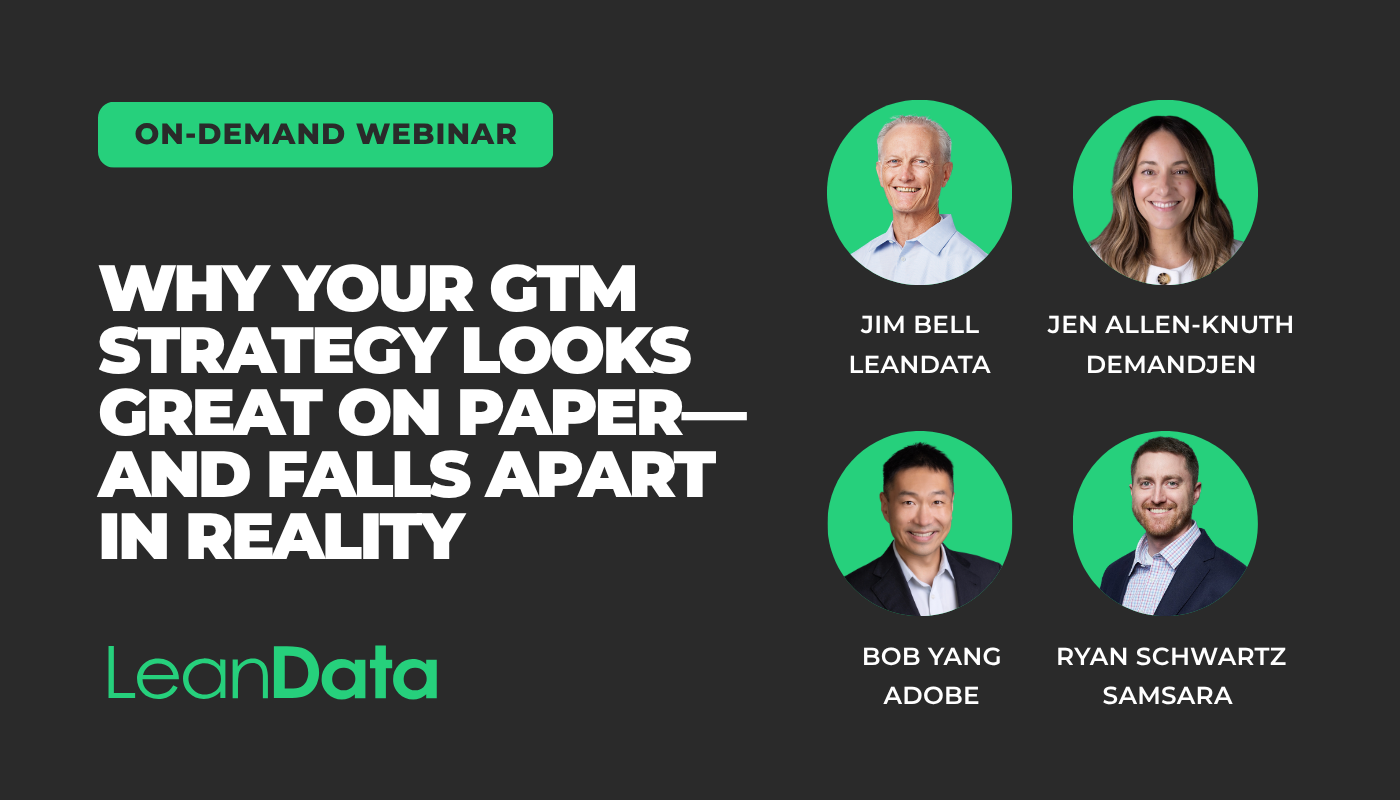
In this session, senior GTM leaders from Adobe, Samsara, and DemandJen join Jim Bell, CMO at LeanData, to unpack the findings and share what high-performing GTM teams are doing differently. The conversation goes beyond theory. These are practitioners who have navigated fragmented systems, siloed data, and complex buyer journeys firsthand.
And increasingly, AI is how they’re closing that gap.
What You Will Learn
- How Adobe deconstructed 200 end-to-end deals to build a fact-based view of their buyer journey and what they found
- How Samsara is centralizing data into a single lake so both people and AI agents can act on the same signals in real time
- Why not every lead deserves a demo follow up and how to classify intent before handing off to sales
- The four disciplines that separate GTM leaders from laggards: cross-team coordination, shared metrics, buyer journey alignment, and deliberate technology investment
- What thinking agentically actually means in practice and how teams are using it to move faster without adding complexity
What the HBR Research Report Revealed
The data from HBR Analytic Services is stark:
- 83% of GTM leaders say strategy is very important. Only 38% say it is very effective
- 92% agree GTM should align to the buyer journey. Only 29% say they understand that journey very well
- Only 32% say sales and marketing are truly aligned in executing their strategy
- 54% cite increased revenue as a direct benefit of improving GTM execution
- Leaders are 5x more likely than laggards to understand the buyer journey well
The gap between strategy and execution is not a new problem. However, AI is making it impossible to ignore and giving the teams that act on it a compounding advantage over those that do not.
Panelist AI GTM Use Cases
- Bob Yang, Adobe: Bob leads global go-to-market for Adobe’s AI platform and products. He shared how Adobe moved away from the traditional model where marketing owned top of funnel and sales owned progression. By aligning roles, enriching opportunity data with buying group signals, and sharing KPIs all the way down to compensation, Adobe shifted from an us-versus-them mentality to a how-do-we-work-together mentality across a global sales organization of 5,000 sellers.
- Ryan Schwartz, Samsara: Ryan is VP of Marketing Systems and Intelligence at Samsara. He shared how Samsara built centralized data pipelines that bring all key GTM metrics into a single data lake, making that data available to AI agents that can proactively surface insights, flag anomalies, and deliver recommendations in real time. He introduced the concept of thinking agentically: rapidly prototyping solutions with AI and training the entire marketing organization to build and work with agents.
- Jen Allen-Knuth, DemandJen: Jen is the founder of DemandJen where she trains sales teams to compete against buyer status quo. She made the case that not every GTM touchpoint should be optimized for immediate commercial conversion. Classify the intent of every campaign before deciding what follow up it deserves. She also highlighted call recording technology as one of the most powerful tools available for pattern recognition at scale, and argued that pairing internal data with third-party win/loss analysis is essential for understanding the truth behind why deals are won and lost.
Webinar Transcript
Jim Bell
00:21 – 11:00
I wanted to welcome everyone to why your DTM strategy looks great on paper and falls apart in reality. I’m, my name is Jim Bell.
I’m the chief marketing officer at LeanData. I’m super excited to be hosting our session today.
Today, we’re gonna be talking about a challenge that many go to market leaders, I think, quietly suspect, is an issue is that the go to market strategy is not actually the problem. In fact, most teams have been clear clear on their market, on their ICP, on their positioning more so than they’ve ever been, but strategy alone doesn’t drive growth.
Execution does. And so what we’re seeing is a widening execution gap, and that’s the what we wanna talk about today.
And it’s based on some research that we have done, in conjunction with, Harvard Business Review Analytics Services. So our agenda first, we’ll go through some housekeeping and then introduce our panel today, and then we’ll talk about the research findings.
And then we’ll spend the bulk of our time on that discussion around the key findings from the research about go to market execution. Alright.
So what I’d like to do next is, introduce our panel. I’m really excited about the group that we’ve got, for you here today.
So let’s bring them up. So first from Adobe, we have Bob Yang.
Bob currently leads the global go to market for Adobe’s AI platform and products that are transforming customer experience orchestration. Prior to that role, Bob led the sales strategy and operations, at Adobe as well as enablement, and he’s been supporting Adobe’s global enterprise sales organization for a number of years.
Jen Allen Youth is here with us as well. She is the founder of DemandJen, where she trains sales teams to compete against buyer status quo, and changing their behavior.
Jen spent eighteen years as a frontline seller at CEB, and was very involved with the Challenger sale, before becoming a chief evangelist for the Challenger framework and the head of their opportunity excuse me, head of, community growth for Lavender AI after that. Currently, she trains teams at companies like GE, IBM, Square, Walmart Marketplace, and Bloomberg, and she spends her free time rescuing dogs and being a stepmom to four kids.
And finally, we have Ryan Schwartz. Ryan is joining us from Samsara where he is the VP of marketing systems and intelligence.
Ryan is recognized as a thought leader in agentic and technical marketing, having managed advanced marketing and sales technology stacks for nearly twenty years. Ryan has a deep background in managing technical marketing and demand teams for enterprise organizations.
Private Samsara, Ryan has held leadership roles at Lacework, Nava, which is formed like TripActions, MongoDB, DocuSign It has been a part of, five successful exits since 2011 as an operator and advisor, two of which, were IPO. So super excited to have this group on board.
I’m gonna just leave it at the intros for now, and I’m gonna come back, and you guys are gonna carry the load on the conversation after I go through a little bit of the research. So thank you for bearing with me.
So let’s go to the to the report, that’s now available, and we’re happy to send you that at the end of this. So this was a Harvard Business Review, analytics services report.
Everyone on our panel participated in this, and were interviewed as subject matter experts. But beyond that, there were over 500 people who were surveyed all b to b professionals in sales and marketing.
You can kinda see the breakdown here of the types of, types and sizes of organizations and the types of roles that they held. I’m not gonna dwell on that part, because I do wanna move us towards the conversation.
But the big result coming out of the findings was this idea of a significant execution gap when it comes to go to market strategy and delivering on results. So as part of the survey, we we asked people how important is go to market strategy in your organization, and 83% said it was very important.
That was the highest rating on the scale. But only 38% said that their strategy was very effective.
So there’s clearly this big gap between importance and effectiveness when it comes to executing your go to market strategy. And of those who, who are seeing those gains and seeing that improvement, definitely started increased revenue as the largest benefit that they saw.
There were many others behind that. So let’s dig down a little bit more into the data.
As a part of the survey, the the group of people were sort of asked how effective they were, and then they were classified based on the score in that question of that question into the leader group, which were the ones who scored themselves the highest in their, go to market, execution. There Those that were sort of categorized as the followers, the ones who are sort of in the mid range in that in that question, given their rating.
And then the laggards, which was the group that were the least effective by their own measurement, of their effectiveness on go to market. So if we looked at and compare the leader group and the laggard group in particular, four key themes really came out of what’s the difference between those who are leading and those who were really falling behind over the laggard group.
The first was the leaders really prioritize cross team collaboration. So 81% of them, prioritize that collaboration versus 48% in the laggards group.
The second was that they really used the buyer journey as the organizing principle, around their go to market strategy. And so 53% of the leader group felt like they understood their buyer journey well.
Whereas, when you get down into the followers, it was 18%. When you got to the laggards, it was only 11%.
So you can see a clear correlation between the buyer journey and go to market effectiveness. The third was around aligning teams around shared metrics and goals.
63% of the leaders reported strong team alignment, and that bottom group of the laggards, it was just 11%. And finally, and not surprisingly, investing in technology and AI to scale execution was another key area of differentiation.
Although the gap wasn’t as large here, 71% of the leaders saw AI as important for go to market, whereas only 50% of the lighters, did in that case. So we’re gonna use this kind of framework and not entirely in this order to sort of talk about, sort of these key, insights from the report about why there is this gap in execution between the leaders and the laggards.
So I’m gonna sort of, skim through some of the data in here on each of those four, and then I’m gonna sort of open up these four topics into, for our panel to talk about. So first on prioritizing cross chain collaboration and coordination, 78% of the folks who are surveyed felt that their organization needs better coordination across GTM systems.
The ones who are in the leader group were defining common metrics to help align teams on shared strategy, and they were using things like cross team reviews of deal outcomes as a way of helping create better alignment and understanding of where things were. On the second topic, aligning teams around shared metrics and goals.
As the leaders were definitely much more likely to be, aligning on those goals specifically and sharing them across teams, they saw that shared metrics provided an execution infrastructure, so people will look at the same data and help create the linkages and the handoffs between teams. And the benefits of that collaboration included things like improved marketing ROI, better buyer targeting, and faster reactions to buyer signals.
The third was leveraging the buyer journey as that organizing principle. So 92%, of the survey respondents agreed that GTM strategy should very much align with the buyer journey.
But the buyer journey has changed dramatically, and that was clear clear from the data as well, that that idea of a linear sales funnel, a linear buying process just no longer reflects, how buyers discover and explore solutions today. Secondly, that a buyer journey better buyer journey understanding directly correlated with revenue growth outcomes, we saw from the survey.
And the leaders treated this idea of process around the buyer journey and aligning their teams as a continuous discipline, not a onetime initiative, to help them move forward. And finally, on the technologies and AI side, certainly, you know, 68 agreed that AI is important for their organization’s b to b go to market strategy.
By the way, this survey was completed towards the end of last year. I expect this number would be even higher today.
And we but we did get some interesting data on some of the top AI use cases around insights, optimizing campaigns, coaching sales reps, personalizing content on the marketing side, as well as insights around lead matching and routing being key tools. Again, having to do with handoffs, and getting the right data to create the right actions by go to market teams.
And finally, AI being used for mass personalization to help do the work that was often done by by humans. So I skimmed through this stuff quickly.
There’s a bunch of data in here. You’ll get the slides.
I’ve always been a big fan of stealing data from slides like this to use to help push forward my my different initiatives, but I really wanna move to, talking to our panel today. So let’s start with that first, key finding that we had, which is really around starting with the right foundation, which is sort of the people and the alignment and prioritizing cross team collaboration.
And maybe, Ryan, I’ll I’ll start with you. The report finds that only 32% of organizations say their sales and marketing teams are are very aligned, and that’s before you kind of factor in the pace of change that AI is introducing.
At Samsara, I’ve got a chance to see a little bit of your work, and it’s really impressive. You’re operating at the intersection of some pretty significant forces, agentic AI, compounding innovation cycle that need to move faster than ever.
How is that changing how you think about cross team collaboration?
Ryan Schwartz
11:00 – 13:33
Yeah. Thank you.
And hey, everyone. Yeah.
I would I would probably argue that there’s never been a time in our careers where, cross and collaboration is more important. If if there’s not, like, a close organizational value at the speed in which we’re moving, the speed in which we’re innovating, if you don’t have that, like, we won’t be able to get the most impact to our buyers and to our customers.
And there’s some complexities that are happening right now. If you look at with agentic compounding as you’re looking at being able to do more at once and moving at a faster pace and also in the state of perpetual learning, like, the rate of innovation is incredibly fast right now, and all of us are adapting to this new pace and, like, this new mental load of of perpetual learning.
The result of this is that teams are moving a lot faster. And so if if you’re not staying well aligned, all of a sudden, you could very quickly become disjointed and work in a different direction.
So there are a few things that we’ve started to do to try to solve this, but I will, like, admit, like, we are we are confident learning on how to improve this. I think all of us are.
There’s a few things. One is we’re starting to do much closer aligned road mapping, and we’re solving problems together.
So we will, as a go to market team, define what are the the key projects and, solutions that we need to go and and solve, and then create a cross functional group, a pod of people who are working on solving that problem. So we’re much more oriented in, kind of going across, you know, removing these barriers, move removing silos, and really functioning more as a tight unit.
And as a result of that, you’re seeing decentralization start to happen. We’re starting to see, well, like, hey.
Where these silos used to exist, AI and, the rate of in which we’re moving in. Like, we can actually decentralize some of this.
An example of that might be that, let’s say you used to maybe have a team, that did, like, all analysis, like, was done through this one team. Well, now you can make, all these data pipelines available through an MCP, and then you can have a data connector with a skill set to be able to start to do these insights for you.
Now you’re delivering, making everyone able to do analysis. So as a result of that, you can start to decentralize some of these, these core responsibilities.
And so that’s that’s kind of what we’ve started to do is we’ve we’ve basically started to become much more oriented on specific strategic goals, creating cross functional teams that are responsible for driving those outcomes, and, and kinda, like, decentralizing some of, like, the roles that, you know, that used to be kind of siloed before.
Jim Bell
13:33 – 14:14
Yeah. I think that makes a lot of sense.
So much of who we’ve operated over the years in the past is is in a very sort of functional, silent way. So I think a more goal oriented, setup makes a lot of sense, doing that cross functionally.
I know so one of the changes we’ve seen, is certainly sort of the move to buying groups. I know, Bob, that was something you kind of were quoted and mentioned in the in the report, and sort of that sort of creating this natural requirement, I guess, for synergy between, sales and marketing.
So curious how, you know, what’s how you’ve sort of been driving transformation in that collaboration between marketing and sales and maybe particularly what you’re doing around buying groups.
Bob Yang
14:14 – 16:00
Sure, Jim. And look, I mean, our breakthrough was that we we shifted from, you know, the traditional model where marketing created top of funnel and then sales drove progression and closed the sort of the linear demand gen that you said earlier.
And we we realigned the roles and responsibilities. We purposefully made it more collaborative so that even within pipeline progression, for example, where traditionally it was purely a sales responsibility, we, realigned it to the marketing and sales drove that hand in hand.
And so combination of buying groups, as well as, additional data and context within each opportunity by enriching that, we’re able to, use that to identify gaps, in coverage. For example, if you had, an engagement, from a particular persona buying group that was last lacking, it was both sales and marketing’s responsibility to try to get that person to, a tea dinner or an event or identify coverage.
And that teamwork and shared ownership really transformed, what was, you know, oftentimes a sort of us and them mentality to a how do we work together mentality. And, you know, through that, the the governance, and the data that comes up around gaps, pipeline engagement, you know, whether that’s AI surfaced or human surfaced, we had a shared, existing review process, whether it was the marketing, DemandJen review, or a progression review as well as, you know, an individual sales deal review.
We all looked at the same data, and understood how that data came about and what it meant and the different avenues across both teams that we had to address any issues.
Jim Bell
16:00 – 16:41
Yeah. Absolutely.
And and, to to do that kind of at the scale that you’re dealing with an ability, that is no small task, I imagine. Okay.
Jen, you you kinda mentioned in the report about sort of, I guess, a warning about, you know, without strong coordination across GTN teams and sort of a more education first approach. You do really risk sort of, sort of confusion, etcetera, across different channels while you’re trying to, you know, communicate with customers.
So you do work with a lot of different b to b organizations. I’m curious on, kind of if you could elaborate more on that importance of collaboration and channels about communication.
Jen Allen-Knuth
16:41 – 19:25
Sure. First, I have to give Bob two snaps.
If Adobe can do it at their scale, the rest of us can do it. I that is music to my ears to hear that that has been formalized.
So first, let me define education first. It’s not a new thing.
Right? So this is an example of an education first channel. Right? I am I imagine LeanData is looking to engage with customers here who might go on to become customers of their product.
But one of the biggest breakdowns, and this is something I lived and I see a lot of organizations fall into this trap, is the desire to make any individual thing we do in marketing turn into a commercial outcome immediately. And so what I mean by that, when I was at Challenger, I did a series around winning the Challenger sale.
And the whole concept there was, like, we can earn mind share by being innately helpful to our prospects before we ask something of them. So I would do a video, and it would be sorry.
I knew that was gonna this is what you get when you have four hogs in the house. I would do a video series, and it would be about how a challenger would run discovery.
I wasn’t pitching the challenger sales solution. I was rather just saying, here’s what good looks like.
Here’s how I got to it. Here’s what I got stuck with.
The problem becomes when you take a learning focused campaign, asset, engagement like that, and then toss it over to sales, and then sales sends the follow-up email of, would you like to see a demo of challenger? Right? So I imagine for many of us, if we sit through a webinar like this, which is inherently based on thought leadership, And then you get a demo on the other side saying, now do you want a a demo of lead lead data LeanData? It it’s gonna create friction in the experience. And so that, I think, is what when I see a lot of sales and marketing teams that end up kind of working against one another and both ultimately working against the buyer, it’s because there’s even a lack of classification of what is the intent of this.
Not every quote unquote lead deserves a hand raise or follow-up. I I would imagine there’s probably a really interesting conversation your reps could have out of this conversation, which is more focused on helping someone learn.
So at its core, like, one very tactical thing that we implemented that I I encourage other organizations to think through too is to sort of tag things like this. Is our goal to earn mind share, earn trust, learn, help buyers learn about the problems that we solve? Or is it to show them how we help? Both are okay, but both would necessitate very different follow-up experiences.
So I think a lot of times the friction comes to comes down to one side doesn’t know what the other is doing, and we’re all just trying to convert it into some sort of commercial thing that makes our dashboard green.
Jim Bell
19:25 – 20:15
Yeah. I think that’s a really great point that that even in that context of sort of selling that concept of people looking for a trusted adviser, right, and the partners they work with or salesperson, and then carry on a teaching conversation that there’s this bias towards, where we’ve got numbers to hit.
We gotta hit our metrics, and so I wanna move to a demo. I wanna move to something that allows me to advance you in, you know, in the CRM system to the next stage.
Cool. Thank you so much.
So that does kinda lead us into the the the metrics part. I know, Bob, you sort of described sort of getting far more sophisticated in terms of, asking, you know, certain level of high level questions.
But what what kind of key signals or KPIs is Adobe using now that sort of gets more at that, sort of signal based progression model, I think, that you call it that that you guys are on now?
Bob Yang
20:15 – 21:51
Yeah. You know, it was an interesting journey.
You know, the for for us, the the biggest challenge was deemphasizing the the traditional linear model where marketing created top of funnel pipe measured on AQLs, SQLs, and then, you know, we’ve measured sales on conversion rates and and bookings. Right? And so, I mean, we we call the AQS care model, you know, affectionately the gross tonnage model.
Right? You’re just, like, piling on as much as you possibly can and not, you know, worried so much about, okay, what happens at the other end? And so, you know, the the change I talked about earlier where we we shared an outcome, we drove to a shared outcome even during pipeline progression and close, worked itself all the way through to the KPRs. Right? We we marketing all of a sudden cared about sales conversion rates and actual late stage pipe.
And we all cared sales cared way more about account engagement, scores than they had done in the past, because we were focused on quality. And so those drove actual results where by aligning these KPIs with the changes we made in roles and responsibilities, we exactly knew what each metric we wanna focus on and how each side between marketing and sales, what role they could play.
And, you know, we actually propagated all that all the way down to compensation, right, which is near and dear to to everybody’s heart. And I think that end to end view of both roles, KPIs, as well as comp, is one of the things that drove the the success of of our model.
Jim Bell
21:51 – 22:09
Yeah. That makes a lot of sense.
Sounds very much sort of aligned there. Ryan, I I know you guys have been through a transition as well in terms of your, the metrics you look at and sort of how you’ve, sort of gone through an evolution for, how that shows up for the teams there.
Maybe you could share with us a little bit.
Ryan Schwartz
22:09 – 24:42
Yeah. Sure.
I think one thing that you often see is that there are a lot of different KPIs and different teams are managing different KPIs. It’s actually really difficult to see them all in one place to make a really good sense of, like, what’s what’s actually going on.
You might have a lens, that is top of funnel. You might have one that is, like, sales conversions.
You might have another one that a team is doing that is looking at production capacity and, do you have enough in ease and seed and what does that look like? And then you might have another one that’s looking at your in your transfer rates and opportunity conversion there and or and that way that you measure different segments needs to be different. Like, enterprise segment is gonna have much, much way different type of signals of the health of of the pipeline there versus that of our commercial and mid market segment.
So I think one complication that a lot of times happens is that all this data sits in different places. Some of it might be in a relatively centralized place, like in a database or, you know, a data lake of some sort.
Others might just be in spreadsheets, and so trying to, like, kill this knowledge in one place is really tricky. So one thing that we’ve, been, like, really focusing on is creating, data pipelines for all of these key metrics.
So we have cross functional groups between sales, finance, you know, marketing, etcetera, and we’re all agreeing on the primary KPIs that we really need to care about for the go to market business, and then making sure that we are aligned on those definitions. And then all of that data needs to sit in the data lake so we all know exactly where it’s at and how it’s structured.
And we build standardized dashboards and views on top of those. But the other main really, really cool benefit of this is that because they’re all in a centralized data lake, we can now make that data available to agents.
So now you can have, people who are, of course, you know, looking at this data and looking at the insights and things like that, but you can also be much more proactive. AI can also be doing this.
It can help do analysis if there’s something to troubleshoot or find an anomaly. It can help, provide ambient insights where it’s proactively telling the key stakeholders of something that it sees.
Now you can make this data available in an MCP layer where our cloud or other, you know, tools can use this information for individuals to do something with and do analysis or create decks from. You can have AI solve with propensity modeling and health scoring.
Like, there’s so much more you can do by putting it in a centralized data lake and then structuring in a way that, works with agents. And so now you have the people being more strategic, and you have that compounded effect with AI also being able to use it, to deliver, you know, insights back to the business.
Jim Bell
24:42 – 25:13
Yeah. It’s a good reminder of, you know, how much the sort of siloed version of the world as modeled by the linear, you know, buyer journey and the linear sales funnel has created these entire populations of technology stacks and datasets that have been that have been separate.
And, maybe, DemandJen, I’d love to hear from you. Kinda as you work with clients who are facing that problem, how do they sort of where do they start in kind of breaking down those silos, and how do they sort of get aligned around where to go?
Jen Allen-Knuth
25:13 – 28:11
Sure. I mean, I remember when I started as a sales rep twenty two years ago, I had this impression that every big enterprise, every executive had all this data, and everybody makes data grounded decisions.
And then I got into some of them. I was like, hold on.
A lot of it seems to be but off based off gut instinct. And so I think to me, one of the biggest breakdowns comes from we all bring a different set of belief statements and assumption statements about why we think and behave the way that we do.
And that’s true in our personal lives. It’s true in a boardroom.
It’s true in a corporate office. And I think often, one of the biggest misalignment areas comes from different groups, both, like, horizontally, meaning products, marketing, sales continued, but also from leader to top down about a very basic question, which is when we lose, why do we lose? And I think a lot of the decisions, a lot of what we choose to track when it comes to data comes down to a belief that we hold about why we lose.
So if I am on the sales side and I think that we lose because our price is too high, it’s going to cause me to point the finger elsewhere while maybe not actually acknowledging or understanding the problem itself. So maybe it’s not a pricing issue, maybe it’s an issue with the way that we are helping someone evaluate the cost of an action.
Right? So these things then cause each of these discrete groups to start tracking things that build their backed case of why they’re right and the rest of the room is wrong. And I think that was the dangerous thing that I started seeing happen a lot when I would look at these cross functional go to market teams is we’re all trying to make the case that it’s not us.
And so I think taking a very fundamental question such as when we lose, why we lose, one, it’s really important that we have a shared belief system around that as a team, and where there’s friction, we knock that out. But then two, I think that sort of sets the path of now what do we need to go and look at from a data driven perspective to understand the root cause of some of that.
So to be very specific, there was a a client I was working with who said, you know what? We don’t like any of marketing’s inbound leads because we can convert outbound call led leads faster. Or we can we can book more meetings via outbound by just cold calling, which is was random.
I don’t hear that a lot. But so we dug into it and sure enough, the numbers were bigger on that side.
But when you compared marketing’s inbound lead conversion versus the cold call originated conversion, it was night and day. It was something like a 40% difference.
And so I think if you go in with this inherent belief that this is better and what you’re doing is wrong, it doesn’t matter what process you set up with because every each group is going to be constantly pulling to why they’re right. So that’s why I come back to it.
I think sometimes a lot of this is just getting on the same page, getting out all the dirty laundry before we set up systems of what to track and how we’re tracking it and why we’re tracking it.
Jim Bell
28:11 – 29:05
Yeah. That makes absolute sense.
And I know that, you mentioned sort of the everybody sort of gathering the data based on, you know, kind of what they were trying to prove or their sort of point of view on the process. I’m curious.
I’m and I’ll go back to you, Jim, on the all people using the buyer journey, which is kind of our next topic and, as as the organizing principle around what to look for and, how do they bring in that sort of, I don’t know, qualitative component maybe with leveraging AI to sort of bring more data versus we all have these classic issues, right, where, I don’t know, you’re trying to look at who your competitors are and sales reps don’t fill in the fields. Right? And so you’re you’re you’re the largest set of the data is like NA, but are you using are are your clients using call recordings or other ways to sort of get more richness around how the buyer journey informs us?
Jen Allen-Knuth
29:05 – 31:23
Well, I wish more companies were doing what Bob and Ryan are and actually truly centering it in the buyer journey. I would say, like, we’ve been talking about buyer journeys for years.
We’re still probably not there yet. I hope every every year gets us a little closer.
I do think you bring up call recordings. I do think call recordings are one of the absolute best advancements to the sales profession, specifically because it allows us to pattern recognize in a way that would have just never been someone’s first priority because of how time consuming it is.
So I’m a business of one. Right? I don’t have the complexities that Bob and Ryan do in their business.
But even for me, if I do 12 calls in a week, by the end of the week, I’m not pattern recognizing everything else I did prior to the week. Like, I’m not thinking, wow, this same terminology around the way that this prospect decide to describe this problem has come up three times.
Because I’m in the weeds like most sellers are, doing the call, doing the follow-up, you know, following up with the other ones, doing my outbound. And so I think the unique opportunity that something like a call recording technology presents is it’s it’s allowing us to pattern recognize these broader themes at a much faster rate than we could have ever done before.
If I think about doing something like that, that would have been a once a year thing. And by the time the report came out from marketing or sales, it would be probably a little bit expired.
And so I think when we talk about the buyer journey, one, if it I mean, there’s some things that will always stay the same. But I think even looking at how buyers do research and how who buyers involved in a purchase, some of that is definitely changing.
And so if we can start to pick up on some of those patterns, you know, what percentage of our deals does the contact talk about bringing in IT at this stage? I think all that does is it makes us easier it makes it easier for us to, one, update our go to market strategy on a more regular cadence, but, two, give the frontline who is responsible for execution much clearer direction around what we need from them in order to execute on that strategy. So I think the whole report concept, right, is, like, you fill these things in a boardroom and then it gets to the front line and it falls apart.
I think some of this technology is making it easier to be more specific of what you’d like to see out of your sellers doing differently.
Jim Bell
31:23 – 31:42
Yeah. Absolutely.
I think that that it’s a really important point about the pace of being able to iterate and get that data and get insights from it. Bob, I know in the in the report, yeah, you kinda used the parable of the blind man and the elephant.
I know you guys have gone through a journey, around understanding the buyer journey. I would love to hear your perspective.
Bob Yang
31:42 – 33:48
Sure. And, you know, I think for us, the the the fundamental end to end fact base was what was transformative for us because everybody has a different anecdote.
Everybody has a different narrative. Some of those could be outliers and some, they could be the mainstream most common scenario, but you don’t know.
They’re all probably true, but it’s not the complete truth. Right? Because there’s very few roles in an organization that see the end to end buying journey, right, either through system fragmentation or incomplete data or whatever.
And so, you know, as Jim said earlier, it can cause finger pointing. Right? Why I’m right and you’re wrong.
And it’s not necessarily because they’re, you know, lying or wrong on purpose, but because in their context, their lens and fragment of the picture, that’s what their conclusion is, but it’s not looking at the complete picture. And so what we did was, you know, at the start, we we finally got tired of all the the the different narratives, not being able to figure out, okay, what is actually going on.
And so we just bit the bull and said, we’re gonna deconstruct 200 deals, end to end, two year buying cycle, and let’s just build the fact space. What do they download? Were they inbound versus outbound? What events did they go to? Who do they talk to? How do we engage with them? Right? And we we pull together, from individual fragments, a complete picture of the buying journey.
And that was a great foundation for us because you can’t actually you can’t argue with what happened. Right? These are facts, things that, you know, actually were locked in the systems, but pulled together for the first time.
And that was our breakthrough. And now we can do that much more easily with with the tool sets, with AI.
And I totally agree with Jen that it’s now more important than ever to keep these, views updated, because buying behavior is changing. The world is changing.
How customers wanna engage is changing. But, fundamentally, I do believe that the end to end view, is super important in making sure that, you actually are focused on what what what really needs to happen in the buying journey and how that might need to change.
Jim Bell
33:48 – 34:37
Yeah. It was a heard, that story in a bit more depth and and be able to see some of that is really impressive and just sort of the some cases, like, the size of the buying group and the, you know, the the assumptions or the lack of correlation of you know, I think there was a lack of correlation of what the initial sort of first touch was in terms of what they downloaded and then the actual solution that they bought, you know, was almost a zero correlation, which kinda leads me over to you, Ryan.
I know that, you guys have been working on this and you you sell a number of different products. Could you talk about how you segment and move kind of from more, let’s say, an account based approach to more of a buying group approach based on, you know, solution or segment or whatever? How do you handle that? Yeah.
Ryan Schwartz
34:37 – 34:59
Well, I will say I I, you know, I I I agree with Bob and Jen. I there’s never been a more important time to get all of the signal you can possibly get from conversational intelligence to to, intense signal intelligence.
Like, you need to mine as much as possible right now to really understand the state of that account and what that what you know, what that account is and the contacts in that account and what they’re actually interested in. So I guess.
Jim Bell
34:59 – 35:00
I have a couple.
Ryan Schwartz
35:00 – 36:48
of thoughts. One is, it is if you have not taken the time to really do a buy in group analysis, I’d it is essential.
Like, take the time to do it, go to the process. It is really important to understand what are the key contacts of these types of accounts, and that can be based off of industry and segment and and, you know, our company size, etcetera, the product mix.
Take your time. But the next thing to note is that buying journeys are really complicated and they can change a lot based off of the segment and the product and whether or not it’s first purchase or expansion or expansion or which, you know, which region that’s in.
There’s so many different complexities into it. So one thing that we have started to to do is now that we have all of this signal, like, you have the conversational intelligence, you have all of the signal, you can start to create, like, agents per account so that I’m monitoring the state of that account.
It’s looking for all of the activities and intense signals that this account has been demonstrating and so as to give recommendations back to the reps or back to marketing. And not only does it give recommendations, it gives personalizations.
It’ll help you, like, generate a a Gong sequence, for example, or, you know, a recommended place and things like that And to deliver the maximum amount of value to that account and also recommend the key contacts and, you know, what are they engaging and what are they interested in. So it helps us deliver better value to our prospects and our customers and to meet them where they’re at.
I think so I think there’s, like, buying journeys is one of those things that has a lot of science to it and also has the next level that that I AI unlocks, which is, like, that state of hyper personalization. Like, okay.
We have the science, and now we know the state of the account. Now we can really deliver what is really the best experience and the best, kind of messaging for that given customer or that prospect.
Jim Bell
36:48 – 37:24
Yeah. It really does feel like we’re actually getting close to that world of sort of mass personalization in a way that feels more credible, real, and, and authentic, I think, than than we’ve ever been certainly.
So that does kinda move us into the technology realm, which was the kind of the fourth pillar, of what separated the leaders and the laggards. So Bob has is I know your title has changed.
I think when we first met, you were sort of running sales ops and leading partnerships and a bunch of other things. But now you sort of got AI front and center of your title.
So how has your job changed?
Bob Yang
37:24 – 39:49
Yeah. You know, I’m more focused, now specifically on the AI transformation and both within Adobe and as I think about how our go to market organization has changed as well as, you know, what we’ve been doing with our customers.
The the key thing that I’ve come to realize, is that AI transformation at scale is hard. Right? And especially here at Adobe, we have a global sales org of 5,000 sellers.
And then, you know, everywhere in the press, you hear about stories of AI not delivering value, and that’s fairly commonplace. But, I mean, I I think the key skill point, is when you’re able to, you know, embed the AI into an existing business process, and that you’re not creating something new just for the sake of AI.
And that’s where I feel like a lot of things fall down because it’s much harder to drive adoption. You know, for us, the the the bar to get from, you know, just a pilot to let’s try to drive this thing at scale in the business is exactly that.
How easy is it to embed into an existing business process? As an example, you know, if we use we built an AI tool to identify risk within, our deals. And if you could embed that into an existing weekly deal review cadence, then the adoption’s fairly easy because the change isn’t that hard.
If you’re creating entirely new process, around how how to use AI, for example, to change a customer journey, then, you know, it’s much harder to do at scale. It’s easy to do within, you know, a team of 20.
It’s much harder to do, at scale with a team of 2,000. And so there, the bar for me is much higher in terms of the value and the return you have to get, to to to make it, worth the investment in terms of the enablement, the hand holding, the the tech stack changes.
And and so I think a lot of that well, I I appreciate the the LeanData, approach to AI around, you know, having a context layer that, is agnostic in orchestration and that and that’s also full cycle so that you can integrate AI signals and data feeds into an existing orchestration there where you don’t need to introduce necessarily new workflows or integration paths because that lowers the bar, the activation energy required to take a pilot, which it generally works to a certain extent and be able to scale it and deploy it globally, you know, across an entire sales organization.
Jim Bell
39:49 – 40:36
Yeah. That is that is absolutely what what we see, which is that, you know, that go to market process is mission critical for revenue.
That’s a lot of money being spent on marketing programs, on sellers, on everything else. And so finding an existing process where you can take a particular node, a particular role, a particular sub process, and leverage AI to make that much more efficient or to drive higher value and higher outcomes out of it, I think is exactly the way to do it where you sort of are able to isolate it and scale it without causing everybody to have to change their behavior or absorb a giant sort of change management project.
So totally agree. Ryan, would love to hear kind of your take on how, you’re using AI to, sort of scale, you know, more broadly across the teams.
Sure. Well,.
Ryan Schwartz
40:36 – 44:43
first of all, I’ll I’ll just share kind of, like, what my or my constant goal is for the team, and that is to kind of always be on the edge of what is possible. So that means, like, constantly innovating, constantly, like, trying new things, learning, being a constant state of expansive thinking.
It it also has this new implication, which means you have to not really have any emotional connection to the decisions and things that you made in the past. You have to just be open to be like, hey.
Tomorrow, a new way a new way might, be better. The new technology might be possible, and you might just have to disconnect from what you’ve done in the past and just, you know, try a new thing.
And so it is, that’s kinda the state I want our team to be in, and that’s the, you know, that’s the goal. There, so what what does that mean in in practice? I think we’re in this like, there’s probably never been a more fun time to be a technologist.
It’s just innovating so quickly. It’s so much crazy.
It’s a little bit on the terrifying side, but it’s a lot of fun. So you’re, now you have to make a lot of our decisions there.
Like, what do we wanna build? What do we wanna buy? How quickly can we, do we test our theory? And so it’s it’s kind of I call it thinking agentically. It’s a different way of of thinking of how to solve a problem.
And, for example, like, anybody can be able to build it now. So you can you we can rapidly prototype.
We have an idea for something. Great.
Let’s not, like, let’s not overly plan it or, like, beat on it seven times. Let’s just let’s go build a good spend a day, build it, get a 70% of the way there, and let’s decide if this if it has legs or not.
So, okay. Yeah.
This this could be something. I’ll maybe just go to three or four.
Let’s go build three or four different ways of solving this problem. Let’s test it out.
In in in a week, we might have just tested three different ways of solving a problem, have a pretty good idea of which one’s going to work. Now we can go and take it to production.
And so now how do you know which technologies to use and what you wanna build and stuff? This actually becomes really tricky. At the end of the day, like, I want to be working with technology partners that I feel are helping us, innovate, helping us push push forward.
I want I I don’t wanna be dragging anything wrong with me. Right? So the, so it is it is like, there’s things we can build and, like so that’s the kind of what I look for as a technology partner is just also being very honest with them.
Like, hey. Like, this is just some of the challenges we’re having.
This is where we’re trying to go. Can you help us fit there or not? What are you seeing in the market? Like, what ideas do you have? So at the end of the day, like, I think how we are doing this is we have a team of, AI engineers that are rapidly building and prototyping, but we’ve also trained, or we’ve been we’ve been training, I should say, like, pretty much all marketing in a broader a broader organization of how to how to build agents, how to work with agents, how to, how to, like, start thinking agentically.
So that way, it can become ubiquitous in, you know, in the organization over time. So, yes, you have a team of expert builders that is, like, the primary focus of what they do, but everyone has also been trained to a degree of how to do it.
And that way, they can unlock themselves. And like I said earlier about decentralization, I think that’s really important.
And that is also how you rate kind of you know, you reach the stage of our compounding effect. So it’s, it is it is it is that is kind of how we’re doing it.
It’s like we are rapidly prototyping. We are training everyone how to be builders.
It does introduce a new need. This is a brand new need, I think, is, an AI ops and agentic operations team who is gonna be responsible for managing all of these agents and monitoring their health and severability, evaluation, validation, all of that.
So we are starting to build that type of team. But, the shift the shift that we are seeing is that everyone can be builders.
We can get to rapid prototypes really quickly. We can find this really healthy mix between new technologies that we’re evaluating and and and partnering with and ones that we are building to really deliver the best experience, for our internal team members and and also for our buyers.
Jim Bell
44:43 – 45:35
Yeah. Absolutely.
It it is sort of changing, I think, not just how we think about our business and how we act, but but how we get organized around kind of this new world, right, where you’ve got builders, which raises the importance of people like architectures and architects and, sort of people who are covering design, brand, all the other things that, when you make everybody a builder, there are risks that they kinda can go off the rails there. So the the guardrails, visibility, all that becomes very important.
Alright. We’re we’re down to just a few more minutes left here.
So I think, Jen Allen-Knuth, I’ll I’ll hand it to you and see if any any other comments on that. And then, after that, maybe just sort of like where what’s your advice for people who are sort of looking at this data, who wanna improve? What’s your recommendation for a good first step to to get more effective in their go to market execution?
Jen Allen-Knuth
45:35 – 46:48
Sure. I won’t add a thing to what Bob and Ryan shared because those are beautiful answers that I’m not gonna tap.
I will say, if you are gonna take a single next step, it’s kind of a curve from where we were at. I would say before we build anything is go out, seek to understand the customer’s perspective through some sort sort of third party win loss analysis.
I just did a study looking at enterprise and mid market buyers, and one of the things that came out of it was that 65% of mid market and enterprise buyers said, we are not honest with our vendors around why we churn and why we don’t buy. And so call recordings and all of this data that we’re sitting on is fabulous for one side of the equation.
But I think we often we also have to think about what is the ultimate source of truth that we really wanna be buyer centric, if we really wanna build a go to market strategy around our buyer, we also have to make sure we’re getting to the truth of that buyer. So I would say pair all of that greater that was now much easier to get our hands on with some sort of external data that helps us really truly understand what’s behind churn, you know, lost deals, things like that.
Jim Bell
46:48 – 46:57
Yeah. Thank you.
Bob, how about you? What’s a what’s a good next step for people?
Bob Yang
46:57 – 47:31
I think the to echo what Ryan said, I think a lot of it is get started. Right? Understand what the technology can do.
Just as importantly, understand what what it can’t do, because they we’re in turbulent times and, you know, limitations go away after a few months. Right? But if you don’t don’t lose sight of the North Star where you’re trying to get to and any incremental step, towards there adds business value, then a lot of it is that experimentation, and and getting started.
Jim Bell
47:31 – 47:35
Yeah. Absolutely.
Ryan, how about you?
Ryan Schwartz
47:35 – 49:23
Yeah. Agreed.
I think I think one thing, I guess, I’ll add to that is that, I think sometimes you start to try to use ad hoc for doing certain little pieces of things or you start to almost think too big. You know, I I could build an agent to do all of this, but they’re missing the middle ground here, which is, like, cloud calls, like, co work, but I really like this idea of it.
It’s like it’s like, no. Like, any project you go start to do, just start to work on it with AI, and you can you can brainstorm together.
You can come up with solutions together. You can build a deck together.
You can, like, write a draft together. You can, like, build a product or an app that helps create a better way of telling a data story.
Like, there’s so many things you can do when you just get in the habit of working on on it together. And it’s also, it’s also a really easy place to start because you don’t have to worry about learning too much yet.
You don’t have to, you know you know, try to implement a really complex problem on all the potential integrations you have to have and, like, all the other teams you might have to work with. I think it’s just something you can just you can just do and work on it with and just, like so I guess that’s that’s what I’d probably say.
And as, the the thing I’d add on top of that is, then, yeah, then start thinking about, like, oh, what what does my day look like? What what what are our teams doing all the time? What what can we what work we set to plug in agents or things to unlock, to allow our people to to be driving growth and strategy and letting the them, be compounded using AI to drive agility and efficiency. Because that’s where I think the line is.
You need people to drive growth and strategy, and we need AI to help unlock agility and efficiency. So I think you you can you can mature to that, but I think in one amazing, like, use case is just immediately start co working work with it and just, like, just bring it into the way that you function.
Jim Bell
49:23 – 50:11
Yeah. I think that’s a great point in it.
But, tying those together, I think I really get a sense for, people need to begin building these skills. We don’t know exactly where it’s all gonna come out, but they need to be adept and understanding how to do it and sort of and working with it.
So, I wanna thank all of you so much. I wanna let everyone know on the webinar here that you can get access to the full report.
We’re happy to send you that. You can look at all the data in more detail.
But I but, I mean, we wanna thank our panel today. This is just some fantastic examples, and thank you so much for spending the time with us.
Thank all of you for tuning in. We really appreciate it.
We’re happy to help you on this journey at LeanData. This is what we do.
We focus on go to market execution, and so, happy to continue the conversation with you on that front as well. Thank you all very much.