













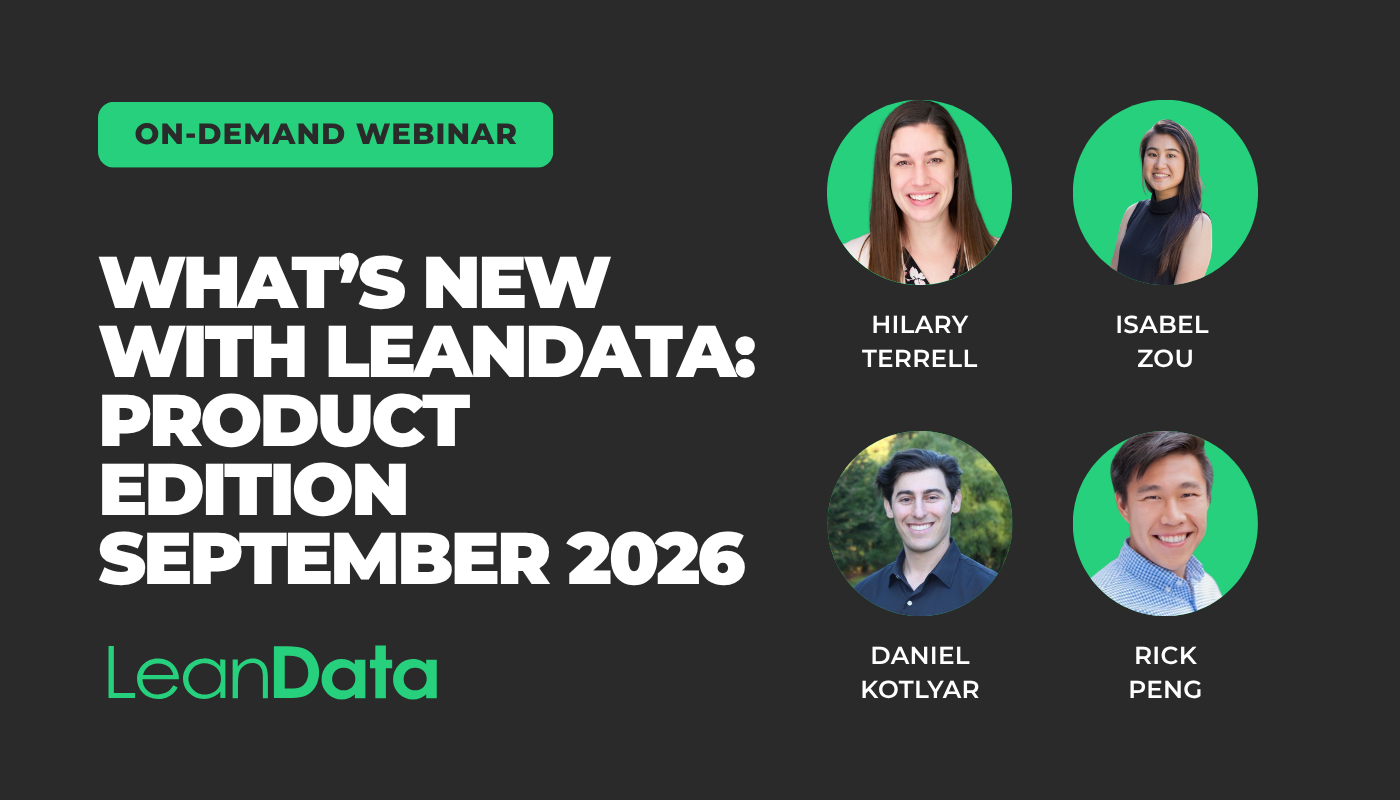
AI is reshaping go-to-market – but AI without the right foundation doesn’t work. LeanData 9.x marks a shift from automating GTM to powering its AI transformation with purpose-built AI that Ops can embed directly into the flows they already run, and the connected infrastructure every human and AI agent relies on to route, schedule, and act.
Learn how LeanData is delivering on these priorities, including:
- LeanData AI Assistant for conversational, plain-English building and troubleshooting of routing flows right inside FlowBuilder.
- AI Inference Node, which embeds LLM reasoning into routing to classify, extract, and summarize unstructured data – then route on the result, all governed and auditable.
- BookIt MCP, which lets AI agents like Claude and ChatGPT book and manage meetings through your role-scoped, governed routing.
- BookIt for Tradeshows, which makes scheduling event-aware so every in-person meeting is booked, tracked, and attributed.
- Outreach and Salesloft integrations, bringing BookIt Handoff and Invite directly into your reps’ sales engagement tools – no context-switching, with routing accuracy and attribution intact.
- LeanData Journeys, which unifies buying group signals across a deal so sellers always know which stakeholder to engage next and how.
Whether you are new to LeanData or already running mission-critical revenue operations on it, you will leave with a clear picture of how to put 9.x to work for your team.
What is the LeanData AI Assistant for Admins?
What are some ways I might use the LeanData AI Assistant
What can the AI Inference Node do?
Does BookIt support in-person events like trade shows?
Session Transcript
Hilary Terrell
Alright. Welcome, everyone, to our what’s new with LeanData product webinar.
It is q 03/2026. That means it is our nine dot x, webinar to tell you about all of the amazing things that have just rolled out.
So before we get started a few housekeeping items to make sure you’re aware of. If you have a question there should be a box on the right hand side of, your chat experience.
We are here. We’ll be monitoring the questions as we go, so feel free to put anything in there and anything we don’t get to, we’ll make sure to follow-up afterwards.
And, yes, a recording will be available after the webinar as well. It’s always on our our resources page on LeanData.
com. We will be talking about capabilities that just released in the product, but just in case we do touch on any coming sooner roadmap items as always, those are for informational purposes and details, timelines, features are subject to change.
Here’s who you get to spend your time with today. Thank you again for joining us.
I’m Hilary. I lead our product marketing team here at LeanData and I am joined by my counterparts on the product side who will be, walking through all the innovation that came in our latest release.
So Isabel, Rick, Daniel, excited to bring them on here soon. Before we get into the actual capabilities, I thought we would start with where are we today in terms of go to market.
This is a quote that was taken from a customer survey that we ran just recently, but I think it’s reflective of what we’re hearing broadly in the marketplace and from our own customers. AI agents have increased both speed and complexity of go to market operations, we have more powerful automation, but we’re more dependent on clean data, clear ownership, documented processes.
And I think this is really grounding why our road map looks the way it does. We wanna make sure you have what you need to really thrive and bring AI into your go to market motion.
And so we see this as an important transition for lead data. We talk about go to market orchestration, that is our core and we’re really moving to this era of helping our customers to power their AI transformation in terms of how AI shows up in their go to market motion.
So a lot of the things that you’re going to see here are really intended to help you accelerate, bringing AI into into go to market. So there have been a lot of innovation from LeanData on the AI front over the last couple of releases if you’ve joined us.
So we’ve released the AI graph summary comparison, the original version of the AI inference node, first version of the AI assistant for admins, agentic scheduling, BookITMCP, our integration with AI SDRs. So many things to be excited about and the momentum continues with nine x.
We’ll be hitting on all the things you see here and more. Again, grounded in that need for a foundation of data, process, and context across the customer journey.
So it’s a pack release and the way we’ve organized, the this walkthrough is thematically in terms of how these capabilities can show up in your organization. The first is AI capabilities that are intentionally built for ops, no meeting left behind, no surprises, our scheduling capabilities where your AI GTM stack comes together and some great, integrations that are part of this release and then turning journey insights into pipeline.
So getting into our first theme of AI that works for ops. And the first capability we’ll be talking about is our LeanData AI assistant for admins.
And what are we seeing in terms of what, what really led to us prioritizing this as as a capability? We heard from our customers, we wanna be able to use AI more effectively in our good market motion, but how, bringing that to life is is difficult. And so what we were hearing from our customers is they wanna be able to offload more of those tasks, to AI beyond a human, but keeping a human in the loop.
But we need a way to do that efficiently, and LeanData has provided that with this new capability of the AI assistant. So I’m gonna pass over to our first product speaker, Isabel, to walk through what’s, available now with our LeanData AI assistant for admins.
Isabel Zou
Alright. Thanks, Hilary, for that for that intro.
Yeah. So with this release, we are bringing our LeanData AI assistant, to the Flow Builder, surface.
Before, what you were in order to make some kind of update to a graph, you really need to have some kind of understanding of the graph itself. What that meant was that you would have to go into specific nodes, click into them to just even get a baseline understanding of what that whole graph does.
Not only that, if you wanted to then make an update, you would actually have to have a quite a big level of expertise in terms of, like, what nodes you might be able to add, how to actually translate your business rules into those specific nodes, and confidently place it in the right place within your flow, so that it does kind of respect the processes that you already had in place. This could be pretty time time state take a lot of time here.
And, normally, like, you would have to have already some familiarity with some graphs. Now with me moving that AI assistant to the Flow Builder surface, you can actually use that assistant, as a chat to help you understand certain parts of your graph.
Maybe it’s the whole graph in general, as well as just get an understanding of, like, what you could potentially do with these graphs, like new use cases that you might like to add. You can insert your business rules and get some guided configuration, help for how to actually change those business rules into something, that you could deploy on your graph, and even explore, like, new potential opportunities here.
So like I mentioned, we do have this new chat UI, so you can ask these questions. It does actually have awareness of your graph.
So it’s not gonna give you kind of, like, these, these general answers. The answers will be grounded in the truth of, like, what you already have in your graph as well as any routing logs that you had that had run through that graph before.
No. That was a bit of a mouthful.
I think it’s best shown, with a demo. So I’m gonna play a demo to see, show you just how it’s actually done.
Alright. So what you just saw, was a demo of that end to end flow, for the assistant.
You saw how it kinda moved from audit logs. You were trying to troubleshoot a certain log, went into that graph itself to help under understand the context of the graph, and then make an update to your graph, all within that one flow.
Now before you imagine, that might actually take a whole day potentially of just analyzing the log and trying to get a grounded understanding of the graph and then feeling like you understood where to make that update. Now you can kind of see that facilitated through through, like, one quick conversation with your assistant.
So we think this is gonna help save a lot of your time. Beyond this, the use cases are pretty endless here too.
You can think about it as, like, maybe you are a new admin and you’re inheriting a graph. That could be a way for you to just get that baseline understanding of the graph and feel more confident about making updates.
Or maybe you are just an existing admin, been using lean data for a long time, and your graph has just grown so massively. This is another place to help you kind of navigate throughout that graph.
You can see the way it the system actually works with the graph and transitions, and highlights certain parts of the graph. So I think this will be really powerful, for all admins, whether you are one with a deep level experience or not.
Hilary Terrell
Amazing. Thank you, Isabel.
I think, hands down, this is one of the coolest things that we have released in some time. When we first showed it internally as as a preview, there were literal cheers, in the audience.
So super excited to get this into the hands of our customers. Thank you.
Thank you. Alright.
Moving into our, next AI star in the show is, the evolution of our AI inference node, which hopefully some of you have begun to engage with. What we are hearing from our customers is that they wanted to make the most use of their go to market data, make it as usable as possible, but there were challenges in getting access to that and getting access to that in a graph and a lot of those really really rich signals were trapped in a place where maybe a routing graph or automation couldn’t read them.
So with the AI inference note and here’s a great quote from a customer who spoke on one of our, one of our webinars recently, this has allowed them to reduce the manual work, in working through incoming incoming leads, reviewing cases, assigning them out, and so excited to bring our product manager Rick to the stage to tell us a bit more about the latest of our AI inference node.
Rick Peng
Thanks for the intro, Hilary. Really excited to, talk to you all about what we’ve added in nine x to the Inference node.
So Inference node came out in eight x, as part of our beta, and we’ve really taken feedback from our customers, and their use cases to see how we can improve, adding AI inferences to our graphs. Now as you’ve mentioned, historically, our graphs have been deterministic.
Admins can see exactly, what goes in and what comes out, and those are built off of rules. Right? And, what’s good there is you know exactly what happens.
You can investigate, and you can find, you know, how the router made that decision. The one thing you don’t have and where these graphs break, is when you’re dealing with, messy data.
And so we’ve seen a lot of our, folks using AI nodes to to supplement that, and that’s where you get the flexibility now in in lean data orchestration graphs. What’s due in nine x is we’ve built on top of that.
So we’ve seen, some of our customers try to enrich, missing form fields or clean up data, with things like company headcounts. Those numbers fluctuate, And so we’ve brought in, web search capabilities so you can have up to date information, to your AI node.
If we go down to some of the use cases, I know a lot of folks are saying, hey. These inference nodes give me, you know, the power of AI, but what does that even mean? There’s just so many places to start.
I think of it as there’s a lot of quick things you can really do, to save a lot of folks’ time. And what we’ve seen and what we do here at LeanData is, you know, if you’ve got multiple products, sometimes you wanna route to the right, person, the right individual, but folks don’t mention the exact product name.
Right? So in the past, when you would had to build out an entire word cloud of, you know, here are the 15 different ways someone might mention, this particular product. You can just use a, inference node to really whittle it down.
So you can really clean up that messy data. You can do the same thing with titles.
We’ve seen, you know, the same role at multiple companies might have a have a different name. Instead of building out strict rules of, you know, if this, then go here, you can say, hey.
Look for, you know, a a rev ops role or a head of sales role. Right? And then direct it to this, this pool here.
We’ve also seen a lot of enrichment. You know? Sometimes you wanna just categorize on that.
You wanna check, you know, how someone has written something, and you also wanna look at your past data. So a lot of times, you might have a lot of rich data in your prior accounts, in your prior interactions.
You might wanna take that and, power your rep with a quick summary so they can keep up with, what’s going on, and they have the right context when they engage with a lead, for example. And and what you can do with an inference note here is you can take a lot of that data, bring it down to what you think are the key points, for someone who is moving fast, and might not have time to sift through piles of of call notes.
So all great things you can do. And I know this example here also gives you the ability to add a confidence.
Right? We know that AI, can make mistakes. And what you can do here is you can say, right, automate the the happy paths, the, the things we know exactly.
As a person. You can, you know, glance in five seconds, make a decision, and then take those really more complicated scenarios, maybe those gray areas, and still route to someone for review.
And and that’s something that you can do with these inference nodes.
Hilary Terrell
Amazing. Incredibly powerful.
It’s like a a Swiss army knife that you can put, right in your in your graph with AI. So amazing.
Thank you. Thank you, Rick.
Alright. We’re going to get into our next theme of the nine x release, and we are calling it no meeting left behind.
What were we hearing from our our customers? They wanted to make sure every meeting was booked accurately. No surprise.
But we were hearing from a lot of customers, I also wanna do this at trade shows. I wanna do this on the event floor.
And if you’ve ever tried to manage an event or been a person at the event, that’s actually managed in this disparate flow typically from what we saw. A rep might have their entire calendar blocked off because they’re at an event, and then if someone goes to book, that person looks like they’re they’re not available.
And so that’s what we’ve really thought about, with this new capability of BookIt for trade shows. So I’m very excited to bring on our scheduling product manager, Daniel, to talk about some of these great new, innovations that we’re bringing to our BookIt products.
Daniel Kotlyar
Awesome. Thank you, Hilary.
Yeah. Very excited to talk about booking for trade shows, one of our most requested and most anticipated, features we’ve had at LeanData scheduling.
So the idea here is to bring our scheduling capabilities available in BookIt to in person events. And this is something that a lot of our customers had already been doing with BookIt, but it had some restrictions because rooms had to be represented as users.
And what BookIt for trade shows does very simply is let rooms, be an entity that we manage. So they don’t need a BookIt license.
They don’t need a Salesforce license. They’re just an entity that has a calendar that can be booked.
You can set capacity so that you ensure we’re booking the right rooms, and then you can use get For forms and book a handoff to schedule meetings that happen with those rooms. But in addition, you can set up a roster where you tell us who is gonna be attending a trade show.
And that just touching on what you previously mentioned, Hilary, we’re able to put a calendar block on those roster members’ calendars so that, everyone external to book it knows that this user’s at the trade show. But more importantly, it allows us to book over that time that’s been blocked off for that trade show.
So we’re aware that that’s a trade show block. So, yeah, quite awesome.
Really just gives the brings the power of BookIt, to scheduling in person.
Hilary Terrell
Amazing. We’re excited to use it at our own events in.
the coming weeks as well.
Daniel Kotlyar
Awesome.
Hilary Terrell
Alright.
Daniel Kotlyar
Cool. Next step.
Hilary Terrell
up your,.
Daniel Kotlyar
go ahead.
Hilary Terrell
event tracking.
Daniel Kotlyar
Yeah. So calendar event tracking, what this allows, BookIt to do is see what’s happened on calendar events and then sync that back to the BookIt logs.
So in the past, if actions were taken on calendar events such as moving the calendar event or deleting the calendar event, those didn’t show up as a reschedule or a cancellation, but now they do. So we’re not reliant on reps using the reschedule link or the cancellation link.
We actually detect what’s happened on the calendar event and then accurately reflect that on the meeting log itself. And that’s really important for data accuracy.
Often, our customers wanna know how many meetings were canceled, how many meetings were rescheduled. And so now since we can attribute, the cancellations and reschedules done on the calendar event, that data is much more accurate.
Part two to this is now we’re doing RSVP tracking as well. So for your attendees, both hosts and guests, we know if they’ve accepted the calendar event or declined, if they haven’t responded.
And you can run automations off of that because we allow you to write that RSVP status to the Salesforce event. So, for example, a use case we’ve heard is, at the beginning of a week, an SDR manager would run a Salesforce report and see, any meetings where the prospect has not accepted.
And they send that report out to their reps, and that prompts the reps to reach out to those prospects to confirm that they’re coming to the meeting that week. So it’s all around this project, all around, creating a two way sync between BookIt’s logs and the calendar event ensuring that, you know, they’re one to one and everything is aligned.
Hilary Terrell
Awesome. Thank you, Daniel.
We’ll see you back in a bit.
Daniel Kotlyar
Yeah.
Hilary Terrell
Next up, is our theme around where your AI go to market stack comes together. You probably have dozens, if not hundreds of tools across your go to market tech stack.
And we’re really thinking about the ways in which the data can be that connective tissue across the customer life cycle and create that consistency. This is a a quote, we got from a customer just over the last couple of weeks, and I thought it was kind of worth teeing up this section.
As companies keep adding AI tools, what I don’t have to question is whether whether they will work with what’s underneath. LeanData has become the one stop shop the rest of the stack connects through and we’re seeing that as kind of that central nervous system for a lot of our of our customers and these integrations are a big part of that.
So the first one I’m excited to talk about is a new integration with Dun and Bradstreet d and b, and I’ll bring Isabel back to the stage to talk about this one.
Isabel Zou
Alright. Thanks, Hilary.
So for this release, we have partnered with Duns and Bradstreet to bring, our account, account hierarchy, white space discovery functionality, together with Duns and Bradstreet enrichment. So now that can be powered by DNB, for all you that might already have a DNB license.
And just to go back a bit, what is white space discovery? Now white space discovery refers to, helping identify any accounts that, are part of an account hierarchy, a known hierarchy out there, but is not actually in your CRM. Now that’s often a gap because you might be planning for certain accounts, just based off of the accounts purely within, what’s already in your CRM.
And it causes you to miss some potential opportunities that were simply just not accounted for because that data and those accounts and those account families were not already in your system. So with this integration, you can now use, you can now use Duns and Bradstreet, to enrich your hierarchies to kind of identify where those missing accounts are.
Then by seeing those missing accounts, you can pick and choose whether or not you’d actually like to add it to your CRM and use it, when it comes to any of your territory planning or quarter to quarterly planning. So this is really powerful in that sense.
It helps bring in and enrich that underlying data, that you actually want to operationalize off of.
Hilary Terrell
Awesome. Thank you, Isabel.
Next up are newest integrations, with Outreach and SalesLoft, our sales engagement platforms, and I will bring Daniel back to the stage.
Daniel Kotlyar
Good to be back, Hilary. So we’ll be talking, yeah, about BookIt integrations with Outreach and SalesLoft.
So we have a lot of reps who work out of Outreach and SalesLoft, our customers’ reps. And the main thing is they don’t wanna be switching over to Salesforce to launch BookIt hand off off of a lead or contact.
And so now they can actually do that just directly from where they spend their day. In Outreach, that exists as a separate tab.
And SalesLoft, it’s launched from the smart person panel. And all an admin has to do to enable this for all of their reps is install the official integration from the outreach or SalesLoft marketplace, and that’ll make, hand off and book an invite, available for all of their reps.
And so the reps simply just log in through OAuth, Salesforce OAuth, and then they’ll have access to, yeah, everything that they’d have as if they had launched it from the, their Salesforce instance. Booking invite, that actually lives within the email composer.
So just as a reminder, what Booking invite allows you to do is select times on a calendar and then insert those suggested times into the email, so that prospects can just select the time that works for them, maybe, like, two to, you know, 02:30PM, and then book the time that way. So, yeah, it’s really just around saving, reps’ time, making things more efficient, less context switching.
Yeah, just making Vocat work for them where they, spend their day.
Hilary Terrell
Amazing. And if you spend your day, leveraging MCTs, this is an exciting update as well.
Daniel Kotlyar
Absolutely. So we’re continuing to push the envelope with Book of MCP.
V one came out in our last release. This is v two.
V one was more around, retrieving meeting logs, some booker for form scheduling, previewing availability, just the first primary actions we thought admins and reps would need. Now v two, while we’re releasing this release goes much further.
So now what you can do is a lot of user management. You can invite users to book it.
You can, deauthorize them. You can remove them from pools.
You can do everything that’s available on that user’s page, but now via MCP. So if admins find themselves logging into the app to invite users to book it, you don’t have to do that anymore.
You could just do it through MCP. Now one really awesome thing we added in MCP view to here is the ability to add and remove users from pools.
And, that’s really important because oftentimes when you have new reps, you need to log into the app and take all these manual actions. Now you don’t have to do that.
You could build automations or do it, just through Claude or, the chat g p t, whatever you’re using, any LLM client. So that’s really neat.
We’ve also improved meeting reassignment. So now you can reassign a meeting to, any user or any pool member at any time.
So there’s parity now with meeting reassignment between what you can do via MCP and, via the UI. And then, also, we’ve added the ability to book meetings through routing links.
So if you already have a routing link that’s configured, with all of the fields that you’d like to request, you can just specify that routing link and book via MCP. So it’s a it’s a little bit more of a contained experience there as opposed to just a book of her forms scheduling, the MCP.
So, yeah, the idea here is just improving MCP, bringing more and more functionality to LLM clients or agents so that you’re able to operate, book it fully independent of the UI.
Hilary Terrell
Amazing. Thank you, Daniel.
Daniel Kotlyar
Yeah.
Hilary Terrell
Moving into our final theme, turning journey insights into pipeline. And for that, we’re gonna talk about LeanData journeys.
If you have heard of the LeanData product called buying groups, I would love for you to type in the chat just to get a sense of how many of you are familiar, with buying groups. Would love to to better understand who’s in the audience there.
That is awesome. Well, it’s back and better than ever.
Never went anywhere, but we’ve been spending the last, six to nine months really honing, how customers are are using it and where that product is going next and we’re excited as part of 9x to relaunch, buying groups as LeanData journeys. What were we hearing from our customers? We are hearing loud and clear that people wanted to effectively multi thread across all the people who are engaged in a buying group whether it’s someone who is a champion, maybe a financial decision maker, an economic decision maker, but it’s difficult to tell who is engaged, what should I do next, what part of the the sales cycle were they’re involved in, and have a single pane of glass to see all these different stakeholders and activities and that’s really the way in which, buying groups has evolved into journeys.
You don’t have to have a quote unquote buying group motion, you can now see on on any account or opportunity all the different stakeholders. So linked data journeys allows you to really get, every signal every customer signal across the buying group to get all of your teams aligned.
So think about an SDR and the folks that they’re engaging with, an AE and the folks that they’re engaging with, and having a single view to best understand who’s engaged at what part of the journey. So with this new version of journeys and more and more capabilities will be coming out in future launches, you’ll be able to prioritize accounts and see exactly how a deal is progressing.
It could be pre opportunity, could be in the opportunity stage, you could chat with the journey’s assistant and understand what stakeholders am I missing, help me understand what I should do next, or craft an email, to a stakeholder. So get instant answers about what’s happening within this journey and potential next steps.
So this is a bit of a teaser, we’ve got a handful of additional webinars coming up, about journeys but really excited, to get this into the hands of more and more customers. So with that, we would love to engage with you at these upcoming events.
We will be with the masses, at Dreamforce in a couple of weeks in San Francisco. Our next expert hour for those of you who are certified LeanData admins, we will be diving into, buying groups, from the contact roles.
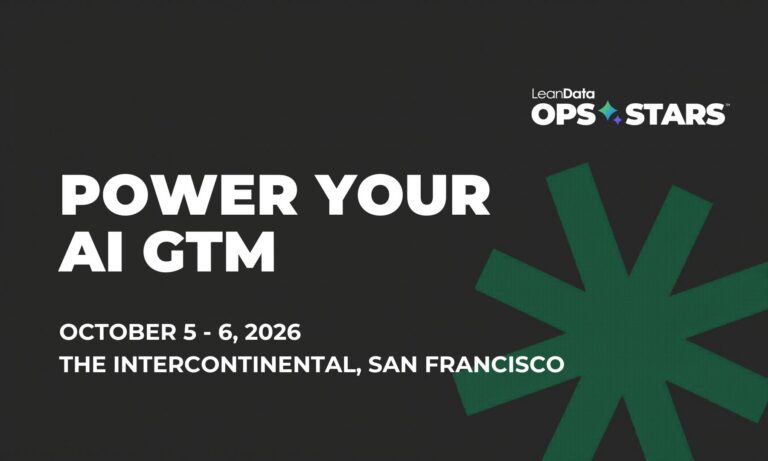
So this purpose built journeys capability and so going into that in more depth, we have an additional journey session that will be coming after OPSTARS. And finally, our marquee event of the year is our user conference, OpSTARS, taking place October fifth and sixth in San Francisco.
We would love to see you all there. We are really taking, a different approach to the event this year.
We have decoupled it from Dreamforce to really make sure we have all of you all of these rev ops, folks in the room together and learning with one another in a focused dedicated day and a half of learning. So we’ve got a full day of keynotes and content and demos and hands on workshops and partner sponsors as well so scan the QR code or check out the website, we would love to see you there and continue the conversations.
We’ll be demoing all the capabilities that we just talked about throughout this time today. So with that I want to thank everyone.
We’ll continue to stay on because I still see a couple of questions in the chat but for those who want to hop thank you so much for joining us, and hope you start to explore all of the goodness, in our latest release. Thanks everyone.