














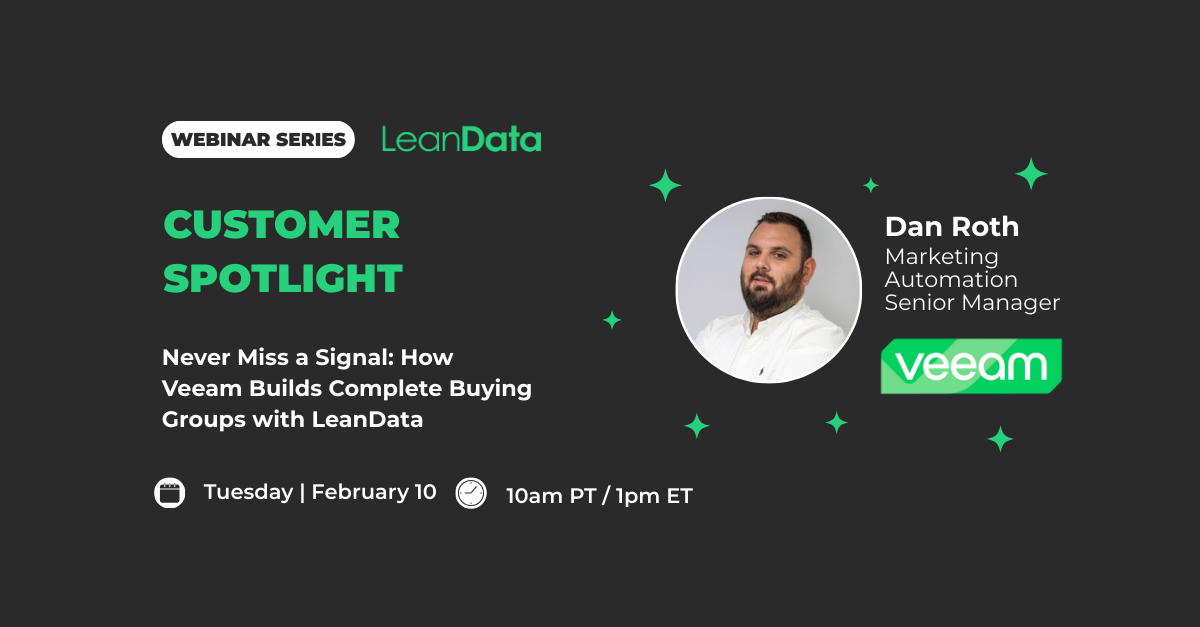
Struggling to connect buyer signals across your organization? Want every engaged prospect surfaced to your sales team? Join us for an inside look at how Veeam uses LeanData to transform individual engagement signals into complete buying groups—ensuring no opportunity slips through the cracks.
In this session, Dan Roth, Marketing Automation Senior Manager at Veeam, shares how his team built a sophisticated signal-based architecture to automate the addition of buying group members to opportunities.
Whether you are looking to improve speed-to-lead or automate complex Opportunity Awareness workflows, this webinar provides a blueprint for aligning your GTM execution with the modern buyer journey.
Key Takeaways
- The Challenge: Before implementing a centralized orchestration strategy, Veeam’s GTM team struggled to manually connect isolated leads in order to get a clear picture of account-level intent.
- The Foundation: To build a scalable motion, Veeam prioritized data integrity as a foundation. By using LeanData to automate complex deduplication and field mapping, they established a clean slate of data.
- The Process: Veeam shifted from a lead-centric model to a sophisticated buying group workflow. This process automatically matches new intent signals to existing accounts and stale opportunities. Instead of creating duplicates, the system alerts the appropriate owner to recycle and re-engage the existing pipeline.
- The Impact: The result is a GTM motion that scales across millions of records with ease. By eliminating manual lead-to-account matching and person-to-opportunity tagging, the operations team have become strategic architects, allowing the sales team to focus entirely on high-value conversations.
Speakers
- Dan Roth: Marketing Automation Senior Manager
- Kevin Au: Head of Training, LeanData
Session Transcript
Kevin Au
Alright. Let’s go ahead and get started. Welcome to everybody who’s joining us for this latest iteration of our LeanData customer spotlight series.
And this is a series where we highlight real life LeanData admins, sales, marketing, revenue operations professionals such as yourselves, and how they are improving their own go to market processes. My name’s Kevin.
I’m head of customer education at LeanData, and I’ll be the one hosting our conversation today. So for those of you who haven’t been here before, the goal of these sessions is really to celebrate people like yourself, our LeanData admins, our operators who are our biggest advocates and champions.
But we also want to pull back the curtains a little bit so that you can see the different ways that others with similar roles to yours are finding success with LeanData. Hopefully spark some ideas, provide some inspiration that you can take, and then you can start building at your own organization.
So before we dive in, I just do wanna cover a few sort of logistical housekeeping items. Firstly, I wanna highlight a few upcoming events.
For those who are LeanData certified, we have our next virtual expert hour next week discussing moving from just routing to full blown orchestration. At the end of the month, we have a webinar on GTM execution.
And in the March, we have a product webinar where we will showcase new and recent features of LeanData. So if you’re interested in what’s the latest with LeanData, that would be a good one to sign up for.
Later in March, we have another webinar on aligning teams to the buyer journey, and then finally, a fundamental certification class for those who haven’t done it yet. So if any of those sound interesting to you, just please visit our events page where which you can see down below and register for that.
K. A few other housekeeping items. We are recording this session.
So if you do want a recording of this, you can reach out to us afterwards, and we’ll have that available probably in a day or so after this event. And, also, if you have any questions, please use the q and a panel that you should see in your interface there to submit any questions.
We’ll do our best to to answer them. But if there are if there are any that we can’t get to, then we’ll follow-up with you afterwards.
And also use the chat feature. We like to, you know, see some engagement with the things that we’re hearing today.
So if there’s something that you that resonates with you, then please feel free to, use the chat feature to engage with that. Okay.
Well, today, I am excited to welcome Dan Roth from Veeam. So I’ll go ahead and invite Dan onto the stage here.
And, Dan, if you could maybe share a little bit about yourself,
Dan Roth
Hello,
Kevin Au
your role, and tell us a little bit about Veeam.
Dan Roth
Kevin. Thank you for having me.
I’ve been working in well, at Veeam for the past seven years now, only in marketing automation. And my background is around 10 in total working with different platforms around marketing automation.
And most recently, we’ve been experimenting and building this buying group model that we’ve built with with the help of LeanData and, of course, our marketing automation platform.
Kevin Au
Yeah. Excellent.
Thanks, Dan. Remind me again, did you guys sign on with LeanData, in in the past year or so, or sort of when was that process happening?
Dan Roth
Well, we are actually renewing now. So in March, we’ll be one year with you guys.
And I have to say that it was a fun year. And looking back and knowing that it’s not even one year now, it’s it feels like it has been a lot more than that because.
we’ve. done so accomplished so so many things together.
Kevin Au
Yeah. Glad to hear it.
Awesome. Well, let’s go ahead and cover the agenda for today. So I wanna give us a little bit of a road map to structure our discussion today.
So we’ll start by talking about the challenge. So where you were before, what were some of the shortcomings of that, and then what’s the ideal of what you wanted to move towards.
Then we can discuss the foundation, which is really gonna center around scoring and matching and enrichments to ensure that you could build a strong and resilient process. And then we will talk about that process, which really centers around, as we’ll as you’ll share with us, buying groups and how you built that from scratch essentially from those foundations.
And then what we can do then is talk about scale. Because once you build a process, you prove it out, you want to expand that so you can realize the most value out of that.
So we’ll talk about that, what things were helpful in that process, and then also some of the metrics that you’ve observed building that with the impact there. And if we have time at the end, we can talk about what you are looking to build next.
So if you wouldn’t mind sharing that at the very end, if we have some time for that, I think that would be helpful for our folks here. So let’s go ahead and start with the challenge or or, I guess, the context for where we’re starting here.
What was Veeam doing beforehand? What were some of the challenges you were facing? What did you want to fix or build from that?
Dan Roth
Okay. So as I was saying, I’m part of the marketing automation team. So we are managing lead scoring through Marketo, and we already had that.
And, it was working, and it is it is still working. The only problem we were facing is that the, signals were isolated because it was a one to one relationship, and our SDR organization had to, you know, pull all the pieces together and try to find people that were interested in the same product belonging to the same account.
And that was a problem for us because it involves a lot of manual work. It wasn’t telling the big picture.
It was only super granular at person level. It wasn’t telling us, you know, engagements on a particular account.
It was only going once again one by one. And, yeah, it was creating a lot of manual work.
And, also, it wasn’t scaling at a pace that we would have wanted to have. And we wanted to have a process in which automation helps our SDR function and does part of the manual work that they were doing before we had this, and this was basically it.
We we wanted to have a different approach and stop doing the traditional lead scoring, if I may say so, and think a little bit bigger than that and see if we can make connections between that particular intent from multiple individuals working for the same company, and see if we can expand on on that and have it at a broader level. So I I think, in my opinion, that was, what we were trying to achieve.
Stop looking at individuals, but meet that, maybe, bleed scoring where person level scoring is not dead, but is is not as relevant as it was, years ago and, you know, adapts to industry standards and adapts to the times we live in and have something smarter and less manual and, you. know, leverage it.
Kevin Au
Yeah. So how did you guys sort of decide on this direction towards buying groups, or was that always kind of the the ideal in the picture moving forward and you always kind of knew that?
Dan Roth
Well, we kind of wanted that, and then, we saw that it is best practice that’s being that circulates in the industry. And we also got some sort of advice from Forrester that this is we’ll eventually end up doing.
So we decided to, you know, start fresh and be trailblazers in in doing this.
Kevin Au
No. That’s great.
You know, I think a lot of folks have that similar, you know, perspective that this is where they wanna move towards. But, you know, that step of being the trailblazer, I think you guys are a little bit ahead of the curve there.
So, appreciate those who kind of go ahead and kind of tell us and share with us how to learn to move towards that process. This idea of personas comes up a lot when we’re talking about buying groups.
So was that a challenge for you guys to identify those personas or how to group them? Or, what was.
it like before?
Dan Roth
Yes. Well, before, and still today, we we have our internal processes that, you know, are connected to how we capture leads or how we capture intent. So to some extent, we already had that.
We were, categorizing personas. But when you’re thinking about the buying group, you also have to slice it and know which are the the the players within that buying group. What’s their function?
Do we have enough folks there? Or even if we have enough, do we have the right personas there?
Because maybe not all of them or not I’m I’m not finding my words here. Maybe there we don’t even have a decision maker there.
So. that’s why it’s critical to slice that. And, it was actually, something that was, you know, negotiable.
Like, we really had to have this way of telling our SDRs that within this buying group, you have this number of persons being added to it, and this is their function. This is their persona.
And maybe there’s a gap there. Maybe there’s a persona that’s missing, and maybe that persona is literally the decision maker, and they would have to hunt for it.
Otherwise, if it’s there, you know, one less step for them, and automation did its job and. served a full package to the SDR.
Kevin Au
Yeah.
Dan Roth
But then we. we also we also we have our internal pro internal processes, but we also rely on on ZoomInfo to enrich.
Kevin Au
mhmm. Got it.
Well, thanks for sharing that, Dan. I think a few things that you mentioned there that I wanted to highlight.
I think the importance of, yeah, identifying the right personas, but it’s more than that as you alluded to. It’s not just taking the titles and categorizing them properly into the right personas, but contextually in the deal, what makes sense for it to move forward, and what do you need there?
And I think that’s the additional layer that folks are trying to get to other than just collecting titles and categorizing them. Right?
And, you know, I think for most folks like you guys experienced, the the data was there. It’s not so much an aspect of missing the data or not enough data, but it’s just not organized and collected in an effective way that helps your seller.
So is that an accurate sort of explanation of where you were?
Dan Roth
Correct. Correct.
And we’ll be actually speaking a bit on personas in this step within our flow that we’ve developed with the help of LeanData as. well.
Kevin Au
Absolutely. Yeah. I mean, getting signals signals cost money. Right?
So the solution is isn’t always just getting more and more signals, but it’s a kind of a wasted effort if you’re not utilizing the signals that you are getting effectively, and there’s just a lot of disjointed effort. So yeah.
So that pretty much sets the context and foundation of where kind of things were, but let’s move into talking about the foundation. You didn’t just jump into building a system, there but are certain things that you wanted to ensure were kind of, in a good place before you could really build that.
So could you talk about that?
Dan Roth
Correct, yep. Well, first of all, lean data actually helped us organize ourselves better.
And firstly, we wanted to start on a clean slate with accurate data and, you know, have it as close as possible to perfection from the beginning. And, with this being said, that meant we were careful with lead deduplication.
We did not want to create duplicates, so LeanData is helping us achieve this. And within the graph where the duplication, we are trying to make sure that certain fields that are critical for our business are not overridden.
So it’s a tango there between fields on the new record and fields on the old record. In some occasions, we are keeping the one on the old record.
And in other occasions, we’re we’re keeping the one from the new record. So that’s something we’ve orchestrated with clean data.
And it was literally when I stepped in, and I remember when we started building this, and at first, I thought that it will be so complicated. But,
Kevin Au
Right.
Dan Roth
again, it wasn’t that complicated. Even though if you’re looking now at the graph at first, it will scare you a bit because it’s a a long graph for for this particular function, but everything makes sense here.
And it’s literally what I was mentioning. We are making sure that in some occasions, we’re keeping the value of the old records.
In some occasions, we’re keeping the the value of the the new record. So this was our first step step in building the buying group.
And at first, it might sound strange because it’s lead and it’s so further down the line where it’s at the beginning of the process that you can’t necessarily see the connection between this and buying groups. But for us, it was critical because we did not want to lose faith when we’ll have the end result.
And I when I mean lose faith, I mean SDRs and our stakeholders losing faith in the process. We wanted to have it right from the beginning.
And with with this, this this was the first step, and the next step was actually, you know, making sure that we are converting onto the correct account. And this was another cool feature that LeanData had to offer.
And I’m guessing people already know about your fuzzy matching logic. That’s something we are using whenever there’s no, you know, one to one match between the company of the lead and the accounts that we are having.
And what we wanted to achieve with this was to make sure that we are converting onto the correct account because, you know, every company has its own hierarchy of accounts and its own structure for accounts. For example, in in our scenario, if the account is a partner account, we are no longer continuing the process.
We are just converting, but there’s no buying group for for that particular scenario. And, yeah, this is these were the first two steps, and we also had the persona building part within the first steps.
And you’ve already mentioned it. We kind of already went into that topic, but it’s literally what you were mentioning. We have our internal processes with our internal fields that we are populating, and we’re taking those into account.
And then there’s ZoomIn for enrich. And the way we are actually doing it is if we have enough data on our own, we are taking the data there, it’s basically categorizing off of that data.
Or we are using ZoomInfo enriched data to basically do the same thing and categorize the persona, which will be later on when we will actually end with the buying group being built.
Kevin Au
Yeah. Great.
So just to kinda work backwards there, that last point you made about so the the data for the persona building you’re getting from enrichment sources, things like that, your internal processes. So just building out who those personas are is leveraging the processes that you already had in place.
And where LeanData came in is just taking that and being able to make some decisions based off of that and segment that out to the proper the proper action or outcome. Right?
Dan Roth
Exactly. Yeah. It helped us to organize. It.
helped us make decisions on large sets of options because that’s basically what we’re doing. We have a lot of options coming from our internal processes plus ZoomInfo and rich, and LeanData is making the decisions there based on our setup.
Kevin Au
Got it. A few other things that you mentioned I think that are worth reemphasizing too is just you mentioned this idea of of confidence. And that’s not only your own confidence in the system, but ensuring that as you move forward, you didn’t want to, lose the trust of your SDRs because these are the ones that you’re looking to help at the end of the day.
Right? You’re looking to help your SDR sell and there’s nothing to kind of derail that as quickly as mismatches or duplicates in the system. Those things are sort of easy to identify as like, Oh, this isn’t right, so therefore I don’t trust the whole thing.
I think you guys got ahead of that and made sure that, Hey, this is accurate. This is good.
Dan Roth
Correct. And it’s still a struggle, but it’s you always have to to explain it to our stakeholders that even if you find an edge case that might not be to your liking, the automation still works, and it creates value. But it is a robot, basically.
It’s not a human being.
Kevin Au
Yeah.
Dan Roth
Just not yet at least.
Kevin Au
Great.
You you also mentioned something I just found interesting that whenever folks share screenshots or pictures of their graph, they always say, like, oh, it’s complicated, and they always have to make those disclaimers and disclosures. But I think most people experience the same thing where, you know, it it seems complex if you’re looking at it from an outsider perspective.
But, you know, having all of the context internally for what you guys built and why things are there, it it’s actually it doesn’t start off very complicated, and everything is in there for a reason and a purpose. So, yeah, that’s a a very common sentiment that I’ve noticed talking to different customers.
K. Let’s move on to our next segment, and I’m assuming we’ll spend the most time here because there are most of the details around the actual building of the process. So we’ve set the foundations.
We’ve built that trust and confidence as far as data accuracy, is concerned. But then where do you start?
What did you actually build? How do we connect all the dots together for building out this buying group motion and this process using lean data? So could you just kind of walk us through each stage and each step of that?
Dan Roth
Yep. Well, this is the part that excites me the most, and it’s pretty straightforward. We already have contacts that were created by LeanData.
We already know their persona. We already know that they’re not duplicates, so we have clean data. The only thing that’s missing is the intent or or the score, and this is where our marketing automation platform comes into play, and that’s Marketo in our situation.
And, you know, Marketo listens for certain behavior and scores because we still have our initial scoring methods, the the the ones that we were mentioning in the beginning, the one to one relationship. But what’s cool is that they’re on steroids now because with LeanData, we’re able to take that intent and put it together and bundle it.
So if we know a person is interested in a certain topic, that certain topic maps to an intent value that we have. So imagine our campaign framework has, like, five or six values there, and it’s basically, slicing our product portfolio.
And whenever they engage with, one of those assets belonging to a certain portfolio, we’re scoring, and we are also stamping, that intent. And by scoring, I mean, we are literally attributing a square to a scoring field, but we are also grading them.
And, we have the normal cumulative scoring methods that everyone has already heard of. And we are also having, like, hand razors, which are, for example, the sales increase.
Or whenever a person does multiple things in a span of time on a similar topic or on a topic that belongs to the same slice within the the framework, we’re calling that highly engaged. So based on those mechanisms that still reside in Marketo, LeanData is capable of reading them.
First of all, it’s tagging the intent. So it knows the most recent Salesforce campaign that they’ve interacted with.
And when I say Salesforce campaign, I actually mean marketing, Salesforce campaign, not literally every Salesforce campaign. Yeah.
So it’s basically speaking about the marketing assets that we’re having. So it’s stamping that intent.
We know what they’re interested in. We know their level of engagement, so we know their their scoring grade.
And with that, we are able to route them through the graph, and this is where the fun starts. We are either trying to find an already existing opportunity that might be recycled because, you know, there there might be opportunities that went stale or opportunities that were not, you know, closed one.
They they were stopped at a given point. And if the intent matches the interest within that opportunity, there’s no need to actually create a new one.
We are adding to the already existing one, and that’s actually helping the process because we are not dumping new opportunities each time there’s intent in in Salesforce. And, also, it helps building the buying group because, know, the already existing one was built off of similar logics.
So the the the players within that opportunities have the same intent or had the same intent within the opportunity, and we’re just leveraging that. Or if we can’t find one, we are just creating a new one, and we’re making sure that we’re tagging it properly with making sure that the product that matches to the intent is properly stamped on the opportunity.
And we, of course, customize the opportunity by having certain field stamp, and the name itself has a play in everything we’re doing here. Also, the ownership of the opportunity has a play in this.
We’re making sure that we are changing the opportunity owner to LeanData user for the newly created ones so that they can be easily identified. Or for the ones that are recycled, whenever, as I was saying, we find an older one, We have a set of rules in place to notify our SDRs or the sellers, and and that’s basically done through Chatter.
And that’s another note that we’re using, and that’s another functionality that we’re leveraging with with LeanData. And, of course, at the end of the day, we also have dashboards that are built off of the setup we have for opportunities.
And. now where is. it? Come on.
Kevin Au
That’s a that’s a lot. Backtracking a little bit, what you’re describing is lean data allows you to have an opportunity awareness as new signals are coming through. And if those new signals sort of fit into an existing active deal cycle or whether it warrants, you know, creating a new one and you’re able to use LeanData for that.
What do you guys do about a situation where you do have an opportunity, but it’s kind of a stale opportunity? It went cold.
Do you kind of treat that as a new opportunity, or you treat that as sort of like a some version of a continuation there?
Dan Roth
Will you refresh it? But it depends because, you know, there are different stages on opportunities.
And up to an to a certain stage, if it exists and it hasn’t crossed a certain stage, we will basically refresh it. Because as I was saying, it’s good for us.
The the buying group only gets bigger as it means that it meets all the the criteria that we’re looking for. The intent is there, and it’s the same intent as the opportunity was showing.
And, yeah, it’s we’re recycling. But if not, if we can’t find one or we can find one, but it’s past a certain stage.
We don’t want to touch it. We want to leave it alone, and we’ll literally create a new one.
Kevin Au
Okay. Got it. As far as you talked about this idea of segmentation based on, you know, a combination of score, intents, and and those things. Do are any of those tied with, like, a specific SLA or time to action requirement?
You want certain level of intent to be followed up with a certain time frame, and do all of your, different signals have an SLA tied to it, or is it kind of some do and some don’t or escalating in some way?
Dan Roth
No. They they have.
They do. And, you know, the most important grades that we’re, having when I was mentioning that we are grading our marketing signals, has on a slave of three hours. And it’s.
literally whenever someone literally raises their hand and says that they want to be contacted. by cell.
And then we have different SLAs that are go to up to twenty four hours when the intent is there, and it’s it’s hot. But they’ve they haven’t raised their hand.
And, of course, that that has a a play within the the logic here. And I won’t go into details, but each opportunity, you know, has, first of all, stages.
And then we also have a a set of different other fields that have a say in it. And we are stamping those fields with with the help of LeanData based on it’s not literally the SLA, so we are not stamping the SLA there.
But there are indicators or markers that correspond to to certain SLAs. And what I forgot to mention is that for the recycled ones, we are also progressing them because, you know, they they might be at the initial stage and the intent that’s coming in, and we are adding that person to that lower end stage opportunity because of this new opportunity contact role being added and the intent of the individual not being as close to the stage of the opportunity, we also progress the opportunity.
So we are doing a lot of cool things with with LeanData in terms of opportunity dynamics.
Kevin Au
Yeah. Very, very contextual, very, very customizable based on the different factors that we have there that are all kind of interplaying together.
A question more about, like, the actual construction of the buying groups. Is it more of a quantity of contact roles you’re looking for?
Is it the presence of certain key roles on that that you need? Or I’m assuming kind of both of them.
How do you kind of think through that and structure that?
Dan Roth
It’s both. And we are we are having, basically, different targets in mind for the number of buying group members whenever we are judging it from the accounts type or segment perspectives.
Of course, for SMBs, it’s it can be only one person. But then when we go deeper and we end up with enterprise, of course, we’ll we have rules that have a certain number of opportunity contact roles needed for the buying group to be complete.
And, of course, also the the persona is critical. We need to have at least a couple of personas present there for the buying group to be considered ideal and ready to go.
Kevin Au
Mhmm. Yeah. Absolutely. No. Thanks for sharing that.
If I can ask, you know, from when you were sure about your data foundations and everything to kind of build this because it seems pretty sophisticated what you’ve, ended up with here. Roughly, how long do you think it took to to kinda get there from where you started?
Dan Roth
Well, it took us a couple of months. I I think close to six months, but.
it was mostly on us. Like, we needed to decide what we want to achieve. If we would have had, you know, black on white, rules already in mind, it would have been an easy ride for the help we were getting from LeanData at that moment because, of course, we’ve built everything with your help.
It took us a bit more just because we had to do our internal reviews and make. sure that all the steps that we want to go through are fulfilled, and we’re not missing anything.
So that was key, actually, the collaboration between the internal teams at Lean. And when I say internal teams, I mean, you know, the SDR function,
Kevin Au
Right.
Dan Roth
the operations function, marketing automation. We we went through a couple of cycles of debating on what’s actually needed or what’s the end result ideal for us.
Kevin Au
Yeah. Alright. So thank you for sharing all of that. I know that was a lot that you sort of condensed into a very small time frame, but, you know, six months worth of, you know, iterations on that.
So thank you for just consolidating all of that for us. I’d like to kind of start talking about the impact of this and kind of layer in also some things you started to mention around the help you received and and being able to actually move forward and implement this.
So can you talk a little bit about the scale that you’ve been able to achieve with this new process and the the impact that it’s had in your organization?
Dan Roth
Yeah. So, first of all, we wanted our well, at least my objective was to help our SDR function and to make their lives easier.
And that was easily achievable with creating mind groups. And when we first started everything, we wanted to make it scalable and easy to, grow, and we are still evolving.
Like, we’re we’re adding, new pieces to the puzzle almost probably each month. And that was a cool feature that I really enjoyed, and I still enjoy working with LeanData on.
And that brought also independence for us because we stopped relying on, coders. We stopped relying on going to internal teams that would have had to code everything.
Kevin Au
Yeah.
Dan Roth
And it literally brought us the freedom of being able to build something super fast and put it in market. Of course, there are internal processes that still go through Salesforce teams, but we’re not relying on on their work because they they have other stuff to do.
And it’s not like they’re working only for us. And it it has been I might sound like I’m sugarcoding it, but it has been a pleasure working with you guys.
And I had a couple of moments where I thought, well, this will be super complicated, and I don’t know how we’ll be able to fix this. Like, I was literally worrying, but then it was Michael in the beginning, and then Nina always came up with a easy solution.
Like, oh, that’s not actually a problem. It’s easy to to do.
Kevin Au
Yeah. Absolutely. I’m glad you mentioned that, you know, simply because a lot of folks come at these problems, and they they may seem, oversized. And then they are.
They’re they’re big problems that we’re looking to solve, but the members of our team have seen, you know, your instance and many others instances. So a lot of the same patterns emerge and a lot of the same issues.
So they’ve kind of been through that before, and they know how to organize things, instructor things to to handle those particular problems. So glad you mentioned that.
Could you walk us through some of these key stats that we collected, some of these numbers, and sort of practically what it meant for your teams? Because you can we can see numbers on the slide and be just be impressed by them.
But, you know, just day to day, your organization overall, what are these numbers and have what are they meant for you and for your team?
Dan Roth
Well, first of all, it meant a lot of manual work no no longer on the table. Because, first of all, LeanData was able to help us with, converting auto converting.
We were setting the rules, but it’s it’s LeanData converting, and that only that process helped a ton because it was, something that was manual before. Like, a human had to, you know, process the leads, take it over, and then search for the account, and, you know, it it would have taken a couple of minutes at least.
So that was our first win. And then we’ve already went through it.
Like, the the big win was creating the the buying groups and creating opportunities that have multiple persons already added to that opportunity without the human actually interacting and adding those folks there. Like, it basically eliminated a lot of initial steps that were mandatory in the past.
So no longer leads to account match and no longer adds people to opportunity. You straightaway skipped and went straight into dealing with the opportunity.
And you were able as an SDR to jump into the discussion there and just analyze the persona and see the the intent and already make the call. Like, you no longer have to do the the initial steps.
And, yeah, I I I think these are the the key takeaways from my side. And, of course, we you have the numbers that I won’t go through, but I’m impressed with that 10,000,000 records already processed.
And that. means anything. Like, even the persona
Kevin Au
Right.
Dan Roth
stamping is one of the areas. there.
Kevin Au
And that’s a key point. Right? You know, all of these transactions are are automated for you, and they count.
So it’s not like if there’s no reassignment happening, it doesn’t count, but all of these are contributing to a streamlined automated system for you. And, you know, I think something to just kind of pull out from this as you have described this process of building buying groups.
I think the opportunity contact role, functionality of Salesforce is so useful but underutilized just because it’s, when when it’s a manual process, it’s it’s inconsistent and unreliable. And when if it’s inconsistent and reliable, why would you use it?
Why can’t you trust it? But you guys having built out automations around that really unlocks what it’s meant to be for and really enables your sellers to have that context and have the information that they need to do their jobs. And automation takes something that had was well intended having this particular connection, this opportunity contact role, and and turns into what it should be.
Dan Roth
Fully. agree.
Kevin Au
Alright. So you’ve built something really impressive here, but I know you’re not done, that you’re looking to do more. So if possible, could you share a little bit about maybe what’s next, what you’re looking to do, some ideas that you have?
Dan Roth
Fun fact is the is that with building this process with LeanData, it kind of made us a target. And when I say made us a target, I mean, we have now teams within Veeam that’s come to us asking, hey.
Can we solve this issue with help of LeanData? And, of course, some can and some cannot.
But we are working on other processes that we want to replace with LeanData, and we already started working on one. There was a process in in Marketo and in Salesforce.
So it was part marketing automation platform, part CRM that we moved to LeanData, and it’s in the lines of categorizing intent. So we are already working on that.
And there are other processes that we are looking into moving to LeanData. I mean, as I was saying, we’re there are a lot of processes that potentially can move to to LeanData now.
We just have to be careful on what we pick and how heavy it would be for us and for the the graph as in us understanding and keeping an understanding of the the graph itself. We have another scenario in which there are some tasks tasks that are created manually created, and then someone else picks that task and has to go through a process of creating opportunities, for example.
It has nothing to do with bind groups. It’s a it’s a completely different topic.
And we want to automate that with LeanData, and we can automate that with LeanData. It’s just a matter of time.
And we’ll basically listen for particular action happening in in in Salesforce. And based off of it, further on, we’ll be creating opportunities.
And once again, it will help our, SDRs eliminating that, manual workpiece that we all dread. Yep.
We’re always on the look for new new scenarios that can adhere to LeanData’s capabilities.
Kevin Au
Yeah. Excellent.
Well, Dan, thank you for sharing that. Maybe in a year’s time or so, we’ll have you on again, and then you can share with us all the stuff that you’ve built in the, since since our conversation here.
So looking forward to that.
Dan Roth
It’d be my. pleasure.
Kevin Au
Alright. Thank you, Dan. We are essentially at time now, so thank you for, sharing all those things.
I’d like to just maybe walk through some key takeaways if I could best attempt to summarize everything that you shared with us. And, firstly, that would be starting with data accuracy.
You know, we you talked about killing dupes, ensuring and honing in on lead to account matching, stamping the right personas, so making sure the views of the buying groups that you would eventually create were trustworthy and clean. That’s a key takeaway that I got from our conversations.
Next, once you have that, the capture piece, most people already have down, but it’s this idea of segmenting and then prioritizing, that folks can build with lean data. So assuming that you have all the capture taken care of through the different tools, whether it be marketing automation or other vendors enrichment, all those things, being able to then take that and organize it makes a world of difference.
Otherwise, it just kinda sits in your CRM, and it doesn’t provide much value. So taking that next step there.
And then once you have that process down to automate those components of things, and then that allows you to scale it up. So a good process and framework for just step by step how to approach this, and, obviously, there’s a tons of details that kinda go within each of those.
But, this is sort of the general framework that I heard just from our conversations here. Alright.
So, again, thank you, Dan, for your time, sharing with us everything that Vein’s been doing. I’m sure the attendance here picked up a lot of ideas or at least inspiration for how they want to approach their own processes.
And for everyone viewing, thank you for attending. For those who submitted questions that we weren’t able to get to, I didn’t see too many, but we’ll be able to follow-up with you afterwards.
So just be on the look up for a follow-up email, and we should have a recording available if you would desire that. So with that, I’ll let you all go.
I know your time is valuable, but thanks for spending about forty five minutes with us. And thank you, Dan, once again for, being on with us today.
Dan Roth
Thank you.
Kevin Au
Alright. See you, everyone.