














Summary
This OpsStars 2024 panel explores how Sales Development is changing fast and what RevOps, Sales Ops, and GTM leaders must do to build a high-performing SDR function in an AI-driven world. Speakers unpack the evolution of the SDR role, the rising need for skilled reps, and how AI can eliminate research-heavy grunt work so teams can focus on quality conversations. The session delivers practical guidance for leaner teams under higher pipeline pressure.
Key Takeaways
- SDR teams are becoming smaller, more skilled, and more expensive which increases the need for efficiency and strong GTM orchestration.
- AI removes low-value research tasks, giving reps more time for human conversations that actually drive pipeline.
- RevOps plays a central role in tool evaluation, process design, and identifying gaps that limit SDR productivity.
- Aligning phone, email, and intent-driven motions requires coordinated training, clear SLAs, and shared focus on the right ICP.
- Prioritizing high-value accounts and automating responses for non-ICP leads protects rep time and improves revenue outcomes.
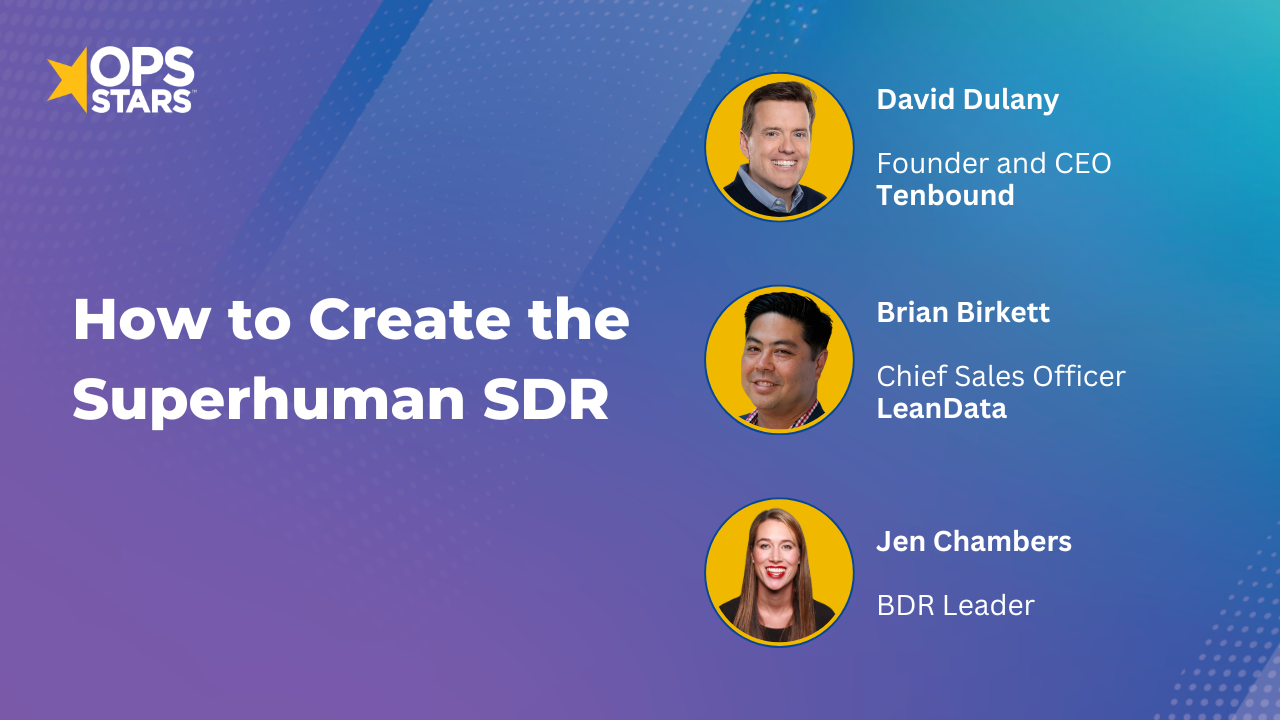
Speakers
Founder & CEO, Tenbound (Acquired by CIENCE)
David is a recognized leader in sales development and the creator of Tenbound’s Sales Development Market Map. He advises organizations on SDR strategy, tooling, and operational execution.
Chief Sales Officer, LeanData
Brian has spent more than a decade shaping LeanData’s go-to-market execution, including rebuilding SDR programs that deliver higher-quality pipeline with fewer resources.
Sales Leader
Jen has led SDR and inside sales organizations for more than ten years and helps companies modernize sales development with smarter processes and AI-driven enablement.
What You’ll Learn
How is the SDR role changing and why does it matter now?
SDRs are shifting from high-volume activity to higher-skill, conversation-ready engagement. Teams are smaller, expectations are higher, and organizations need reps who can understand the buyer, navigate complex GTM motions, and deliver quality pipeline with less manual effort.
Where does AI amplify SDR productivity instead of replacing the human element?
AI eliminates research-heavy tasks like finding accounts, sourcing contacts, and drafting email copy. This frees SDRs to focus on the human interactions that drive pipeline, while RevOps ensures the right tools and workflows support efficient, consistent execution.
What should RevOps prioritize when rebuilding or optimizing an SDR function?
Start by identifying bottlenecks through ride-alongs, understanding the jobs-to-be-done, and aligning stakeholders across enablement, marketing, and sales. Then introduce technology intentionally to remove friction, improve account prioritization, and accelerate quality conversations.
Video Transcript
David Dulany:
All right. Thank you so much. This is going to be a fun, interactive panel, so we definitely want to keep the energy up. We also have time for questions at the end. I am really excited to talk with everyone about how to create the superhuman SDR and what we’re seeing in the market. I’m David Dulany with Tenbound, and my esteemed panelists are here. Why don’t you both introduce yourselves?
Brian Birkett:
Hi everyone. My name is Brian Birkett. I’m the Chief Sales Officer at LeanData. I’ve been involved with the company for close to eleven years. I had a four-year sabbatical and came back in November. I’m excited to talk about this because SDRs have historically been part of the lifeblood of the company, and the role is changing quickly.
Jen Chambers:
I’m Jen Chambers. I’ve been a sales leader for over a decade in this space, so I have a lot of experience to contribute.
David Dulany:
We’ll go through some key points and dive into each topic: the evolution of the SDR role, changes in the last few years — especially the last eighteen months — the impact of AI, building a future-ready SDR team, and the tools that can make this transformation possible.
To start, who here manages SDR or BDR teams? And who is in sales ops, marketing ops or RevOps? Any SDRs or BDRs? Great — we’re talking to a RevOps-heavy room.
Let’s talk about the evolution of the SDR role. In the last few years, there has been a significant shift in the way SDRs operate. When I say SDRs, I also include XDRs — SDRs, BDRs, LDRs — whether they’re doing outbound or following up on inbound leads. How have you seen the role evolve, and where do you see it going?
The Evolution of the SDR Role
Jen Chambers:
I’ve seen the role shift to much smaller, leaner teams, and those teams have to be far more efficient than in the past. We’re no longer in a “growth at all costs” world. We must spend smarter. Reps need a higher level of skill, which means they cost more, but they also bring more experience and deliver a better experience for customers and prospects.
Brian Birkett:
I completely agree. I would also add that SDRs are still the pipeline engine for revenue teams and often other departments. As the market has evolved, many first-level roles — whether in sales or customer success — have become harder. Where we used to promote SDRs on a set timeline, the skills required for the next role have increased. We need to raise the bar, invest more in SDRs, and prepare them for their next step while ensuring they succeed in their current role.
David Dulany:
Many of you have probably seen this: organizations have significantly reduced SDR headcount to right-size teams due to economic shifts, particularly in tech. Some teams have been cut 40–50% or more in the last couple of years. But the pipeline requirements have not changed — in some cases, they’ve increased. That creates tremendous pressure and demands a higher skill level from the remaining SDRs.
The other major trend is the impact of AI. How have you both seen AI affect the SDR role?
The Impact of AI
Jen Chambers:
AI is absolutely part of the role moving forward. Any rep who isn’t advancing their skill set and learning what tools are available will be left behind. There is still an essential human element in this role — the SDR isn’t going away — but reps must understand how AI can make them more efficient. RevOps plays a critical role in identifying the core pain points and choosing tools that meaningfully support the team.
Brian Birkett:
It’s become harder to connect with prospects. Email response rates are down. SDRs must focus on having more quality conversations. So what can we do to enable that? Training reps to handle better conversations, dialing technology to increase connects, and AI to help identify the right accounts and personas. AI can strengthen the human element by enabling reps to spend more time on conversations and less time on manual tasks.
Jen Chambers:
I’ll add that when you reduce your team, you must understand the role AI will play before making those cuts. The remaining reps need to be set up for success.
David Dulany:
Historically, SDRs spent hours doing manual grunt work — researching accounts, finding contacts, locating phone numbers. AI eliminates much of that repetitive effort, freeing SDRs to actually have conversations. Do we still need 100 SDRs doing manual research all day? Probably not. But AI-generated messages are increasing, and prospects can spot them immediately. So on the content side and the process side, AI can be both a friend and a foe.
Brian Birkett:
On process, AI is a friend, but also a potential distraction. With so many new tools, it can be hard to know what actually moves the needle. It’s early, but I believe AI will make teams more effective long term.
Jen Chambers:
AI is a friend if you use it properly. But reps must level up their skills. If they don’t, AI becomes a foe — not because AI is harmful, but because it exposes gaps in capability. Ultimately, that’s still a favor, because it pushes people to develop.
David Dulany:
Exactly. AI replaces the rote work that keeps reps from having conversations. RevOps must set up systems that empower SDRs to focus on high-value interactions.
Building the SDR of the Future
Jen Chambers:
Events like this matter. Face-to-face brand exposure drives pipeline. Phone outreach will continue to be essential. Email will remain difficult. If reps spend their day researching instead of practicing conversations, it becomes much harder to drive pipeline.
David Dulany:
Let’s get tactical: how do we build the future SDR process? What does a day in the life look like? Where are SDRs spending time that doesn’t move the needle? How can RevOps remove the friction?
Brian Birkett:
I’m a big fan of the ride-along. Spend a day with your SDRs. Understand the gaps. The SDR role includes account selection, finding contacts, crafting messages, delivering messages, scheduling call blocks, and practicing conversations.
My RevOps partner Christine and I looked at where we wanted to move the needle. We knew we wanted more phone conversations, so we invested in tools that increased connects. We realized our email copy needed improvement, so we enabled an AI email-feedback tool. Start with the biggest gaps, not the entire ocean.
Jen Chambers:
RevOps plays a huge role. They must partner with enablement and marketing, sit with the BDR team, understand expectations, and analyze where time is being lost. Then identify where AI can help.
David Dulany:
A good example is ConnectAndSell. You press a button, and the system connects you to prospects. But it removes all the research time — meaning reps need much stronger real-time conversation skills.
Brian Birkett:
We implemented Nooks, a tool that dramatically increases call volume. We brought the entire SDR team into the office for “SDR-Palooza.” We practiced dialing, role-played, and trained. We intentionally shifted from an email-based culture to a conversation-based culture.
Jen Chambers:
Nooks is interesting because their AI bot lets reps practice talk tracks before calling. Reps don’t have to “practice on live prospects” anymore.
David Dulany:
Spam-call labeling is an issue in general, but it hasn’t been a major blocker yet for these tools.
Jen Chambers:
Some tools use their own dialer, while others integrate with existing dialers. Using your own cell number sometimes works best — aside from newer reps still on family plans.
Tools, Tech, and Process
David Dulany:
Let’s talk tools. What’s in your stack today?
Brian Birkett:
We use LeanData for intent signals, SLAs, and routing — table stakes. We use Nooks for higher connect rates. We use tools like Hyperbound for call practice. We use Lavender for email improvement. We also built our own account-scoring model in Salesforce using signals and firmographic data. Our SDR team is a third the size of last year, so focusing on the right accounts is critical.
David Dulany:
Do SDRs bring you tools? Or do you identify them?
Brian Birkett:
Both. Some SDRs “go rogue” and buy their own tools — we try to discourage that, but they’re in the market and always hearing about the latest thing. We’re forming an AI committee within RevOps to evaluate new tools systematically. An inefficient SDR team is a cost center, not a revenue center.
Jen Chambers:
There are many tools worth exploring: Reggie, CopyAI, ChatGPT for business applications, Scaled (which teaches reps how to build their own GPT bots), 6sense, ZoomInfo, Unify, Common Room, Relevance, Artisan, Qualified, and Clay. Clay is powerful for scraping data and surfacing contacts, but complex to use. ColdIQ publishes helpful comparisons of many of these tools.
David Dulany:
Tenbound also maintains a sales tech directory with over 2,000 tools to help teams find what fits.
Key Takeaways
Brian Birkett:
Know your gaps. Then find solutions. The AI landscape is massive, and no leader can know everything. Prioritize, partner with RevOps, and select tools intentionally.
David Dulany:
It’s all about RevOps. If someone says they want to build an SDR team, I often tell them: hire RevOps first.
Jen Chambers:
Pay attention to your top performers. They are often the first to identify gaps and experiment with solutions.
Audience Q&A
Audience Member:
You mentioned focusing on high-value prospects. We get many inbound hand-raisers who aren’t qualified. What do you do?
Brian Birkett:
We segment responses. For non-ICP accounts or irrelevant personas, we automate a helpful response. We do not offer a meeting. We direct them to resources and move on. Focus is everything.
Jen Chambers:
It isn’t worth spending rep time on unqualified leads. Provide a helpful resource and move on.
Audience Member:
We have fewer SDRs now, higher goals, and more expectations. How are you adjusting compensation?
Brian Birkett:
We shifted from compensating on meetings to compensating on qualified opportunities. We eliminated gift-card incentives that drove unqualified meetings. We lowered the numerical target but raised the quality bar. It required change management, but the team understood the mission, and the tools we invested in helped them succeed.
David Dulany:
Great. Thanks, everyone. We’ll be around. Enjoy the conference.