















Summary
AI in go-to-market (GTM) strategy is moving from aspiration to application, but the gap between intent and execution remains wide across most B2B organizations. New research from Harvard Business Review Analytic Services pinpoints exactly where AI is delivering results in go-to-market execution and what conditions have to be in place first.
What You’ll Learn
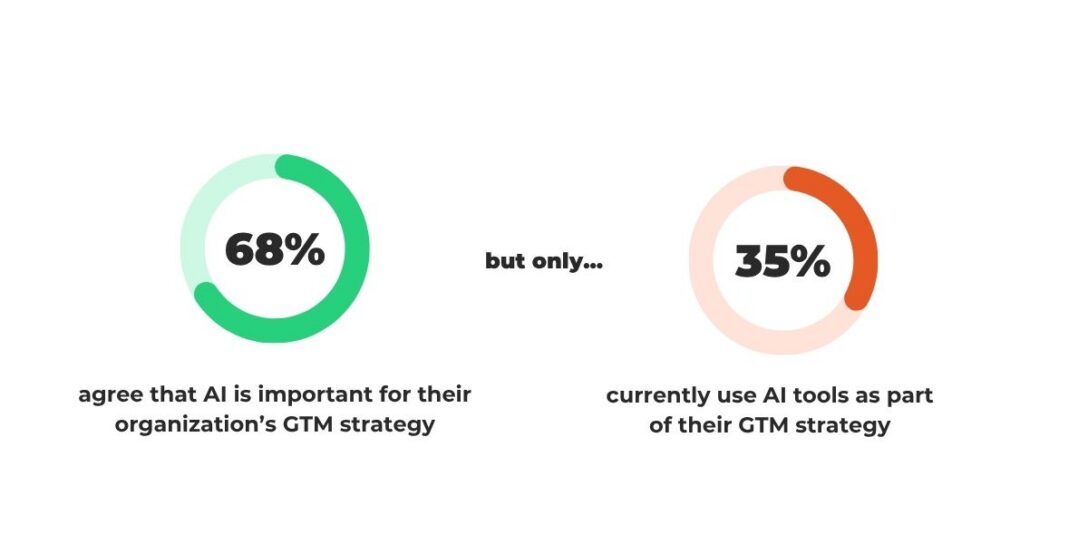
- Why 68% of B2B leaders believe AI matters for GTM strategy, yet only 35% currently use AI tools
- The five most common AI use cases in GTM execution today, ranked by adoption
- How buyers use AI to research solutions before talking to sales, and what that means for your content strategy
- What generative engine optimization (GEO) is and why GTM teams need to pay attention to it now
- Why the organizations pulling ahead build execution infrastructure before adding AI
Big Plans, Slow Progress
Most B2B organizations have a plan for AI in their go-to-market strategy. Most of them also haven’t done much about it yet.
That gap is one of the more telling findings in a new research report from Harvard Business Review Analytic Services, sponsored by LeanData, based on a survey of 522 B2B leaders.
The research doesn’t argue that AI is overhyped. However, it does show, clearly, that knowing AI is important and knowing what to do with it are two very different problems.
The Belief-to-Practice Gap
According to the data, 68% of survey respondents agree that AI is important for their organization’s GTM strategy.
Among the highest-performing organizations, those the report classifies as leaders based on GTM effectiveness, that number is 71%. Among followers, it’s 75%. Even 52% of laggards acknowledge AI’s importance.
And yet, only 35% of organizations currently use AI tools as part of their GTM strategy.
That’s a significant disconnect, and it mirrors a broader pattern the research surfaces throughout: most B2B companies know what better GTM execution looks like, but they struggle to get there.
The organizations that do make consistent progress share a common trait: They build a strong execution foundation first, one that connects teams, unifies data, and establishes shared processes. Then they add AI on top of that infrastructure.
AI doesn’t fix a fragmented GTM motion. It amplifies whatever’s already there.
Where AI Is Being Applied in GTM Right Now
Among organizations already using AI tools, the applications are practical rather than experimental.
The survey’s top use cases for AI in GTM execution are:
- Analyzing disparate data sets for insights (52%)
- Optimizing marketing campaigns (51%)
- Coaching sales reps (45%)
- Refining customer personas (44%)
- Personalizing content at scale (43%)

These use cases are about improving existing work, not replacing it. AI helps teams act on the data they already have, reach the right buyers more precisely, and scale activities that would otherwise require more headcount to execute.
“I don’t want my sales reps practicing on buyers. I want them practicing on AI.”Jen Allen-Knuth
One application that often gets undersold is sales coaching. AI coaching tools let reps rehearse pitches and refine cold calls before they’re in front of an actual prospect, which matters especially when most sales managers are stretched too thin to provide consistent, individualized coaching.
Mass personalization is the other area where AI is showing clear value. Meagen Eisenberg, CMO at Samsara, described deploying AI tools that range from propensity models and buying group identification to automated sequence generation and AI-generated ABM landing pages.
Her point cuts through the noise: what once took weeks to build and launch now takes days. Busy decision-makers skip anything that isn’t directly relevant to their situation, so personalization at scale has moved from a competitive advantage to a baseline expectation.

How Buyers Use AI, and What That Means for You
The buyer side of this equation matters just as much as the seller side.
AI-powered search tools have changed how B2B buyers research solutions before they ever speak to a sales rep. The traditional linear funnel, where buyers move predictably from awareness to consideration to decision, has given way to something more fragmented. Buyers gather information from more sources, in less predictable sequences, often completing significant portions of their evaluation before engaging with a vendor directly.
Generative Engine Optimization
This shift has a direct implication for your content strategy: generative engine optimization (GEO), also known as answer engine optimization (AEO), is becoming a discipline GTM teams can no longer ignore. Where SEO targets traditional search engines like Google, GEO focuses on how your company appears in AI-powered search tools like ChatGPT, Perplexity, and Gemini.
“In the last six months, we’ve really had to adjust our content strategy to make sure we’re at the top of the selection set for these tools.”Meagen Eisenberg
GEO/AEO requires understanding where large language models pull their information, how your company shows up in AI-generated responses, and the fact that those results shift depending on how a query is phrased. Unlike SEO rankings, which are relatively stable, GEO results fluctuate, which means the work is ongoing.
For CMOs and demand generation leaders, this is a current strategic priority, not a future-state consideration. If your buyers rely on AI tools to research solutions and your company doesn’t surface in those results, you have a discoverability problem that no amount of outbound activity will fully compensate for.
The Leaders Are Already Moving
The research draws a meaningful line between organizations actively exploring new tools and those that aren’t.
According to the data, 76% of leaders and followers say they are exploring new technologies to improve GTM execution. Among laggards, only 51% say the same.
This gap compounds.
Organizations that delay investment in AI capabilities fall behind not just in efficiency today, but in their ability to respond to buyer signals, coordinate across buying groups, and personalize at the speed modern buyers expect.
 “In very complex organizations with multiple buyers, how quickly you can get to them becomes a competitive advantage”
 Chris Dent


That speed depends on having the right infrastructure in place. Lead routing, signal capture, buying group visibility, these aren’t problems AI solves on its own.
They require clean underlying processes and connected systems. Organizations that treat AI as a shortcut around those fundamentals tend to add complexity without improving execution.
Where to Start with AI in GTM Execution
The HBR Analytic Services research points to a practical starting point for organizations still figuring out where AI fits. The use cases with the clearest near-term payoff are signal analysis, personalization at scale, and sales coaching.
None of these require an overhaul of your existing stack. They require a clear execution process that AI can support.
If your content team hasn’t started thinking seriously about GEO and AEO, that conversation belongs on the calendar now, not in next quarter’s planning cycle. The buyers you’re trying to reach are already using these tools. The question is whether you show up when they do.
FAQ
What are the most common AI use cases in B2B GTM strategy?
What is generative engine optimization (GEO) and why does it matter for B2B companies?
Why do most B2B organizations struggle to use AI in their GTM execution even when they believe it’s important?
How does AI in GTM strategy differ between high-performing and low-performing B2B organizations?
Download the free HBR report for insights into AI’s role in GTM execution.

Kim Peterson
Kim Peterson is the Senior Manager of Content Strategy at LeanData where she digs deep into all aspects of go-to-market strategy and execution. Kim's writing experiences span tech companies, stunt blogging, education, and the real estate industry. Connect with Kim on LinkedIn.