













Summary
LeanData BookIt is a B2B meeting scheduling software suite built natively inside Salesforce. It combines lead-to-account matching, intelligent routing, and instant scheduling to connect buyers with the right rep, every time.
What You’ll Learn
- What LeanData BookIt includes and how each product works
- How BookIt’s matching and routing capabilities compare to competitors like Chili Piper and Calendly
- New BookIt features added in 2025 and 2026, including API-driven agentic booking, SMS reminders, and Routing Links
- How BookIt fits within the LeanData Intelligent GTM Orchestration platform
- Which type of organization benefits most from BookIt
One Stat That Should Keep Sales Leaders Up at Night
Responding to a new lead within the first minute drives a 391% increase in conversions. Yet the average B2B sales team takes over 40 hours to follow up. That gap between buyer intent and seller response is where pipeline goes to die.
This is exactly the problem B2B meeting scheduling software is designed to solve. But with hundreds of scheduling tools listed on G2, how do you choose one that actually fits the complexity of enterprise B2B sales?
The answer depends on three things:
- How accurately you can match buyers to the right rep?
- How intelligently you can route those meetings?
- How quickly you can get a meeting on the calendar?
LeanData BookIt was built to address all three.
What is LeanData BookIt?
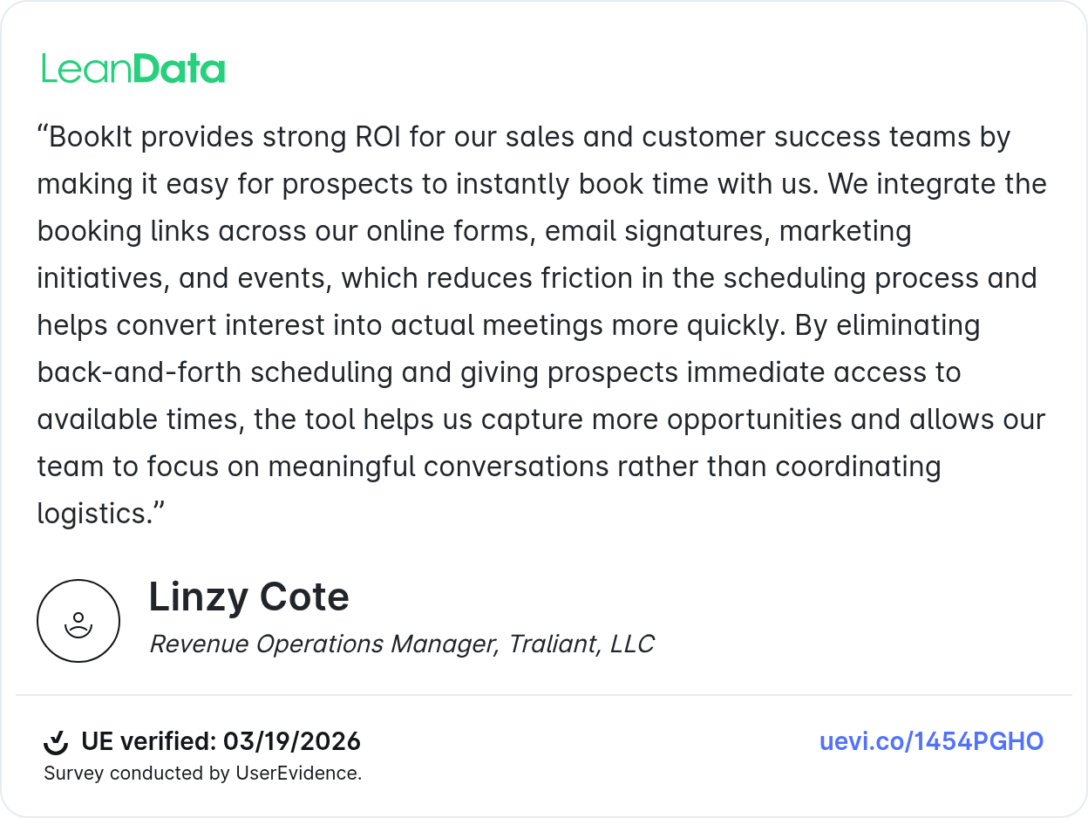
LeanData BookIt is a suite of four meeting scheduling products built natively inside Salesforce. Each product serves a different stage of the buyer engagement process, and they all share the same underlying matching, routing, and round robin engine.
Here’s a quick overview of the four BookIt products:
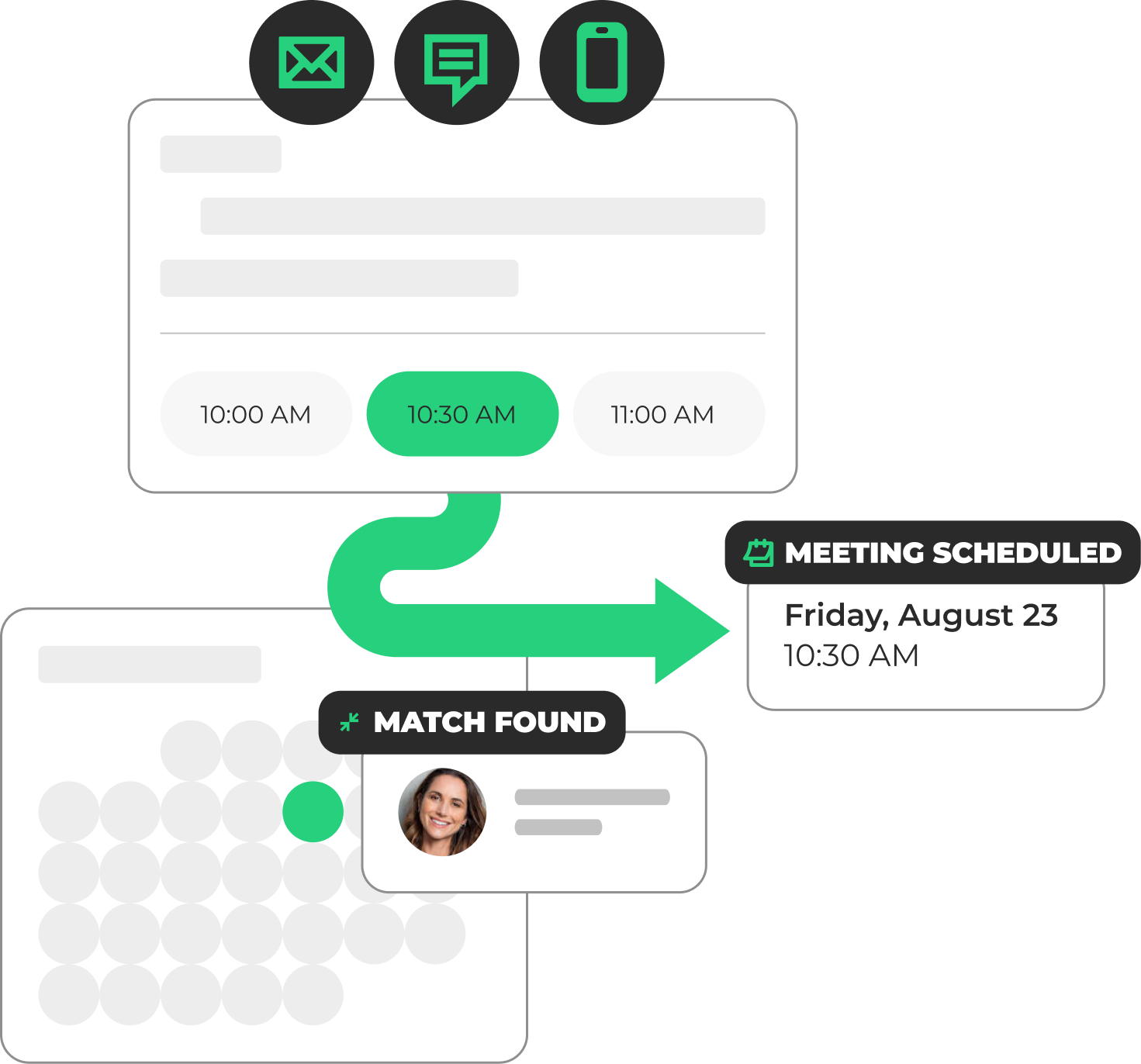
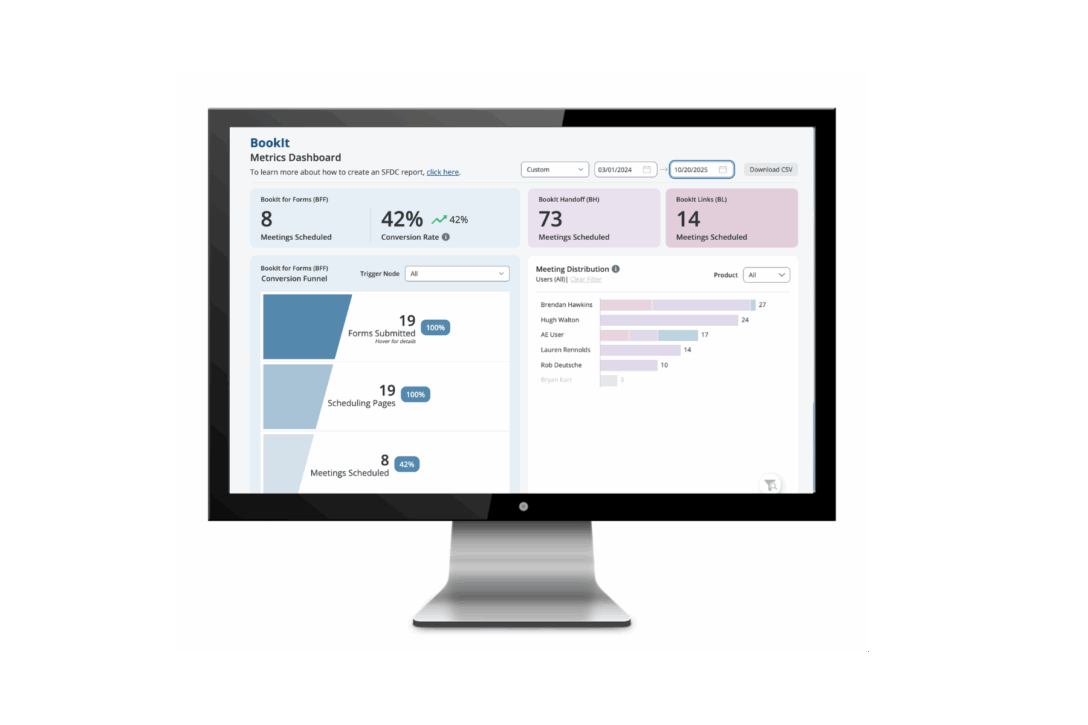
- BookIt for Forms (BFF): When a high-intent prospect fills out a webform (requesting a demo, for example), BookIt for Forms lets them instantly book a meeting with the right rep directly from the form. There’s no waiting, no back-and-forth emails. The prospect fills out the form, sees available times, and books a meeting on the spot. Behind the scenes, BookIt matches the prospect to existing accounts, qualifies the
- BookIt Handoff: SDRs, BDRs, and other meeting schedulers use Handoff to book meetings on behalf of other team members, including groups, directly from Salesforce Lead and Contact records. This creates clean, friction-free transitions between teams. Handoff also includes Smart Rep Suggestions, which automatically recommends the right meeting type and team member based on account context, matched records, and your routing logic.
- BookIt Links: Reps can create personal or team scheduling links that can be shared via email, LinkedIn, sales engagement sequences, or any digital channel. Recent updates include Dynamic Links with Round Robin Pool support, multi-meeting type landing pages, and Single Use Links that expire after one booking.
- BookIt Chrome Extension: A browser-based tool that lets reps schedule meetings without leaving their current workflow. It provides quick access to scheduling capabilities from anywhere in the browser.

What Makes BookIt Different from Competitors
When evaluating B2B meeting scheduling software, most tools handle the basics: they let someone pick a time slot and put a meeting on the calendar. The real differences show up in matching accuracy, routing intelligence, workflow flexibility, and operational visibility. Here’s where LeanData BookIt separates from competitors like Chili Piper, Calendly, and standalone scheduling tools.
Matching That Actually Works
Many scheduling tools have limited or no lead-to-account matching. Without accurate matching, the scheduling tool lacks the context to decide who should take the meeting.
LeanData’s fuzzy matching engine looks beyond basic email domains. It evaluates multiple fields to connect leads to accounts, opportunities, customer records, and other Salesforce objects with high accuracy, even when data is incomplete or inconsistent. This matching layer powers every routing decision BookIt makes, which means the right rep gets the meeting, not just the next available rep.
Chili Piper, for example, relies on Salesforce data and form fields for routing, and Calendly’s routing is even more limited.
Neither offers a dedicated matching engine with the same depth of fuzzy logic that LeanData provides natively.
Routing That Handles Real-World Complexity
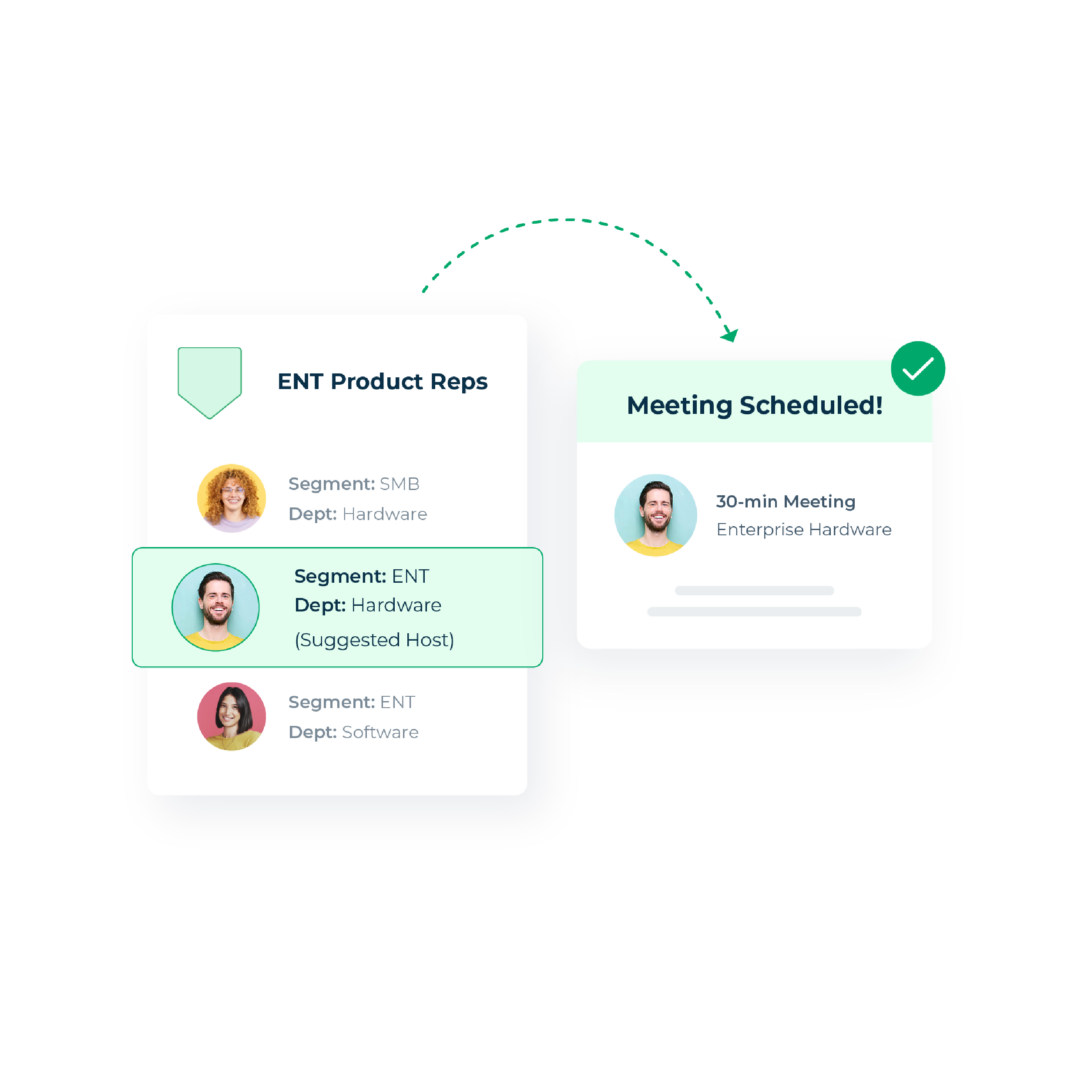
LeanData’s visual, drag-and-drop FlowBuilder supports any distribution model: round robin, territory-based, account-based, overlays, and explicit user assignments. You can build scheduling logic that adapts to your actual go-to-market motion without rigid if/then configurations.
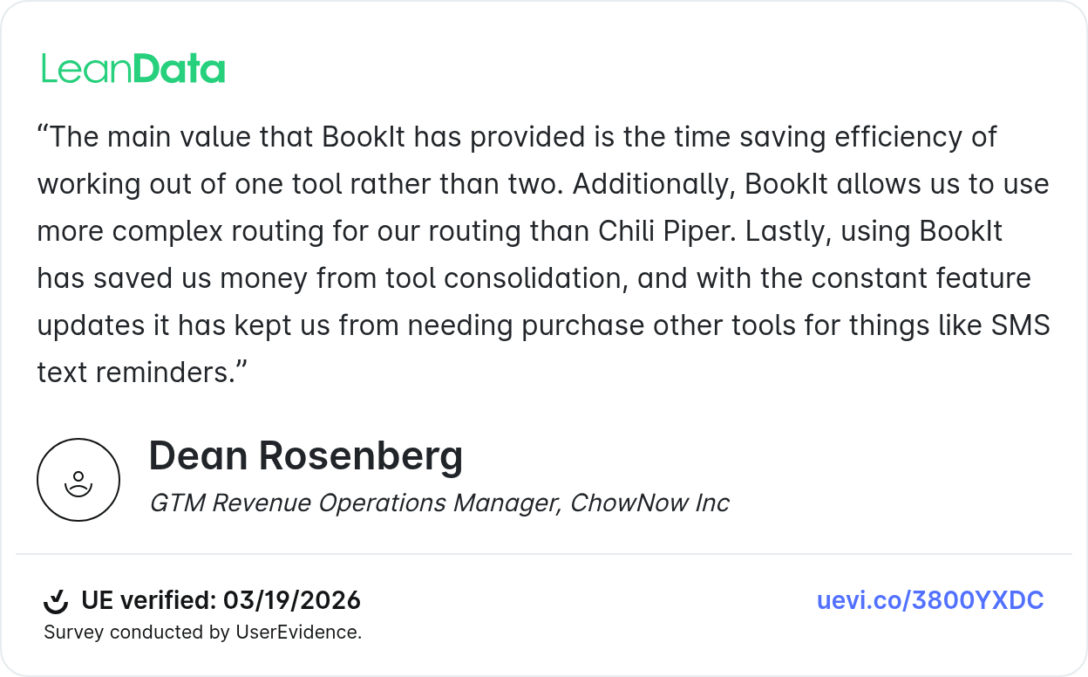
Chili Piper offers routing capabilities, but its logic lives primarily within its own product. Calendly has added routing forms, but the logic is comparatively simple for enterprise use cases.
Neither provides the same level of visual workflow building that LeanData’s FlowBuilder does, and neither ties scheduling logic directly into a broader orchestration platform.
Plus, BookIt Handoff’s Smart Rep Suggestions take routing a step further. Operations teams can configure suggestions so that when an SDR is ready to schedule a meeting, the system automatically recommends the right meeting type and the right team member based on whether the buyer is an existing customer, matched to an account, or meets specific criteria.
Built Natively in Salesforce
LeanData BookIt runs as a native Salesforce application. This means your scheduling data, routing logic, audit trails, and CRM records all live in one place. There’s no middleware, no separate database to sync, and no risk of data falling out of alignment.
Chili Piper integrates with Salesforce but operates as a separate platform. Calendly requires add-ons or middleware like Zapier for deeper Salesforce functionality. For organizations that run their entire revenue operation in Salesforce, the native architecture matters because it reduces technical debt and simplifies administration.
Visibility You Can Actually Use
LeanData BookIt offers real-time flow metrics, letting admins scan diagnostics at any node to spot successful actions, bottlenecks, or stuck records. Detailed audit logs provide a complete history of every form submission and routing decision, so you can quickly identify why a prospect followed a specific path.
This level of transparency is rare in scheduling tools. Most competitors offer basic reporting dashboards, but few provide the node-level diagnostics and audit trails that operations teams need to troubleshoot and optimize.
New BookIt Features (2025 and 2026)
LeanData has shipped significant updates to BookIt over the past year. Here are the highlights, organized by category:
Scheduling API for Agentic Booking
BookIt now offers expanded API capabilities that let AI agents and custom applications invoke BookIt’s routing and scheduling logic programmatically. This means AI SDR tools like Qualified, Agentforce, or custom chatbots can check for existing meetings, fetch real-time availability, and confirm bookings, all through BookIt’s governed backend. Round robin fairness, calendar integration, and SLA compliance remain intact, even when a bot is doing the booking.
Routing Links
Routing Links let admins create a single, intelligent booking link that routes through the BookIt for Forms graph logic. Prospects click one link, fill out a short form (or skip it entirely if URL parameters pre-fill their information), and BookIt routes them to the right rep automatically. This eliminates the need for reps to search for the correct individual or territory-specific link, and it works without requiring a marketing automation platform.
SMS Meeting Reminders
BookIt now integrates with Twilio to send SMS meeting reminders at configurable intervals before a meeting. Prospects opt in by providing a phone number on the scheduling page. Given that text messages are generally opened more quickly than emails, this feature directly addresses no-show rates.
Meeting Type Limits
Admins can now set daily and weekly caps on the number of meetings that can be booked for a specific meeting type. Once the cap is reached, the scheduling page blocks additional bookings for that period. This prevents rep burnout and ensures reps have time for follow-up, pipeline building, and other non-meeting activities.
Enhanced Dynamic Links
Dynamic Links now support Round Robin Pools, multi-meeting type landing pages, and auto-populated custom fields through URL parameters. This gives prospects a better booking experience and lets reps share more versatile scheduling links.
Conditional User Provisioning
Admins can define rules (for example, Role = Account Executive) that automatically invite matching Salesforce users to authorize their calendars for BookIt. This removes the manual process of provisioning each user individually and ensures the right people are connected to the right BookIt products.
Redesigned Scheduling Page
The BookIt scheduling page now includes a week view, making it easier for prospects to find available times across multiple days at a glance.
Additional Updates
- Google Calendar vacation sync eliminates manual vacation tracking for reps
- Intelligent Handoffs now work for Accounts, Opportunities, and Cases, not just Leads and Contacts
- Round Robin Pool History provides an exportable audit trail of all pool modifications
- Conference, reschedule, and cancel links are automatically added to Salesforce event descriptions
- Admin-only schedule controls give admins centralized management of rep working hours and holidays

How BookIt Fits Within the LeanData Platform
BookIt is one piece of LeanData’s Intelligent GTM Orchestration platform, which serves as the connective tissue across the entire revenue lifecycle. While BookIt handles the scheduling layer, it shares infrastructure with LeanData’s broader product suite:
Orchestration (FlowBuilder) provides the routing engine that powers BookIt’s matching and assignment logic. The same FlowBuilder that routes leads and contacts also drives BookIt’s scheduling decisions. Recent additions to FlowBuilder, including the AI Inference Node (which uses LLMs to interpret unstructured data like activity notes) and the Create Record Node (which creates any Salesforce object type directly from a workflow), extend what’s possible within BookIt-connected flows.
Buying Groups identifies and maps multi-stakeholder buying committees, adding context that BookIt can leverage when determining who should take a meeting. Title Clustering, for example, normalizes thousands of job title variants into standardized personas, which improves routing accuracy for both scheduling and broader GTM workflows.
Account Hierarchies maps corporate structures from parent companies to subsidiaries, giving BookIt the context to route a meeting request from a subsidiary to the rep who manages the global relationship.
Insights provides reporting, audit logs, SLA timers, and speed-to-lead dashboards that span both routing and scheduling activities.
The connection between these products matters because scheduling decisions don’t happen in isolation.
When a prospect books a meeting, the system needs to know which account they belong to, whether there’s an open opportunity, who owns the relationship, and what the current engagement looks like.
LeanData delivers that context natively, while standalone scheduling tools require separate integrations to approximate it.
Who Is the Best Fit for LeanData BookIt?
LeanData BookIt is designed for B2B organizations that use Salesforce as their CRM and have inbound, outbound, or account-based go-to-market motions. It’s particularly well suited for companies that have:
- Complex routing requirements (multiple territories, overlays, account-based assignments)
- Sales development teams that schedule meetings on behalf of account executives
- High-intent inbound channels like demo request forms, event follow-ups, or product trial signups
- A need for Salesforce-native scheduling data for reporting and compliance
- Growing sales teams where fair, automated distribution matters
Companies with simpler scheduling needs or those not using Salesforce may find that Calendly or a lighter-weight tool is a better fit.
And organizations already invested in Chili Piper’s ecosystem will want to compare the depth of matching and routing capabilities, the total cost of ownership (Chili Piper charges per-user fees plus platform fees per module), and how important Salesforce-native architecture is to their operations team.
FAQ
Does LeanData BookIt work with CRMs other than Salesforce?
Can AI agents or chatbots book meetings through BookIt?
How does LeanData BookIt pricing compare to Chili Piper and Calendly?
What’s the difference between BookIt for Forms and Routing Links?
Scheduling That Connects to Your Entire GTM Strategy
B2B meeting scheduling is a revenue function, not an administrative task. The speed and accuracy with which you connect buyers to reps directly affects pipeline conversion, sales cycle length, and buyer experience.
LeanData BookIt brings matching, routing, and scheduling together in a Salesforce-native platform, and it connects those scheduling decisions to the broader context of your entire go-to-market operation.
Curious what BookIt looks like in practice? Visit the LeanData pricing page, or schedule a demo with the LeanData team.
Want to see what BookIt for Forms looks like behind the scenes?

Kim Peterson
Kim Peterson is the Senior Manager of Content Strategy at LeanData where she digs deep into all aspects of go-to-market strategy and execution. Kim's writing experiences span tech companies, stunt blogging, education, and the real estate industry. Connect with Kim on LinkedIn.