














Summary
Lumin Digital shares how data accuracy, tech alignment, and trust transformed their go-to-market performance. Learn how Lumin redefined its Ideal Customer Profile (ICP), rebuilt CRM trust, and operationalized buyer journey visibility to improve engagement and conversion across every stage.
Key Takeaways
- Build data confidence first; accurate, trusted data powers every GTM motion and AI model.
- Create shared transparency through data definitions, documentation, and team enablement.
- Identify and activate your ICP using firmographic, technographic, and engagement signals.
- Connect your tech stack to gain a unified view of the buying journey and orchestrate actions across teams.
- Evaluate new tools through an integration-first lens to prevent silos and sustain alignment.

Speakers
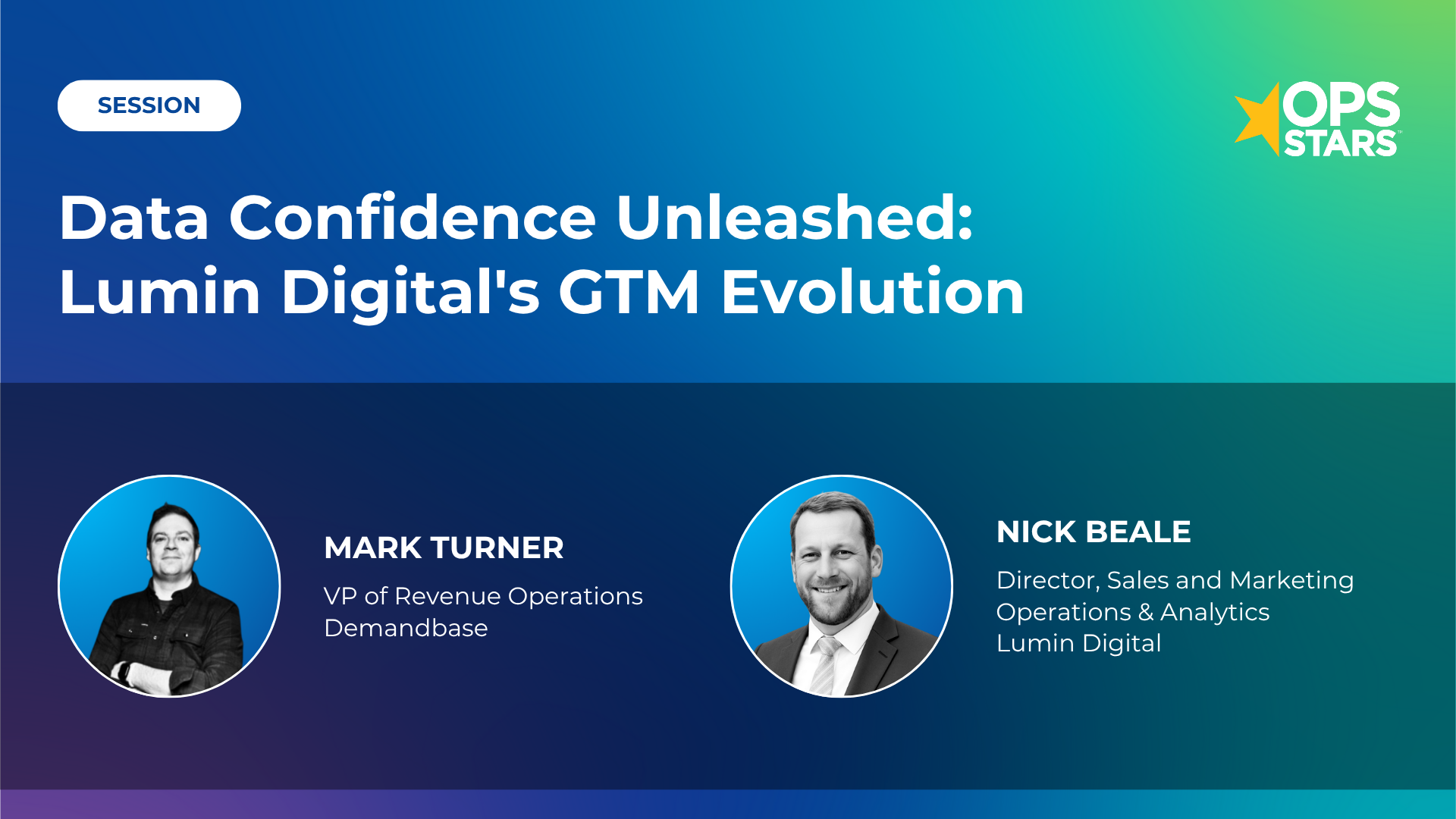
Nick Beale, Director of Sales and Marketing Operations, Lumin Digital
Nick leads Lumin Digital’s GTM strategy, analytics, and technology architecture. His focus on CRM quality and data trust has driven measurable gains in velocity and conversion across the customer journey.
Mark Turner, Vice President, Revenue Operations, Demandbase
Mark helps organizations operationalize data-driven alignment across marketing and sales. At Demandbase, he empowers teams to build cohesive systems that unify data and accelerate growth.
What You’ll Learn
Q: How did Lumin Digital reestablish trust in its data?
A: They began by defining every key field, eliminating duplicates, and creating shared documentation. Regular enablement sessions reinforced adoption and confidence across sales, marketing, and client experience teams.
Q: What measurable impact came from unified data and orchestration?
A: Lumin achieved a 400% increase in engagement insights, a 10x rise in direct signals from ICP accounts, and improved conversion rates across journey stages after integrating Demandbase, G2, and HubSpot.
Q: Why is data foundation critical for AI-driven GTM?
A: AI and automation rely on structured, trustworthy data. Clean CRM architecture enabled Lumin to orchestrate campaigns and derive insights with speed and precision, improving decisions at every touchpoint.
Session Transcript
Mark Turner:
Hey everyone, welcome. Thanks to LeanData for hosting us. My name is Mark Turner, Vice President of Revenue Operations at Demandbase, and I’m joined by Nick Beale.
Nick Beale:
I’m the Director of Sales and Marketing Operations and Analytics at Lumin Digital. My role focuses on go-to-market architecture, technology stack, analytics, and operational processes. Essentially, I make sure we’re optimizing our systems across the entire go-to-market engine and putting the right structures in place to support that.
Mark Turner:
Perfect. Can you walk us through some of the initial challenges you faced when you joined Lumin?
Nick Beale:
Sure. Some of our biggest challenges involved getting our arms around the CRM and understanding the data within it. I’m sure many of you have experienced something similar when joining a new company and discovering how the technology was configured and where the gaps are. We faced issues with limited enablement across teams, poor user experience in the CRM and marketing automation system, and fragmented pipeline management. We really had to dig in to understand what those challenges were, how users were experiencing them, and how to put strategies in place to address them with the right data foundation.
Mark Turner:
That makes sense. What approaches have you found most effective for aligning sales and marketing?
Nick Beale:
At Lumin and throughout my career, transparency has been the key. As we uncovered issues across our tech stack and data, we made sure to communicate openly with our teams about what was changing, why we were doing it, and how it would benefit them. For example, we introduced intent data, which can sometimes be confusing for sellers. We made sure to explain where the data came from, what it meant, and how they could use it effectively. We’ve also invested heavily in enablement. We run regular sessions, including at our upcoming SKO, to make sure our teams understand the tools, data, and definitions that drive their work. The more transparent and consistent you are, the more buy-in you get.
Mark Turner:
That’s great. Outside of enablement, what tools or strategies have been most successful?
Nick Beale:
It’s about finding the balance between flexibility and structure. Sellers and marketers need room to work in ways that suit them, but within a clear framework. We use HubSpot as both our CRM and marketing automation platform. Within that, we’ve standardized dashboards and built frameworks to bring in additional data sources. We blended enrichment and engagement data and set parameters around what information is truly valuable to our teams, so they’re not overwhelmed with irrelevant data.
Mark Turner:
That’s a smart approach. What’s a common pitfall you’ve seen that teams should avoid?
Nick Beale:
Throwing too many tools and data sources at your teams. I’ve seen organizations “throw the kitchen sink” at sales and marketing, thinking more data and more tools will help, but it often has the opposite effect. It can paralyze teams. At Lumin, one of our main goals was to create a cohesive tech stack. We aligned around how we evaluate technology and ensured that anything new integrates well and adds value to our overall ecosystem.
Mark Turner:
How did you determine which data points were critical and how to integrate tools like Demandbase, G2, and LinkedIn Sales Navigator?
Nick Beale:
We started by identifying our Ideal Customer Profile, or ICP. That meant analyzing our go-to-market strategy, where we sit in the market, and what data points would help us better understand engagement. We brought in technographic data from a fintech provider to learn what technologies our prospects were using. That helped us refine our ICP. We added firmographic and demographic data to understand our buying groups. Then we integrated engagement data sources like Demandbase and G2 into HubSpot to orchestrate those insights across the team. Now, we can see the full buying journey in one place.
Mark Turner:
For people who haven’t built an ICP before, what advice would you give?
Nick Beale:
Start by looking at your past wins. What do your best customers have in common? Use that data to inform your ICP. Then think about where you’re headed, not just where you’ve been. For Lumin, we also looked at the technologies our prospects use, since we integrate with specific financial platforms. If a company uses those, they’re a strong candidate for us. Firmographic details like company size and industry also matter. It’s a mix of historical success and forward-looking potential.
Mark Turner:
You’ve mentioned that data confidence was a big challenge early on. How did you rebuild trust in the data?
Nick Beale:
We listened to feedback and acted on it. We documented definitions for every key data point and trained every team — sales, marketing, client experience — on those standards. It may sound simple, but creating clear, shared definitions reduced confusion and built confidence. When everyone speaks the same data language, trust follows.
Mark Turner:
How do you now use data to monitor and improve customer conversions throughout the journey?
Nick Beale:
We use Demandbase to run always-on advertising campaigns that adapt to where accounts are in their buying journey. Demandbase is integrated into HubSpot, so when an account moves from early engagement to high intent, the content and messaging shift automatically. In the six months since launch, we’ve seen higher engagement, increased pipeline velocity, and stronger win rates. It’s been rewarding to see the results of better orchestration in real time.
Mark Turner:
So as the results improve, your teams trust the data more?
Nick Beale:
Exactly. When sales reps see the outcomes — higher engagement, better-qualified conversations — it reinforces confidence. Data trust grows when people can see the impact for themselves.
Mark Turner:
What metrics have had the biggest impact at Lumin Digital?
Nick Beale:
Two in particular: pipeline velocity and journey velocity. We measure how quickly opportunities move through stages and the conversion rates at each step. The campaigns and orchestrated workflows we’ve built have improved both. We’re also tracking engagement increases, which continue to rise quarter over quarter.
Mark Turner:
If you could give one or two pieces of advice to someone just starting this journey from low data confidence to high confidence, what would you say?
Nick Beale:
First, identify your critical data points — what truly defines an account or opportunity for your business. Second, make sure those data points align with your GTM strategy. Don’t build systems in isolation. Then deliver that information in a way that’s actionable and digestible for your teams. Start with a north star, focus on foundational data, and tackle improvements piece by piece.
Mark Turner:
That’s great advice. We’ve talked a lot today about AI, and I think it ties back to what you’ve said — clean data in means clean results out.
Nick Beale:
Exactly. We’ve seen that firsthand. AI and analytics are powerful, but if the data feeding them is messy, the output won’t be reliable. As our data has improved, our AI-driven insights and automations have become far more accurate. Building that foundation has been critical.
Mark Turner:
What’s your biggest takeaway from this experience?
Nick Beale:
Every company, tech stack, and market evolves. The biggest lesson for me is to get the data foundation right but stay flexible. Don’t assume what worked in the past will work forever. Keep adapting to your current environment and business needs.
Mark Turner:
You’ve done a great job adjusting today, even with the slides not cooperating! Before we wrap up, do you have any final thoughts?
Nick Beale:
At Lumin Digital, we were fortunate to have strong data governance from the start because we sell to financial institutions that operate under federal regulations. That helped us align on what defines an account and use that as our key reference point. For others, I’d recommend defining what makes sense for your business — whether that’s a parent account hierarchy or another framework — and then evolving as needed.
The other thing I’d say is to build bridges across the organization. Partner with other leaders to ensure new tools or initiatives fit into the broader tech stack. Every tool should enhance cohesion, not create fragmentation. For example, when evaluating a commissions platform recently, our first question was whether it integrated seamlessly with our existing systems. If not, it was a nonstarter.
Mark Turner:
We do the same at Demandbase. Our CFO is the ultimate approver, and every purchase runs through RevOps to make sure we have a plan for integration and long-term use. It keeps us from adopting tools we’ll abandon in a year.