













Summary
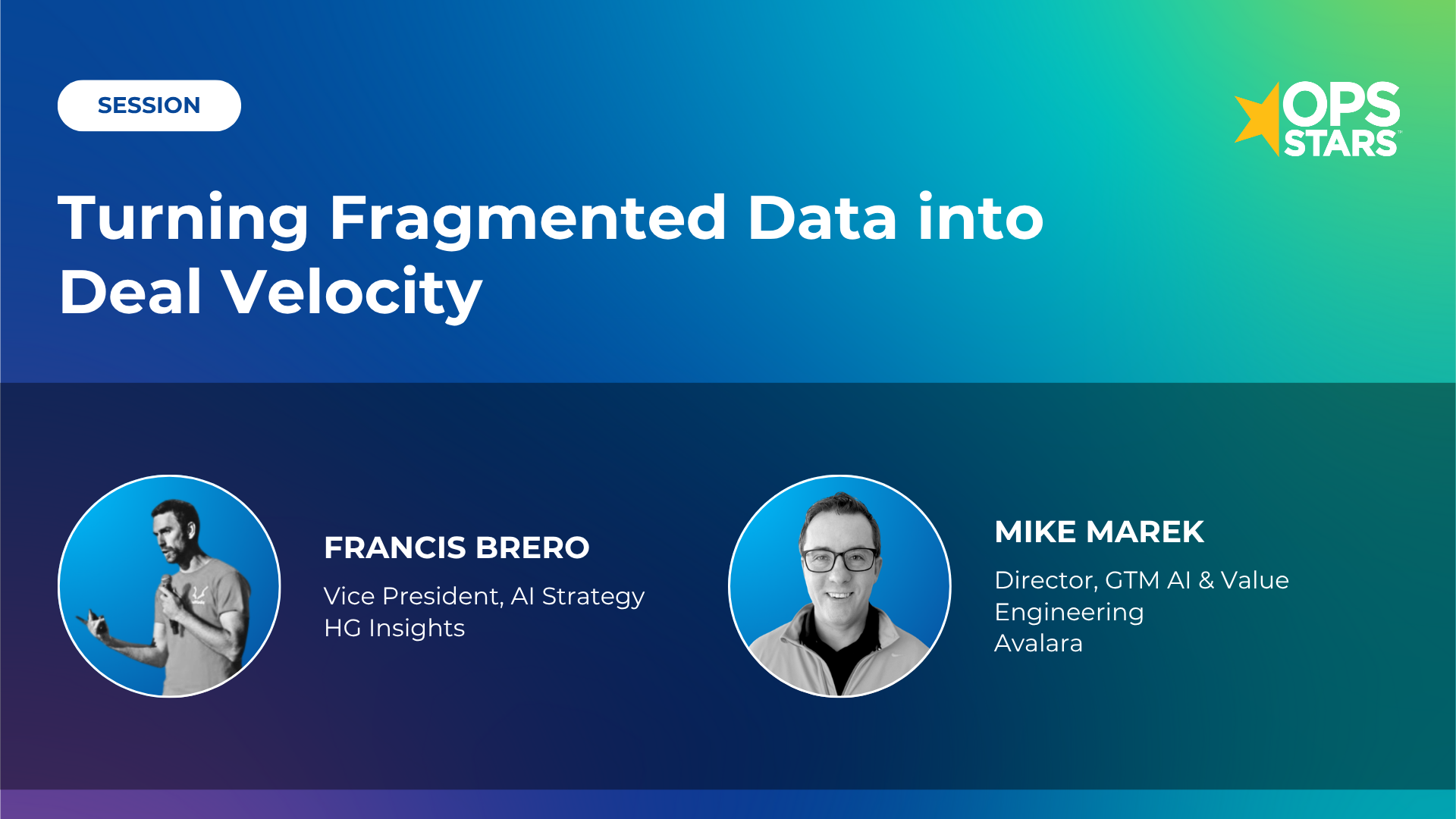
At OpsStars 2025, Francis Brero, and Mike Marek, shared how Avalara transformed its revenue operations by embedding agentic AI across its tech stack. From custom GPTs to automated n8n workflows, they showed how to unify data, scale automation, and accelerate deal velocity across Sales, Marketing, and RevOps. This session is ideal for operations and GTM leaders looking to move from fragmented data to coordinated, AI-powered execution.
Key Takeaways
- Operationalize AI with purpose. Start by automating painful 20 percent tasks like research, email drafting, and prioritization instead of chasing full automation.
- Meet reps where they work. Integrate AI into familiar tools such as ChatGPT, Gong, and Salesforce to increase adoption and trust.
- Focus on connected data. Centralize buyer signals from Snowflake, 6sense, and ZoomInfo to fuel more accurate AI recommendations.
- Accelerate procurement and iteration. Shorter AI cycles and one-year contracts keep stacks flexible in a rapidly evolving landscape.
- Align RevOps and Engineering. Shared ownership of AI governance and data security builds confidence and scalability.
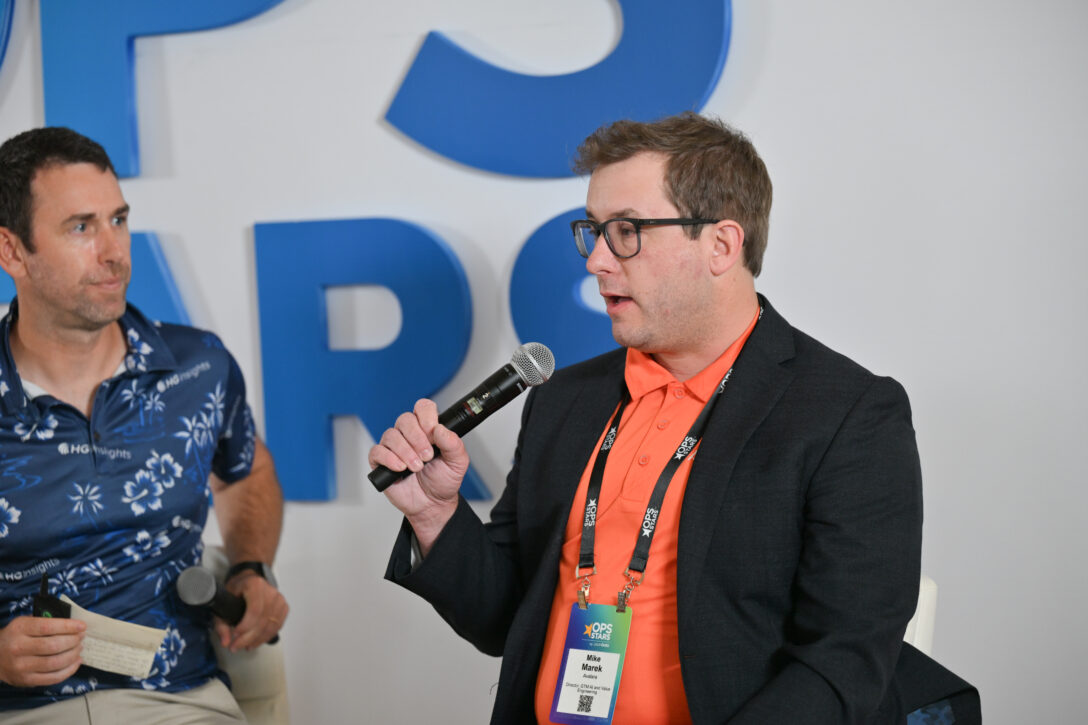
Speakers
Francis Brero, Co-founder & CRO, HG Insights
Francis leads AI strategy and product innovation at HG Insights, helping enterprises translate data into actionable go-to-market insights that accelerate revenue performance.
Mike Marek, Director of AI Go-to-Market and Value Engineering, Avalara
Mike oversees AI implementation for Sales, Marketing, and Partnership teams at Avalara, driving agentic automation to improve rep productivity and deal velocity across global operations.
What You’ll Learn
Q: How did Avalara use AI to boost rep productivity?
A: Avalara built “DiscoGPT,” a custom GPT that researches accounts, summarizes insights, and drafts emails for reps. Combined with an n8n workflow called “Match for Outbound,” the system automatically scores and sends top prospect recommendations each day, saving thousands of hours in manual work and improving speed to lead.
Q: What makes agentic AI different from traditional automation?
A: Agentic AI uses memory and context to perform multi-step tasks independently across systems, like researching an account and drafting a personalized message. Avalara pairs these agents with structured data from Snowflake and CRM systems to generate reliable, on-brand outputs without rebuilding processes.
Q: How can RevOps leaders manage AI governance and security?
A: Avalara moved its agentic workflows to an on-prem environment after initial cloud pilots, ensuring compliance and data control. RevOps and engineering collaborate on frameworks that balance innovation speed with enterprise-grade security.
Session Transcript
Francis Brero:
Thank you, everyone, for joining. I hope you’re ready for the Nick Cage quiz. All jokes aside, this is a topic that is really dear to my heart as the VP of AI Strategy. AI is something I deal with a lot. I feel it’s a topic that’s often discussed, but sometimes we lack the more pragmatic elements about it.
That’s why I’m so excited to host Mike today, who’s going to share some actual examples of successful AI implementations at an enterprise company, Avalara. He’ll share a little bit about Avalara, but they’re a pretty large company. This isn’t like, “Hey, someone got something running in a small startup.” This is hundreds of reps using AI to be more productive. I’m really excited to share that conversation.
Mike, maybe you can give a quick intro about yourself while I grab the clicker.
Mike Marek:
Hi, I’m Mike Marek, Director of AI Go-to-Market and Value Engineering at Avalara.
At Avalara, we take tax and compliance for business-to-business companies and automate it. We were one of the first suppliers on the cloud, and now we’re moving into fully AI-driven tax compliance.
Because we’ve invested so much on the product and engineering side, it has trickled down into go-to-market. All 5,500 Avalara employees have access to ChatGPT. We have it at our fingertips, and we’ve also invested in n8n, which is an agentic process builder. Everyone has access to that as well, so we’re automating many of our current processes.
Francis Brero:
Can you share a bit more about your role? GTM AI and Value Engineering might not be familiar terms for everyone. Where do you report in the org, and what’s within the scope of your team?
Mike Marek:
Currently, I report through the sales organization, though it sounds like I’ll be moving into Revenue Operations soon.
When I was originally brought on, I was a true value engineer, making proposals and bringing in Forrester ROI metrics. I also led our RFP program, and I automated most of what I just talked about.
This year, I moved into AI initiatives. My oversight includes sales, marketing, and our partner group, building out agentic flows that benefit reps across all of those functions.
Francis Brero:
As we talk about specific AI implementations at Avalara, it helps to start with the tech stack. The goal isn’t to promote tools but to explain that Avalara, as a large organization, has significant data supporting its go-to-market team.
It’s generally hard to combine all that data and make sense of it in a way that delivers value. Mike, can you walk us through some of your tools and why they’re helpful to your GTM team?
Mike Marek:
Sure. This is only a partial list, but one of the best moments of my career was meeting Francis last year at our RevCo.
In my old role as a Revenue Operations Analyst, I couldn’t get access to all the data I needed. HG Insights, formerly MadKudu, solved that by providing a single pane of glass. We could look at 6sense, ZoomInfo, and other sources all in one spot.
We’ll walk through some of the agentic workflows I’ve built, but that single view was key. I immediately thought, “This is what I’ve been looking for my entire career.”
Francis Brero:
One thing that stood out about Avalara is how your size gives you leverage. Many platforms don’t make their data easily accessible, but when you’re a large enterprise, you can push for access.
Avalara pipes everything into Snowflake as part of its MDM strategy, like many organizations. These projects can take years, though, and often deliver little short-term value to GTM teams.
That’s why our early conversations were so interesting. You were trying to leverage the data already in Snowflake to make it operational for sales. Tell us about the first internal project you built—DiscoGPT.
Mike Marek:
DiscoGPT is in its second iteration now. Initially, every Avalara employee got access to ChatGPT, so our sales reps started building their own custom GPTs. It was like everyone got a model rocket kit—some exploded, some took off, and some were amazing. Disco was one of the good ones.
We launched it in April, and since then we’ve had nearly 50,000 messages and 20,000 conversations. Reps use Disco to research accounts before they call, and it also composes a message for them.
We still wanted to keep the GPT front-end but make it more powerful, so we layered in memory and connected it with our MadKudu MCP scoring and CapDB data from Vista. We also built a purpose-built agent to conduct research and draft more refined prospect messages aligned with our personas.
This new flow only launched a few weeks ago, and adoption has been incredible.
Francis Brero:
That’s fascinating. ChatGPT became viral because every rep could use it for work or personal tasks. It’s interesting to see Avalara double down on that adoption by making GPT enterprise-ready and secure.
You met reps where they already work, and the model is only as good as the data it can pull. Connecting Salesforce and other systems to ChatGPT gives it that power.
You mentioned a “research” node in your workflow. Your team spent a lot of time defining the right questions, expected answers, and supporting PMM content. That structure helped reps get faster, more accurate insights.
Mike Marek:
Exactly. This has already saved us tens of thousands of hours and gives reps the right talk tracks immediately.
Francis Brero:
That’s a great example. The next step after research is usually sending an email. Can you explain that workflow?
Mike Marek:
Yes. I always joked that I wanted to build a dating app, and this is close.
Avalara historically had strong inbound motion but hadn’t built much outbound muscle. This year, we assigned geo territories, and reps said, “We don’t know where to start.”
So, we built “Match for Outbound.” It uses MadKudu scoring, CapDB data, and 6sense insights to stack rank accounts. Then, the n8n flow automatically researches that company and emails each rep daily with their top match and a ready-to-send email.
All they have to do is open Gong Engage, paste the email, and go.
Francis Brero:
That’s incredibly efficient.
Mike Marek:
We’re still refining the message with input from our product and marketing teams, but the AI gets us about 80 percent there. The remaining 20 percent is personalization by the rep.
The research agent even scans LinkedIn profiles to add personalized touches. It’s been a huge success, and our new outbound programs are producing real results.
Francis Brero:
That 80/20 rule is key. Don’t aim for 100 percent automation. Going from 0 to 80 percent saves massive time, but the last 20 percent is where human context still matters.
Mike Marek:
Exactly. Trying to automate everything creates diminishing returns. This balance gives us huge productivity gains without losing authenticity.
Francis Brero:
You’ve mentioned n8n several times. Can you walk us through how easy it is to build one of these workflows?
Mike Marek:
Sure. I’ll show how I built “Match.”
The first step is setting a trigger, which runs every night. Next, it pulls data from a master Excel file connected to Salesforce reports. It gathers all the account details we want AI to research, along with MadKudu scores and intent data.
Then we define the agent’s logic. It’s similar to prompt writing in ChatGPT, except it runs hundreds of times automatically. You can drag and drop fields from Excel and even define the output format for consistency.
We also define a system message to guide the AI’s behavior. For research, I use Claude 4 because it’s more consistent and concise. Finally, we connect the output to an Outlook node that sends the message to reps at midnight. They wake up to a new prioritized lead list.
The first one took me 30 minutes to build. Now I can make one in about five minutes.
Francis Brero:
That’s impressive. Tools like n8n make it possible to scale automation quickly without code.
Mike Marek:
Exactly. I’d be stuck without it. These flows let us automate and scale processes without relying on reps to do things manually.
Francis Brero:
Avalara is a large enterprise with governance and compliance requirements. How did you navigate the usual AI concerns around data privacy and security?
Mike Marek:
We started on the cloud instance but quickly moved on-prem after review by our security and engineering teams. We wanted to ensure our data was protected. That’s why we use our internal model, Alpha, instead of connecting directly to the open ChatGPT API.
It’s been refreshing to see collaboration between engineering, product, and go-to-market teams. Everyone’s aligned and moving fast together.
Francis Brero:
That’s great. How has AI changed your procurement process?
Mike Marek:
Procurement is moving faster than ever. We evaluate tools quickly because we want to lead with AI. What used to take two or three months now takes about two weeks.
We prioritize platforms with open APIs since we need to connect data across our flows. Multi-year contracts are rare now because the market is evolving so fast.
Francis Brero:
That’s an important point. Many companies are shifting away from multi-year deals because AI evolves so quickly. Vendors that can deliver results fast will win.
Mike Marek:
Exactly. We often choose one-year agreements so we can pivot as new tools emerge.
Francis Brero:
How are you balancing build versus buy?
Mike Marek:
If one of our partners already has a solution, we’ll use it. But many times, we need to build it ourselves first, then submit feature requests.
We want to go fast, so we build when we must but prefer to buy if it’s scalable.
Francis Brero:
Makes sense. I imagine your CEO expects every new tool to include AI capabilities.
Mike Marek:
Yes, 100 percent. Every new software product we evaluate must have AI capabilities.
We also launched our own MCP to connect Avalara’s 1,500 different ERP integrations. It’s a game changer, and we expect our vendors to follow the same open-platform model.
Francis Brero:
How has this AI transformation changed the structure of your operations team?
Mike Marek:
The lines between RevOps and Go-to-Market AI are blurring. I’ll likely move into RevOps soon.
I’ve worked in RevOps for 15 years, and tools like n8n and Glean are revolutionary. They automate tasks that used to take hours and give reps instant insights.
Francis Brero:
How are you upskilling the broader organization to work with AI?
Mike Marek:
We started by giving everyone access to custom GPTs, then introduced n8n. Because there weren’t many experts, we brought in consultants to train our teams.
Now we’re internalizing that expertise. Within three months, we’ll have in-house AI builders across departments—sales, marketing, and engineering. Everyone will be able to create their own automations.
Francis Brero:
That’s great. Did you provide training for sales reps as well?
Mike Marek:
Yes. We ran ChatGPT training on WorkRamp and are now doing hands-on sessions for n8n. I’m currently traveling globally to train teams. I was in London two weeks ago, and I’ll be in India next.
We want everyone to be comfortable building and using agentic workflows. It’s the future of how we’ll operate.
Francis Brero:
That’s fantastic. What I love about your story is that it shows how velocity is everything in this new era.
We, as vendors, need to think of ourselves as advisors helping companies through this change. And inside our own organizations, we must drive cultural change through quick wins.
Thank you for sharing such a powerful example of what good looks like in practice.