













Summary
An AI SDR (AI sales development representative) is autonomous software that prospects, personalizes outreach, qualifies leads, and books meetings across email, chat, and voice. This guide covers what an AI SDR is and where AI SDR deployments break at enterprise scale. It also walks through the data, routing, and governance foundation that turns agent activity into booked revenue.
What You’ll Learn
- How an AI SDR differs from an AI GTM orchestration platform, and why that distinction shapes your stack
- The benefits and limits of AI SDRs, drawn from Gartner research
- The specific failure modes that surface once several agents share your records
- When to deploy an AI SDR versus pointing one at work your human reps already do well
- What your CRM, routing, and governance need to support before you scale
Why AI SDRs Are Suddenly Everywhere
Prospecting is moving to agents, and the pace is hard to overstate.
Gartner research notes that a human B2B seller spends roughly 14 percent of the week prospecting, while an AI agent can run prospecting every hour of a seven day week. That gap explains the adoption curve.
In LeanData’s May 2026 AI GTM Customer Survey, 93 percent of respondents had deployed at least one AI agent and 79 percent were scaling or actively expanding.
On the buyer side, AI SDRs win the speed to lead game. An agent that answers instantly, at any hour, in any language, has an obvious edge over a queue of leads waiting for a rep to log in Monday morning.
So the appeal is real. The trouble is that agent output is outrunning the infrastructure underneath it, and that’s where most opereations teams run into a wall.
This guide walks through four main areas:
- What these agents are
- What they do well
- Where they break
- What you need in place before deploying
What an AI SDR is & What it Does
Gartner defines an AI SDR as a software entity built to work autonomously across the early sales motion. In practice, that means an agent that can:
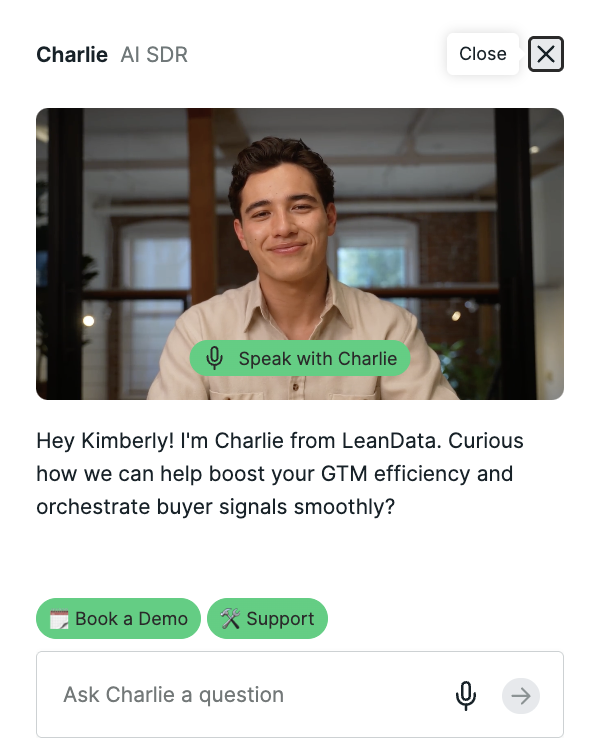
- Profile and identify target accounts
- Write personalized messages and content in multiple languages
- Run outbound and inbound communication across text, voice, video, and chat
- Send and accept LinkedIn requests
- Follow a multichannel sequence
- Answer a prospect’s opening questions
- Ask qualifying questions and act on the answers
- Schedule a meeting between a prospect and a salesperson
The key word is autonomous.
An assisted tool drafts an email and waits for a rep to hit send. An autonomous agent decides who to contact, what to say, and when to follow up, then acts without a human in the loop.
Most products marketed as “AI SDRs” sit somewhere on that spectrum, and where a given tool sits changes how much oversight it needs. When you evaluate one, the first question is not how smart it sounds in a demo. It’s how much it will do on its own against your incoming and outgoing signals.
It’s also important to note that the term AI sales agent is often used interchangeably with AI SDR. AI BDR usually points to the same idea with an outbound emphasis.
AI SDR vs. AI GTM Orchestration
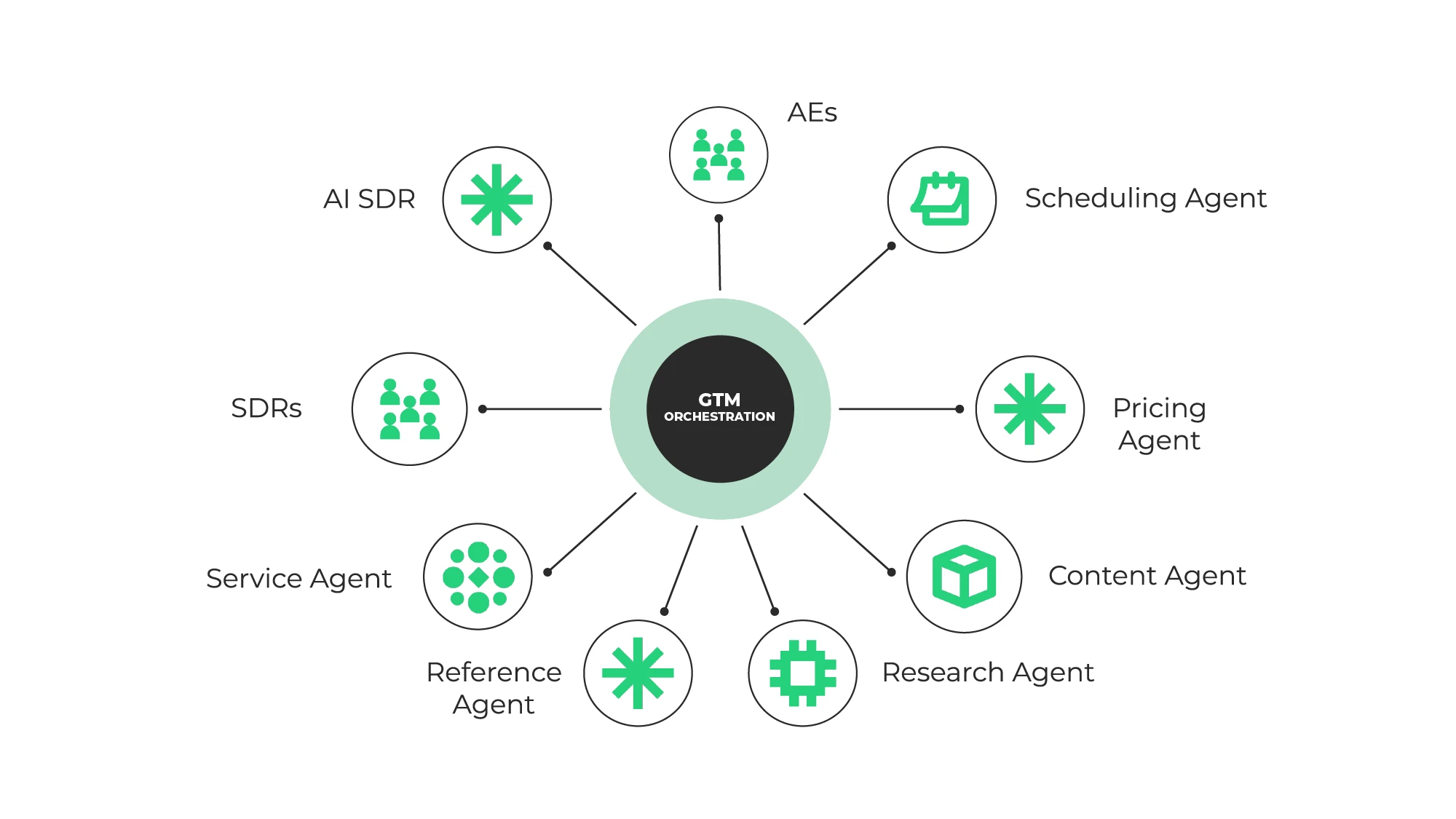
An AI SDR is a participant in your go-to-market motion. It is not the system that runs the motion.
Think of the agent as a very fast, tireless worker who shows up, talks to prospects, and creates activity. That worker still needs a rulebook for who owns which account and a manager who can see what they did and why.
An AI GTM orchestration platform supplies that surrounding structure. It resolves and cleans the data the agent reads, encodes the ownership and territory rules the agent has to follow, routes qualified conversations to the right rep, and logs every action so humans can audit it later.
Confuse the two and you end up asking a single agent to be the worker, the rulebook, and the manager all at once. That’s exactly the setup that produces the failure modes outlined below.
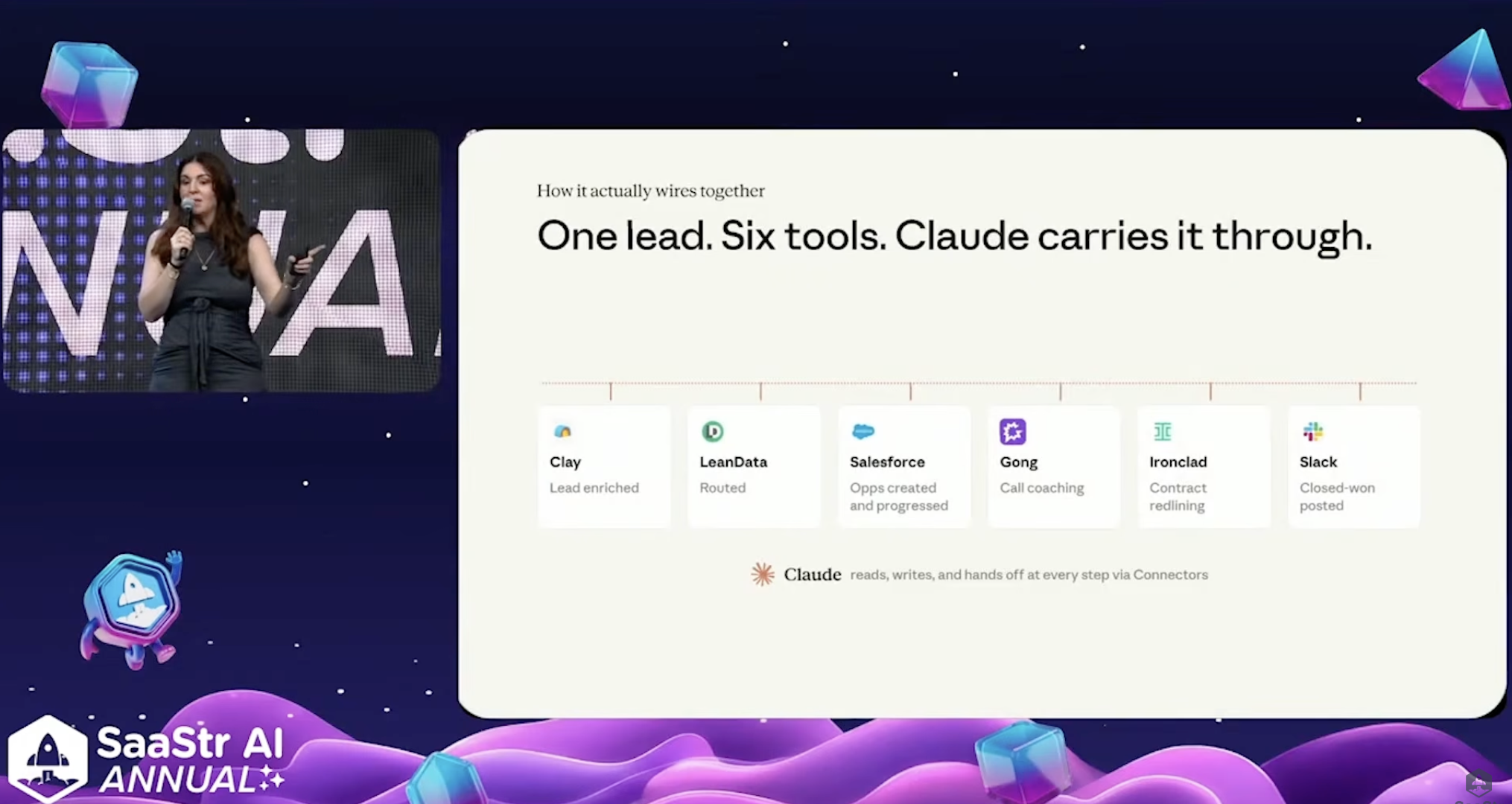
The healthier model puts the agent inside an orchestration layer, where any AI SDR platform can plug in. The agent handles the conversation, and the platform handles the matching, routing, scheduling, and record keeping.
AI SDR Benefits and Limits
AI SDRs are good at a real and specific set of things, and weak at an equally specific set. The benefits cluster around speed, coverage, consistency, and cost. The limits cluster around nuance, judgment, and anything that depends on the quality of what you feed the agent.
At a few thousand dollars a month, an agent looks inexpensive next to a fully loaded SDR salary. That math is part of why budgets are moving.
The catch is where AI SDRs struggle. An agent that costs little but acts on bad data, sends off-brand messages, or contacts the wrong people at scale does not save money. It manufactures cleanup work and erodes trust with your market.
A human SDR sending bad outreach is a slow problem. An agent sending bad outreach is a fast one. Speed is a benefit only when the thing being sped up is correct.
Where AI Agents Break at Enterprise Scale
Agents usually work fine in a pilot. However, they tend to break when several of them share your records at production volume. LeanData’s AI GTM Customer survey makes this pattern concrete.
Across 109 GTM teams, here’s what showed up in the last six months:
- Data quality degraded execution for 70 percent of teams. Bad, stale, or duplicate records are the single most common thing breaking GTM execution, agents included. An agent reading a messy CRM does not fix the mess. It acts on it, faster.
- 27 percent had multiple tools or agents hit the same prospect. When more than one system can reach a contact and nothing coordinates them, your prospects get the same pitch from three directions. The most common answer to “how many agents touch your records” was three to four, and nearly one in three respondents did not know the number at all.
- 30 percent had actions taken on records with no clear audit trail. A third of teams have agents doing things to live records that no one can later explain. When a deal goes sideways, there is no way to reconstruct what the agent did or why.
- 60 percent named “agents acting on the wrong records” as their top fear. This was the number one concern about scaling agents, ahead of measuring ROI and agents conflicting with each other. Read together, the top fears all describe the same thing: agents running without a coordination layer underneath them.
Notice what these have in common: None of them is a complaint about the agent’s intelligence. They are all control problems.
The agent is doing what it was told. The system around it cannot keep that activity clean, coordinated, or accountable. A smarter agent does not fix this problem. A foundation does.
When to Deploy an AI SDR vs. Augment Your Humans
A common assumption is that an AI SDR is a one for one replacement for a human SDR. It is not. An agent will not simply step into a headcount slot and match your current conversion rates.
Plan for hybrid teams instead, where the agent takes the repetitive, formulaic, high volume work and your people take the work that rewards judgment and relationships.
Why an agent will not lift your numbers on its own
An AI SDR works with the same raw materials your team already uses: the same data, the same messaging, the same target list.
Its results track your existing motion as a result. If your reps earn a one percent response rate, the agent will land somewhere around zero to one percent too. Further, the prospects who already ignore your reps will ignore your agent just as readily.
High agent volume can hide that rate for a while, so a flood of early activity is not proof the motion works. Fix the underlying motion first, and the agent scales something worth scaling.
Where AI SDRs do their best work
AI SDRs do their best work when they augment coverage and add capacity: answering an inbound inquiry the moment it arrives, guaranteeing every lead gets a response, qualifying at the top of the funnel, and booking a meeting with the right rep without a human handoff. They also let you run sequences you would never staff by hand, like reviving last year’s stalled deals or following up with everyone you met at an event.
Where human sellers should focus
Human sellers, meanwhile, should stay focused on high quality engagement: the multi stakeholder deals, the ambiguous conversations, the moments where reading the room matters. AI SDRs struggle with complex, multi stakeholder buying, which is most of what enterprise selling involves once a deal gets real.
How to deploy and own the agent
Treat an AI agent like a capable new graduate. It needs a job description, clear objectives, supervision, onboarding, training, and feedback. That also means one named person should own its output, the way a manager owns a new hire’s work, rather than leaving the agent to a committee where no one is truly accountable.
Deploy it where you have a clean, repeatable process and a gap in human coverage. If you do not have that foundation yet, use agents for small, contained experiments first, and build the process as you learn.
The Foundation AI SDRs Require
The agents are ready. Unfortunately, most operations are not. In the LeanData AI GTM Customer survey, 68 percent of teams said their GTM infrastructure is not fully ready for AI, and only 31 percent said it was.
Typically, the readiness gap, not the agent, is the barrier standing between activity and revenue.
All SDRs, human or agentic, need a good starting point. They require:
- Quality targeting data
- Strong messaging and positioning
- Sufficient product knowledge
- A formalized sales process
- Defined handoffs
- Good prospecting plays.
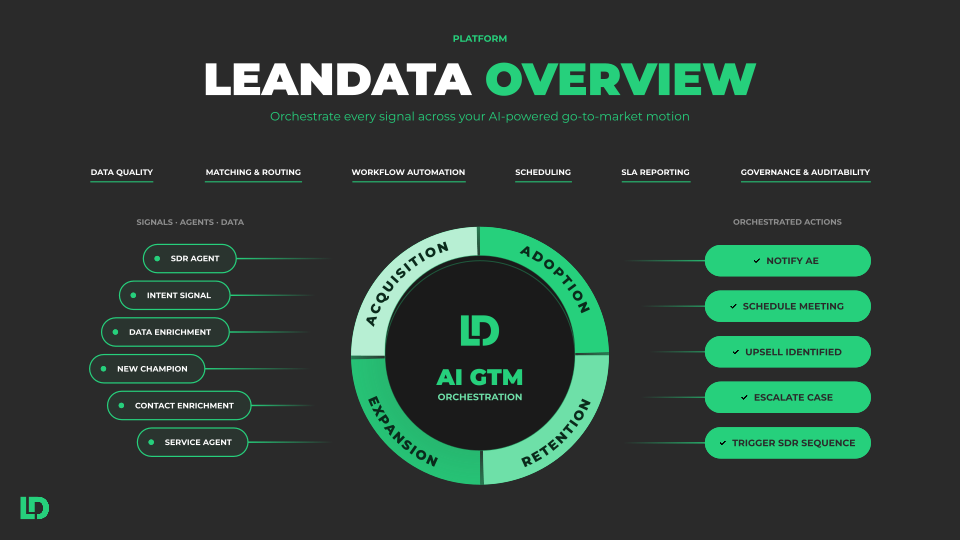
Strip those away and the agent has nothing solid to stand on. LeanData organizes that same foundation into three layers:
- Data foundation. Clean, resolved, continuously governed records that agents and people can both trust. This is where matching and deduplication live, and it is the layer the survey shows breaking most often. An agent absorbs everything you give it, including outdated content and stray pages you forgot were still public. What you feed it becomes how it speaks to your market, so the input has to be clean before the agent goes live.
- Context and intelligence. Encoded knowledge of ownership, history, and relationships, so the agent acts with the full picture rather than a single field.
- Orchestration and execution. Deterministic, auditable action inside the CRM. The orchestration layer does not suggest a next step and wait. It executes the routing, the handoff, and the SLA, and it logs all of it.
The ideal AI GTM orchestration setup is both deterministic and agentic, side by side. The agent brings the speed and the conversation. The orchestration layer brings the rules, the routing, and the record.
Concretely, that means an agent qualifies a buyer, then the orchestration platform matches the lead to the right account with high accuracy, routes it to the correct rep by territory and ownership, books the meeting in real time, and enforces a response SLA so nothing goes cold.
How Uber for Business Made AI SDRs Work
LeanData’s Uber for Business case study is a useful model because the team fixed the foundation before it added a single agent.
Growing toward a 10 billion dollar run rate, Uber for Business ran into the problems scale creates: routing delays between lead engagement and rep assignment, SLA breaches after hours, and manual scheduling friction at the exact moment buyer intent peaked. So the team rebuilt the execution layer on LeanData, with instant routing, redesigned SLAs, and automated scheduling.
The foundation results came quickly:
- Routing gap reduced by 80 percent
- Improved speed to lead by about 90 percent
- Lifted SLA attainment by 45 percentage points
- Sales cycle fell from 78 days to 25
- 68 percent gain in deal velocity
- Win rates rose from 32 to 49 percent.
As Nicole Peinado, Uber’s Revenue Technology Manager for AI Ops, put it, “If you fix the plumbing, the business outcome will follow.”
Foundation Established, Now Add Agents
Only then did the team add agents, starting at the top of the funnel where the work is repetitive, high volume, and time sensitive. The pattern was specialization rather than one generic workflow:
- A self service agent on Agentforce that assists prospects through the self service funnel. When it meets a question it cannot resolve, BookIt powers both the meeting booking and the warm handoff to a live rep, with full context at the moment of booking.
- An outbound agent that researches persona fit and personalizes cold outreach at scale.
- A verticalized campus advisor running targeted outreach for education, a segment where Uber had no human coverage.
- An inbound agent that nurtures and qualifies low intent leads and filters junk so human reps can focus on selling.
Control runs underneath all of it. Uber tags every lead and contact its agents touch, so each action stays auditable, and humans QA about 10 percent of the roughly 400 leads that flow through each week.
IT governs what data each agent can reach, limited to the leads, contacts, and content it needs.
The combined result, through Agentforce and LeanData, was a 23 percent cost reduction, 28 percent more outreach capacity, and a 22 percent revenue uplift.
Nicole’s sequence is worth copying: improve the foundation, orchestrate the flow, then connect the systems.
Building the Business Case for an AI SDR
If the foundation is the technical argument, capacity is the financial one. LeanData’s AI GTM Customer survey found that 66 percent of GTM Ops teams are at or over capacity, with critical work sitting in a backlog and no room for strategic projects.
AI is adding complexity faster than these teams can absorb it. That is the pressure an AI SDR is supposed to relieve.
The business case works when you frame the agent against that capacity gap rather than against headcount. An agent that guarantees instant response on inbound, runs sequences your team would never have time to build, and frees your reps to work the deals that need a human is creating capacity you could not buy with another hire at the same cost.
First, it covers the work that was falling through. Then it lets your people move up to higher value selling.
The business case for the AI SDR also accounts for the foundation. Budget for the orchestration layer alongside the agent, because an agent on a shaky foundation generates cleanup costs that quietly eat the savings.
See how an AI SDR connects to routing you already trust
FAQ
How much does an AI SDR cost?
Will an AI SDR replace my human SDRs?
What data does an AI SDR need to work well?
Who should own the AI SDR in a RevOps org?
How do you measure AI SDR performance?

Kim Peterson
Kim Peterson is the Senior Manager of Content Strategy at LeanData where she digs deep into all aspects of go-to-market strategy and execution. Kim's writing experiences span tech companies, stunt blogging, education, and the real estate industry. Connect with Kim on LinkedIn.