














Summary
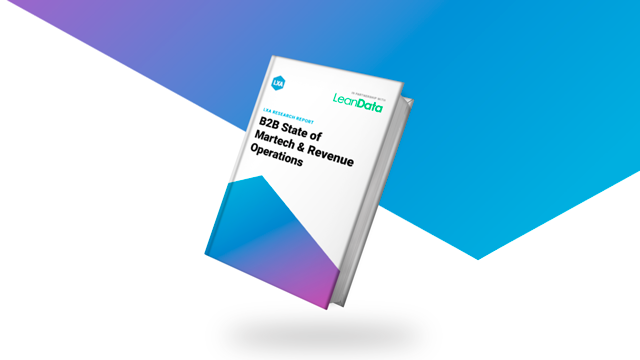
The 2026 B2B State of Martech and Revenue Operations report surveyed 201 senior leaders at large enterprises to benchmark where revenue operations stand heading into a year defined by AI. The findings expose a widening gap between AI ambition and the operational readiness required to make that ambition deliver revenue.
What You’ll Learn
- Why enterprise martech stacks shrank from 62 tools to 37, yet the coordination burden barely moved
- Which of the five maturity pillars scores lowest, and what that says about where teams have under-invested
- Where lead management quietly leaks pipeline, and the routing gaps behind it
- Why companies adopt AI fastest for content and slowest for revenue-critical work like lead routing
- The six priorities the report recommends for closing the readiness gap in 2026
The Defining Tension of 2026
Almost every revenue team now agrees on what good looks like. Clean data, documented processes, and reliable routing should come before any serious AI rollout.
The 2026 B2B State of Martech and Revenue Operations report puts a hard number on that consensus: 82% of leaders say those foundations are prerequisites for scaling AI. Yet fewer than one in three have the enforcement mechanisms in place to act on the belief.
That distance between knowing and doing is the story of the year.
Organizations are accelerating AI investment, conviction, and hiring, while the lead management, governance, and cross-functional discipline that turn AI into revenue lag behind. As a result, the cost of the mismatch is starting to show up in execution, and it will compound before it corrects.
This article walks through the report’s central findings, and explains what the data means for the teams that own go-to-market infrastructure.

About the Research
LXA conducted this study in April 2026 in partnership with LeanData. The sample is deliberately narrow and senior: 201 leaders at B2B organizations with 2,500 or more employees, spanning seven countries.
Respondents included CMOs and VPs of marketing, plus leaders across marketing technology, demand generation, sales operations, revenue operations, and marketing operations.
Because the sample focuses on large enterprises, the findings describe the environment that complex, high-volume revenue teams operate in every day.
Where the report compares against prior years, those earlier figures reflect a broader respondent mix, so treat the trend lines as directional rather than exact. With that context set, here is what the data shows.
Leaders Surveyed
201 B2B leaders at companies with 2,500+ employees, spanning seven countries
Top Roles Surveyed
CMO/VP Marketing, MarTech, Demand Gen, Sales Ops, RevOps
Industries Surveyed
Technology, financial services, manufacturing, telecoms, corporate services
Finding 1: The Martech Landscape has Plateaued, but Complexity Hasn’t
The report’s tech stack stat is dramatic: The average enterprise stack fell to 37 tools, down from 62 a year earlier. On the surface, that reads like simplification. Look closer though, and the picture changes.
Twenty-one percent of organizations still run 50 or more tools, and 74% still prefer a best-of-breed approach. Teams are trimming selectively rather than collapsing onto a single suite.
Consequently, the operating model is leaner but still multi-vendor and still integration-dependent.
That shows up clearly in the top barrier to maturity: 51% of leaders cite integration complexity, more than any other constraint. Fewer tools did not produce fewer connections to manage.
Meanwhile, buying committees keep growing and technology budgets keep rising, with 79% expecting spend to increase over the next year as AI-capable platforms command a higher unit cost.
The takeaway: stack size went down. But, the work of making those systems talk to each other did not.
Finding 2: Process and Operations is the Weakest Link
The report benchmarks maturity across five pillars. The pattern across them is more revealing than any single score. People and Teams now leads, and Process and Operations sits last, by a consistent margin and with the smallest improvement over three years.
People and Teams, once the weakest area, is now the strongest. Process and Operations, once mid-table, is now reliably last.
This means that organizations have hired and equipped their teams ahead of building the operational infrastructure those teams depend on.
Maturity is no longer held back by a shortage of tools or talent. Instead, it’s held back by the processes, governance, and coordination that decide whether those investments translate into reliable execution.
78% of B2b leaders believe AI agents are the most transformative technology. Yet only 17% have AI embedded across their business.
Finding 3: Lead Management Gaps Are Costing Pipeline
Nowhere does the process gap bite harder than in lead management. The report asked leaders to name their most significant gaps, and the results describe an environment where manual coordination and operational bottlenecks reinforce each other.
Here’s the full picture, organized by how often each gap was cited:
- 47% report manual processes that cannot scale with growth: the single most-cited gap. Teams cannot grow because their processes depend on people doing things by hand.
- 45% report slow or missed follow-up on inbound leads. High-intent moments go cold while leads wait.
- 42% report poor alignment between marketing and sales on lead qualification. The buyer journey fragments at the handoff.
- 40% report data quality issues preventing accurate routing or assignment. Bad inputs produce bad routing decisions.
- 32% report duplicate or mismatched lead-to-account records. Records that don’t connect create inconsistent outreach and wasted effort.
Finding 4: AI Deployment Is Concentrated Where Mistakes Are Recoverable
Conviction about AI is close to universal. Seventy eight percent of leaders believe AI agents will be among the most transformative technologies in marketing and sales operations. Yet only 17% have AI embedded across multiple areas of their business.
Further, just 2% describe it as central to how they operate. Most are still running experiments or have deployed AI in one or two narrow use cases.
The deployment pattern tells you why: Teams adopt AI fastest where a mistake is cheap, and slowest where a mistake hits revenue directly.
A weak AI-generated draft is an inconvenience you can fix in seconds. However, an agent that misroutes a high-value lead, though, has a direct commercial cost. So it makes sense that lead routing and assignment sits dead last at 11%.
That 11% cuts two ways.
It signals a market that is reluctant to hand pipeline-critical decisions to autonomous agents until the underlying processes are sound. At the same time, it marks a window of advantage for teams that build those foundations early and move while others hesitate.
Finding 5: Governance Is Not Keeping Pace
If AI is moving into revenue-critical work, governance has to move with it. The data says it isn’t.
Only 50% of leaders are confident their organization has the controls and processes to deploy AI safely at scale. Meanwhile, 82% agree that clean data, defined processes, and reliable routing must come first. The belief is settled. The investment to back it up is not.
Skills priorities reveal the same imbalance. Teams are prioritizing the ability to use AI over the ability to govern it. Applied AI skills top the list at 47%, while AI governance and responsible AI practices rank sixth at 31%, behind several other AI and data skills.
Then there is data quality itself, cited by 44% as a barrier to maturity. Without visibility into SLA compliance, lead-to-account matching, and routing accuracy, teams are flying blind on pipeline health, and every AI initiative becomes a gamble.
One more wrinkle: the report found no single owner for AI governance.
RevOps, marketing leadership, and IT all hold a stake. The emerging consensus among practitioners is that governance should be shared across those functions rather than parked in any one of them.

What the Research Means for Revenue Leaders
The report closes with six priorities for 2026:
- Audit operational discipline before scaling AI. Start with your routing, qualification, and lead-to-account matching, and check them for SLA enforcement. Only 26% of peers have that enforcement today. Layering AI on top of unmonitored routing accelerates leakage instead of fixing it.
- Extend governance across the full buyer lifecycle. Process gaps don’t stay contained once AI enters the picture. A broken marketing-to-sales handoff ripples into pipeline velocity, renewal timing, and expansion later. So orchestration needs to span acquisition through retention, not just the top of the funnel.
- Simplify fragmentation through workflow, not procurement. Stacks are shrinking, yet integration complexity remains the top barrier at 51%. Rationalize based on workflow requirements and data architecture, not budget line items alone. The goal is fewer points of failure between systems.
- Align revenue actions to the buyer journey. 42% cite poor marketing-sales alignment on qualification. Shared definitions, unified visibility, and enforceable SLAs across functions compensate for a journey that fragments by default.
- Invest in governance that keeps pace with AI adoption. As agents start acting autonomously in revenue workflows, the cost of ungoverned deployment climbs. Share ownership across RevOps, marketing, and IT.
- Recognize the widening gap between leaders and laggards. Process and Operations remains the lowest-scoring pillar. Teams that treat operational discipline as the binding constraint will compound their advantages, while the rest accumulate operational debt that AI surfaces faster than it solves.
Closing the Readiness Gap Before It Widens
The 2026 data is consistent from the first finding to the last: Investment in people and technology has outrun the processes that connect them. And, AI is now accelerating the pace of execution faster than most operations can keep up with.
The teams that close the gap soonest will pull ahead. The teams that wait will watch the distance grow between what their technology can do and what their operations can actually deliver.
The good news is that the fix is operational, not magical.
Audit your foundations, extend governance across the lifecycle, and simplify through orchestration rather than another round of procurement. Do that, and AI ambition finally has somewhere reliable to land.
Get the full benchmark, including the charts and methodology behind every figure
FAQ
What is the B2B State of Martech and Revenue Operations report?
What is the AI readiness gap in revenue operations?
Why is AI lead routing adopted so slowly compared to other AI use cases?
What is the lowest-scoring area of revenue operations maturity in 2026?
How does GTM orchestration help close the AI readiness gap?

Kim Peterson
Kim Peterson is the Senior Manager of Content Strategy at LeanData where she digs deep into all aspects of go-to-market strategy and execution. Kim's writing experiences span tech companies, stunt blogging, education, and the real estate industry. Connect with Kim on LinkedIn.