














Summary
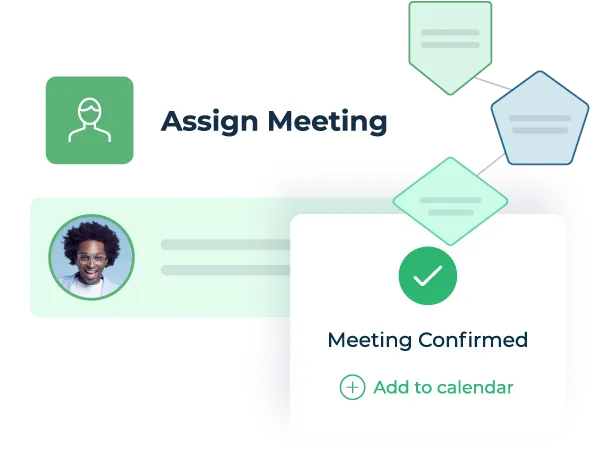
Scheduling software for B2B sales teams automates the process of connecting qualified buyers with the right sales rep at the moment of peak interest, eliminating the manual back-and-forth that causes deals to stall. Learn how LeanData’s BookIt suite integrates scheduling directly with Salesforce routing logic so that every meeting, from inbound form fill to internal handoff, is booked with precision and full context.
What You’ll Learn
- The features that separate purpose-built B2B scheduling software from general calendar tools
- Why scheduling and orchestration have to work together to reduce speed-to-lead
- What the three LeanData BookIt products do and when to use each one
- How to measure whether your scheduling automation is actually working
The Meeting That Never Gets Booked
A prospect fills out your demo request form. Your routing logic works exactly as designed — the lead lands with the right rep in seconds. And then three days pass before anyone finds a time to meet.
By then, the buyer has moved on.

This pattern shows up in almost every revenue stack at some point. The routing problem gets solved first, because it is visible and urgent. The scheduling problem stays hidden longer, because no one system owns it. One tool handles assignment, another manages calendars, a third sends reminders, and Slack fills whatever falls through the cracks. Each piece functions independently. The full sequence from form fill to confirmed meeting does not.
In a LeanData survey of B2B operations professionals who use scheduling automation, 83% said their primary goal was connecting prospects to the right rep as quickly as possible. Another 72% said accurate assignments were a top priority. Speed and accuracy together: that combination is where most disconnected stacks fall short.
What is B2B Meeting Scheduling Software?
B2B meeting scheduling software automates the process of booking sales meetings between buyers and the right members of a revenue team. At the most basic level, it eliminates manual calendar coordination.
At the level enterprise teams actually need, it qualifies inbound leads, matches them to the correct rep based on territory or account ownership, enforces round-robin logic, handles internal handoffs between SDRs and AEs, and writes every action back to the CRM.
The distinction between a general scheduling tool and a purpose-built B2B scheduling solution comes down to what happens before and after the calendar invite.
General Scheduling Tool vs. B2B Scheduling Software
Why Routing and Scheduling Have to Work Together
Routing answers the question: who should handle this lead? Scheduling answers the question: when will they actually talk? Both questions matter, and solving only one of them produces partial results.
When scheduling lives in a separate tool from your routing and orchestration layer, several things go wrong consistently:
- Leads sit in a queue with no automated next step.
- Reps receive notifications but have no frictionless path to booking.
- Buyers who hit a “we’ll be in touch” response lose momentum.
- SLA timers tick without anyone tracking time-to-meeting as a distinct metric.
- When something breaks: a missed assignment, a double booking, a lead that goes uncontacted, there is no centralized log that shows what happened and where.
As your GTM motion grows, these gaps multiply. More territories, more product lines, more reps, and more routing complexity all mean more places for a meeting to fall through.
The solution is not another point tool. It is connecting scheduling to the same orchestration layer that handles your routing.
The operations teams who get this right measure speed-to-lead not from lead creation to assignment, but from lead creation to confirmed meeting. That metric tells a different story, and it pushes teams to think about scheduling as part of orchestration rather than something that happens after it.
“The main benefit of BookIt has been the superior logic ability to present the right reps calendar. The logic is easy to understand and to edit. With Chili Piper, we had to build all logic filters separately for different forms. It was easy to get wrong and hard to troubleshoot why.”Rachel Godfrey
Key Features to Look for in Scheduling Software for Business
Not all scheduling tools are designed for the complexity of enterprise B2B sales. Here is what separates a tool that handles your current volume from one that scales with your motion.
Native CRM Integration
The most important feature is one that often gets underweighted in evaluations: whether the scheduling tool writes data back to your CRM natively, without middleware or manual syncs. When scheduling lives inside Salesforce as a native application, every booked meeting, every no-show, every routing outcome is captured in the system of record your team already trusts. There are no sync delays, no API calls that fail overnight, and no gaps in reporting.
Qualification-Aware Scheduling
Not every form submission should result in a meeting. Purpose-built B2B scheduling software lets you define qualification rules so that only leads matching your criteria are presented with booking options. This prevents unqualified prospects from landing on a rep’s calendar and keeps conversion rates meaningful.
Intelligent Matching and Round Robin Scheduling
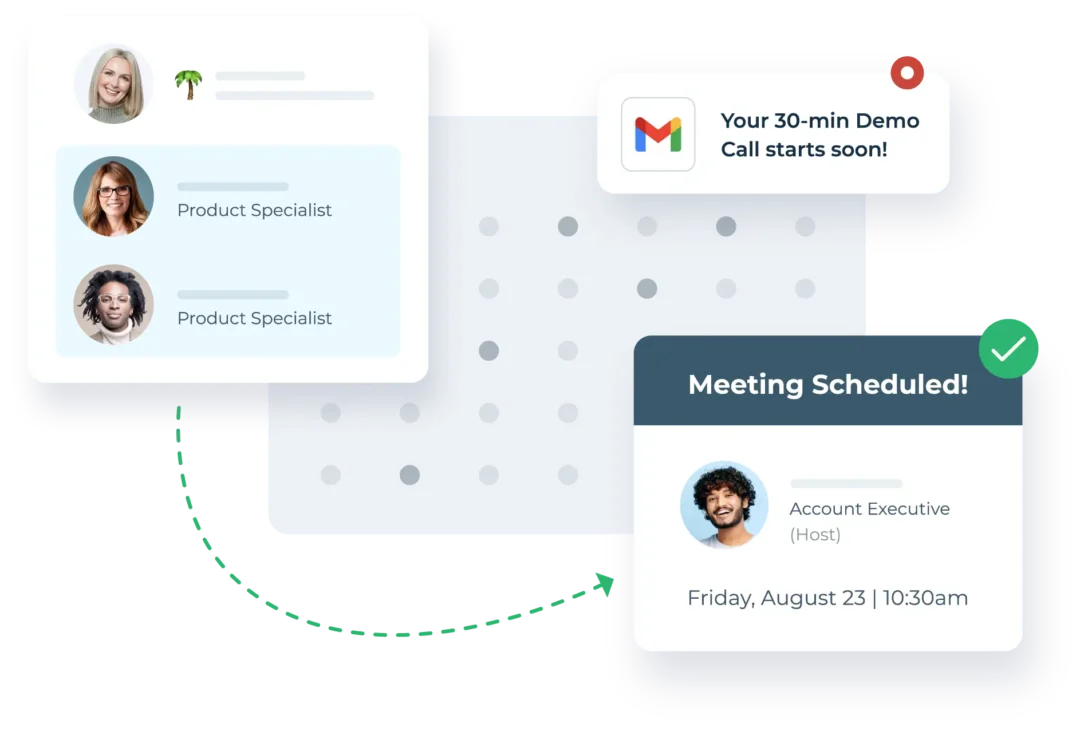
Round robin scheduling software distributes meetings equitably across a team while respecting territory assignments, account ownership, capacity, and time-zone coverage. When a rep goes on PTO, the logic should route around them automatically, not create an exception that has to be manually managed.
Handoff Automation
Enterprise sales motions involve multiple handoffs: SDR to AE, AE to Solutions Engineer, AE to Customer Success. Each one is a moment where deals slow down or stall. Scheduling software that automates handoff suggestions based on your business logic, and books the next meeting live on the call, eliminates the most common source of conversion loss.
Audit Logs and Transparent Reporting
When a meeting does not get booked, you need to know why. Audit logs give operations teams visibility into every scheduling outcome: who was suggested as the host, which time slots were presented, whether a reminder fired. This transparency matters especially for troubleshooting and for demonstrating the operational value of the scheduling system.
No-Code Configuration
Marketing and sales motions change. Territories shift, new products launch, rep headcount grows. Scheduling software that requires developer support to update routing rules or meeting types creates a backlog every time the business evolves.
No-code, drag-and-drop workflow builders let operations teams make changes in hours instead of weeks. LeanData’s Conditional User Provisioning takes this further by automating BookIt onboarding for new reps.
So, when a Salesforce user matches admin-defined conditions, such as Role equals Account Executive, they receive an automatic calendar authorization invitation with the correct BookIt product access already assigned. No manual bulk uploads, no missed users.
SLA Tracking from Form Fill to Booked Meeting
Most teams track speed-to-lead as time-to-assignment. The more revealing metric is time from form fill to confirmed meeting. Scheduling software that surfaces this metric shows exactly where delays occur in the full sequence, not just the first step.
The Three Use Cases Where Scheduling Automation Matters Most
#1 Inbound Lead Conversion
A prospect submits a demo request. Within seconds, the form submission triggers a qualification check, matches the lead to an existing CRM record if one exists, identifies the correct rep based on territory or account ownership, and presents the prospect with available meeting times.
The meeting lands on the rep’s calendar before the prospect closes the tab.
This is the highest-leverage use case for scheduling automation because buyer intent peaks at the moment of form submission.
Any manual step between form fill and meeting invite introduces unnecessary friction.
#2 SDR-to-AE Handoffs
It takes an average of 7.5 emails to schedule a meeting. For SDRs whose job is to qualify and hand off, that overhead adds up fast, and 65% of a rep’s day is already spent on non-selling activities.
When an SDR wraps a discovery call and needs to book a follow-up demo with an AE, the handoff should happen live, with the right AE suggested automatically based on territory and account matching, and the meeting booked before the prospect hangs up.
Handoff scheduling automation replaces the email thread with a single suggested action, surfaced directly inside the CRM record. The SDR sees a recommended host, confirms the selection, and books the meeting on the spot.
Prospects who book meetings through LeanData BookIt close at a 53% higher win rate than the broader population, and their average deal cycle shrank from 78 days to 25.
Further, LeanData’s Scheduling API allows AI agents to check availability, confirm bookings, and manage the full scheduling flow programmatically through BookIt, while preserving round-robin fairness, calendar integration, and SLA compliance.
Teams building on Agentforce, AgentExchange, or any other agent platform can use BookIt as a governed scheduling backend, so every AI-initiated meeting goes through the same routing logic and audit trail as every human-initiated one.
#3 Outbound and Prospecting
Reps prospecting via email, LinkedIn, or phone need a frictionless way to share their availability without triggering a back-and-forth scheduling thread.
Personalized booking links let reps embed their availability directly in outreach, and group or round-robin availability links let buyers connect with the first available specialist rather than waiting for a specific rep to respond.
LeanData BookIt: Scheduling That Connects to Your Revenue Stack
LeanData’s BookIt suite is built specifically for B2B revenue teams that run on Salesforce. It is a native application, not an integration, which means scheduling logic lives inside the same platform as routing, matching, and workflow automation. Every scheduling action is informed by CRM data and written back to CRM records automatically.
LeanData BookIt: Product Comparison at a Glance
BookIt for Forms
Learn more about BookIt for Forms.
BookIt for Forms turns a standard webform into an immediate scheduling experience. When a prospect submits a demo request, BookIt qualifies the submission against your routing rules, matches the lead to an existing Salesforce record with 95% accuracy, identifies the right rep, and surfaces available meeting times before the form thank-you page loads.
The scheduling experience is fully brandable: colors, logos, meeting types, and email reminders are all configurable without engineering support. Integrations with Marketo, HubSpot, Salesforce Marketing Cloud Account Engagement, Pardot, Unbounce, Google Analytics, and calendar platforms are built in.
For ops teams, the no-code FlowBuilder controls every decision in the qualification and routing logic. Changing a territory rule or adding a new meeting type takes minutes.
“The main reason we selected LeanData BookIt was its advanced automation capabilities combined with seamless integration with our existing Salesforce setup. This enables us to streamline our scheduling processes, reduce manual intervention, and significantly improve the efficiency and accuracy of our sales operations.”Sarosh Saiyed
BookIt Handoff
Learn more about BookIt Handoff.
BookIt Handoff automates the scheduling of next-step meetings directly from within Salesforce Lead, Contact, Account, Opportunity, and Case records.
When a rep needs to hand a buyer to another team member, Handoff automatically suggests the correct host based on territory, segment, round-robin logic, or any other business rule — and accounts for rep availability and vacation status in real time.
Automated reminders reduce no-shows. Audit logs show every suggested host, the outcome of each handoff attempt, and the meeting type assigned. The entire process requires no coding to configure or adjust.
BookIt Links
Learn more about BookIt Links.
BookIt Links gives every rep a personalized booking link they can share via email, LinkedIn, automated sales engagement sequences, or any other outbound channel. Individual links, team links, group links, and round-robin availability links all exist within the same product.
A Chrome extension lets reps access their links from anywhere without switching contexts. Meeting types are customizable at the user level, and a Meeting Metrics Dashboard gives operations teams visibility into booking volume, conversion rates, and rep-level performance.
What Real Ops Teams Say About Scheduling Automation
The LeanData BookIt user survey asked revenue operations professionals who switched from other scheduling tools why they made the change to BookIt and how they measure success. The results point to a consistent pattern.
The top five reasons teams chose BookIt, in order:
- They were already using LeanData for routing and wanted one platform.
- Tech stack consolidation and cost reduction
- Salesforce-native architecture
- Audit logs and transparent reporting that other tools lacked
- Ease of use without constant admin overhead
BookIt Operational Results: What LeanData Customers Reported

Show video transcript Hide video transcript
Uber for Business: 68% Faster Deal Velocity
For Uber for Business, which manages corporate travel and meal solutions for over 170,000 companies, the connection between scheduling automation and revenue outcomes is direct and quantified.
Before implementing BookIt, their sales cycle ran an average of 78 days. After prospects could book meetings directly through BookIt, that number dropped to 25 days, a 68% increase in deal velocity. Win rates for the same group of prospects rose from 32% to 49%.
 “We leaned heavily towards LeanData’s BookIt solution. It already connects with our CRM, we’re able to have visibility into books of business, and we’re routing it to the correct owner. That owner doesn’t have to worry about rerouting it to somebody else.”
 Nicole Peinado


Uber has also used BookIt as the scheduling layer for their AI agent, built on Agentforce. When the AI SDR encounters a complex inquiry it cannot resolve, it hands the prospect to a live rep and books the meeting through BookIt. Scheduling automation becomes the bridge between AI-driven qualification and human-led selling.
Read the full Uber for Business customer story →
Meltwater: 75% Faster MQL-to-SQL Conversion
Meltwater, a global media and consumer intelligence platform with 27,000 customers across six continents, faced a different version of the same problem. Enterprise leads were frequently misrouted to local reps instead of the correct global account owners. Their traditional “contact us” flow created a lag between form submission and meeting booking, slowing momentum and lowering conversion rates.
After implementing BookIt, Meltwater cut MQL-to-SQL conversion time by approximately 75%.
““The big advantage of using BookIt is that follow-up to the prospect is essentially zero,” says Abigail Vickers, Revenue Operations Manager at Meltwater. “They fill out the form, immediately see a calendar, and pick a time that works for them.””Abigail Vickers


The scheduling improvement was part of a broader orchestration deployment that also automated account-based routing across global territories, merged more than 6,000 leads, and properly assigned 3,800 accounts.
Read the full Meltwater customer story →
Rebuy: 8 Hours per Week Returned to Each BDR
Rebuy’s experience illustrates the operational impact when scheduling and routing are managed separately. Before LeanData, BDRs were spending approximately eight hours per week on manual lead conversion, routing, and record creation in Salesforce.
After connecting BookIt with LeanData Orchestration, that time shifted to prospecting and qualifying. The Merchant Success team gained strategic control over account assignments, enabling more sophisticated customer management and improving retention.
Read the full Rebuy customer story →
 “I wanted something easier to use, and that can do more with less errors. I also like that routing and scheduling are the same platform, so it makes it very easy to manage.”Nicole Looker


The Metrics That Tell You If Your Scheduling System Is Working
Connecting routing and scheduling in a single platform creates the visibility to measure what actually matters.
5 Metrics for Measuring Scheduling Automation Performance
How to Evaluate Scheduling Software Before You Commit
The wrong scheduling tool creates the same problem it was supposed to solve: more administrative work, more systems to manage, and more places for a meeting to fall through. Before adding another product to your stack, ask these questions:
- Does it write data back to your CRM natively, without a third-party sync?
- Does it work with your existing routing logic, or will you need to rebuild that logic inside a new system?
- Can you change routing rules, territories, or meeting types without filing an IT request?
- When something breaks, can you see exactly what happened and where in an audit log?
- Can it handle round-robin distribution across a team while respecting account ownership and capacity?
- What happens when a rep is on PTO?
If the answer to any of these is “we would need to configure that with engineering,” the operational overhead of that tool will exceed its value at scale.
Read: Enterprise Scheduling Software: What to Look For →
The Scheduling Problem Is Solvable
Routing and scheduling are two parts of the same workflow. When they live in the same platform, connected to the same CRM data and governed by the same no-code logic, the gap between “lead assigned” and “meeting confirmed” closes.
LeanData BookIt connects all three stages of the scheduling journey: inbound form conversion, personalized outbound links, and internal handoffs, inside a single Salesforce-native platform.
Operations teams get full visibility through audit logs. Reps get suggested next steps with no manual calendar work. Buyers get a faster, more coherent experience.
More than 1,000 B2B companies trust LeanData to run their most critical GTM workflows. See what BookIt can do for yours.
Talk to a BookIt Expert Today
Frequently Asked Questions
What is the difference between scheduling automation software and a standard calendar tool?
What is round robin scheduling software and how does it work?
How does CRM scheduling integration improve speed to lead?
Can scheduling software work for post-sale and customer success motions?

Kim Peterson
Kim Peterson is the Senior Manager of Content Strategy at LeanData where she digs deep into all aspects of go-to-market strategy and execution. Kim's writing experiences span tech companies, stunt blogging, education, and the real estate industry. Connect with Kim on LinkedIn.