














Summary
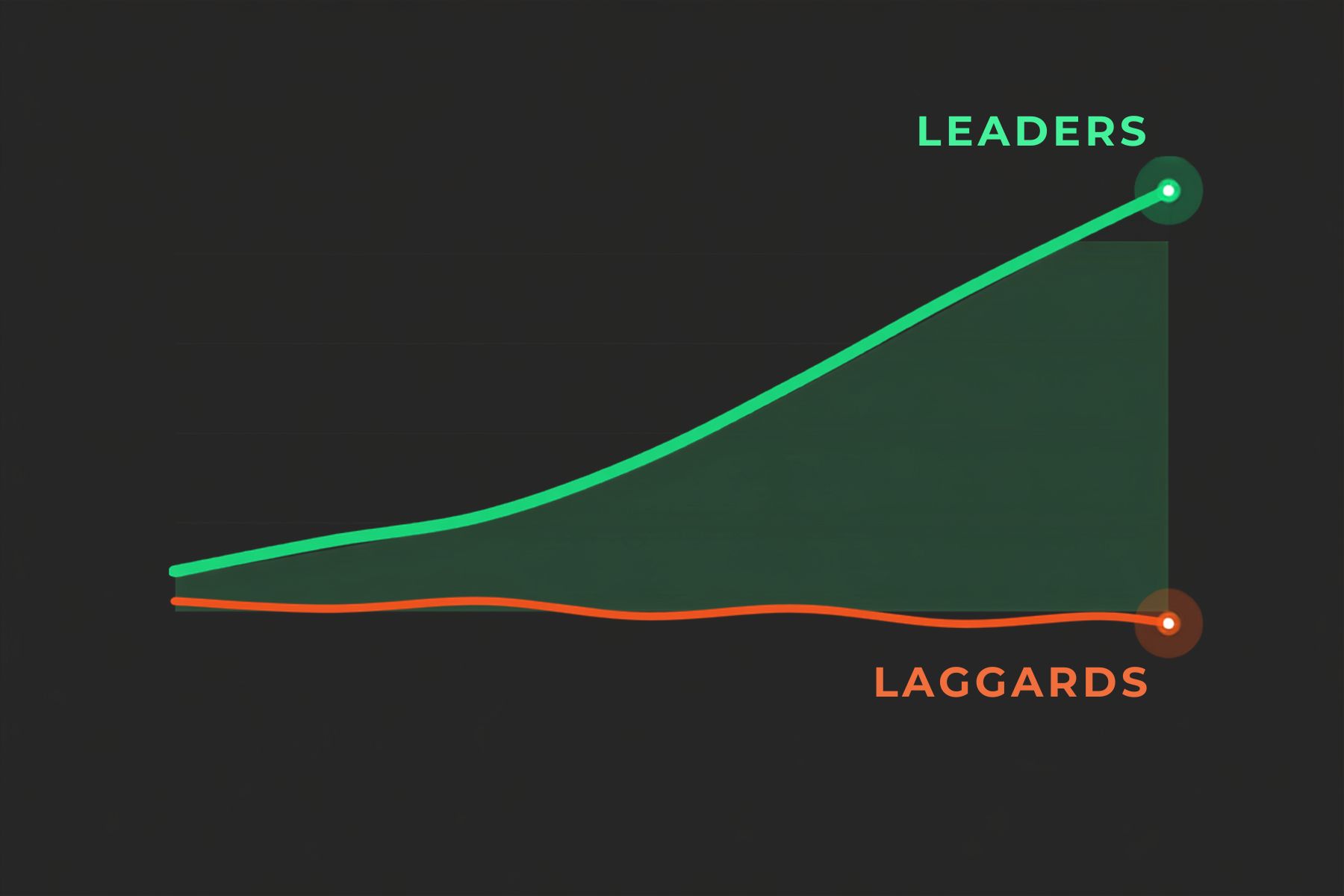
Harvard Business Review Analytic Services research breaks down what separates GTM leaders vs. laggards, and the gap has surprisingly little to do with budget or team size. The real difference comes from process discipline, shared metrics, and clear ownership across sales, marketing, and customer teams.
What You’ll Learn
- How the research sorts B2B organizations into leaders, followers, and laggards, and why only 38% earn the leader label
- The three collaboration habits where the distance between top and bottom performers is widest
- Which coordination breakdowns leaders quietly sidestep while laggards keep running into them
- How stronger execution connects to revenue growth, higher conversion rates, and better buyer experiences
- Why leaders run GTM execution as a standing practice instead of a one-time fix
The Go-to-Market Myth You Can Finally Retire
Ask a roomful of revenue leaders why some go-to-market teams pull ahead, and you’ll hear the usual suspects: bigger budgets, more headcount, better use of AI, or a flashier tech stack.
It’s a comfortable explanation, because it lets everyone off the hook. If the winners simply spent more, then the rest of us were never in the race.
The research tells a different story.
Harvard Business Review Analytic Services surveyed 522 B2B professionals for a study sponsored by LeanData, and the organizations that execute their GTM strategy very effectively don’t win on spend.
They win on discipline.
Plus, the habits behind that discipline are ones any team can adopt, which is either reassuring or uncomfortable, depending on how your last quarter went.

How the Research Splits the Field
Before getting into what leaders do, it helps to know who they are. The survey sorts organizations by how effective they say their GTM strategy is for selling to B2B buyers.
- Leaders, the group whose strategies are very effective, make up 38% of respondents.
- Followers, with somewhat effective strategies, account for 42%.
- Laggards, whose strategies are not very effective, round out the final 20%.
So fewer than four in ten organizations clear the bar. That alone reframes the conversation.
And no, companies surveyed were not a handful of unicorns with unlimited resources. The data reflects B2B revenue teams, the majority Followers or Laggards, knowing their strategy matters but struggling to make it land.
The Difference Is Discipline, Not Dollars
Here’s the part that surprises people: when you line up leaders against laggards, the widest gaps don’t appear in spending categories.
Instead, they appear in process, clarity, and ownership.
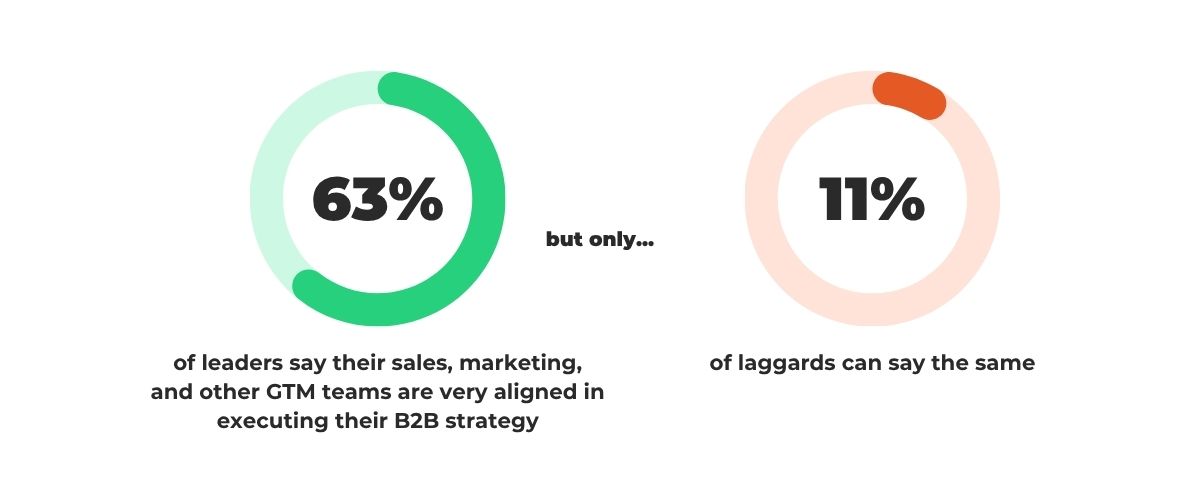
Start with alignment. While 63% of leaders say their sales, marketing, and other GTM teams are very aligned in executing their B2B strategy, only 11% of laggards can say the same.
Then, look at how the two groups invest their attention. Leaders prioritize improving collaboration across teams at a rate of 81%, compared with 48% of laggards. None of that requires a bigger checkbook. What it takes is treating coordination as the actual work, not an afterthought.
Three Habits That Set B2B Go-to-Market Leaders Apart
When the survey asked which steps organizations take to improve collaboration, three moves opened the clearest distance between leaders and laggards. Consequently, these are the habits worth copying first.
Source: Harvard Business Review Analytic Services survey, September 2025.
Notice the pattern: shared metrics give teams one definition of winning. A shared strategy points everyone at the same goal. Clear roles answer the question that quietly drains so many deals: who owns this, and what happens next?
Leaders don’t leave those answers to chance, and the gap shows up in their results.
What Leaders Avoid That Laggards Keep Repeating
The survey asked organizations which challenges they currently face in designing their GTM strategy. Laggards reported internal breakdowns at much higher rates.
Here’s how Leaders and Laggards compare on the problems that stall execution:
- Ineffective coordination between teams: 34% of leaders report this challenge, compared with 49% of laggards.
- Misaligned or conflicting goals across sales, marketing, and product: 33% of leaders versus 51% of laggards.
- Teams that don’t agree on strategy: just 17% of leaders, against 39% of laggards.
- Uncertainty over which teams should engage at each stage of the buyer journey: 20% of leaders compared with 37% of laggards.
Read those numbers together and a clear picture forms: Laggards spend their energy refereeing internal disputes about who does what and why. Leaders settled those questions earlier, so their teams can spend energy on buyers instead.
As a result, the work that reaches the customer is more consistent, and far less of it gets lost in the handoffs.
“If teams are able to truly interconnect and align on what their goals are and how they’re working toward them, you’ll see the true impact of what you can achieve from a revenue and pipeline perspective.”Amanda Shelley
Why This Shows Up in Revenue
Process discipline would be a nice idea if it stayed academic. Unfortunately, it doesn’t and the benefits land right where it counts.
When organizations build a better understanding of the buyer journey, 64% of leaders point to revenue growth as a benefit they’ve achieved. Only 37% of laggards say the same. The pattern repeats across other outcomes too.
Leaders report increased conversion rates at more than double the rate of laggards, 51% versus 23%, and they report improved buyer experiences at 53% versus 24%. Better coordination doesn’t just make the org chart tidier. It moves pipeline, win rates, and the experience buyers remember.
This is the argument a Director of RevOps or SalesOps can carry into a budget meeting. The case for investing in alignment and process isn’t a soft appeal to teamwork. It connects directly to revenue.
Go-to-Market Execution is a Standing Discipline, Not a Project
One more trait separates the top performers, and it explains why their lead tends to hold. Leaders distinguish themselves by continually working to optimize their B2B processes and workflows. They treat alignment as something the team revisits, refines, and improves as buyer behavior shifts.
Leaders also lean into new technology to support that discipline.
- 70% of organizations are exploring new tools to improve GTM execution
- 29% of Leaders use AI to coordinate and analyze sales activities versus 12% of Laggards.
Here’s the catch: AI adds speed, but it also adds signals. Without intelligent orchestration, more AI tends to produce more activity and noise rather than more revenue. This makes discipline matter even more as AI spreads across the motion.
Closing the Gap Starts With Ownership
Leaders in the HBR research are winning because they made a series of unglamorous choices:
- They agreed on how to measure success.
- They pointed teams at a shared strategy.
- They named owners for each stage of the buyer journey.
- They kept refining all of it instead of declaring victory and moving on.
The HBR Analytic Services report lays out the full Leader versus Laggard comparison across every dimension of GTM execution, from strategy and collaboration to technology and AI adoption.
Download the full report to see exactly where your organization stands and what the top performers do at every step.
Read next: how to make AI a reliable part of your GTM motion.
FAQ
What separates GTM leaders from laggards?
What percentage of B2B organizations qualify as GTM leaders?
Do GTM leaders see better revenue results?
How do GTM leaders improve team alignment?
What is the first step to becoming a go-to-market leader as defined by the HBR research report?

Kim Peterson
Kim Peterson is the Senior Manager of Content Strategy at LeanData where she digs deep into all aspects of go-to-market strategy and execution. Kim's writing experiences span tech companies, stunt blogging, education, and the real estate industry. Connect with Kim on LinkedIn.