













Summary
Leading AI companies, including Anthropic, OpenAI, and Databricks, use LeanData to run their go-to-market orchestration, and the reason is more instructive than the headline. This article looks at how AI-native organizations structure their GTM stacks, why AI intelligence and deterministic execution serve different functions, and what operations and revenue leaders can learn from the companies building the technology.
What You’ll Learn
- Why AI companies with world-class engineering teams still rely on purpose-built GTM software.
- The difference between what AI does well and what GTM orchestration does well, and why both are necessary.
- What “fixing the foundation first” actually means before deploying AI agents.
- What the AI companies’ choices tell operations leaders about building a scalable revenue stack.
The GTM Stack Anthropic Uses to Route Leads
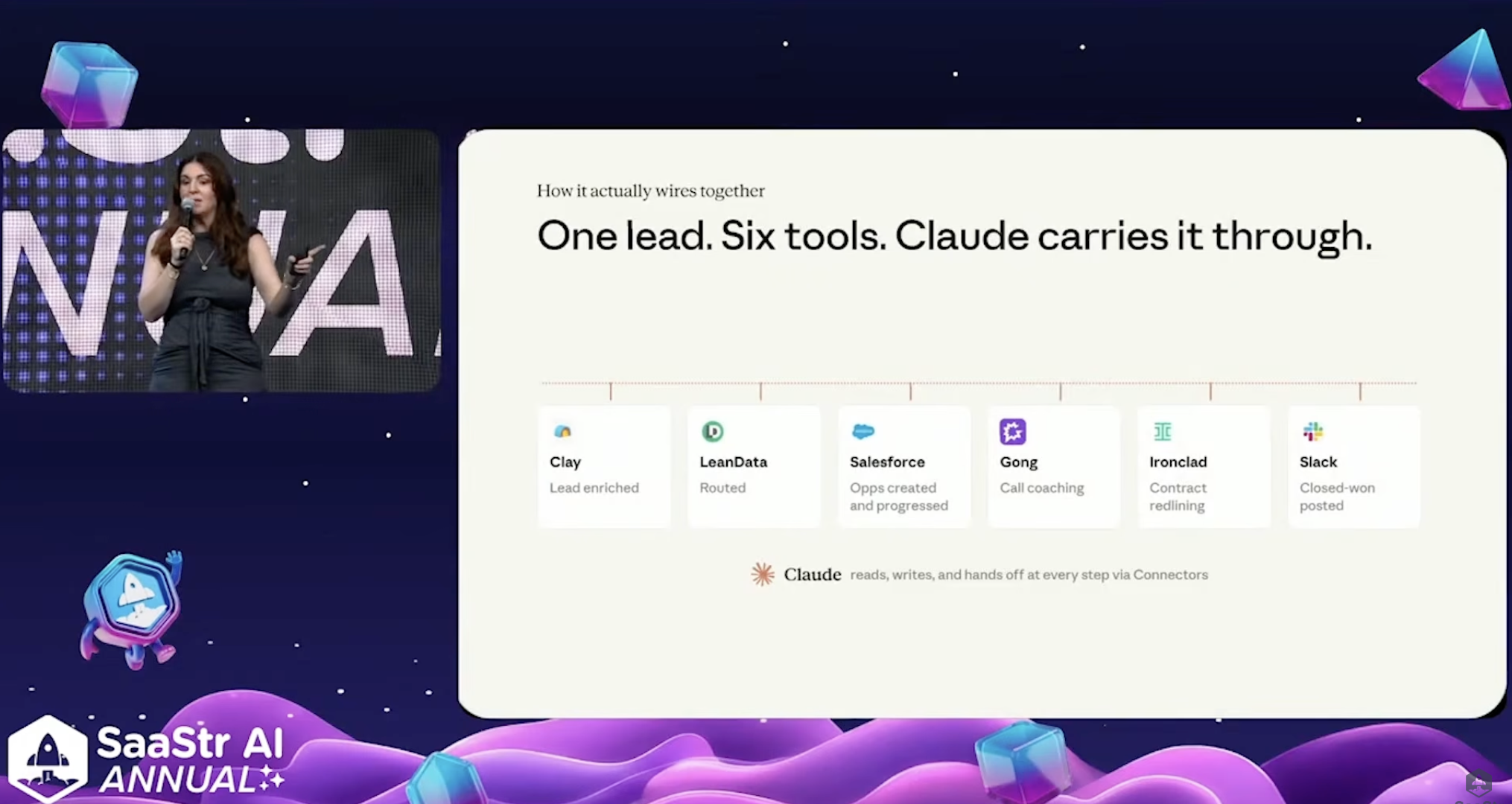
At SaaStr AI Annual this month, Anthropic took the stage and showed the audience a slide. The title read: “One lead. Six tools. Claude carries it through.”
The six tools were Clay, LeanData, Salesforce, Gong, Ironclad, and Slack. Clay enriched the lead. LeanData routed it. Salesforce tracked the opportunity. Gong handled call coaching. Ironclad managed contract redlining. Slack posted the closed-won notification. Claude read, wrote, and handed off context at every step.
Anthropic, the company that built Claude and recently became the fastest company in history to reach $40 billion in revenue, runs its revenue motion on a stack that combines probabilistic AI tools with deterministic execution systems.
And Anthropic is not alone.
The Companies Building AI Chose Not to Build Their Own GTM Infrastructure
This is the part of the story that tends to stop revenue and operations leaders in their tracks.
Anthropic has some of the most capable engineers in the world. They built Claude. They could spin up an internal lead routing system in a week if they wanted to.
OpenAI scaled from under 10 GTM staff to more than 500, across 10 business segments and 120 outsourced sellers in dozens of countries and languages
Both choose to run their GTM orchestration on LeanData.
The fact that they looked at the market and chose a purpose-built platform tells you something meaningful about what works at scale.
When organizations with unlimited engineering capacity evaluate the build-versus-buy question for GTM infrastructure and land on buy, they are making a deliberate decision about where to direct their engineering time and what kind of reliability their revenue motion actually requires.
The companies that are seeing results from AI in their GTM motion are not the ones with the most AI tools. They are the ones who are clear on what AI is for, and what it still needs to work.
What AI Does, and What Orchestration Does
AI and GTM orchestration solve different problems. Understanding that distinction is the foundation of every successful AI-powered revenue motion. GTM stacks require both probabilistic and deterministic systems, and they will not replace each other.
Probabilistic systems, meaning AI models, excel at reasoning through ambiguity. They find patterns across millions of data points, predict which accounts are likely to convert or churn, summarize signals from multiple sources into a rep-ready brief, and draft personalized outbound based on intent and account context.
The output is intelligent, but it is not guaranteed. Ask the same question twice and you may get a slightly different answer. That flexibility is a feature when the task is reasoning. It is a liability when the task is revenue execution.
Deterministic systems do one thing: produce the same result every time, regardless of volume, regardless of who submitted the lead, regardless of whether it is 2pm on a Tuesday or 3am after a conference.
When a lead comes in, it goes to a specific person, based on specific rules, within a specific time window. The SLA was met or it was not. The lead matched to the right account or it did not. There is no ambiguity, and that is the point.
In a GTM motion, the division of labor looks like this:
These are not competing jobs. They are complementary ones. The companies winning with AI figured that out first. AI tools like Claude, Gemini, Perplexity and others can tell you the best chess move. They cannot be the chessboard.
Before You Add AI, Fix the Foundation
The most agentic LeanData customers all say the same thing: AI does not fix a broken GTM motion. It accelerates one that already works.
If your Salesforce data has duplicates, mismatched leads, or bad account associations, AI workflows and agents will make the wrong decisions faster. If you do not have your GTM processes documented and governed, an AI agent will automate the chaos, not resolve it. The foundation has to come first.
What “fixing the foundation” actually looks like in practice:
Data quality. Leads matched to the right accounts, contacts connected correctly, duplicates resolved. This is the starting point for everything else in the revenue motion, AI-powered or not.
Routing logic that ops owns. GTM logic should live in a system that revenue operations can update without engineering involvement. Territory changes, segment adjustments, and round-robin pool changes should deploy in minutes, with the ability to test before going live.
SLA enforcement. Knowing which leads are being worked, which are sitting idle, and when response time thresholds are being crossed. This accountability structure is what makes AI outputs governable.
Auditability. When a VP asks why a specific lead went to the wrong rep, or why a deal sat unworked for three days, the answer should point to a rule, not require someone to read an AI transcript and explain a model’s reasoning.
This is not a prerequisite that takes years. It is the operational foundation that LeanData customers build and then expand from, moving from data quality to routing to workflow automation to scheduling, adding AI signals into the same orchestration layer at each step.
AI Signals Need Somewhere to Go
One of the most important things LeanData does right now is govern what happens after AI generates a signal.
Today’s GTM stacks increasingly include AI SDRs, intent platforms, predictive lead scoring from enrichment tools, chatbot-qualified conversations, and AI-generated account health scores.
Each of these tools produces outputs. Without an orchestration layer, those outputs pile up as noise. With LeanData, they flow into the same routing and workflow logic that governs every other action in the revenue motion.
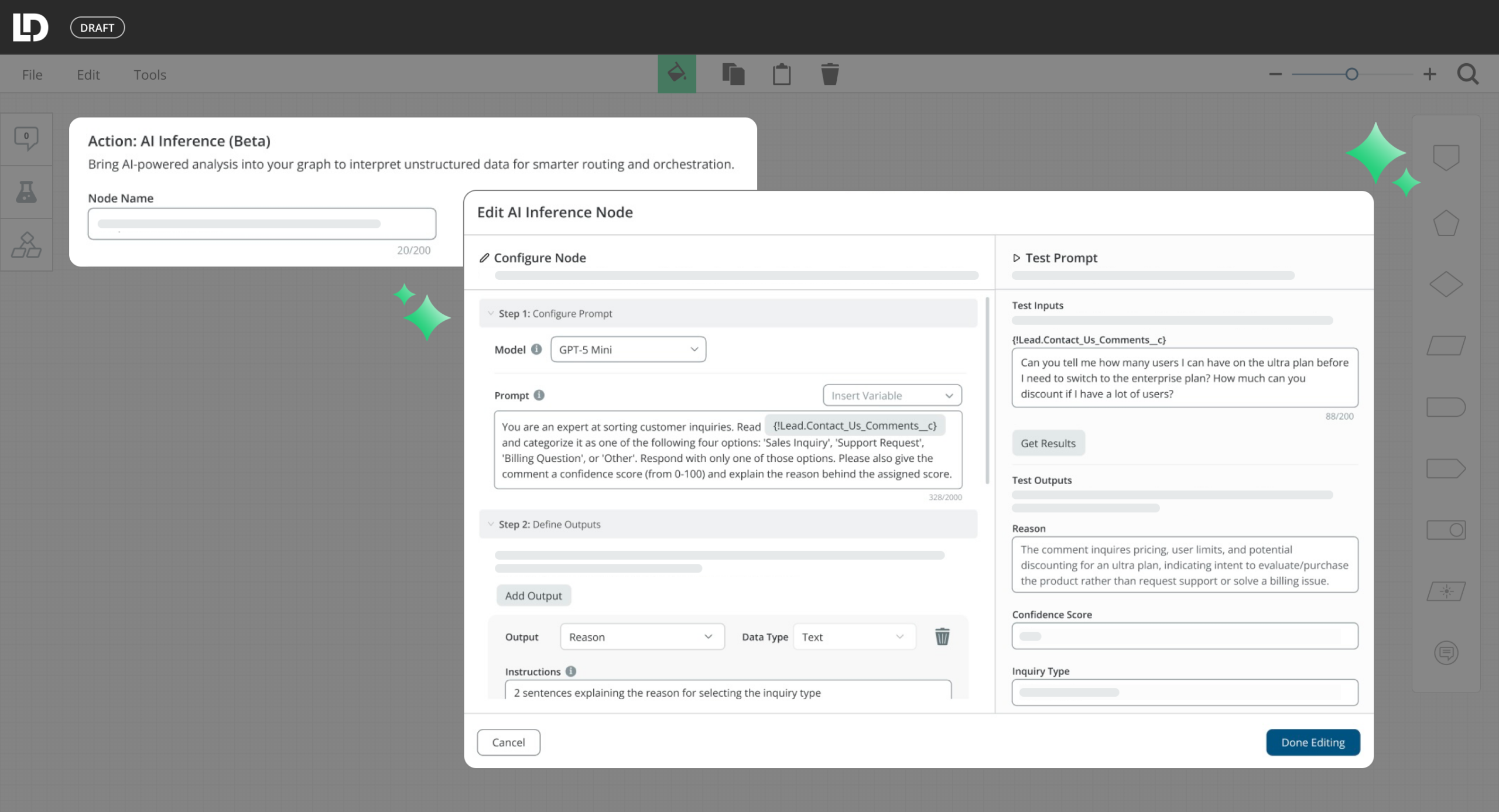
LeanData’s AI Inference Node takes this further by embedding a reasoning engine directly inside the routing workflow. Without requiring a separate enrichment vendor or engineering support, the node can:
- Read unstructured text
- Classify inbound requests by product fit or intent
- Extract competitive signals from CRM fields
- Analyze sentiment in support tickets to detect at-risk accounts
- Normalize messy job title data for routing decisions
The principle applies across any company with a signal that standard enrichment does not cover. What is your golden signal? The one every experienced rep knows to look for before engaging an account? The AI Inference Node can surface it on demand, at the moment of routing, without additional tooling.
Speed to Lead Gets More Expensive as You Grow
There is a direct relationship between the size of your deals and the cost of a dropped or delayed lead. As annual contract value (ACV) goes up, missed follow-up becomes more expensive. As your team grows, manual lead management creates more failure points.
The operational rigor of your GTM motion needs to scale with your deal complexity, not against it.
LeanData customers across the technology industry have measured this effect directly:
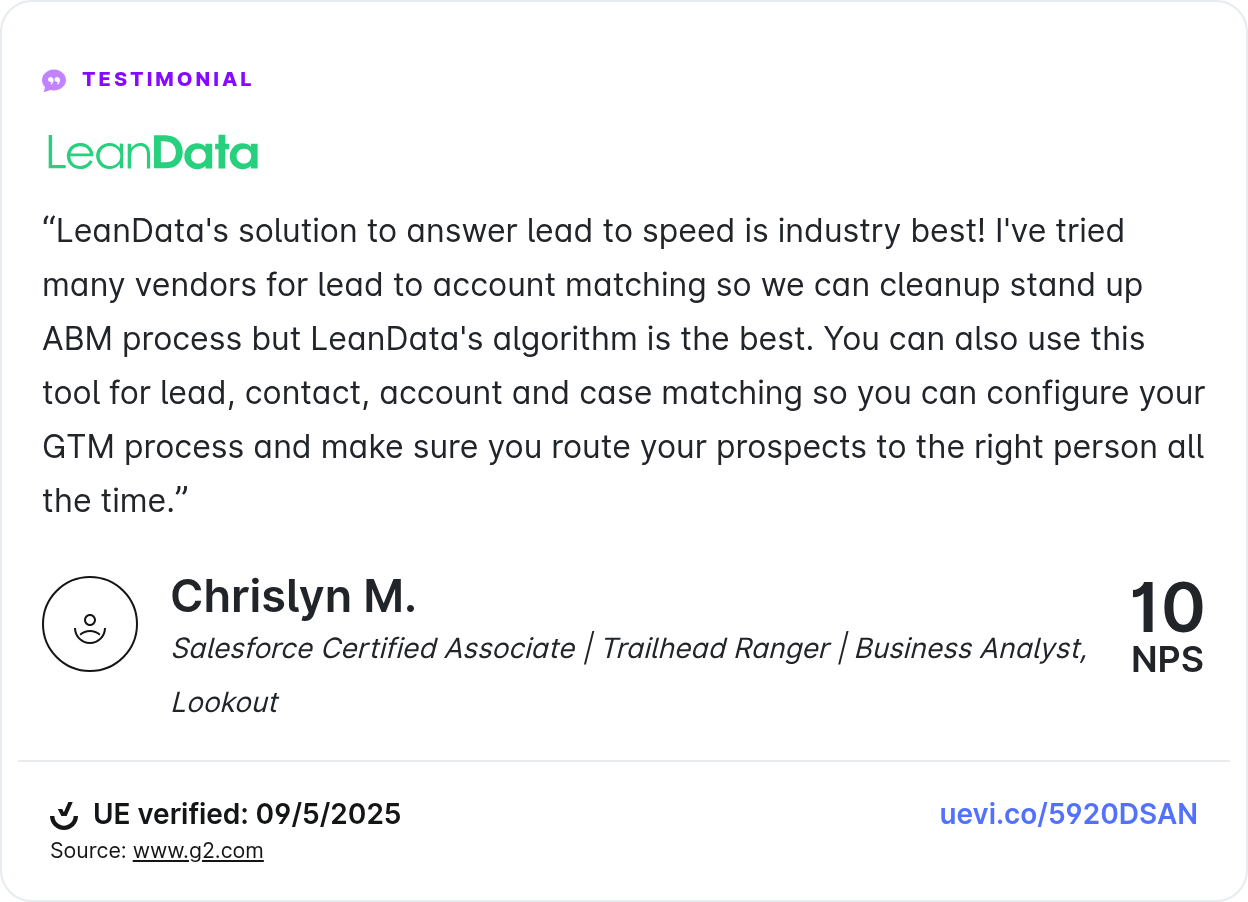
- SUSE improved speed to lead by 70% in a single quarter after implementing priority-based SLA routing, reducing average response time for high-intent leads such as demo requests to 1.3 hours. By linking SLA adherence to rep compensation, they reached 100% SLA attainment.
- Zendesk reduced lead routing time by 82%, from 45 minutes to under 8 minutes, and cut manual lead assignment by 45%. The team saved approximately 55 hours of work per week and scaled global routing to over 42,000 postal codes without adding headcount.
- F5 eliminated unmonitored lead queues where deals were stalling, including urgent cybersecurity requests that sat unworked. After implementing LeanData, inbound requests route immediately to the right team member, with automated follow-up alerts and SLA tracking built in.
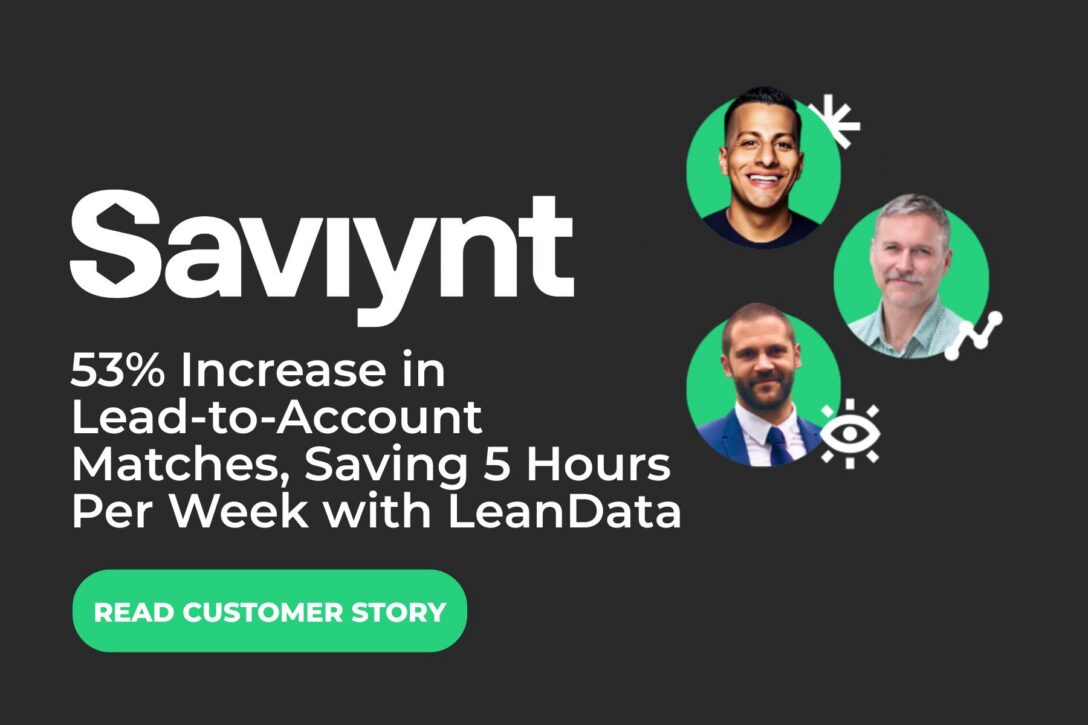
- Saviynt saw a 53% increase in lead-to-account match rates compared to their previous tool, and eliminated the five hours per week that sales leadership was spending manually triaging unmatched leads.
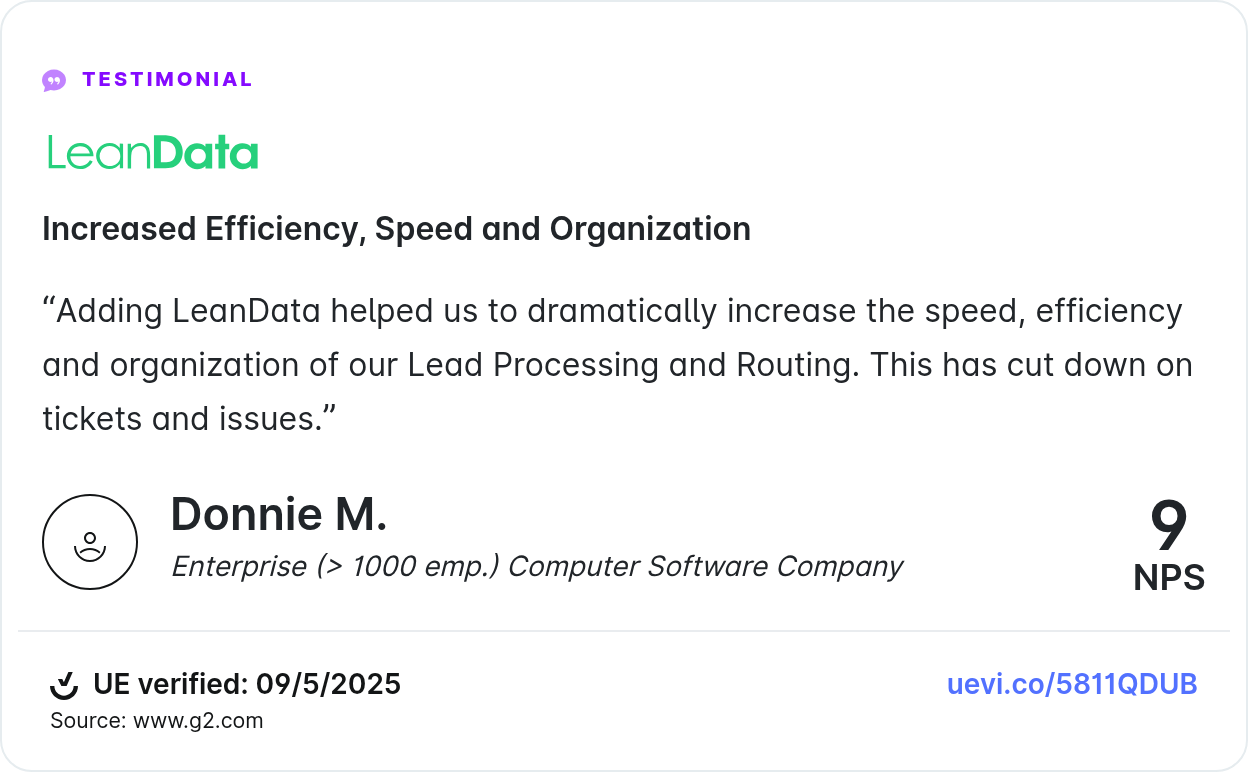
The pattern is consistent. The cost of missed or delayed follow-up scales with the size and complexity of the business. Revenue operations teams that treat lead routing as a commodity process tend to discover that it costs one misrouted deal at a time.
What This Means for Your GTM Stack
The companies that are getting results from AI in their GTM motion right now are not the ones who gave AI the most jobs. They are the ones who were clearest about which jobs belong to which tool.
The signal from Anthropic, OpenAI, and other AI-native companies running on LeanData is worth translating into practical terms. If you are deploying AI agents, evaluating AI SDRs, or being asked to show ROI on AI investments in your GTM motion, the question worth asking first is whether your orchestration foundation is ready for it.
AI does not create your GTM process. It does not document your routing logic, enforce your SLAs, or give you an audit trail when something goes wrong. That is what LeanData is for.
And as the companies building the most advanced AI in the world have demonstrated, those two layers of the revenue stack work together, not in place of each other.
FAQ
Q: What does LeanData actually do in an AI-powered GTM stack?
Why can’t AI just replace lead routing software?
Can’t we build this in-house using AI?
What is the AI Inference Node and how do customers use it?
You could build it. Or you could do what Anthropic did.

Kim Peterson
Kim Peterson is the Senior Manager of Content Strategy at LeanData where she digs deep into all aspects of go-to-market strategy and execution. Kim's writing experiences span tech companies, stunt blogging, education, and the real estate industry. Connect with Kim on LinkedIn.