













Summary
LeanData’s Q1 2026 release delivers innovative new features designed for enterprise B2B revenue teams, including account hierarchies, AI inference nodes, agentic scheduling APIs, and improved title clustering. This article breaks down each feature and explains what it means for teams managing complex GTM workflows in Salesforce.
What You’ll Learn
- How Account Hierarchies help enterprises visualize corporate structures and act on expansion opportunities
- What AI Inference Nodes do and why they give go-to-market leaders transparent, controlled AI inside existing workflows
- Why AI agents need a scheduling backbone, and how LeanData’s new APIs fill that gap
- What Title Clustering improvements mean for persona segmentation and buyer alignment
- How features like the Create Record Node and Conditional User Provisioning reduce operational overhead at scale
What’s New in LeanData: AI, Hierarchies, and More
If your revenue team has ever lost a deal because two reps worked the same account family without knowing it, LeanData’s Q1 2026 release was built with you in mind.
This update helps enterprise B2B organizations manage complex account structures, embed AI into go-to-market workflows with full visibility and control, and prepare their scheduling infrastructure for a world where AI agents book meetings on behalf of reps.
Plus, it includes meaningful improvements for admins who keep everything running day to day.
Here is what’s new and why it matters.
Account Hierarchies: From Visibility to Action Across Corporate Families
Enterprise sales rarely involves a single account. A global account family includes a parent company, regional divisions, and dozens of subsidiaries, but CRMs may only store direct parent and ultimate parent references. That makes it difficult to plan territory strategy or coordinate outreach after an acquisition.
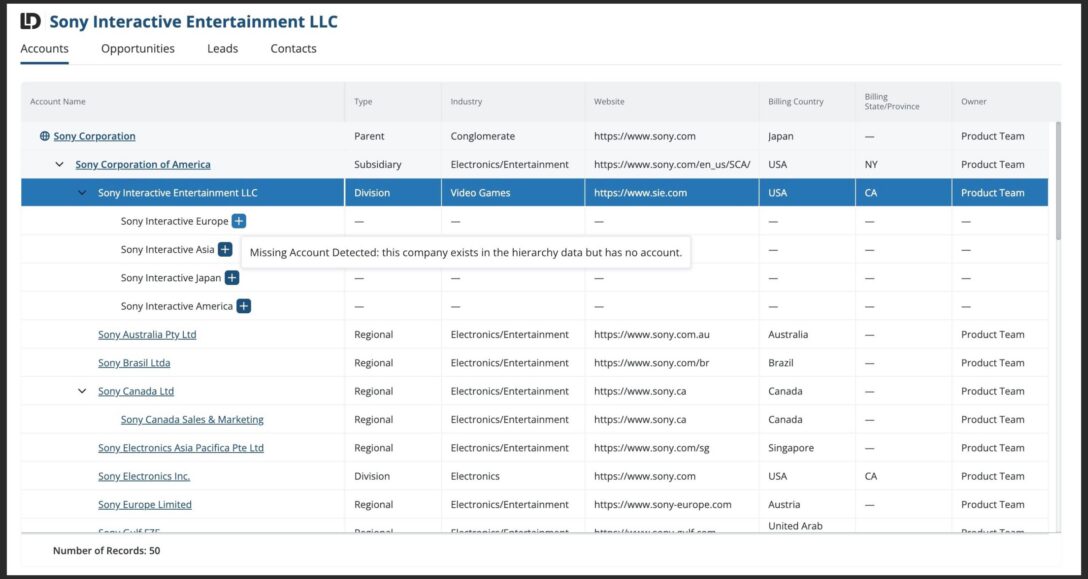
LeanData Account Hierarchies solves this by automatically mapping, building, and maintaining multi-level account hierarchies using enriched CRM data. Revenue teams can then visualize those relationships directly inside Salesforce through LeanData’s Hierarchy View.
This gives leaders focused on strategic account planning full context into how accounts relate to one another.
Account Hierarchies Functionality Beyond Visualization
Within LeanData’s FlowBuilder, a new Account Hierarchy Match Node lets teams build routing logic that operates across the full account family. When a new lead arrives from a subsidiary, it can be automatically routed to the rep who owns the parent account, or trigger a notification to the account team.
Then there’s LeanData’s Whitespace Discovery, which integrates with ZoomInfo to identify corporate entities that don’t yet exist as accounts in your CRM.
These missing accounts appear directly in the hierarchy view, with data pre-populated, and can be seamlessly added to your CRM and assigned for follow up.
As a result, account planning sessions become more productive because teams can spot expansion opportunities across the entire corporate structure.
Here’s what LeanData Account Hierarchies enables:
- Automatically map and maintain parent/child account relationships using enriched CRM data
- Visualize full account hierarchies alongside related objects inside Salesforce
- Route, assign, and trigger notifications across an account family using the new Account Hierarchy Match node in FlowBuilder
- Discover missing corporate entities through our ZoomInfo integration and create them with pre-populated data
- Calculate hierarchy-level metrics and export data for reporting and account planning
AI Inference Nodes: Controlled AI Where It Matters Most
Many organizations are adopting AI across their tech stack, but go-to-market leaders face a real tension: they want the speed AI provides, but they also need transparency into how decisions are being made. Routing a lead to the wrong team because of an opaque AI decision is not reliable go-to-market execution.
LeanData’s AI Inference Nodes change this by embedding large language model prompts directly into the routing graph. Instead of handing your entire routing process over to AI, this feature allows you to place AI at specific points where unstructured data needs interpretation, while everything else in your workflow remains visible and rule-based.
Here’s how it works in practice:
- Configure a node with an input (the unstructured field you want analyzed), a prompt (your instructions to the LLM), and defined outputs (the structured values you expect back).
- Pair the Inference Node with decision nodes or update record nodes downstream in your graph.
For example, when prospects submit a “Contact Us” form, some are asking for a demo and others need customer support. An AI Inference Node can classify that intent and route each inquiry to the right team automatically, replacing dozens of manual rules with a single node.
Bring Your Own Key Model
LeanData is launching our AI Inference Nodes with a Bring Your Own Key model, supporting OpenAI and Gemini.
This gives IT and security teams control over which AI provider is used and ensures data stays within their approved boundaries. Plus, a built-in testing tool lets admins preview the AI’s reasoning before activating the node in production.
Agentic Scheduling: The Scheduling Backbone AI Agents Need
Organizations are investing heavily in AI agents for sales development. But here’s the gap: most AI agent tools are built for conversation, not for the scheduling handoff.
Without a dedicated scheduling backend, agents resort to redirecting prospects to a separate booking link, introducing friction at the moment a buyer is ready to commit.
LeanData’s Q1 2026 release prepares for this gap with updated Scheduling APIs. The new API endpoints let AI agents check for existing meetings, retrieve available time slots, verify qualifying information, and complete bookings, all within a conversational surface like chat or email.
Enterprise teams get a governed interface with guardrails and strict schemas.
LeanData BookIt remains the system of record for scheduling logic, preserving rules like round-robin fairness and SLA compliance, while agents handle the interaction layer.
For go-to-market leaders evaluating AI agent tools, this matters: the conversation layer and the scheduling layer are two different problems, and LeanData provides the infrastructure agents need to schedule accurately.
Title Clustering: A Faster, More Accurate AI Model
For teams using LeanData’s Buying Groups Edition, title clustering is how thousands of job title variations get normalized into meaningful categories like Sales, Marketing, or Finance. This helps organizations understand who is in a buying group and align outreach to the right personas.
LeanData now runs title clustering on a proprietary LLM trained specifically on job title data, replacing the previous reliance on a general-purpose public LLM. It processes titles more efficiently at scale.
In addition, a new Cluster Calibration workflow adds a human-in-the-loop step. Before the model processes your full dataset, it presents a sample of job titles and asks the admin to confirm the correct cluster for each one.
The model then adapts to those decisions. Consequently, the results align more closely with how your specific organization defines its buyer personas and segments.
Automate Record Creation in Your Routing Graph
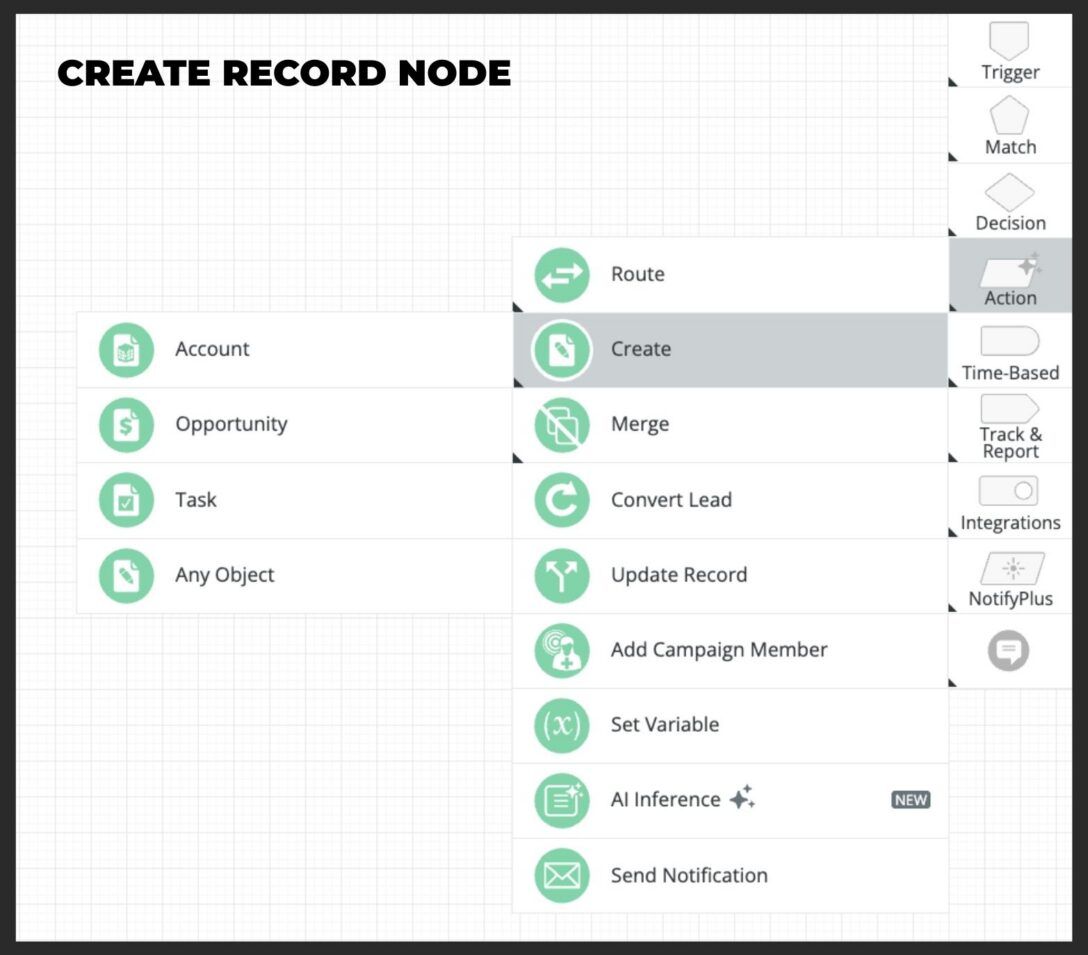
Previously, LeanData’s FlowBuilder offered dedicated nodes for creating specific record types like Accounts, Opportunities, and Tasks. The new Create Record Node removes that limitation, letting teams create any standard or custom Salesforce object directly within a routing graph.
This opens up workflows that weren’t possible before.
When a lead is converted during routing, you can automatically create a Contact Role record on the matched Opportunity. When a high-priority inbound request arrives, you can instantly generate a Salesforce Case. The node uses data and context already available in the graph, so there’s no additional setup or code required.
For organizations that have customized Salesforce, this node adapts to how you work.
Conditional User Provisioning: Automate BookIt Onboarding at Scale
As organizations grow, managing which reps have access to scheduling tools becomes an operational bottleneck.
Conditional User Provisioning automates this by letting admins define reusable condition sets based on Salesforce User fields. When a user matches one or more conditions, they automatically receive an email invitation to authorize their calendar for the applicable BookIt products.
Each provisioning run includes a preview step and an audit email, so admins always know who was invited and why.
As a result, new reps get access faster, and operations leaders spend less time on access management.
Building for What Comes Next
LeanData’s Q1 2026 release reflects where enterprise go-to-market is heading:
- Account structures are growing more complex through acquisition and global expansion.
- AI is becoming an embedded layer within business processes.
- AI agents are handling real buyer interactions, which means they need reliable infrastructure behind them.
Whether you’re a CMO aligning AI with demand generation, an operations leader scaling a growing team, or an IT director governing how AI enters Salesforce, this release was built with your priorities in mind.
Ready to take your GTM to the next level?
FAQ
How does LeanData Account Hierarchies work with existing Salesforce data?
Can I control which AI models LeanData uses in my routing workflows?
What is agentic scheduling and how does LeanData support it?
Do I need a separate integration to use Whitespace Discovery in Account Hierarchies?

Kim Peterson
Kim Peterson is the Senior Manager of Content Strategy at LeanData where she digs deep into all aspects of go-to-market strategy and execution. Kim's writing experiences span tech companies, stunt blogging, education, and the real estate industry. Connect with Kim on LinkedIn.