















Summary
When your lead-to-opportunity conversion rate starts declining, the instinct is to blame lead quality or marketing targeting. But for most B2B organizations, the root cause is operational: slow routing, inaccurate matching, and a lack of buyer context at the moment of handoff. This article breaks down the five most common reasons conversion rates erode and shows how companies like Snowflake, Brandwatch, and Uber for Business fixed them.
What you’ll learn
- What healthy lead-to-opportunity conversion benchmarks look like across B2B industries
- The five operational root causes behind declining conversion rates
- How automated routing, SLA enforcement, and buyer context improve MQL-to-SQL handoffs
- Real outcomes from Snowflake, Brandwatch, and Uber for Business after fixing their lead processes
- Where AI is beginning to accelerate the routing and scheduling layers of GTM execution
Why B2B Lead-to-Opportunity Conversion Rates Decline
Think about what happens to the thousands of leads your marketing team generates every quarter.
According to Ruler Analytics, only 2.9% of MQLs ever convert to revenue. That number is jarring, but it hides a more useful question: where, exactly, are those leads disappearing?
The answer, for most B2B organizations, isn’t lead quality. It’s the operational gap between a lead entering the CRM and a rep actually engaging with it.
Slow routing, mismatched records, missing context, and zero accountability for follow-up all quietly erode conversion rates. None of these problems show up in a dashboard until revenue is already missed.
Companies like Snowflake, Brandwatch, and Uber for Business have identified and fixed these gaps, and the results are significant.
This article walks through the five most common root causes and the operational changes that reverse the decline.
What does a healthy lead-to-opportunity conversion rate look like?
Before diagnosing what’s broken, it helps to know what “normal” looks like.
The MQL-to-SQL handoff is the single biggest drop-off point in most B2B sales funnels. According to Forrester and multiple industry benchmark reports, average MQL-to-SQL conversion rates range from 13% to 21%, depending on industry, lead source, and sales motion.
Top-performing teams with strong routing automation, clear qualification criteria, and tight sales-marketing alignment regularly hit 30% or above. And the improvement doesn’t have to be dramatic to matter. Other industry reports suggest that even a five-point increase in MQL-to-SQL conversion can lift overall revenue by roughly 18%.
The point is not to chase a single benchmark.
It’s to figure out where in the lead-to-opportunity handoff your drop-off is steepest, and then fix the process that governs it.
Five reasons your lead-to-opportunity conversion rate is declining
1. Your speed to lead is too slow
Research published by the Harvard Business Review found that companies responding to leads within one hour are seven times more likely to qualify them than companies that wait even an extra hour. The same study found that firms waiting 24 hours or longer were 60 times less likely to qualify a lead than those responding in the first hour.
Yet the average B2B lead response time is 42 hours.
The delay usually isn’t rep laziness. It’s operational: leads sit in queues waiting for manual assignment, routing logic is hardcoded into Salesforce and requires developer support to change, or enrichment processes add minutes of latency before a lead is even visible to a rep.

Zendesk faced exactly this problem. Before automating their routing, lead response took 45 minutes on average. After implementing automated matching and routing with LeanData, that dropped to eight minutes, an 82% reduction. Lead touches decreased 90% on average, falling from four to eight hours to just 30 minutes.
2. Leads are matched to the wrong accounts
When a lead gets attached to the wrong account, it goes to the wrong rep. That rep either wastes time researching an account that isn’t theirs or engages the buyer without the right context. Both outcomes kill conversion.
This problem compounds in organizations with large account hierarchies, multiple product lines, or partner channels.
3. Marketing and sales define “qualified” differently
Marketing counts MQLs. Sales counts pipeline. If the two teams score and prioritize leads using different criteria, the handoff between them becomes a conversion cliff.
Marketing sends over leads that meet engagement thresholds but lack genuine buying intent. Sales deprioritizes them because they don’t match what reps consider “ready.”
This misalignment is structural, not interpersonal. It’s the result of separate systems, separate definitions, and no shared visibility into where buyers actually are on their journey.
Bridging it requires a unified view of buyer signals across both teams, which means consolidating data across your CRM, marketing automation, and engagement platforms into a single place where both marketing and sales can see the same picture.
4. Nobody is enforcing follow-up SLAs
Without automated tracking, there’s no way to know whether or how quickly reps follow up. Leads go cold while sitting in someone’s queue because the rep was in a meeting, on PTO, or simply overwhelmed with volume.
5. Reps receive leads without buyer context
A lead record with a name, email, and company tells a rep almost nothing.
- What product is this person interested in?
- Have they engaged with marketing content before?
- Are they the only person from their organization exploring your product, or are there five others?
- Is this account already in an active sales cycle?
Without this context, reps either spend time researching (which delays response) or reach out with generic messaging (which reduces conversion).

How leading B2B teams are reversing the decline
The root causes above share a common thread: they are all process problems, not people problems. And process problems can be fixed with better orchestration across the routing, matching, and scheduling layers of your go-to-market motion.
Automate the routing layer. Replace manual queues and hardcoded Salesforce rules with automated lead-to-account matching and routing. Automation eliminates the latency, errors, and inconsistency that come with human-dependent lead distribution. It also means routing rules can be updated in hours instead of weeks, a flexibility that matters in any organization adjusting territories, segments, or go-to-market strategy.
Enforce speed-to-lead SLAs with automation. Automated SLA tracking, notifications across Slack, Microsoft Teams, and email, and automatic re-routing when SLAs are missed create accountability without adding operational overhead.
Give reps full buyer context at the moment of assignment. Signal consolidation, journey tracking, and buying group visibility mean reps engage with relevance instead of assumptions. This is also where AI is beginning to accelerate GTM execution.
LeanData’s AI-powered matching uses machine learning to uncover hidden relationships across CRM objects, and features like AI Graph Summary help ops teams understand and optimize routing logic without digging through code.
What does this look like in practice?
Three companies that addressed these root causes, each with different starting points, all saw measurable improvements in conversion:
Brandwatch replaced manual lead processes with LeanData’s intelligent GTM orchestration and doubled their conversion rates. The shift removed the bottlenecks and inconsistencies that had been quietly suppressing pipeline performance.
Snowflake deployed LeanData matching and routing across its global account-based strategy and achieved a 20% to 30% increase in inbound lead conversion rates, sub-five-minute response times on demo requests, zero lost leads from misrouting, and a 78% reduction in SDR research time.
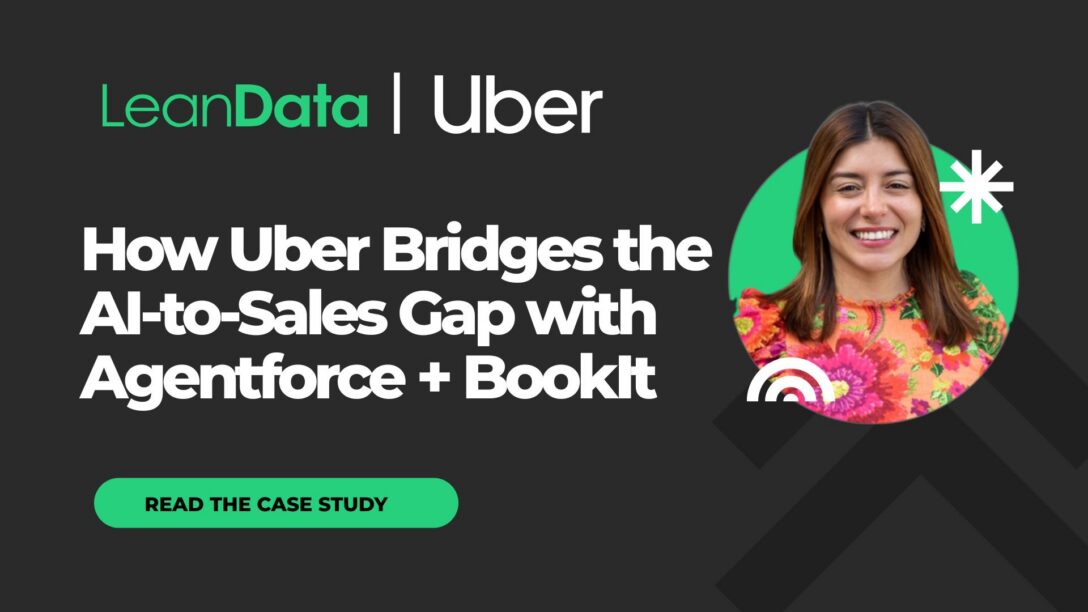
Uber for Business integrated LeanData BookIt with Salesforce Agentforce, bridging AI-driven lead qualification to human sales conversations. Deal velocity increased 68% and win rates climbed 53%.
The common thread across all three is not a single feature or tactic. It’s the decision to treat lead-to-opportunity conversion as an orchestration problem, one that requires coordination across matching, routing, scheduling, and signal visibility.
Where to start
- Audit your current lead response time. Look at the gap between lead creation in the CRM and the first rep activity on that record. If that number is measured in hours or days rather than minutes, routing automation is the highest-leverage fix you can make.
- Examine your matching accuracy: how often do leads land with the wrong rep? And evaluate whether reps are receiving enough buyer context to have a productive first conversation, or whether they’re spending their time researching instead of engaging.
For teams already exploring AI across their go-to-market motion, the orchestration layer is where AI governance and coordination need to live. Isolated AI experiments across different teams and tools create new complexity.
A platform that orchestrates AI-driven signals, human-led actions, and system-triggered workflows in one place ensures that speed doesn’t come at the expense of control.
Curious About LeanData?
FAQ
What is a good MQL-to-SQL conversion rate for B2B companies?
How does speed to lead affect conversion rates?
What causes leads to get routed to the wrong sales rep?
Can AI help improve lead-to-opportunity conversion rates?

Kim Peterson
Kim Peterson is the Senior Manager of Content Strategy at LeanData where she digs deep into all aspects of go-to-market strategy and execution. Kim's writing experiences span tech companies, stunt blogging, education, and the real estate industry. Connect with Kim on LinkedIn.