













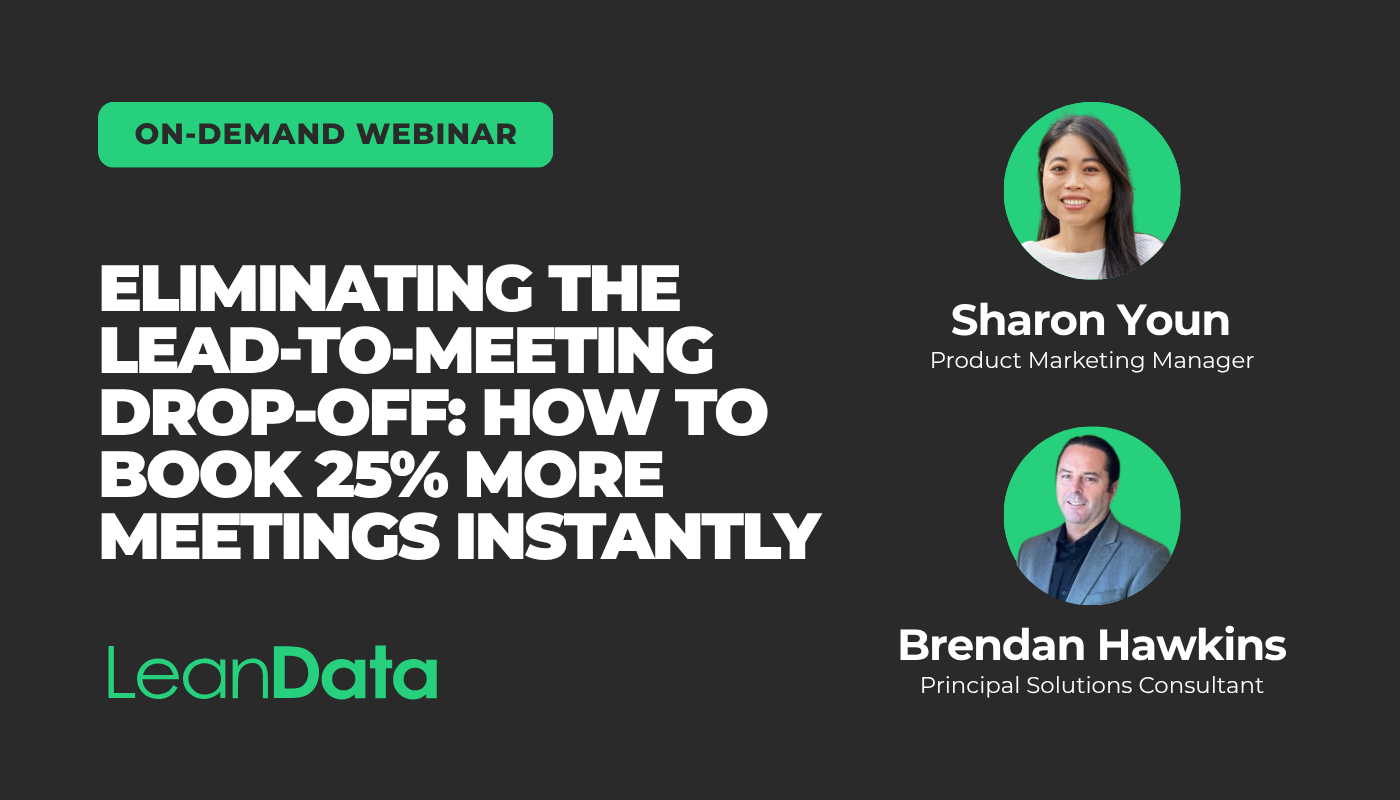
Twenty-five percent of high-intent leads never make it to a meeting.
They fill out your form, express interest, and then disappear — not because they lost interest, but because friction got in the way. This session walks through LeanData Scheduling and shows exactly how BookIt for Forms, BookIt Handoff, and BookIt Links solve for lead-to-meeting drop-off across inbound, outbound, and post-sale motions.
What You Will Learn
- Understand why scheduling friction kills pipeline and how the five-minute rule applies to your inbound funnel
- Configure BookIt for Forms to display the right rep’s calendar immediately after form submission, no SDR coordination required
- Use LeanData’s FlowBuilder to build routing logic for target accounts, growth segments, and existing customers without writing code
- Execute seamless SDR-to-AE and post-sale handoffs using BookIt Handoff so no deal drops between teams
- Deploy BookIt Links with QR codes and personalized routing for event season to convert booth conversations into confirmed meetings
Why This Matters
Speed to lead is not a nice-to-have. When a qualified prospect fills out your form and waits three days for a response, that deal is already at risk. Manual SDR coordination, calendar back-and-forth, and incorrect rep assignments are not just inefficiencies, they are revenue leaks.
LeanData Scheduling connects your routing logic directly to the booking experience so every meeting lands with the right rep, at the right time, with full Salesforce context intact. That connection between routing decisions and scheduling execution is where most point solutions fall short.
Use Cases
- A prospect from a named target account submits a contact form and instantly sees the assigned AE’s calendar on the thank-you page
- An SDR qualifies a prospect on a discovery call and books the AE follow-up before the call ends, using BookIt Handoff
- A RevOps team uses LeanData FlowBuilder to route new prospects into a round-robin SDR pool while protecting existing account relationships for the AE
- A marketing team loads BookIt Links as QR codes at an event booth so every booth conversation ends with a confirmed meeting
- A post-sale team automates the implementation kickoff meeting by embedding a BookIt scheduling link in the new customer welcome email
Session Transcript
Sharon Youn
Hi everyone, my name is Sharon Youn and I’m on the product marketing team here at LeanData. I’m super excited you’re here today because we’re gonna talk about something that’s probably costing you pipeline right now, and you might not even realize it.
We’re talking about that gap between when someone says, “Yes, I wanna talk to you,” and when they actually get on the calendar.
So that lead to meeting drop off, it’s real, and we’re gonna show you exactly how to solve for this. I’ve got Brendan Hawkins with me today, and he’s one of our principal solutions consultants.
He lives and breathes this stuff, and he’s gonna walk you through some live demos so you can actually see how this works in action. So let’s jump right in.
Alright. So this is what we’re going to be covering today. First, we’re gonna talk about the cost of scheduling friction. Like, what’s actually happening when you make people wait three days to book a meeting? This might come as a spoiler surprise, but they’re not waiting.
Then we’ll show you LeanData scheduling, our suite that includes BookItForForms, BookItHandoff, and BookItLinks. This is what solves the problem.
We’ve got a customer spotlight. Uber for Business just did this, and their results are really impressive. They’re seeing a 68% faster deal velocity, and we’ll get into the details of how they got to that.
Then Brendan’s gonna do a live demo. Three different flows so you can see exactly how this works in real life.
We’ll talk about Q2 event season strategy because conference season is here. And if you’re not using intelligent scheduling at events, you’re leaving a lot of pipeline on the table.
And then we’ll leave you with resources that you can then take back to your team today. If that sounds good, let’s get into it.
Okay. So here’s the stat that should make you mad, if not, at least a little upset. We’re seeing that 25% of high intent leads never make it to a meeting.
These are people who have filled out your form. They said yes. They’re ready to talk, and then they just disappear. The reason isn’t a lack of interest. It’s friction. They’re waiting for an email. They’re playing calendar tag.
Maybe they’re even getting sent to the wrong rep. So by the time someone finally reaches out and engages, they might have already moved on. Or even worse, your buyers might have talked to your competitor who responded just a little faster. And so we’re trying to solve for that today.
Let me walk you through what this actually looks like. Someone might fill out a form. Maybe they’re super excited. They show a lot of high intent, and they wanna talk to someone in real life. And then they wait.
They get an email that says, “Okay, someone’s gonna reach out.” Maybe an SDR might pick up the phone a few hours later or the next day, and there’s back and forth just trying to find a good time to meet. And so they’re playing calendar tag.
Potentially, someone might need to reschedule. And by the third day, that moment is gone. And this is what we’re seeing kill a lot of companies in terms of just lost pipeline. We’re seeing that 60% or more of SDR time is just spent on manual non-selling coordination.
They’re not talking to prospects. They’re playing calendar Tetris. So the five-minute rule is real. Leads go cold in just five minutes without immediate follow-up. If you’re making them wait, you’re losing.
And then there’s the whole host of manual triage errors. You get the wrong rep. There’s bad timing. Potentially even having the wrong context for the meeting. It’s a whole mess. And so this is what scheduling friction looks like, and this is what we’re going to eliminate today.
So here’s what LeanData scheduling does. We’ve got three products that cover the entire buyer journey. BookItForForms: instant booking from web forms, chatbots, and AI SDRs. So your prospect will fill out a form, and the right rep’s calendar appears immediately. There’s no wait. There’s no manual triage. It’s done.
BookItHandoff and BookItLinks help cover some of your outbound use cases. BookItHandoff helps provide that seamless SDR to AE handoff as well as any post-sales handoff use cases that you might be working through. Your SDR can qualify someone on the call and book the demo with the AE before your prospect hangs up. And the same goes for any AE to AM or AE to CSM handoff. There’s no drop off.
With BookItLinks, this solution helps you provide any personalized dynamic booking links for every channel. You have outbound, email, Slack, and wherever else you can drop a link. The link knows who the prospect is, applies your routing rules, and then books with the right rep automatically.
And here’s the thing: this is the only scheduling suite that’s natively built inside your go-to-market orchestration platform. It’s not just a bolted-on tool. It’s connected to your entire routing engine, your Salesforce data, as well as any SLA logic that you built in and any other data that you have flowing through into your CRM.
So this, of course, is all native on the Salesforce platform. There’s a no-code flow builder, and it comes with a 95% matching accuracy. So this is intelligent scheduling. It’s not just putting a random meeting on a calendar.
And so what makes LeanData scheduling different from solutions like Calendly or anything else in the market? Three things. It’s routing intelligence. You have your AI-powered lead-to-account matching at a 95% plus accuracy. Every meeting goes to the right rep automatically.
If it’s an existing account, it routes to the account owner. If it’s a new prospect, it hits your round-robin pool. And so if it’s coming from a personal email domain, it might not even show a calendar at all depending on how you set up your flow builder. So we know that the routing is smart. It’s gonna book with the right rep and the right context.
Secondly, we’re providing a no-code flow builder. Your RevOps team can adapt your go-to-market plays in hours and not weeks of custom code. You can drag and drop, change your routing rules on the fly, and there’s no need for putting together a dev ticket or waiting on another department to help you implement these changes.
Finally, this is all native to Salesforce. All of your data stays within that Salesforce environment as that ground truth for AI and automation. You get full audit logs, SLA tracking, scheduling analytics. Everything is all on that singular platform.
And this is why companies like Uber, Qualified, and Remote use LeanData. It’s not just a calendar tool. It’s infrastructure that they trust and rely on.
And the results back this up. In a recent customer survey, 86% of BookIt users reported an improvement of 25% or more in form-to-meeting conversion. 91% of them reported an improved speed-to-lead of 25% or more, and 55% of respondents said that they decreased their no-show rate by 25% or more.
Before we get into the demo, I just wanted to show you who’s using this. We have Uber for Business, Shopify, Qualified, Samsara—a whole host of leading companies. And these are companies that care about pipeline. They care about speed-to-lead, and they’re using LeanData scheduling to eliminate that lead-to-meeting drop-off.
Some of the top use cases that we see from them are AI SDRs and chatbots, website forms, SDR to AE handoffs, any post-sale handoffs, and event season. So if you’re doing any of these things right now and you don’t have intelligent scheduling, you’re losing meetings, period.
Alright. Let’s dig into a customer story of ours. I wanted to talk about Uber for Business because their story has some really cool results. They implemented Agentforce, Salesforce’s AI agent, to handle their self-service inbound funnel. The AI agent qualifies prospects, answers questions, and creates that meeting-ready moment.
But then when they actually needed to book the meeting—and not just any meeting, making sure that it’s the right meeting with the correct regional AE based on their existing territory logic—they ended up deciding to use our BookIt scheduling APIs.
So now the Agentforce agent will call our API in real time. It checks availability, applies routing rules, and books the meeting all inside the conversation so that there’s no redirect and there’s no manual handoff.
And the results: they’ve been able to see a 68% increase in deal velocity. So they went from 78-day sales cycles down to 25 days. They’ve also been able to see a 53% increase in their win rates, and this is already in production with a Fortune 500 company. And so this is what happens when you really invest in eliminating that scheduling friction.
Lattice, another customer of ours, came to us with a very classic problem that many of you guys might be experiencing today. They were using multiple SaaS tools to manage their lead lifecycle, and the results were slow response times and unnecessary complexity.
Their RevOps team made a critical decision to consolidate. They switched from Chili Piper to BookIt, and the results were immediate. Lead response times dropped down to ten minutes or less. And that’s what speed-to-lead looks like in practice, and it’s what we’re going to show you how to build right now.
Alright. So now I’m going to hand it off to Brendan, and he’s gonna walk you through exactly how this works. You’re gonna see three main flows: 1. Converting inbound instantly from a web form and chatbot. 2. The orchestration behind the booking so that you can see the routing logic in Flow Builder. 3. Scheduling beyond the first meeting: SDR handoffs, post-sale handoffs, all of it. So I’m gonna hand it over to Brendan.
Brendan Hawkins Alright. Now that you’ve seen what Lattice accomplished, let’s get hands-on. I’m gonna walk you through four different demo scenarios that show you exactly how this works in real life. And I want you to think about your own process as we go through this. Where are the gaps? Where are the leads falling through? Drop questions in the chat as they come up, and we’ll address them at the end.
Let’s start with the most common use case: inbound form scheduling. Here’s our scenario: a prospect from Hard Rock, a named target account, just filled out your contact sales form. Watch what happens next.
In the background, LeanData’s AI engine fires a lead-to-account match. It checks the CRM, finds an existing account record, and sees that Sarah is the assigned account executive. Instead of triggering an email workflow or a Slack to an SDR, BookIt does one thing: it displays Sarah’s live calendar directly on the thank you page. The prospect picks a time in seconds. Done.
This is exactly the flow our customer, Amplify, implemented. They put BookItForForms on their contact sales page and completely eliminated the SDR coordination step for high-intent inbound. The prospect just books.
I also wanna call out, BookIt isn’t limited to web forms. You can trigger this same scheduling flow from a chatbot, an AI SDR like our customers at Telium, or even inside an app or product within in-app scheduling. Wherever the buyer signal comes from, BookIt can catch it.
Now let me pull back the curtain and show you the logic that’s running behind that seamless experience. This is Flow Builder, LeanData’s no-code visual drag-and-drop user interface that controls the intelligence that powers scheduling.
Here’s a typical scheduling flow builder with three distinct routing paths for three different segments. First, a meeting request enters through one of several trigger nodes aligned with your various web forms, chatbots, AI agents, and intelligence scheduling links.
Next comes a series of matching nodes. Duplicate lead: have we already provided this prospect a demo in the past? If so, let’s schedule with the prior demo owner. Duplicate contact: are they already a contact in CRM? Does someone have a relationship we can leverage? Let’s assign the meeting with them.
And lastly, our lead-to-account match. Is this a small business account? While this represents nearly 30% of Catalyst Solutions’ annual revenue, these deals are small and need to be transactional to maintain tight margins. For this path, Catalyst has chosen not to schedule meetings with their SDRs. Instead, the prospect is redirected to a recorded product-specific presentation.
Later, through a combination of LeanData’s AI inference node powered by Gemini AI, a thoughtfully built sales agent within Salesforce Agentforce, and Outreach, the sales automation platform, these small business prospects will be nurtured and converted to customers without human intervention.
After the matching nodes, we come to our meeting assignment decision node. Decisions can be made off any combination of form, chat, and match CRM data. Path one is for our prospect target account segment. This is the path that Sarah at Hard Rock Engineering went down.
Our company, Catalyst Solutions, has decided that contacts from target accounts that meet certain criteria are prequalified to schedule thirty-minute discovery calls with their respective account executive. The calendar presented to Sarah is respective of things like working hours, holidays, and even doctor’s appointments. So anything that’s not booked is fair game for Sarah to select from. At a minimum, account executives will always have two hours to research and prepare for these types of conversations.
Path two is for the growth segment. In this segment, Catalyst Solutions typically sees faster-moving opportunities with fewer buying influences. Prospects who meet the right criteria are presented with an SDR round-robin pool that combines everyone’s open time slots, giving the most prospect-centric experience.
This is powerful. Instead of showing one rep’s calendar, BookIt shows the earliest available times across all SDRs in the pool. This maximizes speed-to-meeting. Catalyst has also decided to make these shorter fifteen-minute discovery calls with scheduling options available immediately. No preplanning is required.
Scheduling path three is for our customer accounts. This might be an opportunity to protect or grow customers. So getting the right calendar makes all the difference in the world. But what if the account manager’s out of the office or inactive? Catalyst has orchestrated a backup plan to redirect those meetings to the CSM on the account team.
Now let me pull that back curtain and show you the logic that’s running behind the seamless experience. This is where RevOps builds the intelligence layer. Let’s start with those prospects that do not schedule a meeting.
Despite our best efforts, 30-40% of people who engage with your forms, chat, or agents will abandon the calendar once it’s presented. They see the calendar, then they get pulled into another meeting. They aren’t ready to commit, get distracted, or close the browser tab. Most companies lose their leads forever. LeanData doesn’t.
With the small business segment already in the trusted hands of their Agentforce agent, Catalyst only needs to concentrate on the abandoned calendars for their target account and growth segments. First off, Catalyst Solutions, after monitoring prospect activity for the first few weeks, has decided to force close their calendar after ten minutes. They figure if you haven’t selected a time after ten minutes, you walked away, went into a meeting, or possibly have in fact lost interest.
This is where LeanData’s orchestration platform kicks in. For these BookIt-enabled forms, LeanData is designed to hold on to the lead until either the meeting is booked or the calendar is force closed. However, that time isn’t wasted. Processes like enrichment, record stamping, matching, merging, and pre-assignment decisions are all taking place.
Catalyst is also using LeanData’s AI inference node to examine the sentiment of the prospect to double-check that their inquiries are of a sales nature rather than support, vendors, press, or partnerships.
Once the abandoned calendar is closed and the prospect is redirected, Catalyst Solutions automatically adds them to a “sorry we missed you” campaign in Marketo. Embedded in that campaign is one of LeanData’s intelligent routing links, which can present the calendar of users or pools based on CRM logic.
LeanData is also automatically adding the prospect to an outreach sequence on behalf of the sales rep. Each email in the sequence has a call to action that includes a formless scheduling link with factors like prospect details, host credentials, additional hosts, and meeting type intelligently embedded for the most frictionless experience.
Catalyst sends the rep a Slack notification using Notify Plus. In the notification are all the lead details as well as a minimum SLA of eight minutes. The rep can easily take action, in this example, activating the outreach sequence directly through Slack.
Every rep has a dashboard with up-to-date performance metrics against their peers. Catalyst has found that reaching out to prospects within ten minutes has a far greater success rate compared to reps who delay their actions. Top metrics customers track include overall SLA compliance, time to action by owner, and abandoned calendar recovery rates. This is the visibility most scheduling tools don’t give you. You’re not just booking meetings. You’re enforcing accountability, tracking SLAs, and identifying revenue leaks in real time.
Alright. We’ve covered inbound scheduling and SLA enforcement, but BookIt isn’t just for that very first meeting. Let me show you two more critical scenarios: first, an SDR to AE handoff, and second, a post-sale lifecycle management motion.
Here’s the scenario: your SDR Jake is in the middle of a great discovery call with a prospect he’s been trying to nail down for weeks. They’re qualified and ready to speak to an account executive. Jake knows it’s best practice to schedule that meeting before hanging up with his prospect.
So Jake just clicks on the BookIt Handoff button. LeanData instantly sets the meeting type as an AE follow-up call. It matches the lead to an existing account and identifies Rob as the account owner. We then pull up Rob’s live calendar availability directly from Google Cal. Jennifer says Monday morning will work best. We book the time and the invite goes out from the account executive with options to reschedule or cancel. No post-call coordination or follow-up email. Done.
Now here’s where it gets really powerful. What if Sarah and a solutions consultant need to be in that next meeting? Well, with Handoff, Jake has immediate access to add those team members as well, and they can either be required or optional attendees. The calendar only shows slots where both team members are free. No more back and forth. The prospect books a time that works for everyone.
Alright. Final scenario. Let’s fast forward. Jake’s AE just closed the deal. That lead Jake qualified is now a customer. So what happens next? Most companies drop the ball here. The sales to implementation team handoff is manual and slow.
Not for Catalyst Solutions. They’re automating the entire customer lifecycle. First off, when an opportunity is won, the renewal opportunity and opportunity contact roles are created using LeanData’s Opportunity Flow Builder. Additionally, onboarding actions, notifications, and SLAs are tracked against the deal to easily know their impact on performance.
And finally, contacts that are identified as our primary installation team receive a welcome email from Catalyst. In addition to helpful resources, the email contains a scheduling link. This link will be the kickoff point for the next twelve months of the relationship. First impressions matter. The link is directed at onboarding individuals or pools dependent on product interest. Pools allow Catalyst to utilize their onboarding resources most effectively as no one is assigned to the project until the customer books a meeting.
Sharon Youn Alright. Thanks, Brendan, for going through those demos. Okay. So conference season is here. Let me go over this quick playbook on how to actually get ROI out of every event.
Before the event, you wanna try dropping BookIt links into your outbound sequences at least two to three weeks before your conference. Your prospects can book meetings before they even get to the event. You can then show up with a packed calendar.
While you’re at the event or at the booth, this is where routing links become your secret weapon. You can load routing links as QR codes onto iPads or any type of display at your booth, and this is what makes them special. They’re really dynamic. When someone scans that QR code or clicks the link, LeanData’s intelligent routing kicks in.
So if they’re from an existing account, they are automatically routed to the account owner’s calendar. If they’re a new prospect, they’re routed based off of any territory rules or into a round-robin pool of available reps. So now when someone walks up and has a great conversation with someone at your booth, they can scan the QR code and book a meeting right then and there. They don’t have to walk away with a business card. They can walk away with a confirmed meeting on their own calendar.
And after the event, try using BookIt links or BookIt invites in any of your follow-up correspondence. In order to keep the momentum going, you can put it in your emails, and prospects can then choose a set number of time slots within the email so that there’s less back and forth, and it eliminates that “let me know when you’re free” situation.
And this is exactly what our customer, Qualified, does. They use our platform to automate their event list loads and routing, and this has helped save their RevOps team at least five hours per event. And when you’re doing tens, if not hundreds of events every year, this really adds up. We all know that events are expensive investments for any marketing team. This is how you can make sure that every conversation becomes a meeting.
I wanna talk some numbers really quickly and show how our customers have seen real ROI in their pipeline. At least 91% of our BookIt customers see ROI in weeks, not months, which is incredible. 44% of our BookIt users have improved speed-to-lead by 25% or more; a 68% increase in deal velocity with Uber as well as a 53% higher win rate; 400 to 500 meetings booked monthly through BookIt Handoff alone with our friends over at Remote; and then at least five hours saved for every event at Qualified.
We all know that this stuff works. It’s not theoretical. It’s in production, and it’s generating real pipeline for our customers.
Alright. So before we close out our time together, let me make sure to leave you with everything that you need. First, the recording. You’ll have this in your inbox soon. Make sure to share it with your team, revisit the demo, whatever you need.
Second, if you wanna see LeanData scheduling in action for your specific use case, there’s a link in the chat to request a personalized demo. Our team can show you exactly how BookItForForms, BookItHandoff, and BookItLinks can work in your environment.
And third, we wanted to leave you with a really handy-dandy resource called “LeanData for Events: The Ops Playbook.” That should be linked in the chat as well. It’s super practical. It has a bunch of step-by-step processes, tips from our customers, as well as our own firsthand advice with templates that you can use immediately. You can hand this over to your RevOps team to try out.
And one more thing: we are running a special pricing promotion on LeanData scheduling this quarter. So if you’ve been thinking about solving any of your scheduling friction, now is a really great time to reach out and make use of that.
Alright. Thanks everyone for your time. We know how valuable it is, and we’re genuinely excited to help you turn a lot of your leads into meetings. Please do not hesitate to reach out to us if you have any additional questions. Thank you.