













Summary
This article breaks down LeanData’s GTM Orchestration Maturity Model, explains how orchestration works across the full revenue lifecycle from acquisition through expansion, and shows how enterprise teams can build a coordinated, AI-ready go-to-market (GTM) motion with full transparency and governance.
The GTM Strategy vs. Execution Gap
Most B2B revenue teams do not have a strategy problem. They have an execution problem.
LeanData-sponsored research with Harvard Business Review surveyed 522 GTM leaders and found that 83% say strategy is important to growth, but only 38% believe their strategy is actually effective.
That gap is where revenue gets lost: in disconnected handoffs, siloed tools, inconsistent follow-up, and a buyer journey that breaks between teams.
Intelligent GTM orchestration is the operating model that closes that gap.
It connects signals to the right actions across the full revenue lifecycle, aligning people, processes, and systems around the buyer journey rather than around internal org chart lines. The result is not just cleaner operations.
It is faster response, better conversion, and a GTM engine that can adapt as complexity grows.
What Is Intelligent GTM Orchestration?
Intelligent GTM Orchestration is a coordinated operating model that integrates buyer signals, automates the right actions, and aligns marketing, sales, and customer teams around a shared view of the buyer journey, from first touch through renewal and expansion.
It is distinct from point-solution automation in four ways:
The HBR research is clear on what closes the execution gap: better coordination across marketing, sales, and customer teams ranked as the top priority among GTM leaders.
Orchestration is the mechanism that makes that coordination systematic rather than dependent on tribal knowledge and manual effort.
“92% of buyers have a vendor in mind before they even start a buying process. And then 81% of those buyers are dissatisfied with that buying experience, even with the winning provider. Why? We’re trying to pull them into our process. We’re trying to make them fill out forms. We’re trying to make them talk to SDRs. We’re trying to make them watch a demo when they just want to talk to the product person.”Amy Hawthorne
Start with the Buyer Journey, Not Your Org Chart
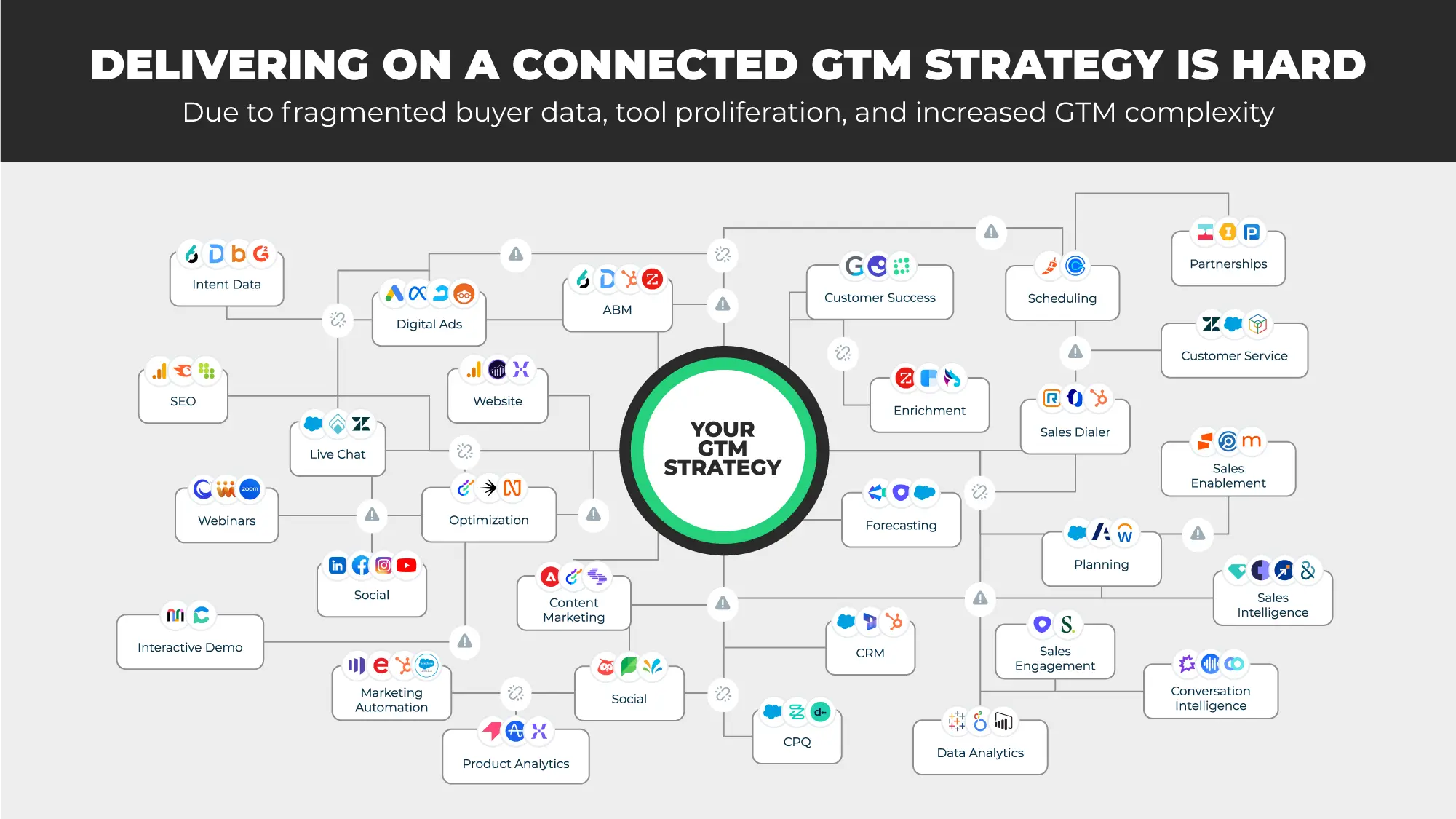
Most GTM organizations are still built around internal functions. Marketing owns one set of processes. Sales owns another. Customer teams manage their own workflows. Buyers experience all of it as one journey.
That disconnect creates friction fast. A lead gets routed late. A handoff happens without context. An expansion signal never reaches the right team. Each problem looks isolated, but together they create a fragmented revenue motion that shows up in pipeline and retention numbers.
Intelligent GTM orchestration starts by zooming out.
It asks a different question: what should happen at each stage of the buyer journey, and how do your teams and systems coordinate around that moment?
When you anchor execution to the buyer rather than to the org chart, operational breakdowns become visible before they show up in revenue numbers.
GTM Orchestration Maturity Model
Stage 1: Alignment
The signal you may be here: Leads are still assigned manually, routing rules live in spreadsheets, or reps regularly complain about bad data.
Focus: Foundational execution. Lead-to-account matching, routing, assignment, and SLA management.
What it solves: Inconsistency, accountability gaps, and slow response times caused by manual processes.
What it looks like in practice: SUSE improved speed to lead by 70% in a single quarter after replacing manual lead management with structured routing and SLA tracking. Rockwell Automation reduced lead qualification time from 7 days to under 5 minutes while simultaneously reducing IT dependency.
Stage 2: Automation
The signal you may be here: Routing is automated but disconnected from other tools, or your team is managing multiple workflows that do not talk to each other.
Focus: Signal-driven workflows. Connecting systems, triggers, and actions across the buyer journey so execution happens automatically, not reactively.
What it solves: Slow follow-up, missed signals, and conversion loss from process gaps between tools.
What it looks like in practice: Brandwatch replaced manual routing with automated workflows and saw time to first touch drop from hours to minutes, with MQL-to-meeting conversion rates doubling. Zoom reduced routing time by 39%, dropping from over 3 minutes to under 1.5 minutes. This speed directly correlated to revenue, boosting the lead-to-opportunity conversion rate from 11% to 17%.
Stage 3: Orchestration
The signal you may be here: Your teams can execute individual plays well, but expansion signals get missed, CS and sales rarely coordinate, and account-level visibility is limited.
Focus: Full lifecycle coordination. Using signals and insights from across the revenue lifecycle to optimize every motion, including acquisition, retention, and expansion.
What it solves: Siloed teams, missed expansion signals, and the inability to coordinate account-level plays across marketing, sales, and CS.
What it looks like in practice: Palo Alto Networks launched a buying groups strategy with LeanData and saw a 15% improvement in revenue, a 2x increase in closed-won rates, and 10x pipeline progression. reported an 86% increase in pipeline after shifting from a lead-centric model to buying group orchestration.

Key Takeaway
Most enterprise teams are somewhere between Stage 1 and Stage 2. The jump to Stage 3 is where the biggest revenue outcomes live, but it requires the foundations of the earlier stages to be stable first.
Orchestration Across the Full Revenue Lifecycle
Orchestration is often associated with inbound lead routing. That is only one use case. The bigger opportunity is applying the same framework across every stage of the buyer lifecycle.
Acquisition
- Lead-to-account matching
and deduplication - Speed-to-lead workflows
and SLA enforcement - ABM signal routing
and territory assignment - Meeting scheduling and rep handoff automation
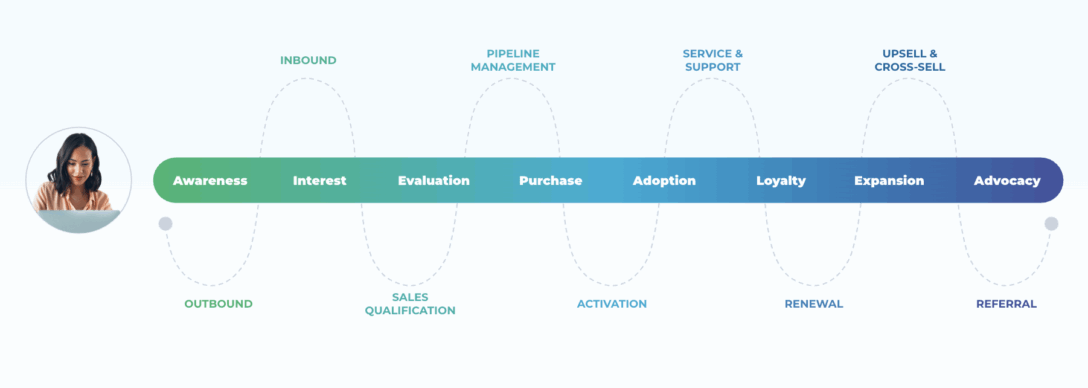
Retention
- Support and success SLA Management
- Churn risk alerts
and ownership routing - Renewals coordination across CS and sales
Expansion
- Buying group identification and engagement tracking
- Cross-sell and upsell signal routing
- Product usage-based routing
- Automated QBR and account review workflows
When these motions are managed separately, teams operate reactively. When they are orchestrated together, you get a system that scales with the business and responds to buyer behavior in real time.
Why This Matters Now
Enterprise teams are being asked to move faster, operate leaner, and integrate AI into execution without losing control. That raises the stakes.
More systems, more signals, and more automation can either improve performance or create more fragmentation, depending entirely on whether there is a governed orchestration layer connecting them.
The HBR research makes the urgency clear: leaders know strategy matters, but most still cannot translate it into coordinated execution.
Intelligent GTM orchestration closes that gap by creating a governed operating model where every action, whether system-triggered, human-led, or AI-driven, runs through the same framework with the same transparency.
The real risk is not moving too fast. It is adding more tools and more AI without the orchestration layer to govern them.
The Next Step for Your GTM Strategy
If your teams are still solving execution issues one workflow at a time, you are treating symptoms instead of fixing the system.
Intelligent GTM orchestration gives you a way to step back, map execution to the buyer journey, and build a revenue engine that is faster, more coordinated, and easier to improve over time.
The maturity model is your starting point: identify which stage you are at, find the biggest gap, and build from there.
The question is not whether your GTM motion is complex. It already is.
The question is whether that complexity is being managed intentionally.
Power Growth Through Orchestration
Frequently Asked Questions
What is the difference between GTM orchestration and marketing automation?
How is Intelligent GTM orchestration different from CRM?
What stage of GTM maturity should we be at before investing in orchestration?
How does AI fit into GTM orchestration?
What results can we expect from Intelligent GTM orchestration?

Kim Peterson
Kim Peterson is the Senior Manager of Content Strategy at LeanData where she digs deep into all aspects of go-to-market strategy and execution. Kim's writing experiences span tech companies, stunt blogging, education, and the real estate industry. Connect with Kim on LinkedIn.