













Summary
The best AI tools for enhancing go-to-market (GTM) execution help revenue teams move faster from buyer signal to coordinated action across marketing, sales, and customer success. This guide evaluates 12 leading AI GTM platforms on the criteria that matter most: how quickly they translate signals into GTM motions, how deeply they integrate with CRMs like Salesforce, and how reliably they orchestrate complex workflows.
What You’ll Learn
- How to evaluate AI GTM platforms using three criteria that predict real pipeline impact
- Which platforms excel at routing AI-generated signals to the right owners in real time
- Where each tool fits in a B2B revenue tech stack, from intent detection to deal execution
- How an orchestration layer keeps AI tools from creating more noise than revenue
- What pricing and integration considerations should guide your buying decision
Why AI GTM platforms are reshaping revenue execution
Every quarter, B2B revenue teams add new AI tools to generate leads, score intent, and automate outreach. The results are often underwhelming.
According to the 2026 State of Martech and Revenue Operations report (LXA/LeanData), only 11% of organizations have built AI for lead routing and assignment, and fewer than one in three have the enforcement mechanisms needed to act on their own stated AI priorities. The problem is rarely the AI itself. It’s the gap between generating a signal and acting on it with the right person, at the right time, with the right context.
AI GTM platforms are designed to close that gap.
They connect buyer signals, whether from chatbots, website visits, third party intent data, or AI SDR conversations, to coordinated revenue actions across your GTM motion. The best ones unify data, apply intelligence, and trigger workflows that keep every team aligned around the same buyer journey.
This guide examines 12 tools that represent the current range of AI GTM platforms.
Some excel at surfacing intent. Others specialize in automating outreach or forecasting pipeline. A few act as orchestration layers that make the other tools in your stack work together.
We evaluated each one so you can make a confident, informed decision.
How we evaluated these platforms
To find the top AI GTM platforms, we evaluated tools in the market against three criteria designed to reveal how well they support real GTM execution (not just feature checklists).
#1 Signal-to-action speed
The time between a buyer signal appearing and a revenue team member acting on it is one of the strongest predictors of conversion. According to the 2026 Speed-to-Lead Benchmark Report, AI users are significantly more likely to meet the ideal lead response time of under 15 minutes.
Therefore, we evaluated how quickly each platform can detect signals such as intent surges, form fills, chatbot interactions, or AI SDR bookings and deliver it to the right owner with full account context.
#2 Salesforce-native depth
Most enterprise B2B teams run their revenue operations on Salesforce. You can eliminate sync delays and data integrity risks when you choose a platform that writes data back to Salesforce natively, respects your existing object model, and executes logic inside the CRM.
We assessed whether each tool offers native Salesforce integration, bidirectional data flow, and the ability to operate within Salesforce’s security and governance framework.
#3 Orchestration determinism
AI introduces probabilistic outputs. That is useful for scoring and recommendations. However, it’s risky for routing, assignment, and handoff logic, where a wrong decision means a leaked lead or a misrouted meeting.
We evaluated whether each platform offers deterministic, auditable workflow execution, meaning rules that fire consistently and can be traced, tested, and governed. Platforms that combine AI intelligence with deterministic orchestration are best positioned to turn signal volume into revenue without adding risk.
AI GTM Platform Comparison Table
1. LeanData
LeanData is the orchestration layer and control plane for an AI-powered go-to-market motion. As AI multiplies the volume of signals flowing into your revenue engine, from chatbots and AI SDRs to intent providers and form fills, the challenge shifts from generating signals to routing them correctly. LeanData connects every buyer signal to the right revenue action at every stage of the journey. It runs natively in Salesforce, which eliminates sync delays and maintains your CRM as the single source of truth.
Key features
LeanData’s FlowBuilder is the routing and matching decision engine that sends every AI-generated signal to the right rep instantly and executes deterministic, auditable actions inside Salesforce. The matching engine continuously resolves and structures account data so that both AI agents and human reps can trust what they see.
BookIt is the agentic scheduling and handoff layer between AI SDRs and human sellers. Through integrations with Agentforce, Qualified, and MCP, BookIt turns AI generated interest into booked meetings without manual intervention or routing errors.
Journeys and Buying Group Engagement aggregates AI-sourced signals into buying group context. In practice, that means Journeys helps revenue teams engage the full buying committee instead of treating each signal as an isolated lead. With that additional context, your team can prevent fragmented outreach, and reps get more visibility into every deal that involves multiple stakeholders.
See Why Veeam Moved Beyond Isolated Signals to Buying Groups.
User reviews
Users on G2 consistently note LeanData’s visual workflow builder is easy to use and its Salesforce native architecture is a major advantage for data integrity. Reviewers say that implementation is straightforward for most customers and that the platform scales well as routing logic becomes more sophisticated.
Pricing
LeanData offers tiered pricing based on product modules and Salesforce usage. Contact LeanData for current pricing details.
What we have seen in practice: The pattern is consistent: Clean data, deterministic routing, and buying group context turn AI-generated volume into closed revenue. When AI SDRs book meetings that route to the wrong rep, or when intent signals land in a queue with no ownership logic, conversion drops. Uber for Business achieved a 68% increase in deal velocity by pairing LeanData’s orchestration with Agentforce and demonstrated what coordinated AI execution looks like in practice.
LeanData: The Foundation for AI-Powered Go-to-Market

2. Salesforce Einstein
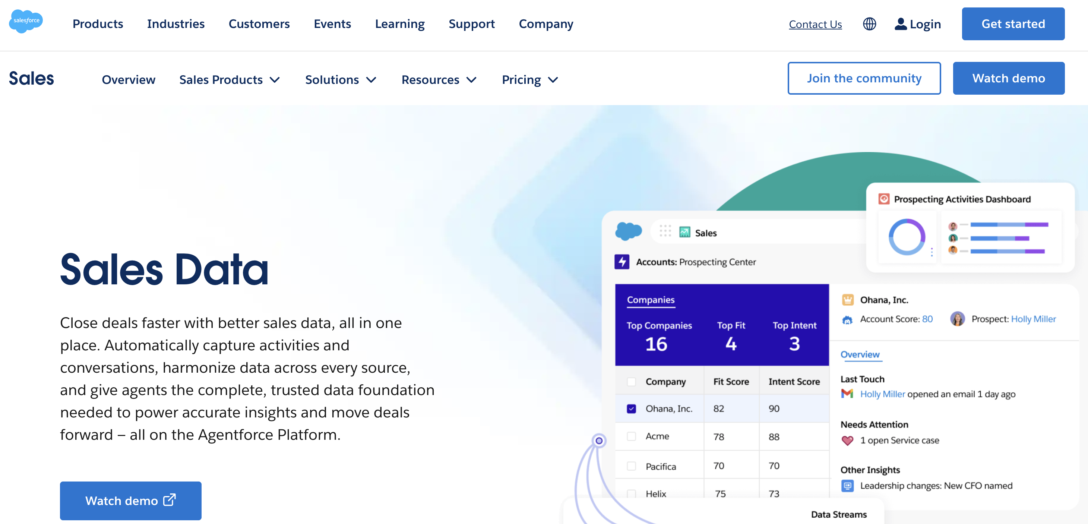
Salesforce Einstein brings AI capabilities directly into the Salesforce platform, making it a natural choice for teams that want predictive intelligence without adding another vendor to the stack.
Key features
Einstein offers predictive lead and opportunity scoring. It surfaces which records are most likely to convert based on historical patterns in your CRM data. The Einstein Activity Capture tool automates the logging of emails and calendar events to reduce manual data entry. With Einstein Copilot, you also get conversational AI assistance for tasks like summarizing accounts, drafting emails, and generating reports. For teams using Sales Cloud, Einstein provides deal insights and forecasting recommendations.
User reviews
Reviewers on G2 and other sites highlight how Salesforce Einstein and Agentforce connect data across tools like Outlook and Slack and help them cut down on manual syncing and separate logins between systems. Some users note that Agentforce features carry additional costs on top of existing licensing and that the quality of predictions depends heavily on the cleanliness and volume of existing CRM data.
Pricing
Einstein capabilities are bundled into various Salesforce editions. Some features, like Einstein Copilot, require additional per user licensing. Check Salesforce’s current pricing page for specifics.
What we have seen in practice: Einstein is most effective when the underlying Salesforce data is clean and well structured. Teams that pair Einstein’s scoring with a routing and orchestration layer see better outcomes than those relying on Einstein alone. AI predictions are only as valuable as the actions they trigger, and deterministic routing ensures those actions happen reliably.
3. HubSpot Breeze
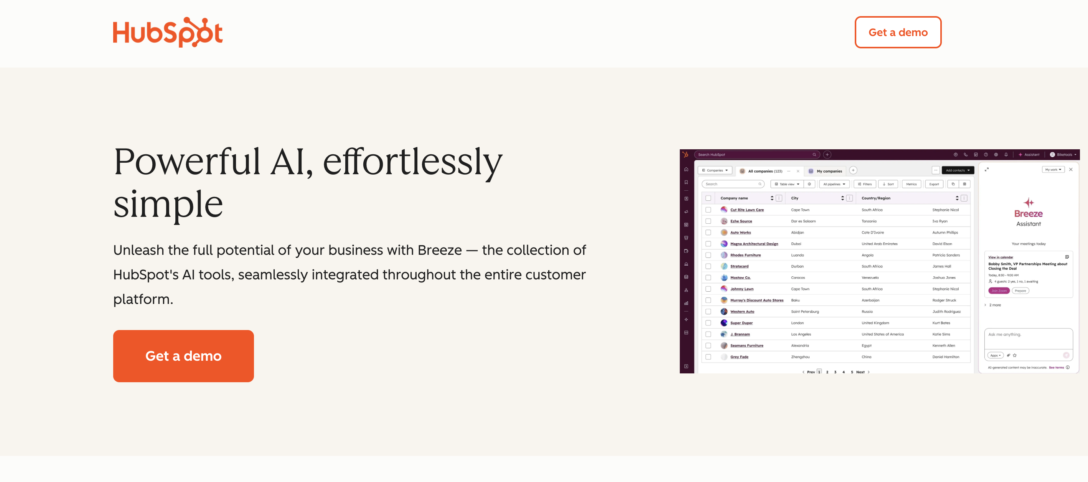
HubSpot Breeze is HubSpot’s AI layer, designed to embed intelligence across marketing, sales, and service hubs. It is particularly well suited for mid-market teams that want AI capabilities without managing a complex, multi-vendor stack.
Key features
Breeze includes a prospecting agent that researches contacts and drafts personalized outreach, a content agent for generating blog posts and landing pages, and a customer agent that handles support queries. Breeze Intelligence enriches contact and company records with firmographic and intent data. The platform also offers predictive lead scoring and AI-powered reporting summaries.
User reviews
Users across HubSpot’s G2 review pages and other sites praise Breeze for its ease of use and tight integration with HubSpot’s CRM. Some reviewers note that Breeze’s capabilities are more limited compared to standalone AI tools, particularly outside a HubSpot-only stack.
Pricing
Breeze features are included in various HubSpot plans, with Breeze Intelligence credits available as add-ons. HubSpot’s free CRM tier includes basic AI features while paid plans start at $20 per month per seat.
What we have seen in practice: HubSpot Breeze works well for teams running their entire GTM motion inside HubSpot. For organizations that also use Salesforce as their system of record, you’ll need a dedicated orchestration layer to make sure signals generated by Breeze flow correctly into Salesforce without data conflicts or routing gaps.
4. Demandbase
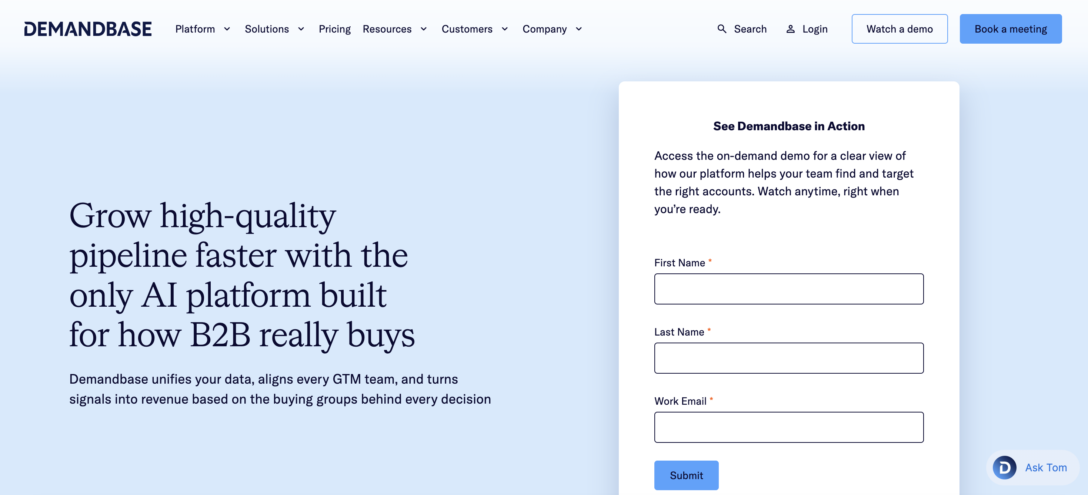
Demandbase is an account-based GTM platform that combines intent data, advertising, and sales intelligence to help teams identify and engage target accounts.
Key features
Demandbase’s AI surfaces account-level intent signals by analyzing billions of content consumption events across the web. Its predictive models score accounts based on fit and engagement to help teams prioritize outreach. The platform also offers account-based advertising, personalization, and sales intelligence tools that give reps context on which stakeholders are active and what topics they care about.
User reviews
Reviewers on G2 note the depth of Demandbase’s intent data and its ability to align marketing and sales around shared account lists. Some users mention that the platform’s breadth can require significant onboarding and that intent data accuracy varies by industry.
Pricing
Demandbase offers custom pricing based on modules and account volume. Contact Demandbase for a quote.
What we have seen in practice: Demandbase excels at identifying which accounts are in market. The challenge we’ve noticed among customers comes after that identification. Intent signals need to then reach the right rep with the right context, and they need to be connected to the full buying group. Teams that pair Demandbase’s intent intelligence with an orchestration layer consistently convert more of those in market accounts into pipeline.
5. 6sense
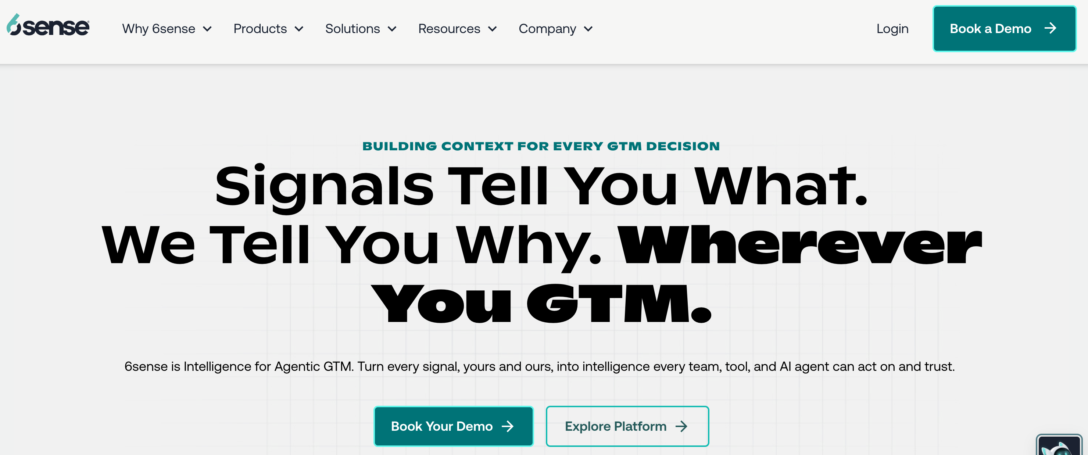
6sense uses AI to uncover anonymous buying behavior and help revenue teams identify accounts that are actively researching solutions before they fill out a form.
Key features
6sense’s Revenue AI platform analyzes intent signals, technographic data, and firmographic attributes to predict which accounts are in an active buying cycle. The platform segments audiences by buying stage so teams can deliver targeted campaigns and outreach at the right moment. 6sense also offers a conversational email tool and integrations with major CRMs and marketing automation platforms.
User reviews
Users on G2 value 6sense’s ability to surface accounts that would otherwise remain invisible. Some reviewers say the platform’s predictions improve over time as more data flows through the system. They also note that initial setup can require careful tuning of intent keywords and segments.
Pricing
6sense offers tiered plans including a free tier for basic intent data. Full platform pricing is custom and available upon request.
What we have seen in practice: 6sense performs strongly in identifying demand early in the funnel. However, the biggest pipeline gains occur when those early signals are immediately routed to the right owner and connected to buying group records. Without that orchestration step, intent data often can be left to sit in dashboards instead of driving action.
6. Clari
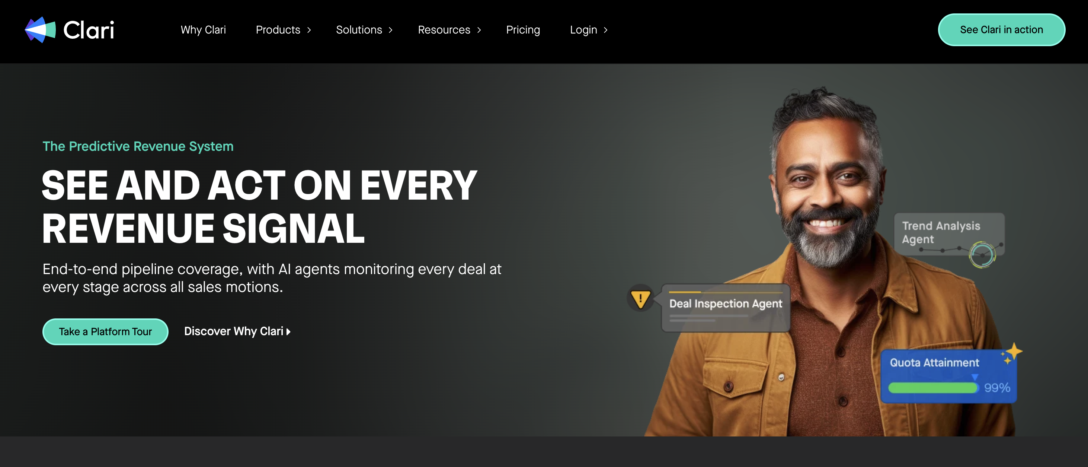
Clari focuses on revenue forecasting and pipeline management. It uses AI to give leadership teams confidence in their numbers and greater visibility into deal health.
Key features
Clari’s AI analyzes CRM data, email activity, and engagement patterns to generate forecasts and flag at-risk deals. The platform captures rep activity automatically, reducing reliance on manual updates. Clari also offers pipeline inspection tools, mutual action plans, and conversation intelligence through its acquisition of Wingman.
User reviews
Reviewers on G2 consistently cite Clari’s forecasting accuracy and its ability to surface pipeline risks that would otherwise go unnoticed. Some users say Clari is most valuable for organizations with enough deal volume to train its models effectively.
Pricing
Clari offers custom pricing based on team size and modules. Contact Clari for details.
What we have seen in practice: Clari gives revenue leaders a clear view of what is likely to close. Forecast accuracy improves when the upstream data, routing assignments, ownership records, and activity logs are clean and well governed. Clari reads the data in your CRM, so the quality of that data directly determines the quality of the forecast.
7. Clay
Clay is a data enrichment and outbound automation platform that lets teams build highly personalized prospecting workflows using AI.
Key features
Clay’s waterfall enrichment pulls data from dozens of providers to build complete prospect profiles. Its AI research agent can visit websites, read LinkedIn profiles, and synthesize findings into personalized email copy. Clay also offers a spreadsheet-like interface for building multi-step workflows. This makes it more accessible to teams in need of flexibility by offering an alternative to writing code.
User reviews
Users on G2 say Clay is flexible and note the depth of its enrichment capabilities. Power users appreciate the ability to chain multiple data sources and AI steps together. Some reviewers say Clay’s learning curve can be steep for less technical users and that its credit-based pricing requires careful management.
Pricing
Clay offers a free tier with limited credits. As of March 2026, Clay restructured its pricing into two self-serve tiers: Launch starting at $185 per month and Growth starting at $495 per month, both scaling with credit usage. Enterprise pricing is custom.
What we have seen in practice: Clay is effective at building enriched, personalized outbound lists. The teams that get the most from Clay pair it with a system that routes those enriched records into the right Salesforce workflows. Together, those tools can connect existing account and opportunity records and support reps with personalized outreach.
8. Copy.ai (now Fullcast Propel)
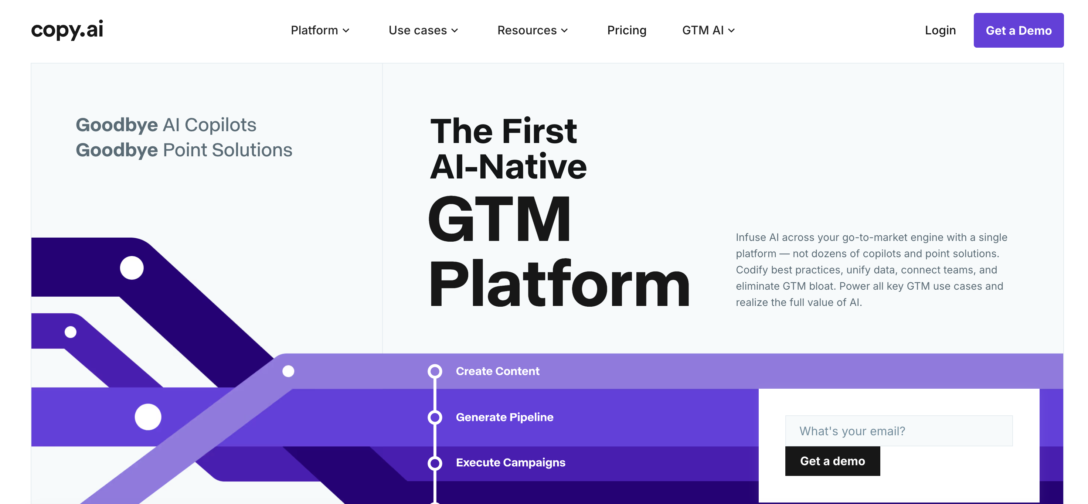
Copy.ai was acquired by Fullcast in October 2025 and now operates as Fullcast Propel, the AI execution layer inside Fullcast’s broader “Plan-to-Pay” GTM suite. It uses AI agents to execute multi-step GTM processes including workflow automation and content generation.
Key features
Copy.ai’s GTM AI workflows automate tasks like lead enrichment, account research, competitive analysis, and content creation. The platform offers pre-built workflow templates for common GTM use cases and allows teams to build custom workflows using a visual editor. Copy.ai also integrates with CRMs and sales engagement platforms to push outputs directly into existing systems.
User reviews
Users on G2 appreciate Copy.ai’s ease of use and the breadth of its pre-built workflows. Some reviewers say output quality varies depending on the complexity of the task and that workflows occasionally require manual review before pushing results to production systems.
Pricing
Copy.ai offers a free tier with limited workflow runs. Paid plans start at $49 per month, with enterprise pricing available for larger teams.
What we have seen in practice: Copy.ai is known for automating repetitive research and content tasks. We see the best results when its outputs feed into a governed orchestration layer that validates data, deduplicates records, and routes actions to the correct owners inside Salesforce. Since the Fullcast acquisition, Copy.ai’s positioning has shifted from a standalone content tool toward a broader RevOps execution layer.
9. HockeyStack
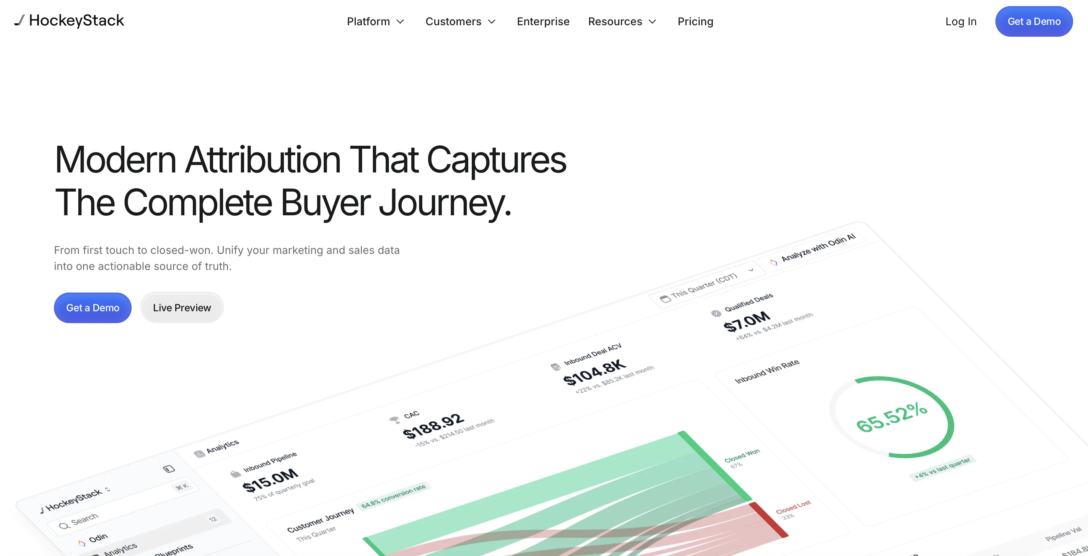
HockeyStack is a GTM intelligence platform that unifies revenue data across marketing, sales, and customer success to provide multi-touch attribution and predictive analytics.
Key features
HockeyStack connects data from your CRM, ad platforms, website, and marketing automation tools to map the complete buyer journey. Its AI surfaces which channels, campaigns, and touchpoints drive pipeline and revenue. The platform also offers predictive analytics that forecast which accounts are likely to convert and which deals are at risk. HockeyStack’s reporting is designed to answer attribution questions that span the entire funnel.
User reviews
Users on G2 praise HockeyStack’s ability to connect marketing activity to revenue outcomes. Reviewers frequently mention the platform’s clean interface and the depth of its journey analytics. Some users say that initial data integration can require coordination across multiple teams.
Pricing
HockeyStack offers custom pricing based on data volume and modules. Contact HockeyStack for a quote.
What we have seen in practice: HockeyStack provides visibility into what is working across the funnel. Teams that combine this attribution intelligence with an orchestration layer can act on those insights faster to route high-performing segments into the right workflows and ensure that attribution data informs routing and engagement logic in real time.
10. Highspot
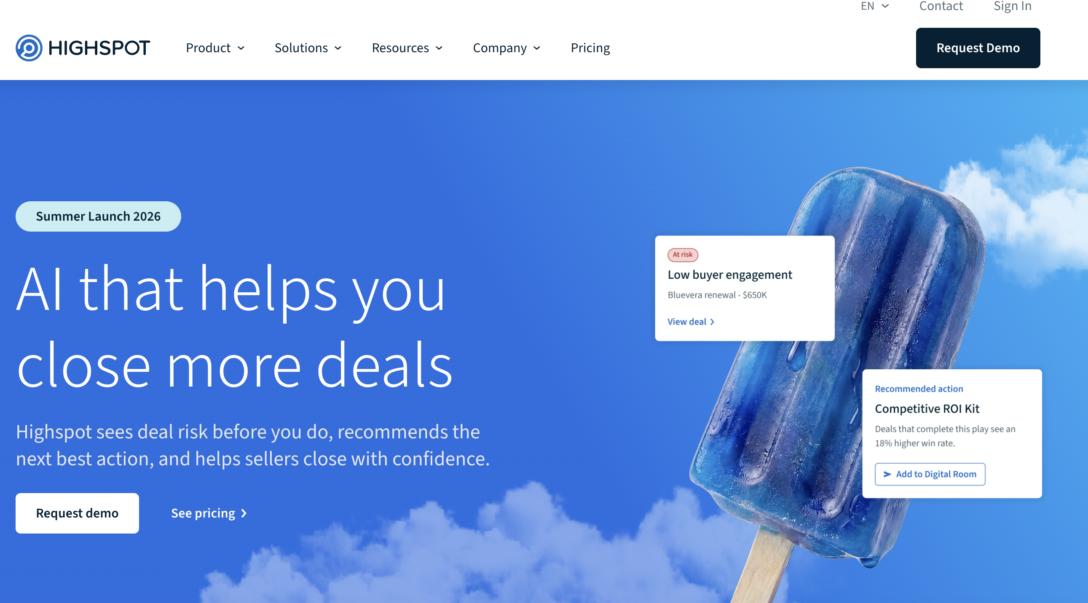
Highspot is a sales enablement platform that uses AI to help reps find, customize, and deliver the right content at the right moment in a deal cycle.
Key features
Highspot’s AI recommends content based on deal stage, buyer persona, and engagement history. The platform offers guided selling experiences called SmartPages, which walk reps through plays and provide contextual coaching. Highspot also tracks content engagement, showing which materials buyers open, share, and spend time on. Analytics tie content usage to revenue outcomes, helping marketing teams optimize their enablement investments.
User reviews
Reviewers on G2 highlight Highspot’s content management and its ability to surface the right assets at the right time. Users appreciate the integration with Salesforce and Outreach. Some reviewers say that maximizing value from the platform requires consistent content governance and tagging.
Pricing
Highspot offers custom enterprise pricing. Contact Highspot for details.
What we have seen in practice: Enablement platforms like Highspot are most effective when reps are already working the right accounts and contacts. We see the strongest content engagement metrics among teams that use orchestration to ensure reps are assigned to the right opportunities with full buying group context before they ever open an enablement tool.
11. Warmly
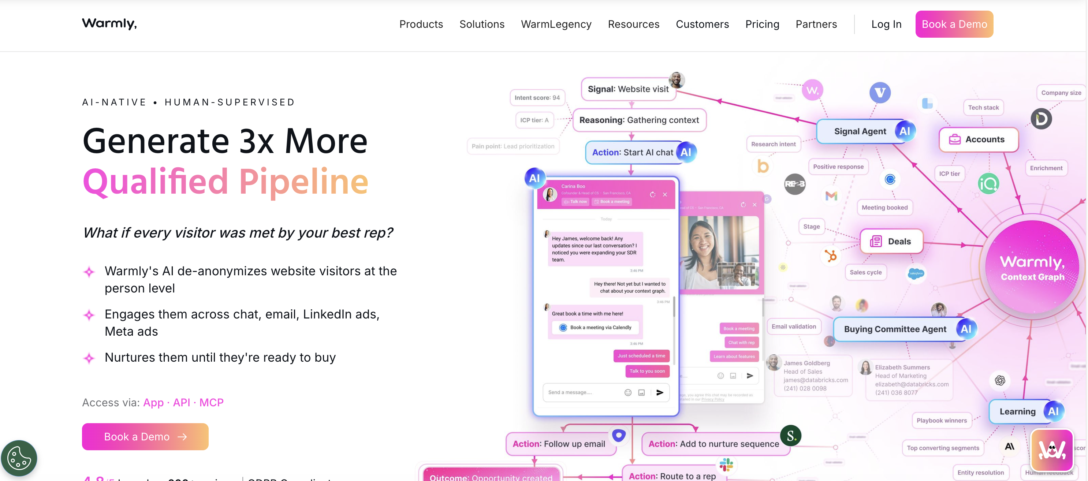
Warmly identifies anonymous website visitors and enables real time engagement through AI chat, automated routing, and integration with sales tools. In June 2026, HubSpot announced its acquisition of Warmly and its plan to fold its visitor-identification and AI agent technology into HubSpot’s Smart CRM. Existing contracts, pricing, and integrations remain unchanged for current customers, though the product roadmap is expected to converge with HubSpot over time.
Key features
Warmly deanonymizes website traffic at the account and contact level to reveal which companies and individuals are browsing your site. Its AI chatbot engages visitors in real time, qualifying interest and routing conversations to available reps. The platform integrates with Salesforce, HubSpot, Outreach, and Slack to send alerts and context where reps already work. Warmly also offers orchestration features that trigger multi-channel sequences based on visitor behavior.
User reviews
Users on G2 appreciate Warmly’s ability to turn anonymous traffic into identifiable pipeline. Reviewers note the speed of real-time alerts and the quality of the AI chat experience. Some users say that deanonymization accuracy varies by region and company size.
Pricing
Warmly’s pricing is structured as custom annual contracts, with tiers starting around $10,000 per year. As of the HubSpot acquisition, pricing for existing customers remains unchanged.
What we have seen in practice: Warmly generates a high volume of real-time signals from website visitors. The teams that convert the most from these signals are those that route them through a system that matches visitors to existing accounts, assigns the right owner, and connects the interaction to the broader buying group record. Without that step, real-time signals often create duplicate records or reach reps without context.
Given the HubSpot acquisition, teams evaluating Warmly today should factor in that its roadmap is likely to converge with HubSpot Breeze rather than remain a fully independent option.
12. Regie.ai
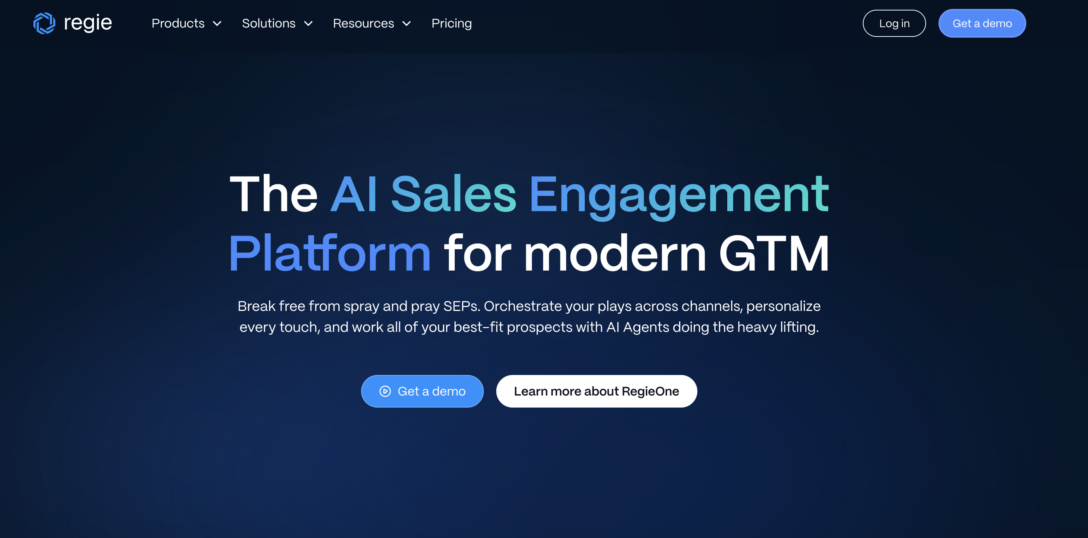
Regie.ai is an AI-powered outbound platform that helps sales development teams generate personalized prospecting content and optimize outreach sequences.
Key features
Regie.ai uses generative AI to create personalized emails, call scripts, and social messages based on prospect data and company research. The platform offers sequence optimization that tests and refines messaging over time. Users can also reduce the manual effort required to build pipeline with Regie.ai’s prospecting agents that autonomously research prospects and draft outreach. The tool integrates with Outreach, Salesloft, and Salesforce.
User reviews
Users on G2 highlight Regie.ai’s ability to scale personalized outreach without sacrificing quality. Reviewers appreciate the time savings for SDR teams. A common criticism across G2 reviews is that AI-generated content can carry a “robotic tone,” meaning SDRs often still need to edit outreach before sending, even at Regie’s enterprise price point.
Pricing
Regie.ai offers custom pricing based on team size and usage. Contact Regie.ai for current plans.
What we have seen in practice: AI-generated outbound is most effective when it’s being sent to the right contacts at the right accounts. We consistently see that teams using Regie.ai alongside an orchestration layer that governs account ownership, deduplicates contacts, and connects outreach to buying group records achieve higher reply rates and fewer wasted touches.
Building the right AI GTM stack for your revenue engine
No single platform does everything. The AI GTM market is composed of tools that excel in specific areas: intent detection, enrichment, content generation, forecasting, enablement, and orchestration. The most effective revenue teams build stacks where these tools complement each other. To do that, your team needs clean data flowing between tools and deterministic logic governing who acts on what.
The critical question is what happens between the signal and the action. AI tools are generating far more signals than most teams could handle even two years ago. Leads from chatbots, AI SDRs, intent providers, and website visitors arrive faster than manual processes can route them. Without an orchestration layer that matches, routes, and governs those signals for you in real time, you’ll continue to see leaked leads, duplicate records, and misrouted meetings.
When evaluating platforms, consider these priorities:
- Start with your system of record. If Salesforce is your CRM, prioritize tools that integrate natively and write data back cleanly.
- Assess signal volume. If you are adding AI SDRs, chatbots, or intent providers, make sure your routing logic can handle the increased volume.
- Think in buying groups. Individual lead scoring misses the reality of enterprise B2B buying. Look for tools that aggregate signals across the full committee.
- Demand auditability. AI recommendations are valuable. AI actions that cannot be traced or governed are risky. Ensure your critical workflows are deterministic and auditable.
- Measure speed to action. The time between a signal appearing and a rep engaging is where pipeline is won or lost.
The platforms in this guide represent strong options available today. The right combination depends on your current stack, your growth stage, and where your biggest execution gaps live.
See What Orchestration Looks Like in Your Stack
FAQ
How do AI GTM platforms differ from traditional marketing automation?
What happens when AI tools generate more signals than my team can handle?
Can I use multiple AI GTM platforms together?
Why does buying group context matter for AI generated pipeline?
How important is Salesforce native integration for AI GTM tools?

Jill Makin
Jill Makin is a Content Marketing Specialist at LeanData. Her content expertise includes B2B SaaS marketing across industries including fintech, healthcare, enterprise orchestration, and more. Connect with Jill on LinkedIn.