














Summary
A sales tech stack is only as strong as the connections between its tools, and now its AI agents. This guide covers how B2B Ops teams build a connected sales tech stack in the AI era. Learn what typically breaks in an AI sales tech stack and how LeanData orchestrates the data, signals, and agent actions that tie everything together inside Salesforce.
What You’ll Learn
- Why AI multiplied your sales tech stack instead of simplifying it
- The five layers every connected sales tech stack now needs
- How LeanData orchestrates your tools and your AI agents
- What connected stack workflows look like in practice
Where a Sales Tech Stack Breaks
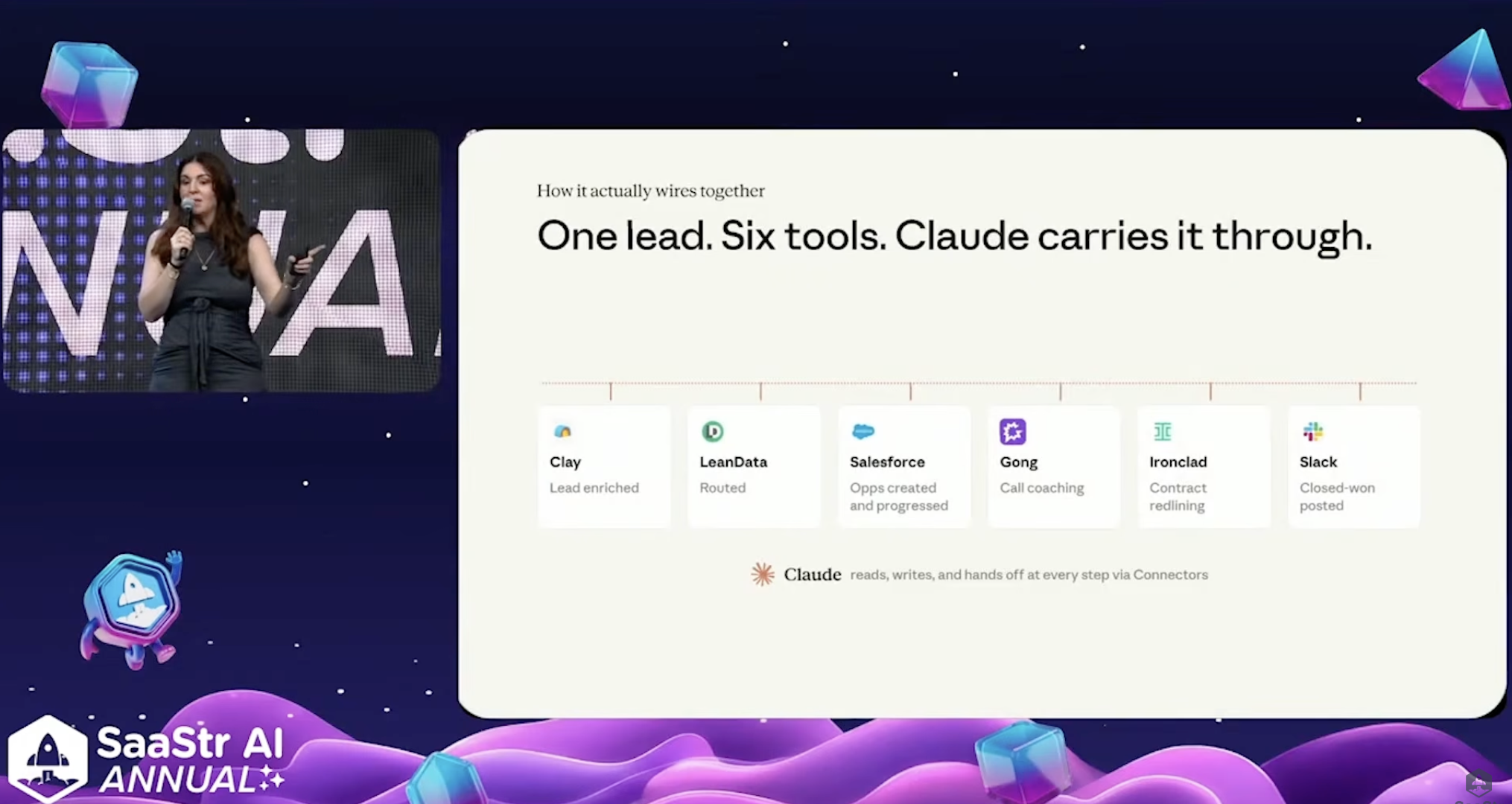
Your sales tech stack probably has everything it needs: a CRM, a marketing automation platform, enrichment tools, intent data, a sales engagement platform, and Slack.
And now, AI. AI SDRs that draft outreach, copilots that summarize accounts, Agentforce and custom agents that qualify and score leads.
So why are leads still landing on the wrong rep’s calendar?
Why do intent signals fire in one tool and go unactioned in another?
Why are two agents now emailing the same prospect on the same day?
The cause is the layer between your tools. Signals flow into your CRM from a dozen directions, agents act on that data automatically, and nothing governs what happens next.
In LeanData’s 2026 AI GTM Customer Survey, 93% of teams had already deployed at least one AI agent. The most common setup was three to four agents acting on the same records. The new reality is: AI has multiplied what the stack can do, along with the number of ways it can break.
AI Multiplied Your Sales Tech Stack
For a decade, the primary tech stack problem was integration. Tools held data but did not share it. AI has changed the shape of this problem.
Your tools now act on data automatically, scoring it, drafting from it, and reaching out on it. LeanData’s AI GTM survey found 79% of teams already scaling or deploying AI agents, sourced from everywhere at once: features inside existing tools, custom builds on LLM APIs, and agent platforms like Agentforce.
Where the Collisions Are Showing Up
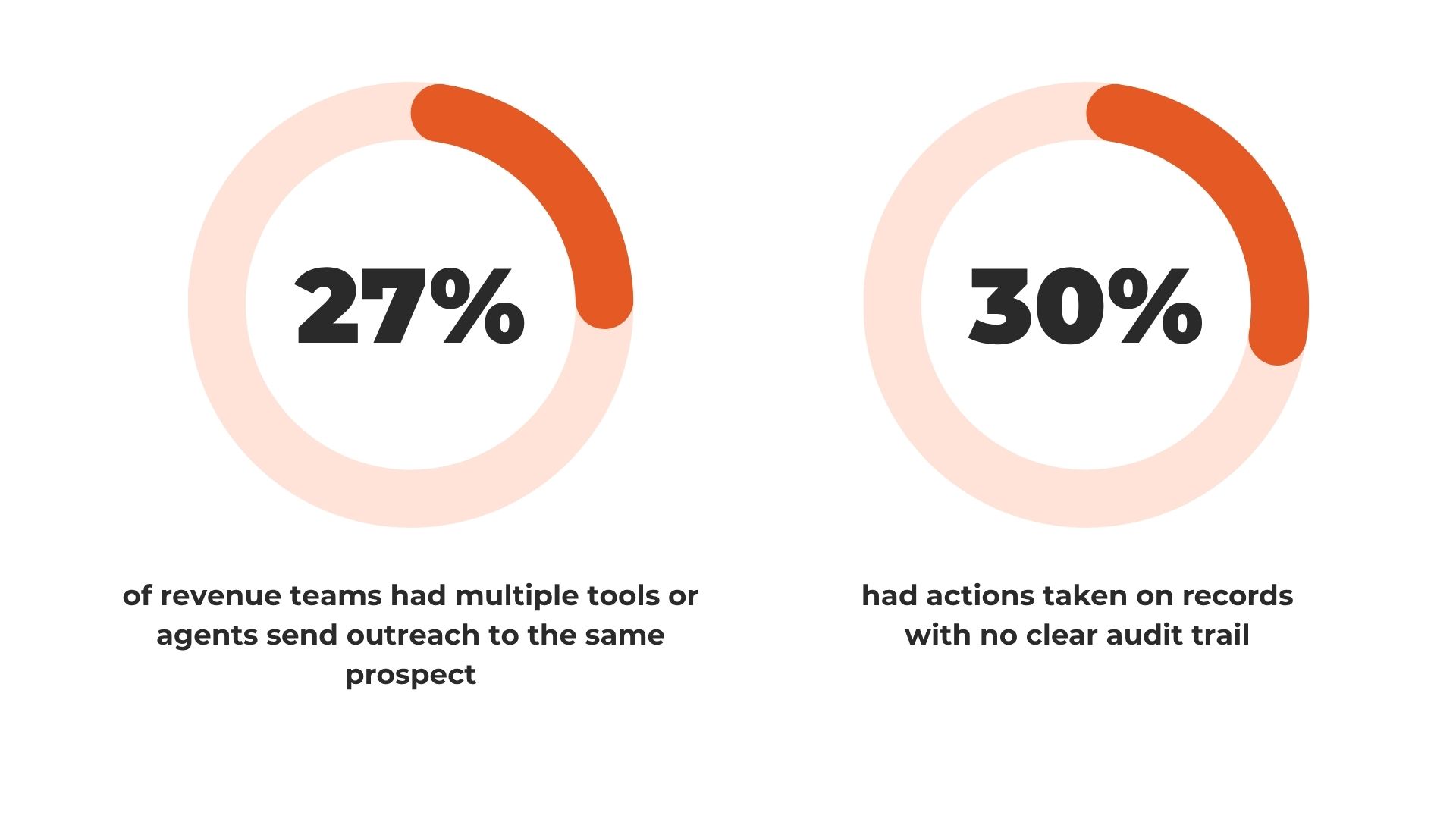
In the last six months, 27% of revenue teams had multiple tools or agents send outreach to the same prospect, and 30% had actions taken on records with no clear audit trail.
When teams named their biggest fear about scaling AI, 60% pointed to agents acting on the wrong records or violating ownership rules. The survey called this a question of control over what agents do on their own.
Gartner frames it the same way. In its 2026 research on sales productivity, analyst and CSO keynote speaker Dan Gottlieb calls AI an accelerant of productivity. An accelerant speeds up whatever you already have, clean handoffs and broken ones alike.
The broken ones simply fail faster now, at higher volume, with less visibility into why. The fix is an orchestration layer that reads every signal, human or machine, applies your routing logic, and executes the right action every time, with a record of what happened.
The Five Layers of an AI-Ready Sales Tech Stack
A connected sales tech stack runs on a CRM as its system of record (frequently Salesforce), with five layers on top, each generating data, signals, or actions.
An orchestration layer like LeanData, working inside the CRM, connects them into one automated workflow.
The newest layer, AI agents, is the one most likely to work at cross purposes without coordination. Keeping it productive starts with being clear about what AI is for.
AI is exceptional at intelligence work: finding the needle-in-the-haystack signal, scoring accounts, summarizing complexity, and drafting outreach.
Execution is a separate job: producing the same routing decision every time, knowing who owns the account and who is at capacity, and leaving a traceable record under peak load. That work belongs to the orchestration layer.
How LeanData Connects Your Sales Tech Stack
LeanData is a 100% Salesforce-native application. It reads and writes directly to Salesforce objects with no external sync, translation layer, or middleware.
Every tool that touches Salesforce becomes something LeanData can act on, and so does every AI agent. When an agent writes its output to a Salesforce field, that output becomes a signal LeanData can route on.
This is where the split between intelligence and execution pays off. AI does the reasoning, and LeanData turns each recommendation into action: the same decision every time, the account owner and the rep at capacity, the traceable record, and zero degradation when volume spikes. The orchestration layer is where an AI recommendation becomes a deterministic action.
Does Salesforce-native mean Salesforce-only?
This is the question revenue teams raise most when evaluating LeanData: does Salesforce-native mean Salesforce-only? It does not. If a tool or agent touches Salesforce, LeanData can use what it produces. So, you keep your choice of enrichment, engagement, intent, and AI vendors.
And, because routing logic lives in LeanData’s no-code FlowBuilder, every decision stays visible and auditable. A complete audit trail was the single most wanted capability in LeanData’s survey, named by 31% of teams, ahead of speed or more automation.
 “We can run our lead, contact, account, and case management out of LeanData without Salesforce developer resources. They help us meet all of the routing KPIs and have helped us transform our business with their automation and workflows. Of all the vendors I work with, the LeanData team is best. Their customer success, support org, and ability to quickly implement customer feedback to the product are fantastic. They have built partner integrations allowing us to connect and run our lead management tech stack out of LeanData.”Kelly G.

What This Looks Like in Practice
Scenario #1: Inbound Lead From a Web Form
In most inbound motions, a prospect submits a demo request, the lead syncs to Salesforce, and a rep checks a queue, confirms ownership, and adds the contact to a sequence by hand.
Using LeanData, the lead is matched to the account instantly, routed to the right rep by territory and availability, enrolled in the right sequence. Further, the rep receives a notification in Slack with full context.
Time to first touch goes from hours to seconds. In fact, LeanData customer SUSE improved speed to lead by 70% in one quarter.
Scenario #2: An AI Agent Qualifies a Lead
Typically, an AI SDR qualifies a lead, then drops it into the same manual handoff, books a generic round-robin meeting, or emails a prospect a human rep is already working.
Using LeanData, the agent’s qualification becomes a signal LeanData acts on. It matches the lead, checks ownership and capacity, routes to the right rep, and books the meeting on the correct AE’s calendar while the prospect is still engaged.
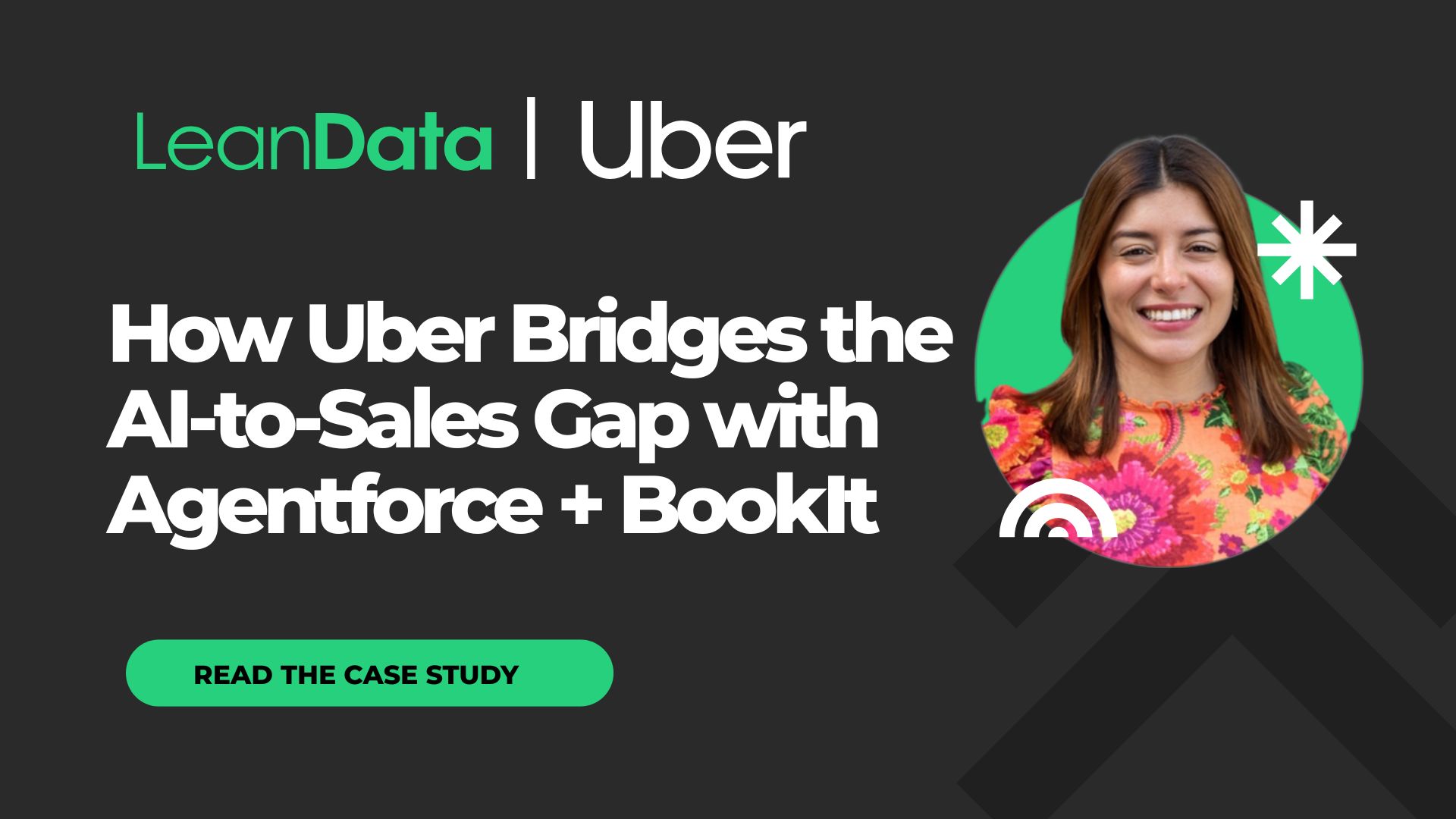
Uber for Business paired Salesforce Agentforce with LeanData BookIt to close that gap, and increased deal velocity by 68% and win rates by 53%.
Building a Sales Tech Stack That Works Together
The best sales tech stacks get every signal, human or machine, to the right person at the right time, with a record of why. The number of tools or AI agents has little to do with it.
That requires a clean data foundation.
Gartner is blunt about data: treat bad data as a chronic condition you manage continuously, because AI acting on a messy CRM just makes the wrong call faster.
LeanData gives AI the matched, governed foundation it needs to act, which is why Gartner finds organizations with strong data infrastructure are 2.3x more likely to exceed customer growth goals.
As one Director of GTM Operations said in LeanData’s AI GTM survey, “LeanData gives us the guardrails we need before we can confidently expand AI into more of our GTM motion.”
To explore LeanData’s full integration ecosystem, visit leandata.com/platform/integrations.
AI can tell you the best move. It can’t be the chess board.
FAQ
How does AI fit into a sales tech stack?
Can LeanData orchestrate AI agents, and does it work with Agentforce?
Does AI replace lead routing?
Does LeanData work with tools other than Salesforce?

Kim Peterson
Kim Peterson is the Senior Manager of Content Strategy at LeanData where she digs deep into all aspects of go-to-market strategy and execution. Kim's writing experiences span tech companies, stunt blogging, education, and the real estate industry. Connect with Kim on LinkedIn.