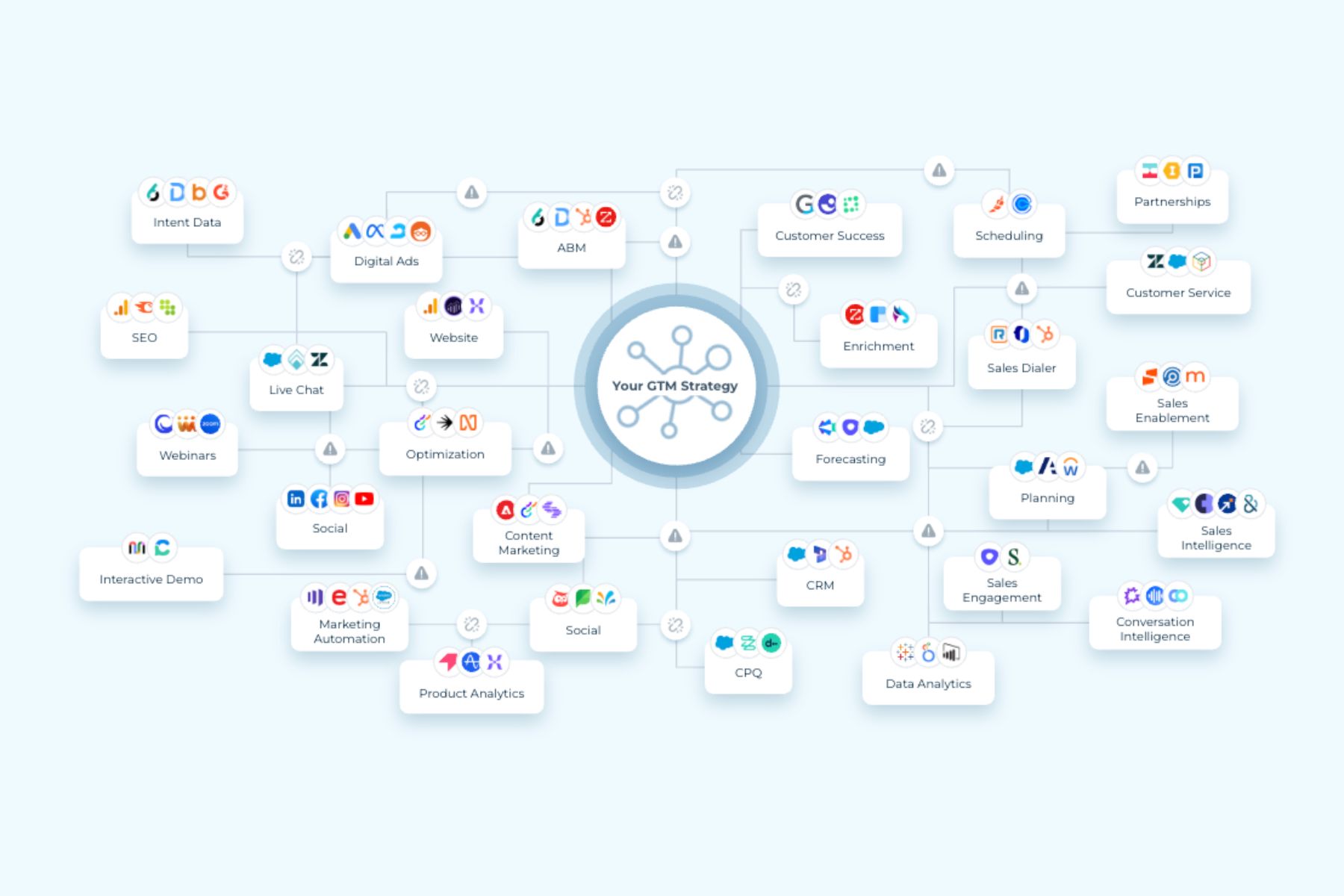














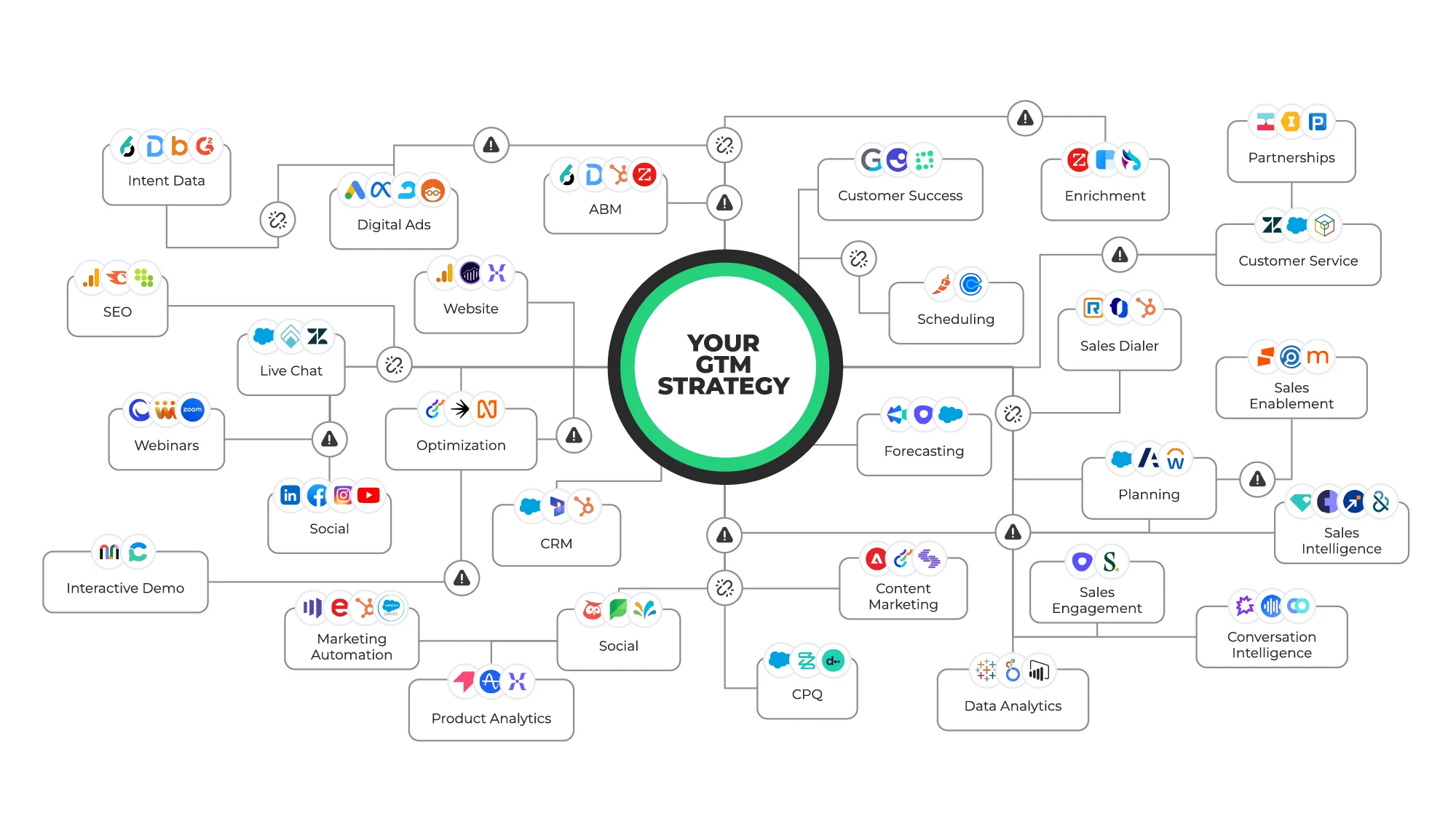
Eighty three percent of GTM leaders say their go-to-market strategy is important to growth. Only 38% say it actually works.
That gap tells a familiar story. Most B2B companies have a GTM strategy, tools, and talented teams across marketing, sales, operations and customer success.
What they lack is coordination: the ability to translate high-level strategy into the thousands of small, connected actions that move a buyer from first signal to closed deal to loyal customer.
The symptoms show up everywhere. Speed to lead suffers because inbound leads sit idle with no one to route them. Lead routing breaks when systems are disconnected and reps get assigned accounts they know nothing about.
Post-sales teams start onboarding calls without context from the deal. And AI tools pop up across the stack with no shared governance, creating a new layer of complexity on top of an already fragmented foundation.
The numbers confirm the problem: only 2.9% of MQLs convert to revenue and fewer than half of B2B sellers attain quota. Not to mention, it costs five to 25 times more to acquire a new customer than to retain an existing one.
These are not tool problems. They are orchestration problems.
And the discipline emerging to solve them is Intelligent Go-to-Market Orchestration.
What Is Intelligent Go-to-Market Orchestration?
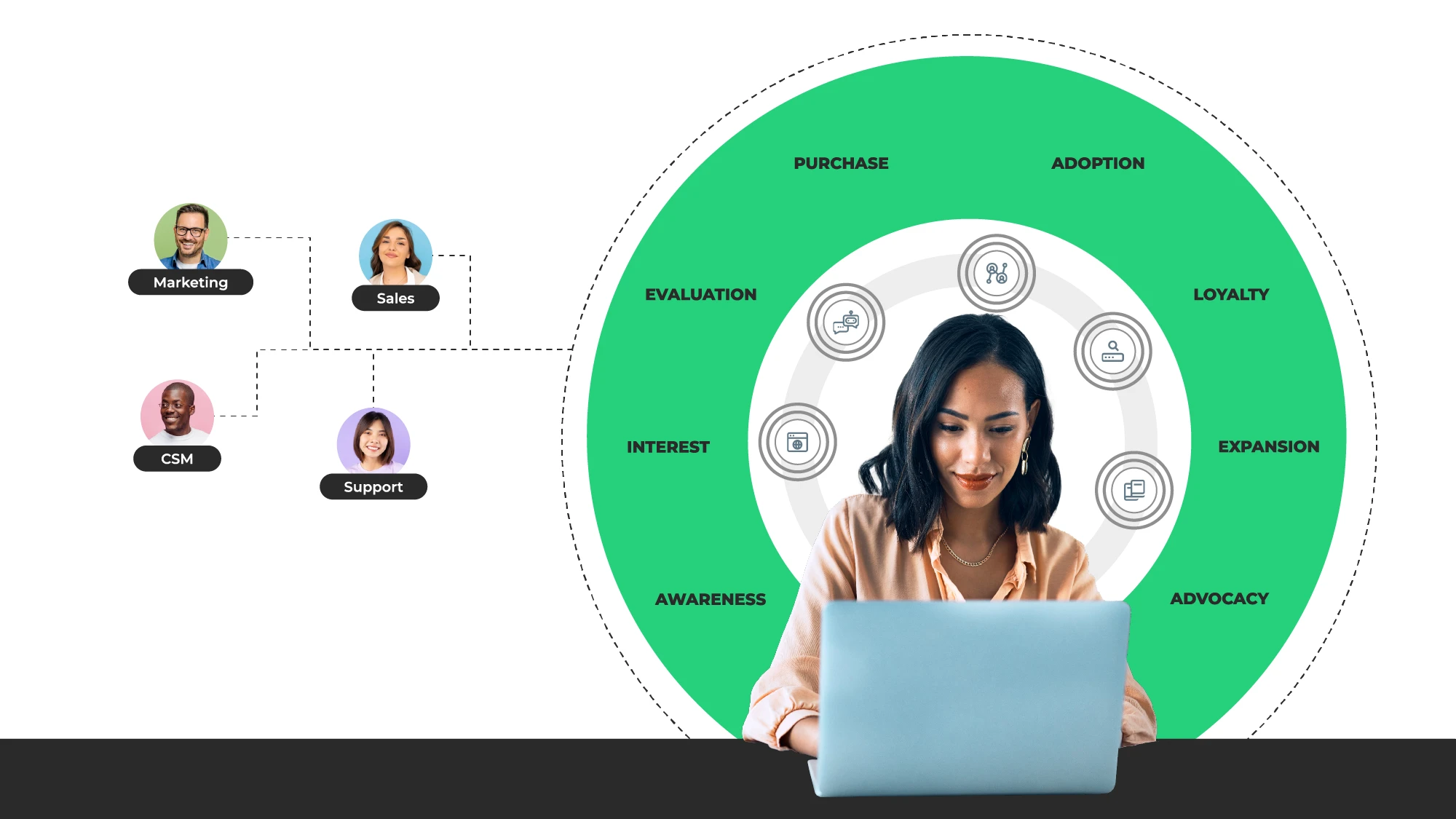
Intelligent go-to-market orchestration is the practice of integrating buyer signals across the full revenue lifecycle and ensuring the right actions are executed at the right time, whether those actions are triggered by systems, taken by humans, or initiated by AI agents.
It is the connective tissue between a company’s GTM strategy and its day-to-day execution.
That definition carries a lot of weight, so it helps to break it apart.
Intelligent means the platform leverages AI to accelerate and improve GTM execution. AI is governed at the orchestration layer, not bolted on as a one-off experiment in a single tool.
Go-to-market covers the entire revenue lifecycle: marketing, sales, and customer service and support. It is broader than demand generation or sales operations alone. It includes acquisition, onboarding, retention, and expansion.
Orchestration is the integration and processing of signals to ensure the right actions are executed efficiently across every team, tool, and system involved in the buyer journey.
How It Differs from Related Concepts
Intelligent GTM Orchestration is easy to confuse with adjacent categories, but the distinctions matter.
It is broader than lead routing. Routing is a feature. Orchestration is the coordination of people, processes, and technology across the buyer’s entire lifecycle, from awareness through expansion.
It sits above marketing automation. Where marketing automation platforms manage campaigns and nurture sequences, orchestration connects the MAP to the CRM, ABM tools, sales engagement platforms, and customer success systems so that signals flow between them and trigger the correct downstream actions.
It goes deeper than workflow engines.
A workflow engine runs a sequence. Orchestration incorporates buyer signals, applies AI to interpret unstructured data, coordinates actions across multiple teams, and adapts without IT involvement when the business changes.
And it replaces DIY approaches.
Salesforce flows and spreadsheets can handle simple routing, but they cannot provide enterprise-grade governance, auditability, cross-object matching, or the agility to absorb territory changes and reorgs without weeks of developer time.
You may hear this discipline called revenue orchestration, go-to-market orchestration, or GTM orchestration. The principle is the same: connecting signals to actions across the full buyer lifecycle.
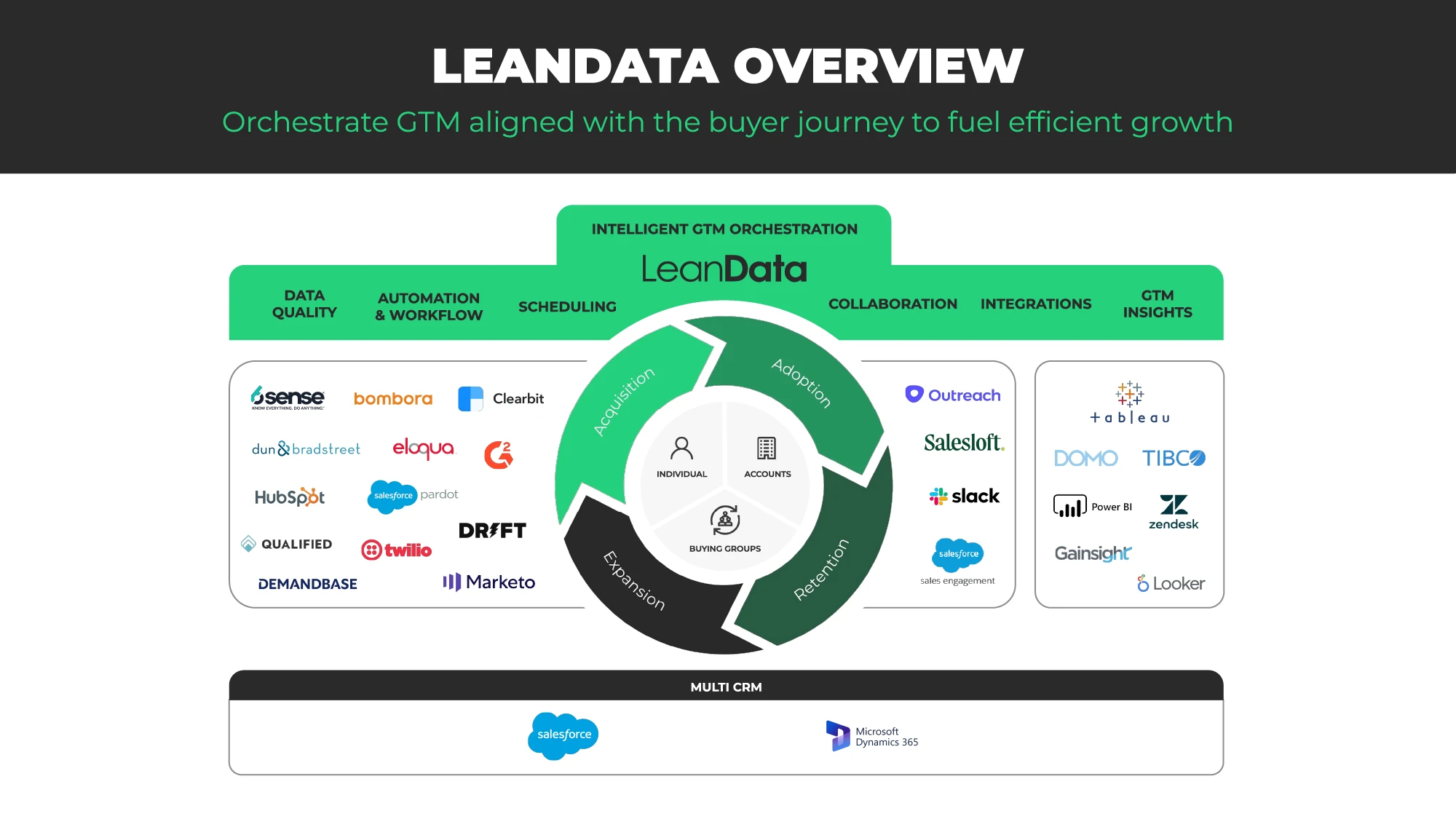
Intelligent GTM Orchestration encompasses what many teams know as lead routing software, sales scheduling, lead-to-account matching, and buying groups B2B management, but it connects them into a single coordinated motion instead of treating each as a standalone process.
Why Intelligent GTM Orchestration Matters Now
GTM Complexity Has Outpaced Most Organizations
Consider what a single inbound lead must go through before it becomes a meeting.
✔️ The data arrives.
✔️ It needs validation.
✔️ Is this a real prospect?
✔️ Enrichment adds firmographic and contact data.
✔️ The lead gets matched to an existing account, or a new account gets created.
✔️ The matching logic checks: is this a prospect, a partner, or an existing customer?
✔️ Is there an open opportunity?
✔️ Which rep owns the account?
✔️ Which territory does it fall into?
Then the lead gets routed, the rep gets notified, and the engagement sequence begins.
Every stage involves different teams and different systems. Every stage requires integrating diverse data and applying business logic. And this is one process. Multiply it across inbound, outbound, ABX, partner, product-led, and post-sales motions, and the complexity becomes enormous.
Without orchestration, something always breaks: leads land in the wrong queue, handoffs stall, and signals from intent providers never reach the rep who needs them.
AI Is Arriving Without a Coordination Layer
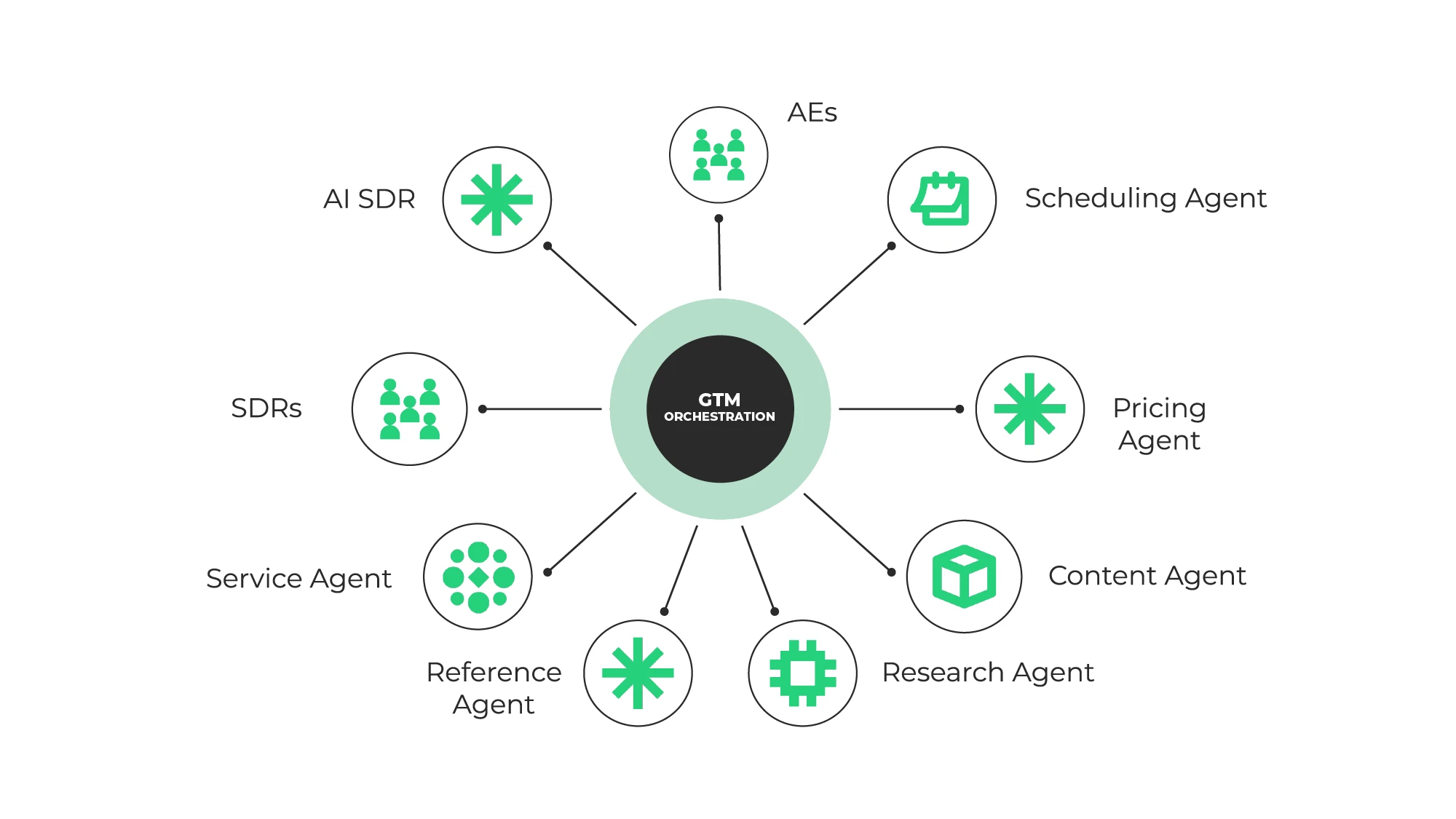
The term AI GTM has gained traction as organizations look for ways to embed artificial intelligence into go-to-market execution. AI SDR agents, qualification bots, scheduling assistants, and enrichment tools powered by large language models are entering every layer of the stack simultaneously.
But AI alone does not close deals. Revenue still requires handoffs, routing decisions, meeting bookings, buying group coordination, and governance.
When each tool runs its own AI independently, the result is siloed intelligence: individual tools getting smarter while the overall buyer experience gets more disjointed.
The important question for every GTM leader is this: how do you capture AI’s efficiency gains without losing control and auditability of your core revenue processes?
Intelligent GTM orchestration provides the answer by governing AI at the orchestration layer, with transparency into every agentic signal and action, and interoperability with existing LLM investments.
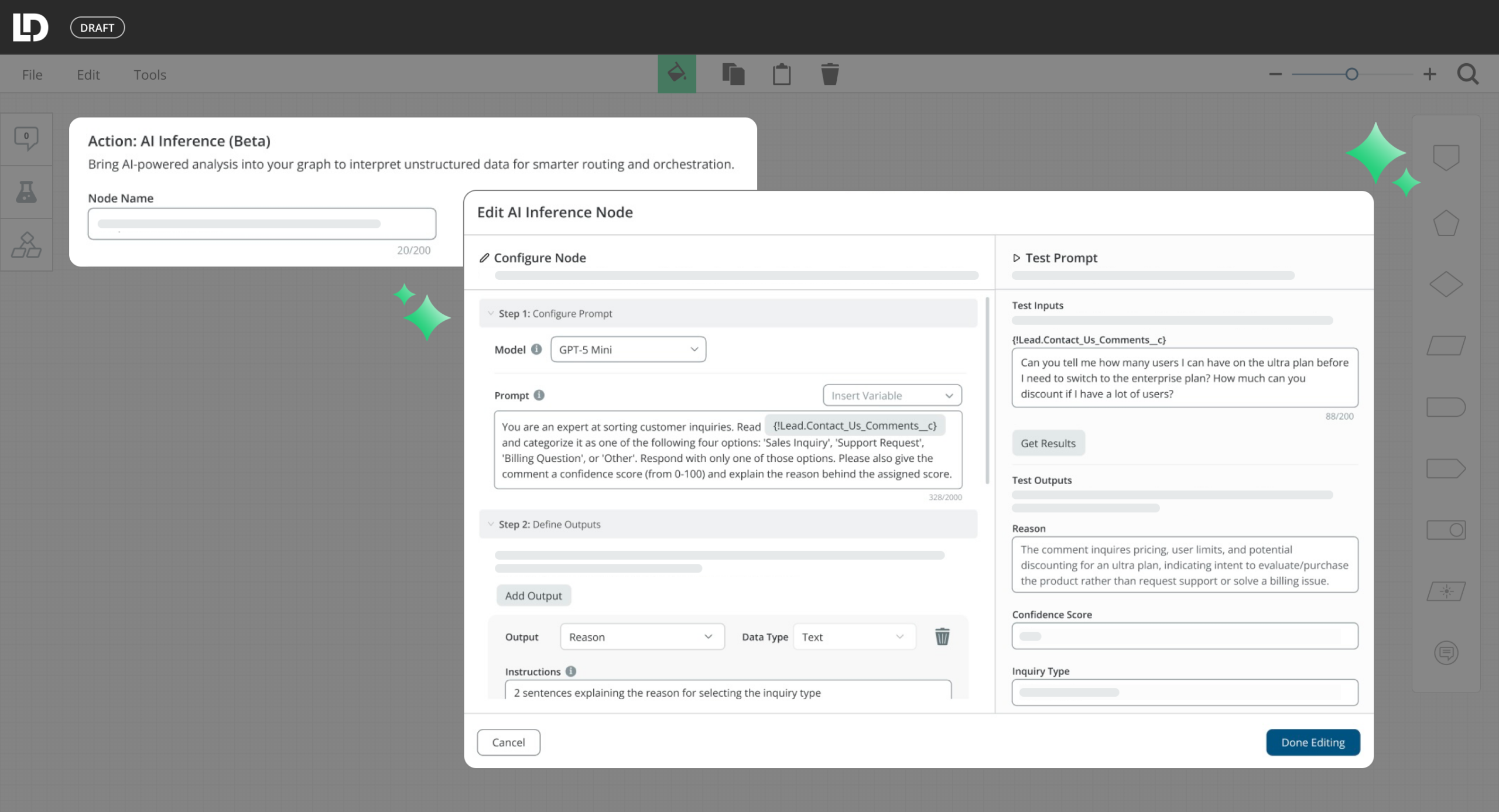
For example, LeanData’s AI Inference Nodes embed large language model prompts directly into routing workflows with a bring-your-own-key model. Administrators configure exactly what input the LLM receives, define the prompt, and specify the structured outputs. Everything remains visible in the routing graph. This gives teams the speed of AI with full visibility into how decisions are made.
Buyers Expect a Connected Experience
B2B buyers move from awareness through evaluation, purchase, adoption, and expansion. They expect the company selling to them to keep up. When the handoff between marketing and sales is clumsy, or when post-sales onboarding ignores everything the buyer shared during the deal, the experience breaks down.
According to Forrester, 73% of B2B revenue originates from current customers. Yet only about 23% of businesses effectively enable their sales teams for expansion conversations. The gap between where the revenue comes from and where the execution focus sits is striking.
The Mandate for Efficient Growth
Budget pressure is universal. Every GTM team faces the same mandate: grow revenue while spending less. Adding headcount or more tools is rarely an option. What is needed is a platform approach that consolidates, coordinates, and adapts, absorbing changes in strategy, org structure, and technology without breaking core processes or requiring IT support.
Orchestration Across the Revenue Lifecycle
One of the biggest misconceptions about GTM orchestration is that it applies only to lead routing or inbound lead management. That perception undersells the category and the value. Orchestration creates impact across four distinct areas of the revenue lifecycle.
Customer Acquisition

This is the most visible use case and where most companies begin. Orchestration powers the full acquisition motion from first signal to closed-won opportunity: capturing inbound leads, validating and enriching data, matching leads to accounts, qualifying and routing to the right rep or system, triggering engagement sequences, and converting pipeline to closed revenue.
The process looks simple on paper. In practice, it involves multiple teams, dozens of systems, and business logic that changes with every territory adjustment or go-to-market play. Orchestration serves as the connective layer that integrates the data, applies the logic, and makes sure the right action reaches the right person quickly and reliably.
Uber for Business offers a strong example. They used BookIt for Forms to target specific high-potential markets with localized web forms. By defining success metrics up front and automating routing from form submission through to rep engagement, they achieved a 59% uplift in conversion rates and generated $382,000 in new pipeline from targeted regions.
Customer Adoption
The deal closed. Now what? The customer relationship depends on what happens in the first weeks after purchase. Orchestration ensures a seamless handoff from the sales team to implementation and customer success. Critical context from the sales cycle, like the use cases discussed, the stakeholders involved, and the expectations set, passes automatically to the post-sales team.
- The right CSM or professional services consultant gets assigned without manual coordination.
- Onboarding sequences trigger.
- Marketing shifts to customer education content and certification programs.
- The foundation for retention and expansion starts getting built from day one.
Without this orchestration, the handoff breaks. At one company, a full-time employee was dedicated solely to coordinating the pre-to-post-sales transition. By automating that process through orchestration, they put the handoff directly in the hands of their customer success team, eliminated the IT dependency, and reduced time to value.
Customer Retention

Churn is a board-level metric, and it is far more expensive to replace a customer than to keep one. Retention orchestration monitors customer health signals: product usage, engagement levels, support ticket volume, and contract timelines. It automatically creates renewal opportunities, routes high-priority support cases to the right specialist, and escalates churn risk to executive sponsors, all months before the renewal date.
The alternative is what one GTM leader described as the “Hail Mary” scenario: scrambling to prove value the week before a contract expires. By then, it is too late. The competitor has already been positioned, or the budget has already been reallocated.
Orchestration replaces last-minute heroics with a continuous, signal-driven approach to customer health.
“We use LeanData to create our Renewal Opportunities automatically and also use the pool routing to automatically assign them as well. This process saves time and resources from having to create and route Renewal Opportunities to the correct person/team.”Angela Toedtman
Customer Expansion
Land-and-expand is a common B2B strategy, but expansion is only possible when the signals for it are captured and acted on.
Orchestration identifies upsell and cross-sell opportunities through product inquiries, usage spikes, engagement scoring, new buying group members, and white space across account hierarchies.
Expansion signals get routed to the right account owner in real time based on existing ownership, customer tier, product interest, and lifecycle stage. When those signals sit in queues or depend on manual coordination, they go stale. The moment of customer intent passes.
LeanData’s Account Hierarchies feature further strengthens expansion by automatically mapping multi-level corporate structures, enabling routing logic across entire account families, and surfacing white space opportunities through enrichment integrations.
The Platform Capabilities Behind Intelligent GTM Orchestration
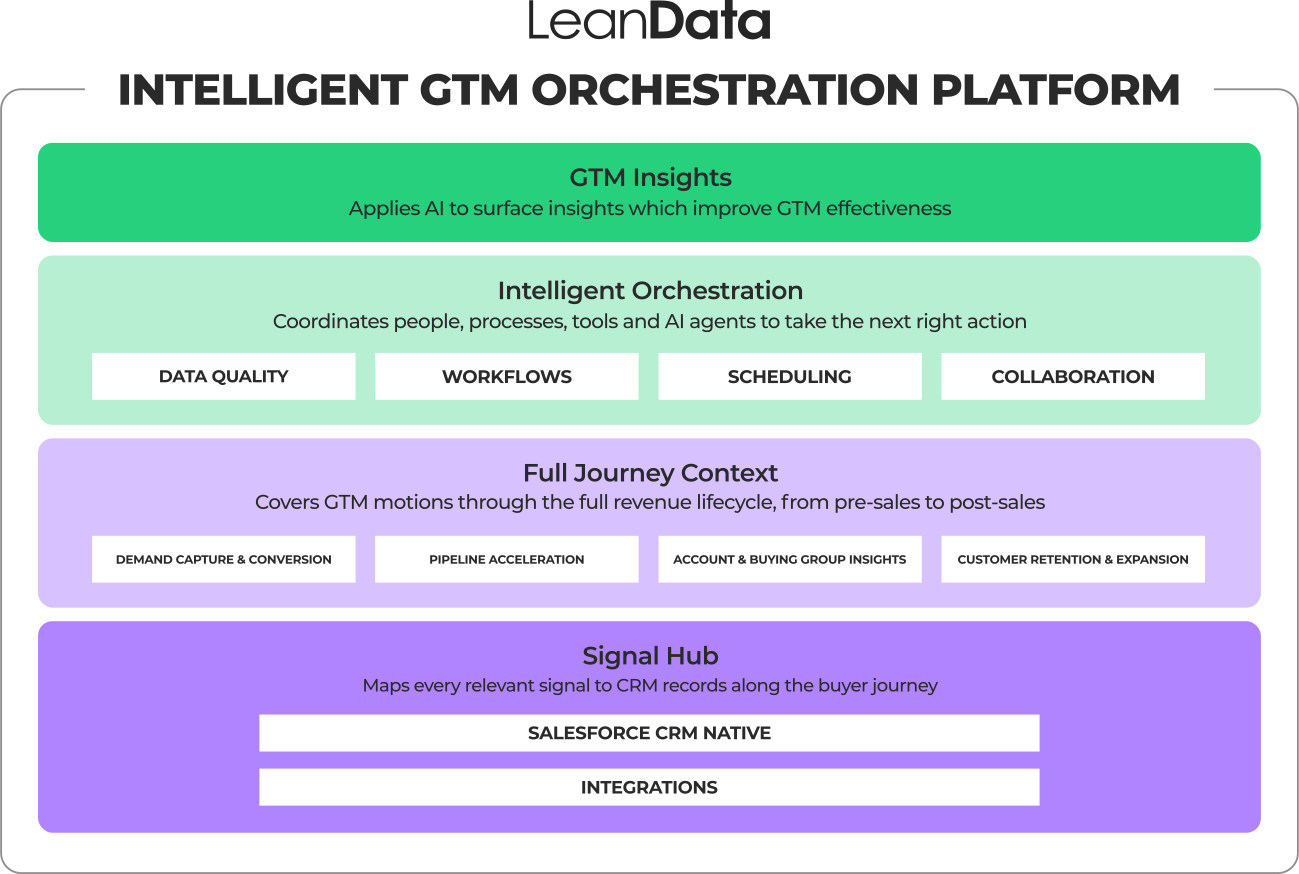
Delivering orchestration across the full revenue lifecycle requires a platform, not a point solution. The capabilities must work together.
For organizations evaluating lead routing software or sales scheduling tools as standalone purchases, it is worth considering whether those capabilities should live inside the orchestration layer, where they can share data, signals, and governance with everything else.
Here is what that platform looks like in practice:
Data Quality: Lead-to-Account Matching and Signal Integration
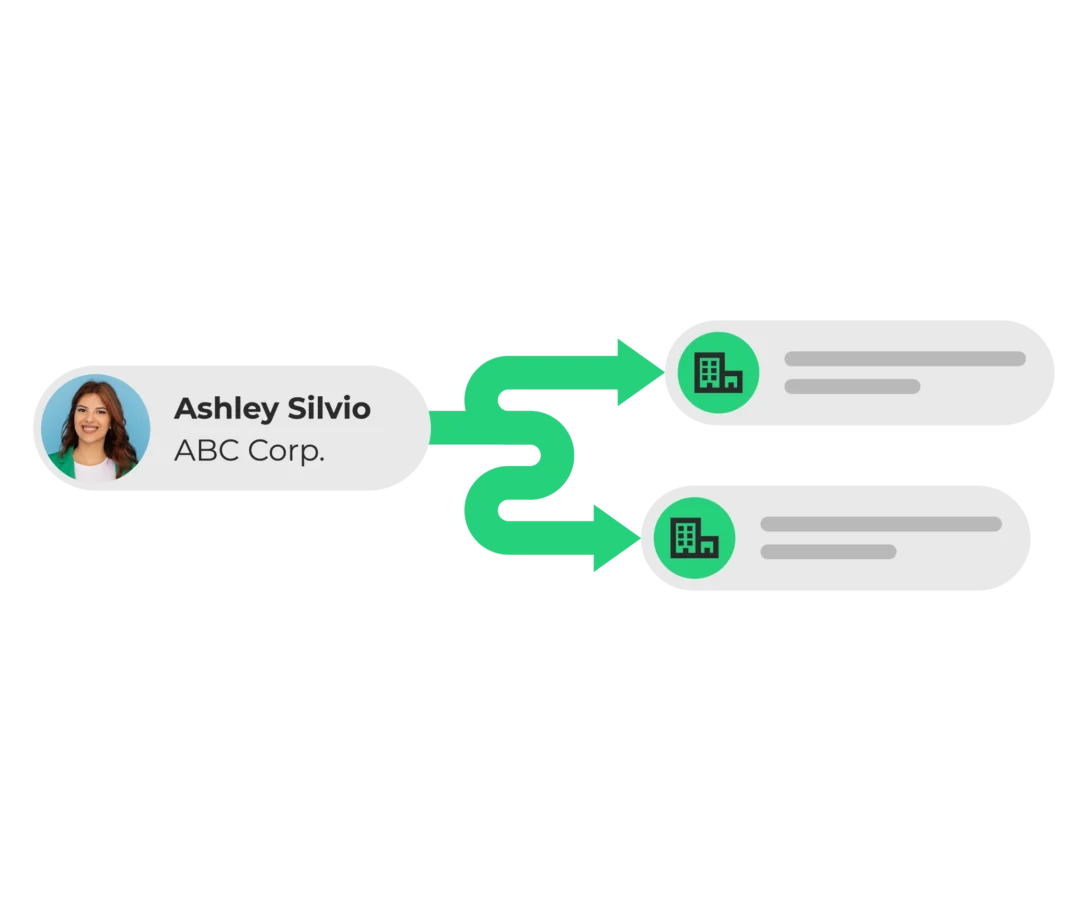
Everything starts with clean, connected data. An orchestration platform integrates and normalizes GTM data across your CRM, marketing automation platform, sales engagement tools, intent providers, and enrichment services. It deduplicates records, enriches contacts, and matches leads to the right accounts so that every team works from a single, accurate view of the buyer.
LeanData’s custom signals capability extends this further by listening to any Salesforce object, standard or custom, and converting those activities into journey signals. Intent data from third-party providers, product usage events, and custom engagement scores all become part of the unified picture.
Signal-Driven Automation and Workflow
Orchestration automates actions based on buyer signals: matching, routing, assigning, scheduling meetings, sending notifications, triggering cadences in sales engagement tools, and creating records. Every signal, whether it is a form fill, a field update, an intent spike, or a product usage event, can trigger a coordinated response.
The automation is built visually with a no-code, drag-and-drop workflow builder, which means operations teams can design, test, and deploy changes without developer support. When the business needs a new territory model, a new sales play, or a new handoff process, the change happens in hours, not weeks.
AI Powered Insights and Intelligence
AI at the orchestration layer learns from the outcomes of your full GTM motion, not from a single tool’s data silo. This creates a fundamentally different kind of intelligence.
LeanData applies AI across several areas. Title Clustering uses BERT-based models to segment personas and identify buying group members, even when job titles vary widely across industries. AI Inference Nodes classify unstructured data, like free-text form submissions, and route the results into structured decision logic within the same workflow graph. AI Graph Summary generates natural language explanations of complex routing workflows so operators can understand and troubleshoot faster. And the Audit Log Assistant analyzes routing history to surface patterns and anomalies.
Each of these capabilities runs with full visibility. Administrators can see what the AI received, what it returned, and what happened next. There are no black-box decisions.
Sales Scheduling and Agentic Handoffs
Speed to lead depends on how quickly a qualified buyer reaches a live conversation. LeanData BookIt scheduling routes meetings from web forms, handoff workflows, direct links, and browser extensions, ensuring buyers reach the right expert without manual intervention.
As AI agents become part of the GTM motion, they need a scheduling backbone. When an SDR bot qualifies a prospect at 2 a.m., it needs to book a meeting with a human rep through the same governed scheduling infrastructure the rest of the organization uses.
LeanData’s Agentic Scheduling APIs provide this connection, ensuring AI-initiated bookings follow the same routing rules, availability logic, and governance as human-initiated ones.
Buying Groups and Account-Based Orchestration
Enterprise purchases are made by committees, not individuals. Buying group orchestration identifies stakeholders across an account, maps their relationships, tracks their engagement, and triggers coordinated plays at the account and buying group level.
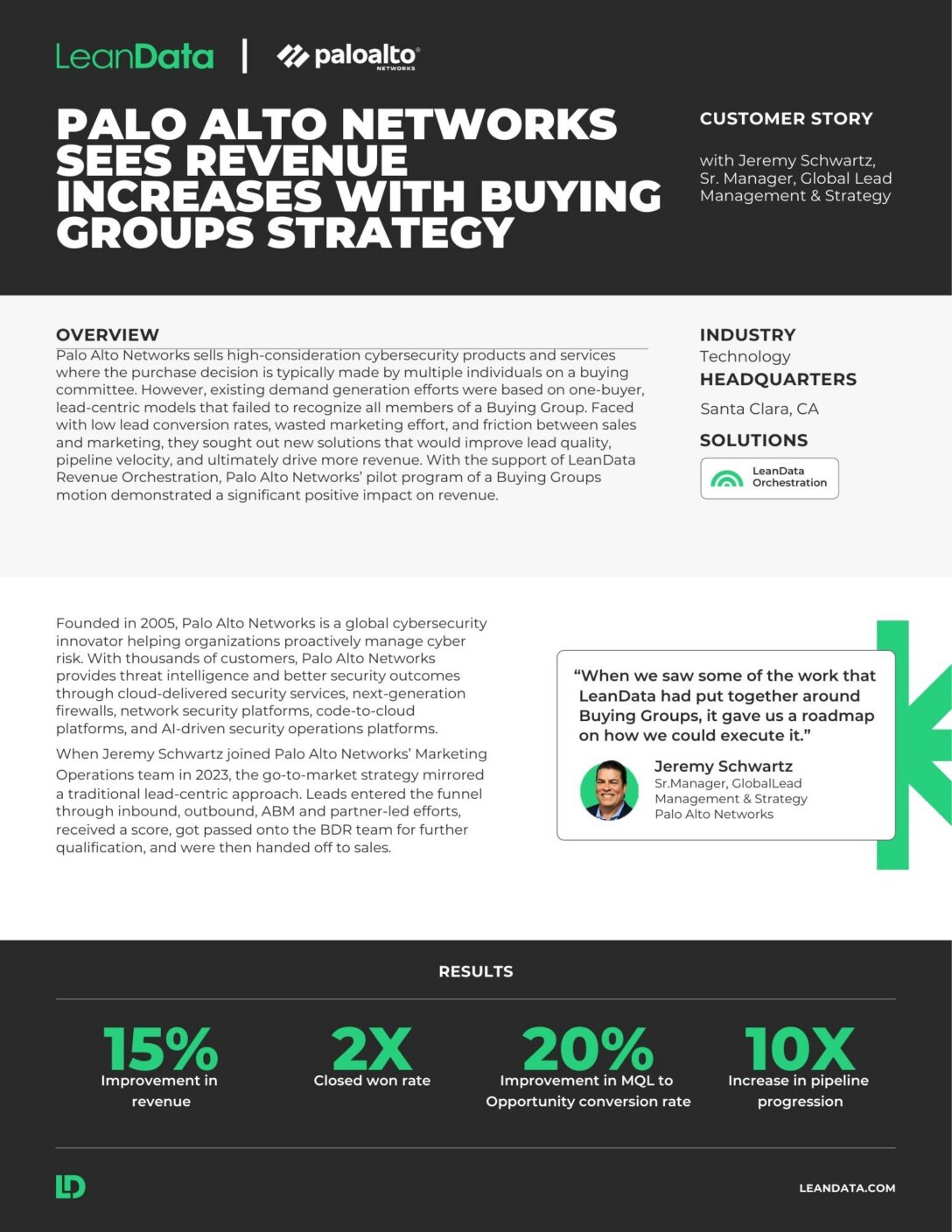
Palo Alto Networks launched a buying groups strategy with LeanData and saw a 15% improvement in revenue, a 2x increase in closed-won rates, and 10x pipeline progression. The foundation was connecting signals from individual contacts to the broader buying committee and ensuring every team member had context into the full group’s engagement.
Enterprise Governance and Agility
For enterprise organizations, governance is a requirement, not a feature.
Orchestration platforms must provide full auditability into every routing decision, business-unit separation for global teams, automated data governance, and the ability to absorb reorgs, territory changes, and tech stack updates without coding.
This agility is one of the most underappreciated benefits of orchestration.
When a sales leader says, “We need to restructure territories next quarter,” or “We are launching a new product line and need different routing for these accounts,” the team with an orchestration platform makes the change in hours. The team without one files a ticket with IT and waits.
The GTM Orchestration Maturity Model
Where does your organization stand, and where should you go next? The GTM Orchestration Maturity Model provides a framework for evaluating your current capabilities and planning the path forward. It has three stages, each building on the last.
Stage 1: Alignment and Speed to Lead
The first stage focuses on assignments informed by your existing CRM data. The goal is to use existing CRM data more effectively for lead matching, deduplication, enrichment, and routing. Core use cases include lead-to-account matching, SLA tracking, and process auditing. The teams involved are primarily marketing and SDR/BDR groups. The result is speed to lead: getting the right information to the right person without manual delays.
Think of this as building the foundation. You cannot automate what you cannot trust.
Stage 2: Automation
The second stage shifts from reactive to proactive. By integrating buyer intelligence across systems, teams automate signal-driven workflows from first signal through closed-won. Core use cases expand to include advanced assignment logic, meeting scheduling, SLA enforcement, workflow automation, and integrations with sales engagement platforms. Account Executives, Partners, and Sales Managers join the motion.
The result is higher conversion rates and faster pipeline progression, because every signal gets a coordinated response instead of sitting in a queue.
Stage 3: Orchestration
The third stage extends orchestration across the full lifecycle, adding post-sales motions like customer onboarding, case management, partner assignment, renewal orchestration, and upsell/cross-sell plays. AI orchestration becomes a core capability. Customer Success, Customer Service, and Account Management teams join.
The result is higher customer lifetime value, because the same connective tissue that acquired the customer now retains and expands the relationship.
Most organizations begin in Stage 1 with their acquisition workflows and expand over time. The framework gives leadership a shared language for where the team is today and where it needs to invest next.
GTM Orchestration Maturity Model
The Role of AI in Intelligent GTM Orchestration
AI is reshaping every part of the GTM stack. But there is a meaningful difference between AI used in isolation and AI governed at the orchestration layer.
When a single tool adds an AI feature, that feature only sees the data within that tool.
- An AI-powered enrichment service knows about contacts.
- An AI scheduling assistant knows about calendars.
- An AI SDR agent knows about outbound sequences.
None of them sees the full picture.
At the orchestration layer, AI has context across the entire revenue lifecycle: leads, contacts, accounts, opportunities, buying groups, signals, and outcomes. It can classify unstructured data and route the result into a structured workflow.
It can identify buying group members based on title patterns that no manual rule set could capture. It can summarize complex routing logic in plain language so operators can audit and improve it.
The critical requirement is governance.
Every AI-driven action must be auditable. Administrators must be able to see what the model received, what it returned, and what downstream action it triggered. The platform must support bring-your-own-key models so IT teams control which AI providers are used and where data flows.
Whether an action is system-triggered, human-led, or AI-driven, it should run through the same orchestration framework with the same transparency. That is what makes orchestration intelligent, not the presence of AI in the stack, but AI operating within a governed, auditable layer that spans the full GTM motion.
How Intelligent GTM Orchestration Drives Efficient Growth
When GTM leaders evaluate any platform, the question is: what does it do for the business?
Intelligent GTM orchestration drives value through two complementary dimensions: efficiency and growth. Together, they add up to what every B2B company is pursuing right now: efficient growth.
The Efficiency Side
Data accuracy: Matching, deduplication, and enrichment reduce errors and give teams a reliable foundation for every downstream decision. When data is wrong, everything built on top of it is wrong too. Clean data eliminates wasted effort and misdirected resources.
Automation: Automating routing, notifications, record creation, and handoffs removes manual work. Response times shrink. Nothing falls through the cracks. One LeanData customer had a full-time employee whose sole job was routing inbound leads. That time now goes back to selling.
Agility: No-code workflow design means GTM teams can adapt to territory changes, org restructures, new products, and new sales plays without waiting on IT. What used to take weeks takes hours. The business moves at the speed of its strategy, not the speed of its developer queue.
The Growth Side
Pipeline volume: More opportunities enter the pipeline when every buying signal gets captured and acted on. Buying group orchestration increases deal sizes by engaging the full committee. Signal-driven workflows ensure that interest from events, web visits, and intent providers translates into live conversations.
Conversion rates: Stage-to-stage conversion improves when the right lead reaches the right person with the right context at the right time. From MQL to SQL, SQL to opportunity, and opportunity to closed-won, orchestration lifts each transition.
Velocity: Deals move faster when handoffs are automated, meetings get booked instantly, and teams are not waiting on manual processes to advance the pipeline.
The Proof
The companies using intelligent GTM orchestration see these outcomes in their numbers.
- Uber for Business: 68% increase in deal velocity, 59% uplift in conversion rates
- Snowflake: 30% increase in inbound lead conversion, 78% reduction in SDR research time
- Palo Alto Networks: 15% improvement in revenue, 2x closed-won rate, 10x pipeline progression
- Expedient: Response time reduced from multiple days to under one day
How to Get Started with Intelligent GTM Orchestration
You do not need to orchestrate everything at once. The most successful organizations start with their highest-pain process and expand from there.
Step 1: Map Your Current GTM Execution
Pick one core process, like inbound lead management, and map every stage, team, and system involved. Identify where handoffs break, where signals get lost, and where data sits in silos. This exercise alone often reveals why orchestration matters.
Then assess where you fall on the GTM Orchestration Maturity Model. Are you in Stage 1, getting the data foundation right? Stage 2, automating signal-driven workflows? Or Stage 3, extending orchestration across the full lifecycle?
Step 2: Build Your Data Foundation
Before you automate anything, make sure your lead-to-account matching, deduplication, and enrichment are solid. Automation built on bad data amplifies problems instead of solving them.
Step 3: Automate Your Core GTM Workflows
Start with the highest-impact, highest-frequency processes: inbound routing, SLA enforcement, and meeting scheduling. These deliver immediate value and build organizational confidence in the platform.
Step 4: Layer in AI Where It Creates Clarity
Once workflows are stable, add AI capabilities at the orchestration layer. Use matching algorithms to improve lead-to-account accuracy. Deploy title clustering to identify buying group members. Use AI inference nodes to classify unstructured form submissions. Enable agentic scheduling APIs so AI agents can book meetings through your governed infrastructure.
The key: keep every AI decision visible and auditable.
Step 5: Expand Across the Revenue Lifecycle
This is where the greatest untapped value often lives. Once acquisition workflows are optimized, extend orchestration into post-sales handoffs, case management, renewal orchestration, and expansion plays. Each extension uses the same platform, the same workflow builder, and the same governance framework you already trust.
The path from acquisition through adoption, retention, and expansion is the natural growth trajectory for any orchestration investment.
The Operating Model for Modern Revenue Teams
B2B revenue teams cannot afford to run disconnected GTM motions. The buyer journey is too complex. The tech stack is too fragmented. And AI is adding both capability and chaos at the same time.
Intelligent Go-to-Market Orchestration solves for all of it.
- It creates the connective tissue that aligns marketing, sales, and customer success around the buyer journey.
- It governs AI so that every action, whether system-triggered, human-led, or AI-driven, is transparent and auditable.
- It adapts to change without breaking the processes your revenue depends on
The efficiency benefits are real: better data accuracy, automated processes, and the agility to move at the speed of the business.
The growth benefits are real too: more pipeline, higher conversion rates, and faster deal velocity.
Together, they deliver what every B2B company is chasing: efficient growth.
Ready to see how Intelligent GTM Orchestration works in practice?
FAQ
1. What is intelligent go-to-market orchestration?
How is GTM orchestration different from lead routing?
What does a GTM orchestration platform actually do?
How does AI fit into GTM orchestration?
How do I know if my organization needs GTM orchestration?

Kim Peterson
Kim Peterson is the Senior Manager of Content Strategy at LeanData where she digs deep into all aspects of go-to-market strategy and execution. Kim's writing experiences span tech companies, stunt blogging, education, and the real estate industry. Connect with Kim on LinkedIn.