















Summary
Account-based marketing (ABM) is a B2B go-to-market strategy that focuses sales and marketing resources on a defined set of high-value accounts rather than casting a wide net across every lead. When revenue teams build the right operational foundation in Salesforce, ABM consistently produces larger deal sizes, higher win rates, and faster pipeline progression than traditional demand generation approaches.
What You’ll Learn
- Why most ABM programs stall between strategy and execution, and what the gap actually looks like in your CRM
- How lead-to-account matching works and why it is the prerequisite for every other ABM motion
- What account-based routing plays look like across the three ABM tiers
- How buying groups extend ABM with opportunity-level precision
- Which metrics RevOps and marketing should track instead of MQL volume
Account-based marketing, an operational model
There is no shortage of content explaining what account-based marketing is. Demandbase invented the term. HubSpot has published dozens of guides. Every ABM platform vendor has a definition page.

What most of those resources skip is the part your RevOps team actually has to build: the data infrastructure, the routing logic, the orchestration plays, and the metrics that tell you whether any of it is working. This guide covers that part.
ABM is an operational model before it is a marketing strategy. You can have the right target account list, the right intent data, and the right campaigns, and still have your leads fall into the wrong queue, your SDRs calling into active opportunities, and your sales team asking marketing why they never see the leads from their named accounts.
The strategy is sound. The execution is broken.
This guide is for the people who have to fix that: go-to-market leaders in marketing, sales, and operations who need ABM to actually produce revenue.
What is account-based marketing?
Account-based marketing is a B2B strategy where sales and marketing align their resources around a specific set of target accounts rather than working every lead that comes in.
Instead of asking “how many leads did we generate?”, ABM teams ask “did we engage the right people at the right companies, and did we get to them before our competitors did?”
ABM treats accounts as markets of one. Every campaign, every outreach play, and every routing decision should reflect what you know about that specific account, where it is in the buying journey, and who inside it needs to hear from your team.
This is different from demand generation, which optimizes for volume. Demand gen asks how to generate more leads. ABM asks how to win specific accounts. In practice, most B2B companies run both, using demand gen to fill the top of the funnel and ABM to accelerate and protect the accounts that matter most.
The three ABM tiers
ABM programs vary in the depth of resources they apply to different accounts. Most teams organize their programs across three tiers.
Deciding which tier applies to which accounts is one of the most important decisions in your ABM program. Your top 25 accounts should not be treated the same as your 800th target account. The infrastructure you build, including your matching logic, routing rules, and content, should reflect those distinctions.
Why ABM requires a different go-to-market motion
Most CRM environments are built around leads, not accounts. Salesforce’s default data model reflects this: leads come in, get scored, get assigned, and eventually convert to contacts. The entire process is optimized for individuals, not buying committees or named accounts.
ABM breaks this model.
When a lead comes in from a company on your target account list, you need three things to happen:
- The lead matches to the correct account record.
- It routes to the person who owns that account.
- It arrives with account context attached.
In a default Salesforce setup, none of those things happen automatically.
This is why the same ABM program that looks good on a strategy slide often fails in execution. The gap is not the strategy. The gap is between what your marketing team plans and what your CRM actually does when a lead arrives.
The Harvard Business Review’s Analytics Services research, commissioned by LeanData, found that 83 percent of B2B leaders say their GTM strategy is very important, but only 38 percent describe it as very effective.
The top execution challenge cited was siloed data preventing teams from seeing a complete view of buyer engagement. That is a matching and routing problem before it is a strategy problem.
How to build a target account list that works
Your target account list is the foundation of your ABM program. If the list is wrong, every campaign, every routing play, and every piece of personalized content runs on a flawed premise.
Building a good list starts with your Ideal Customer Profile, the set of attributes that describe the companies most likely to buy, adopt, and expand your product.
ICP criteria typically include:
- Firmographics: industry, company size, revenue range
- Technographics: what tools they use, particularly their CRM and marketing automation stack
- Behavioral signals: have they engaged with your content, visited your pricing page, searched for your category on G2?
Avoid these list-building mistakes
A few mistakes kill most target account lists before the first campaign runs.
#1 Mistake: Defining ICP by committee. When everyone in the room gets to add their favorite segment, the list expands to the point where no account gets real attention. A useful target account list is selective. If your SDR team cannot realistically work every account on it, the list is too long.
#2 Mistake: Treating the list as static. Intent data changes. Companies get acquired. Budget holders change roles. Your list should update on a regular cadence, and someone in RevOps needs to own that process explicitly.
#3 Mistake: Building the list without sales buy-in. Sales will not work accounts they did not help select. If marketing creates the target account list in isolation, the accounts on it will not get the follow-up the program requires.
Once your list is built, tier it. Not every target account deserves one-to-one treatment.
Set clear criteria for what moves an account from your one-to-many pool to your one-to-few segment, and from one-to-few to one-to-one.
Account engagement score, deal size potential, and strategic fit are all reasonable inputs.
Download Measuring ROI with Lead-to-Account Matching & Routing here.
Lead-to-account matching: the foundation of ABM execution
Before any routing play, any personalized campaign, or any SDR sequence, one thing has to work: when a lead comes in from a company on your target account list, it has to match to the right account record in Salesforce.
This sounds simple. It is not.
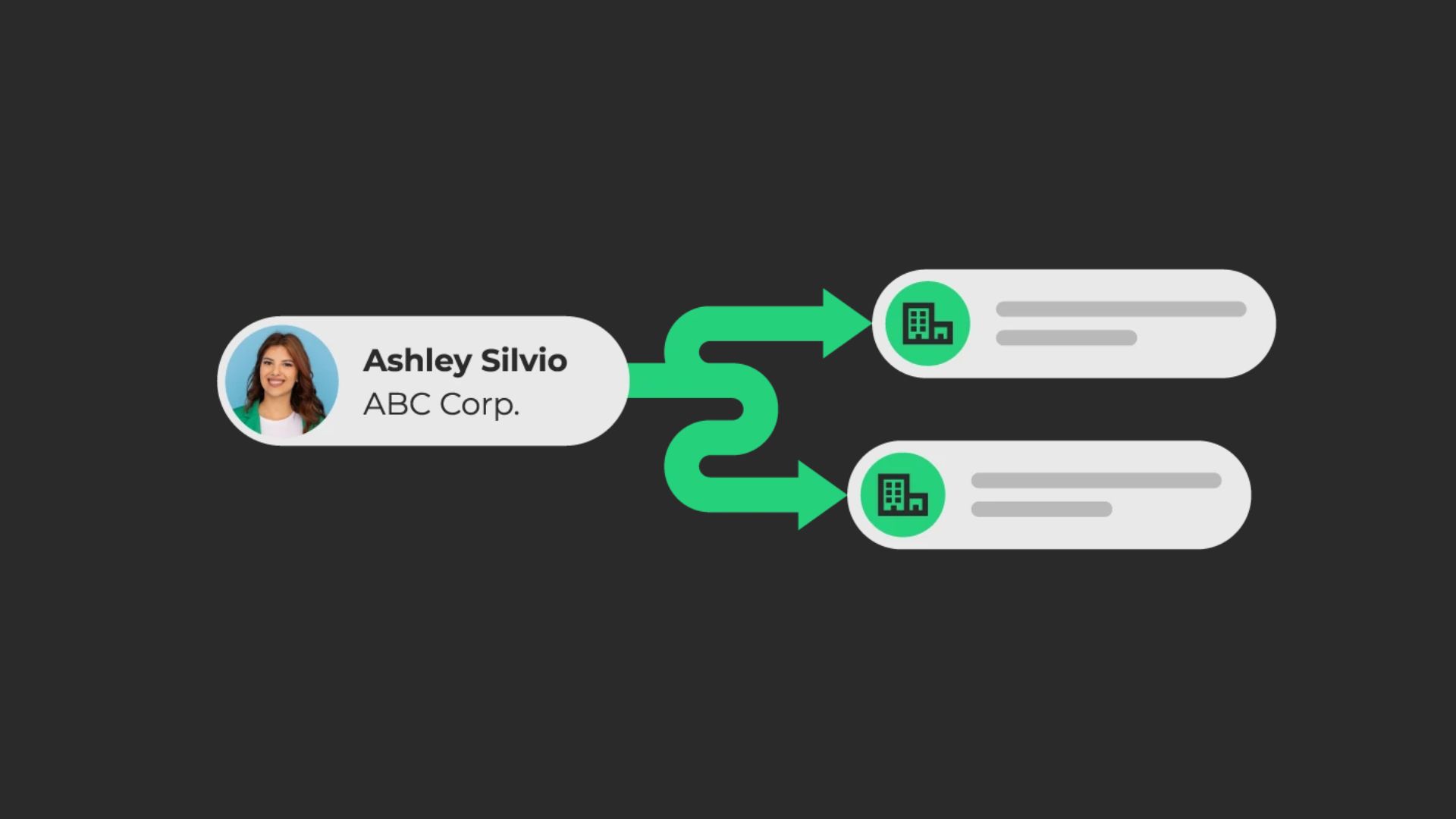
Lead records often arrive without clean company data. Someone fills out a form using a personal email address instead of a work domain. A lead’s company name is “ABC Corp” but your account record says “ABC Corporation.” A contact comes from a subsidiary, but the relationship to the parent account is not visible to your routing logic. Any of these scenarios causes the lead to fall through, either routing to the wrong rep or landing in an unassigned queue.
When that happens with a lead from one of your top 50 target accounts, the cost is real. Your SDR does not know the account already has an active opportunity. Your AE never sees the inbound signal. And the prospect who came to you with genuine intent waits days for a response, or gets a cold call from the wrong person.
How fuzzy matching solves the problem
Domain-based matching catches the easy cases. Fuzzy matching catches everything else.
LeanData’s matching algorithm looks beyond the email domain and analyzes multiple data points: company name variations and abbreviations, phone numbers, physical address, and account hierarchy relationships.
When a lead arrives at “Saviynt Inc.” and your account record says “Saviynt,” fuzzy matching connects them. When a contact from a subsidiary fills out a form, the algorithm traces the parent-child relationship to the correct account.
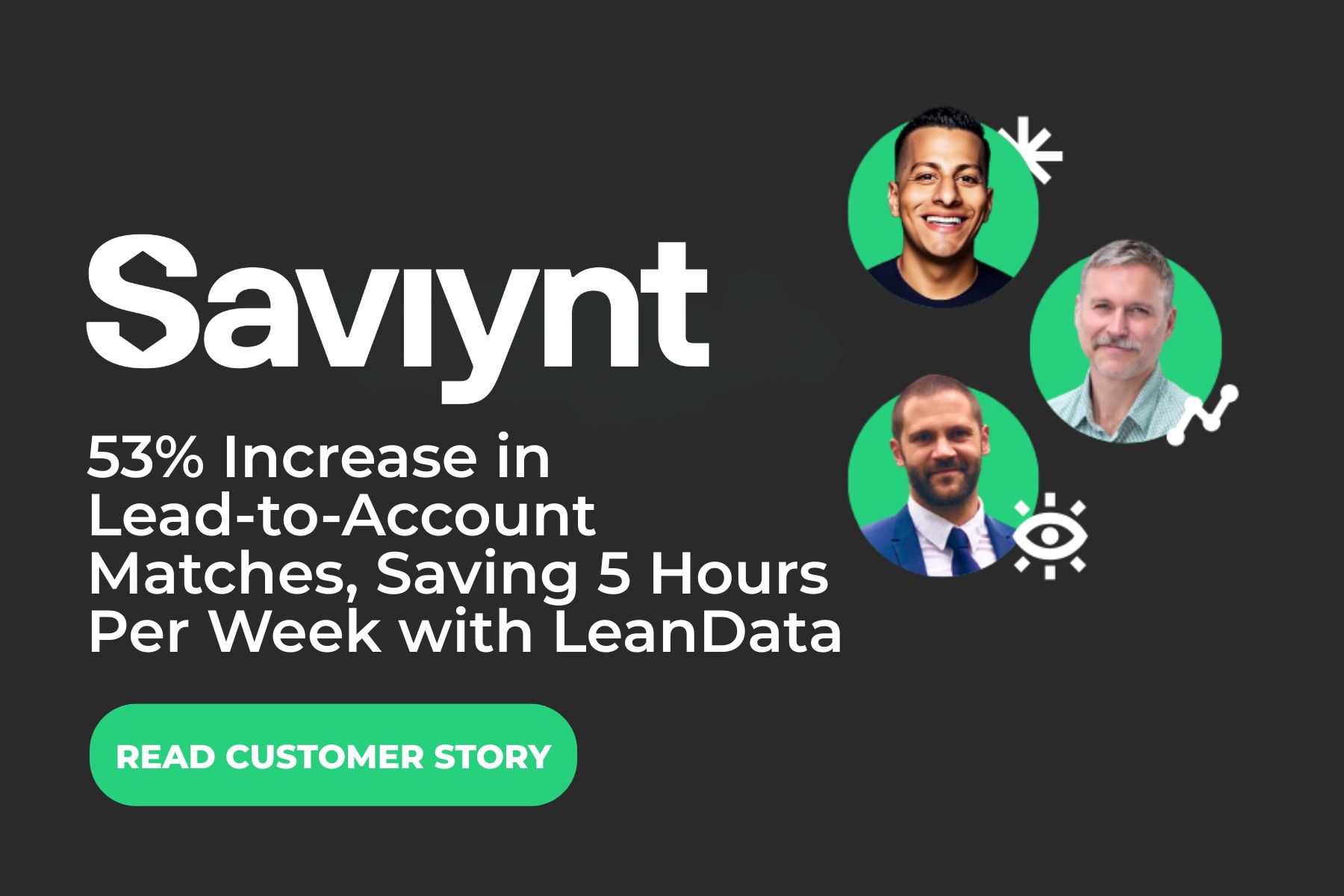
Saviynt, an identity governance and administration platform, saw this difference directly. Before LeanData, Saviynt used a deduplication tool that relied on basic matching logic. Too many leads failed to connect to their associated accounts, and sales leadership spent up to five hours per week manually triaging and routing unmatched records. SDRs were calling into active opportunities because no one knew the lead was from an account already in play.
After switching to LeanData, Saviynt saw a 53 percent increase in lead-to-account matches compared to their previous tool, with no additional customization. Sales leadership eliminated their manual routing work entirely, recovering those five hours per week. And when leads matched to named accounts started routing directly to the account executive instead of the SDR queue, the buying experience improved for prospects and the pipeline process improved for the team.
As Wade Tibke, Senior VP of Marketing at Saviynt, described it: “We no longer have leads and contacts living in silos. We look at them as people at a single account.”
Matching inside Salesforce
For ABM programs built on Salesforce, native Salesforce matching capabilities do not go far enough. Salesforce can match on exact email domain, but it cannot handle name variations, subsidiaries, or records that arrive without a recognizable domain.
LeanData runs as a native Salesforce application, meaning it operates inside your Salesforce instance without extracting data through an API. Your account data stays within your existing security model.
Matching rules update in real time as your account list evolves, so when you add a new named account to your target list, the next inbound lead from that company routes correctly.
Account-based routing and orchestration in Salesforce
Matching is the prerequisite. Routing is where ABM execution actually happens.
Standard Salesforce assignment rules treat all leads the same. A lead from your top strategic account and a cold inbound lead from a company you have never heard of go through the same routing logic. Territory rules look at geography, not account ownership. Round-robin pools distribute leads evenly regardless of existing account relationships.
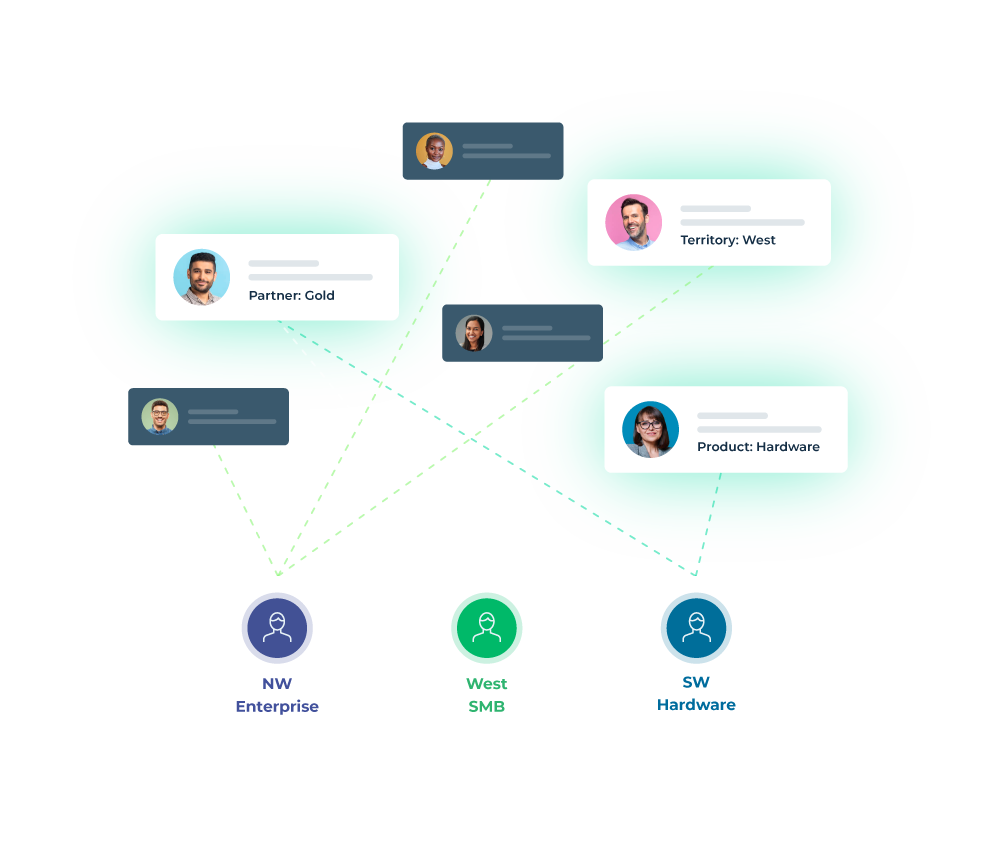
Account-based routing works differently. Every routing decision starts with one question: does this lead match a known account? If yes, who owns it, and what is the current status of that relationship?
Routing plays by ABM tier
The routing logic for each ABM tier reflects the depth of the relationship and the resources behind it.
For your 1:1 strategic accounts, every inbound signal routes to the named account owner, without exception. A contact from a strategic account fills out a form, downloads a guide, or registers for a webinar, and the notification goes to the AE who owns that relationship.
Speed matters here. LeanData customers see an 82 percent reduction in lead response times on average, and 74 percent report increased efficiency in responding to buyer signals.
For 1:few segment accounts, routing applies segment-based logic. A lead from a healthcare technology company in your target segment routes to the SDR pod covering that segment, with the account context and engagement history attached. If the lead matches an account with an open opportunity, it routes to the AE instead.
For 1:many programmatic accounts, routing uses velocity-based logic with account awareness. Leads route quickly to the right person, with the system checking account ownership and opportunity status before assignment.
Orchestration plays beyond lead routing
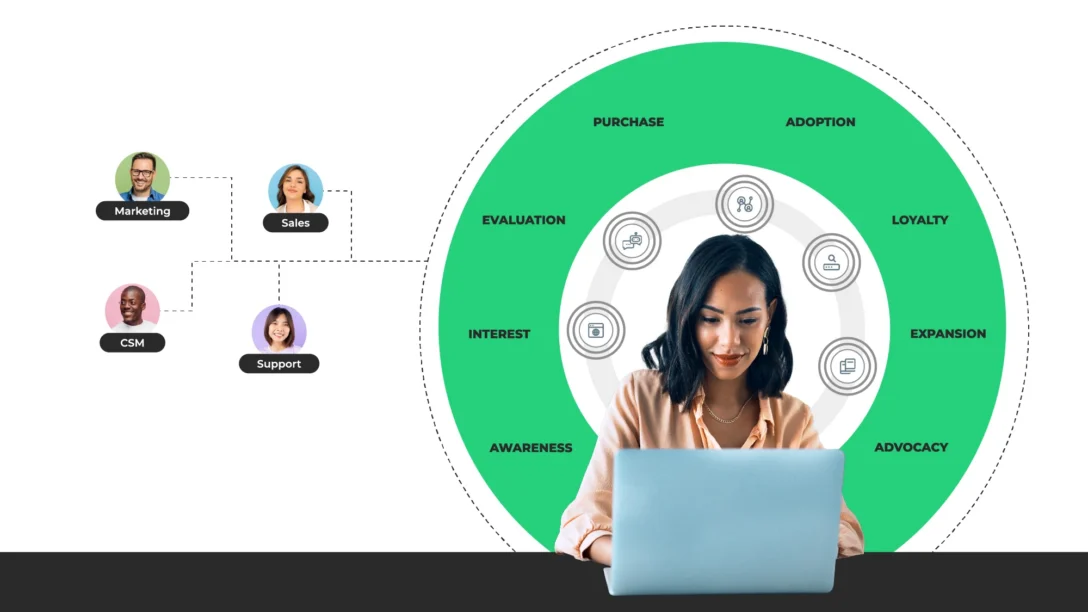
Routing is the first step. Orchestration is the whole play.
When a 6sense qualified account, one that has been showing intent signals for your product category, comes into your system, the orchestration logic does more than route the lead. It can trigger an SDR sequence in Outreach or Salesloft, alert the account owner via Slack, attach the intent data to the lead record so the rep has context before the first call, and set a follow-up SLA with a timer. All of this happens automatically, in the time between form submission and the rep opening their laptop.

Expedient, a data center and cloud infrastructure company, built this kind of orchestration using 6sense intent data connected to LeanData routing. When a target account heated up in 6sense, Expedient’s system automatically enriched the account with ZoomInfo data, identified the buying committee members, and routed them to the appropriate sales rep with an email template ready to send.
As Nicholas Lansberry, Go-to-Market Operations Manager at Expedient, described it: “It arms the sales team with everything they need to hit the ground running: who to talk to, when to contact them, and what to talk about.” Response times dropped from days to hours.
Meltwater’s global revenue operations team built a similar system using LeanData to connect inbound and intent data to the correct account owner across global teams. The system routed more than 6,000 leads and 3,800 accounts accurately, with Slack notifications creating accountability at every handoff.

Other orchestration plays worth building into your ABM motion include re-engagement plays (a dormant account shows intent signals, routing delivers the account context to the right rep for outreach), handoff plays (SDR to AE, AE to Customer Success, with account history preserved at each step), and renewal plays (a customer account shows competitor research signals, triggering an alert to the account manager before the conversation goes further).
LeanData customers see a 70 percent reduction in time spent researching and triaging leads, and an 80 percent reduction in time spent managing routing rules, freeing operations teams to focus on strategy rather than maintenance.
Buying groups in ABM: engaging the full decision committee
ABM targets the right accounts. A buying groups motion targets the right people on the right opportunity within those accounts. These are not the same thing.
An enterprise account may have dozens of departments, multiple budget holders, and several concurrent purchasing initiatives happening at the same time. When you treat everyone at the account as part of the same buying motion, your outreach loses precision and your pipeline metrics lose accuracy.
According to Forrester, 94 percent of sellers report they sell to groups of three or more stakeholders, and 38 percent sell to groups of 10 or more. When only one or two of those people are tracked in your CRM, sales receives an opportunity with incomplete context and spends the first weeks of the deal just finding the rest of the committee.
A buying groups motion solves this by organizing contacts into committees connected to specific opportunities, not just accounts.
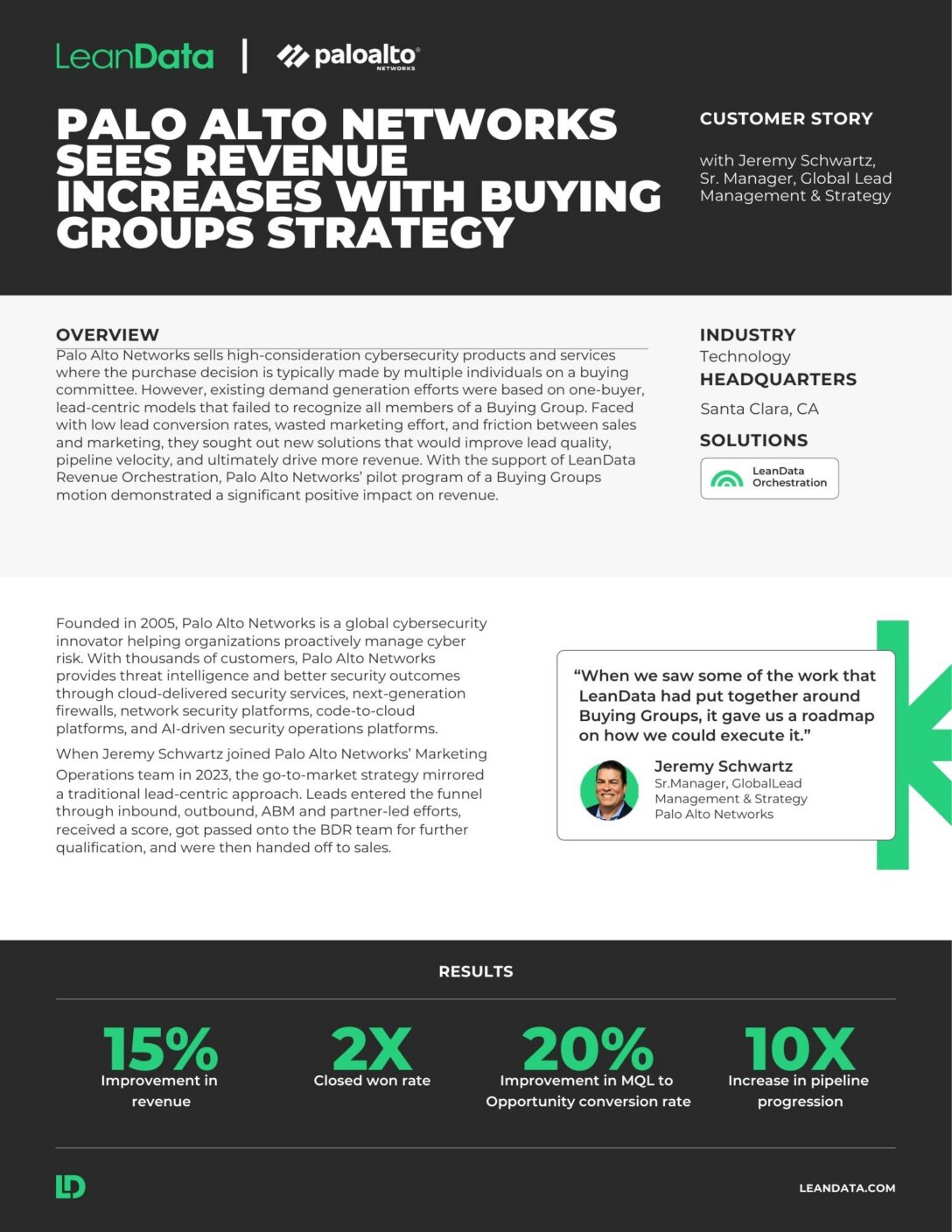
Palo Alto Networks piloted a buying groups motion and saw a 2X improvement in closed-won rates and a 15 percent improvement in revenue over two quarters. achieved a 238 percent increase in pipeline value and a 40 percent increase in average opportunity size after moving from a lead-centric model to buying groups orchestration.
LeanData’s Buying Groups product runs natively in Salesforce and includes:
- AI-powered title clustering to automatically assign contacts to buyer personas
- Journey Automation to track engagement across every buying group member
- Journey FlowBuilder to route qualified buying groups to sales with full context attached
Who owns ABM? Defining roles across sales, marketing, and RevOps
ABM programs fail when ownership is unclear. Marketing runs campaigns. Sales works whatever it decides to work. RevOps maintains the routing logic but has no visibility into whether anyone is following it.
Nobody has a shared view of whether the program is producing results.
Sustainable ABM programs define ownership at three levels:
Marketing
Marketing owns account selection criteria and the engagement programs built around them. Marketing decides which firmographic and technographic attributes qualify an account for each tier, creates content and campaigns calibrated to each tier’s level of personalization, and monitors engagement signals across the target account list.
Sales
Sales owns account relationships and timing. The sales team knows which accounts have executive relationships, where deals are likely to open, and when the timing feels right for outreach. Sales should have direct input into the target account list, because if they do not agree with the accounts on it, they will not work them.
Revenue Operations (RevOps)
RevOps owns the data infrastructure and process design. That includes the matching logic that connects leads to accounts, the routing rules that send those accounts to the right people, the SLA enforcement that holds teams accountable for follow-up speed, and the reporting that shows whether any of it is working.
RevOps is also responsible for keeping the routing rules current when territories change, when new products launch, or when the target account list gets updated.
Common Ownership Failures
The most common ownership failure mode is no one owning the target account list after launch. Marketing builds the initial list, it goes live, and then nobody updates it when companies get acquired, when new ICP signals emerge, or when the sales team’s territory structure changes.
Six months later, the list is stale and the routing logic is directing leads to the wrong people.
The second most common failure is misaligned incentives. Marketing gets measured on MQL volume. Sales gets measured on closed revenue. ABM requires both teams to share accountability for pipeline from target accounts.
Without aligned metrics, each team optimizes for its own scorecard and the program pulls in two directions.
The ABM technology stack
A complete ABM tech stack has five categories of tools working together. Each category serves a distinct function, and the connections between them matter as much as the tools themselves.
For teams building on Salesforce, native tools reduce the risk of data sync failures and keep your account data within your existing security model. LeanData runs as a managed package inside Salesforce, which means every routing decision, every match, and every audit log lives in the same environment where your sales team already works.
ABM metrics: what RevOps and marketing should actually track
MQL volume is the wrong success metric for ABM. MQLs measure individuals, not accounts. They reward marketing for quantity and tell you almost nothing about whether your program is advancing the accounts you care about.
ABM programs need metrics that reflect account progression, buying committee depth, and pipeline health across your target account list.
Account-level engagement metrics
The most useful leading indicator is account engagement score, a composite measure of how many people from a target account have engaged with your content, how recently, and at what depth. A single email open does not move the needle. A decision-maker downloading a technical guide and attending a webinar within two weeks is a meaningful signal.
Account progression tracks how target accounts move through defined stages, from identified to actively engaged, to opportunity created, to closed. When you map your program against account stages rather than lead stages, you get an honest picture of pipeline development.
Pipeline and revenue metrics
Operational metrics
These are the metrics RevOps teams need to confirm the infrastructure is working.
Lead-to-account match rate measures what percentage of inbound leads successfully connect to an account record. If this number is low, leads are falling through before routing logic even applies. LeanData customers consistently see match rates above 95 percent using fuzzy matching.
Speed to lead on target accounts measures how quickly the right person follows up after a signal from a named account. A 24-hour response SLA for target accounts is a reasonable starting point. LeanData users see an average 82 percent reduction in lead response times after implementing automated routing.
Routing accuracy measures whether leads are reaching the right rep, in the right territory, at the right time. LeanData’s audit logs make it possible to trace every routing decision and identify where leads are falling through.
How AI is changing ABM execution
AI is making several parts of ABM faster and more precise. It is also exposing where ABM programs have weak foundations.
On the positive side, AI improves account selection by analyzing patterns in your historical win data and surfacing ICP attributes you may not have identified manually. It processes intent signals at a scale no human team can match, identifying which accounts are in an active buying cycle before they fill out a form.
And it makes 1:many personalization viable. Generating segment-specific content at scale is a reasonable AI use case in ways it was not three years ago.
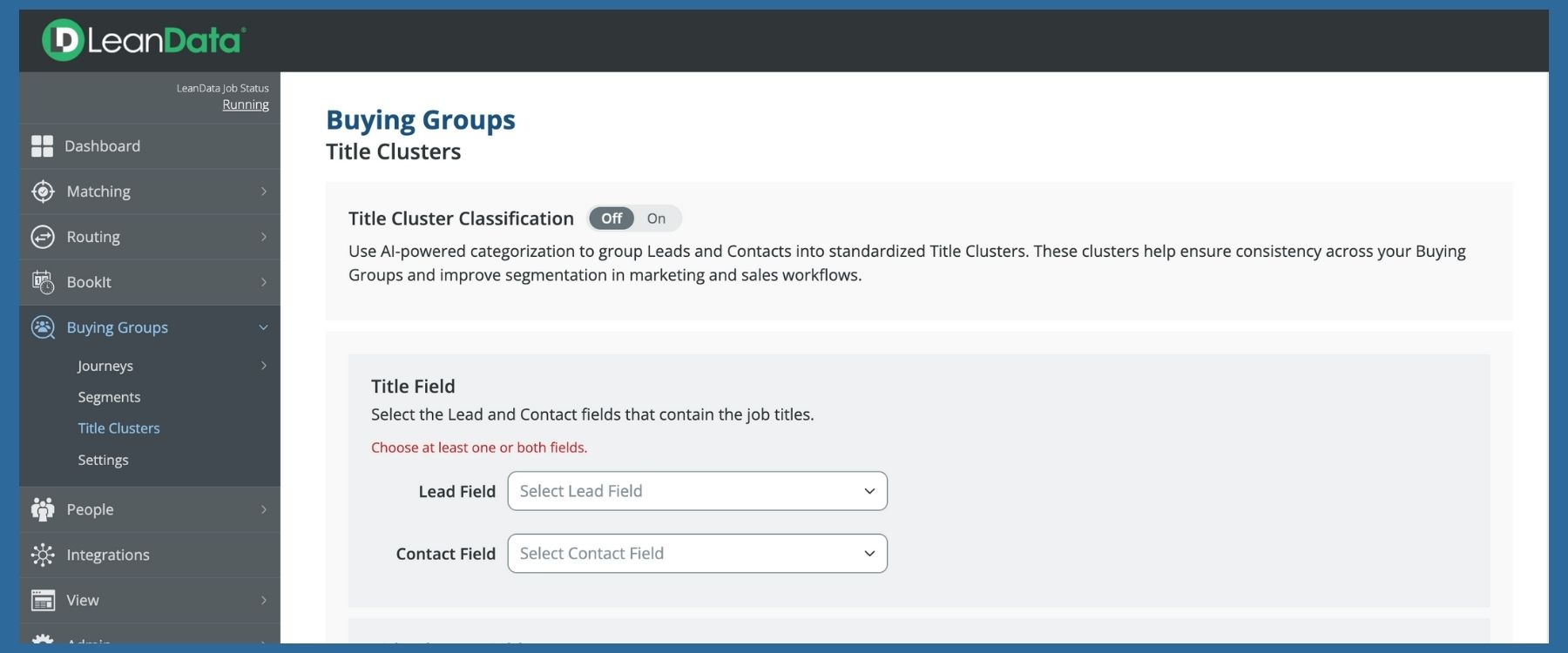
LeanData uses AI in its title clustering capability, which automatically assigns incoming leads and contacts to buyer persona categories based on job title and seniority. Instead of manually reviewing hundreds of records to determine who is the economic buyer versus the technical evaluator, the system classifies contacts continuously and routes them to the right member of the sales team.
What AI cannot fix is a broken matching and routing infrastructure. If leads are not connecting to the right account records, AI-powered personalization reaches the wrong person. If routing rules are outdated, AI-triggered sequences fire to reps who no longer own those territories. The intelligence in your system is only as good as the data flowing through it.
Why ABM programs fail
Most ABM programs do not fail because of bad strategy. They fail because the execution infrastructure does not match the ambition of the strategy. Here are the patterns that show up most often.
No lead-to-account matching infrastructure. This is the most common failure mode and the least discussed. If inbound leads from target accounts are not connecting to account records, sales never sees the signals, routing never applies, and the entire top-of-funnel investment disappears. Fix matching before anything else.
ICP defined by committee. When the target account list includes every segment anyone in the room wanted to add, no account gets real attention. A selective, well-defined ICP list with clear tier criteria will outperform a broad list every time.
ABM owned by marketing, measured on leads. Sales teams do not work accounts they did not choose and do not get credit for. If marketing owns the ABM program and sales success is still measured on MQL-sourced pipeline, the program runs parallel to the sales motion rather than inside it.
Routing logic that does not stay current. ABM routing rules are not set-and-forget. When territories change, when accounts move between tiers, when new products launch, the routing logic needs to update. Programs that were tuned at launch and never revisited create lead pileups in the wrong queues.
No orchestration layer. Marketing can run great ABM campaigns. Sales can have the right accounts in their territory. If there is no system connecting those signals to the right person at the right time with the right context, both investments underperform. The campaigns run, the leads come in, and the follow-up happens three days later when the moment has passed.
Single-threaded deals. Enterprise purchases involve multiple stakeholders. A deal where only one contact is tracked in the CRM is vulnerable. When that contact goes quiet, the opportunity stalls. Building buying group depth into your program from the start reduces that risk.
Get your ABM motion working end to end
Building an ABM program that actually works in Salesforce requires a clean matching foundation, routing logic that reflects your account tiers, and orchestration that connects your intent signals to the right plays at the right time.
LeanData’s Intelligent GTM Orchestration Platform runs natively in Salesforce and gives revenue operations teams the tools to build, run, and measure ABM programs across the full buyer lifecycle, from first inbound signal to closed deal and beyond.
Frequently Asked Questions
How does account-based marketing work in Salesforce?
How do you do lead-to-account matching for ABM?
How do revenue operations teams support ABM execution?
What metrics should we track for an ABM program?
Ready to boost your ABM execution?

Kim Peterson
Kim Peterson is the Senior Manager of Content Strategy at LeanData where she digs deep into all aspects of go-to-market strategy and execution. Kim's writing experiences span tech companies, stunt blogging, education, and the real estate industry. Connect with Kim on LinkedIn.